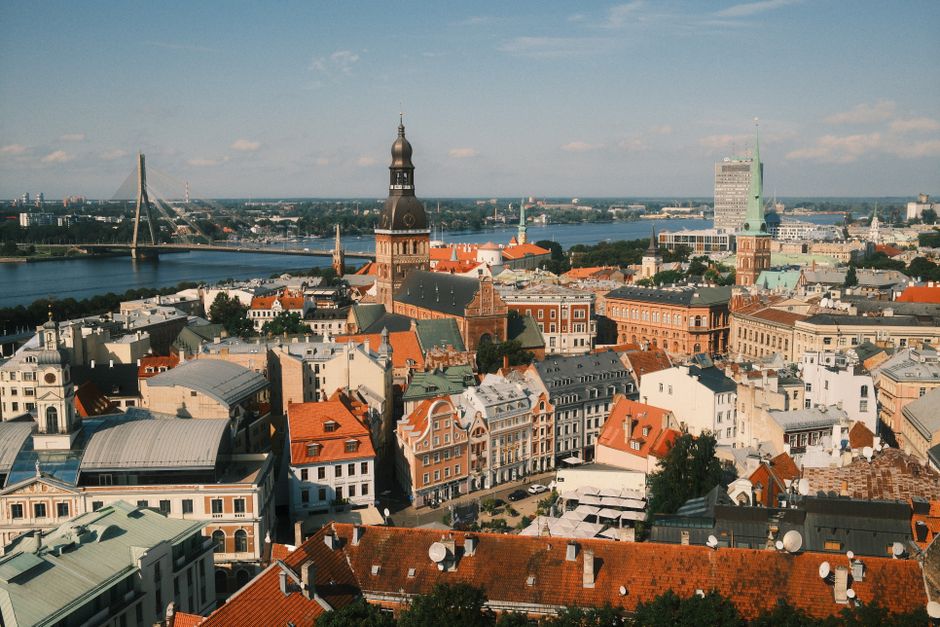
Riga, the capital of Latvia, is the largest city in the Baltic states and one of its most rewarding: a medieval Hanseatic Old Town of spires and guild houses on the Daugava River, ringed by boulevards, canal-side parks and the finest collection of Art Nouveau buildings in Europe. The whole historic centre is a UNESCO World Heritage Site. Riga is also a lively, good-value city of markets, cafés, music and green space, with a beach resort 30 minutes away by train. Come from late May to early September for long days and terraces, in November for the Staro Rīga light festival, or in December for the Christmas market on Dome Square. Give it three days, and two more for day trips to Jūrmala, the Gauja valley and Rundāle Palace.
Right now in Riga
- Wed 9–17°C 48–62°F Clear
- Thu 10–18°C 49–64°F Mostly clear
- Fri 11–14°C 51–58°F 5 mm Cloudy
Weather: MET Norway (CC BY 4.0) · Sea temperature: NOAA CoastWatch · Air quality: OpenAQ · Rates: ECB
Top tours in Riga
See all tours for Riga →
From local operators, with prices and reviews; you check availability and book on Viator, our partner. We may earn a commission at no extra cost to you. How we earn money
Riga at a glance
- Best for: a medieval Old Town, Art Nouveau architecture, markets and food, museums of art and history, music and nightlife, and easy day trips to the beach, castles and a baroque palace.
- How long: 2–3 days for the Old Town, Art Nouveau district and Central Market; 4–5 days to add Jūrmala, Sigulda and Rundāle.
- Best time: late May to early September for warm, light days; mid-November for Staro Rīga; December for the Christmas market.
- Getting in: Riga Airport is about 10 km away, linked by bus 22 (€1.81 paid to the driver by card, as of October 2026); coaches and trains arrive from Tallinn and Vilnius.
- Getting around: walk the centre; trams, trolleybuses and buses cost €1.50 for 90 minutes, with 1-, 3- and 5-day tickets.
- Budget: one of northern Europe’s better-value capitals, especially for food and public transport; Old Town restaurants and bars cost more.
Riga, area by area
According to the Central Statistical Bureau, Riga had 588,911 inhabitants at the beginning of 2026, almost a third of Latvia’s population. The centre is compact: the Old Town, the parks and the Art Nouveau district are all within a 20-minute walk.
The Old Town (Vecrīga)
Riga was founded in 1201 by Bishop Albert, and its Old Town on the right bank of the Daugava is a tight web of cobbled streets and squares: Town Hall Square with the House of the Blackheads, Dome Square with the cathedral, the merchants’ houses known as the Three Brothers, the Swedish Gate and the Powder Tower, the last pieces of the old walls. Best for: first visits, churches, museums and evening atmosphere; busy with tour groups at summer middays.
The boulevards and the Art Nouveau district
Where the city walls once stood, a ring of 19th-century boulevards and the City Canal parks separates the Old Town from the “Quiet Centre” (Klusais centrs). Here, around 1900, Riga was one of the fastest-growing cities in Europe, and about a third of the buildings in central Riga are in the Art Nouveau style. Alberta iela and Elizabetes iela have the most extravagant façades, many by the architect Mikhail Eisenstein. Best for: architecture, cafés and quieter hotels.
The Central Market and the Moscow Suburb
Just south-east of the Old Town, the Central Market fills five huge hangars originally built for German Zeppelins, next to the coach terminal. Behind it, the Spīķeri warehouse quarter has galleries and cafés, and the Moscow Suburb (Maskavas forštate), once the Jewish and Russian quarter, has wooden houses, Orthodox churches and the Stalin-era Academy of Sciences, with a viewing terrace. Best for: food, markets and history.
Pārdaugava: the left bank
Across the river, the Latvian National Library, nicknamed the Castle of Light, looks back at the Old Town skyline. Further on are the restored wooden houses of the Kalnciema Quarter, with a Saturday market and summer concerts, and the island of Ķīpsala with its old fishermen’s houses and the best sunset views of the Old Town. Best for: views, wooden architecture and a local feel.
Top things to see in Riga
Prices and hours below were checked on the official sites in October 2026 unless noted. They change, so check before you go. Many museums are closed on Mondays.
The House of the Blackheads and Town Hall Square
The ornate red Dutch Renaissance façade of the House of the Blackheads is Riga’s most photographed building. It was the guild house of unmarried foreign merchants from the 14th century, destroyed in 1941 and rebuilt in the late 1990s, and today it is used for state receptions and as a museum, with restored halls and medieval cellars. Riga claims the first decorated Christmas tree, put up by the Blackheads in 1510; a plaque on Town Hall Square marks the spot.
Tickets and hours. As of October 2026, entry costs €10 for adults, or €12 with a coffee and €13 with sparkling wine or a glass of Riga Black Balsam. It is open every day, 10:00–17:00, but closes early or entirely for state events, and in October 2026 it closes early on 5, 8, 10, 13 and 28 October and is closed to visitors from 14 to 16 October. An audio guide is available in 13 languages.
St Peter’s Church and its tower
St Peter’s, a Gothic church first mentioned in 1209, has the Old Town’s tallest spire, rebuilt after it burned in the Second World War. A lift takes you to a viewing platform at about 72 m, with the best panorama of the Old Town’s rooftops, the Daugava and the Art Nouveau district. Secondary sources list a ticket of about €9 for the church, exhibitions and tower, with longer opening on Friday and Saturday evenings; the church’s own website was not available, so check on arrival. Go early on clear days, as queues for the small lift build up.
Riga Cathedral and Dome Square
Riga Cathedral (Doms), begun in 1211, is the largest medieval church in the Baltic states, a blend of Romanesque, Gothic and baroque, with a cloister and a great organ of 1884 that was one of the largest in the world when it was built. Short organ concerts are held regularly; check the programme at the door. Dome Square in front hosts open-air cafés in summer and the main Christmas market in winter.
The Art Nouveau district
Walk Alberta iela, Elizabetes iela and Strēlnieku iela to see screaming faces, sphinxes, peacocks and flowing lines on the façades of apartment blocks built in the early 1900s. At Alberta iela 12, the Riga Art Nouveau Museum recreates an architect’s apartment of the period, with a spectacular spiral staircase; check its current prices and hours locally. Free self-guided walking routes are available from the tourist information centre on Town Hall Square.
Riga Central Market
One of Europe’s largest markets, and part of the UNESCO site, the Central Market uses five 1920s Zeppelin hangars moved from Courland: one each for meat, fish, dairy, vegetables and grocery and gastronomy, plus outdoor stalls of flowers, berries and mushrooms in season. Come in the morning for smoked fish, rye bread, honey and pickles, and eat at the food hall in the gastronomy pavilion. Entry is free. The UK government warns of pickpockets here, so keep valuables close.
The Freedom Monument and the city parks
The Freedom Monument, unveiled in 1935 and topped by a copper figure, “Milda”, holding up three stars, is the symbol of Latvian independence. A guard of honour stands at its foot, with a changing of the guard through the day. It stands on Brīvības iela between the Bastejkalns park, along the City Canal, and the Esplanade, with the Nativity of Christ Orthodox Cathedral. Boats cruise the canal and the Daugava in the warmer months.
The Latvian National Museum of Art
Latvia’s main art museum fills a grand 1905 building on the Esplanade, restored and extended underground, with Latvian and Baltic art from the 18th century to the present, including the Latvian painters of the early 20th century who are little known abroad.
Tickets and hours. As of October 2026, an individual ticket costs €10 for adults and €5 for pupils, students and seniors; a ticket for the permanent exhibitions only costs €7, and a combined ticket €15. It is open Tuesday to Thursday 10:00–18:00, Friday 10:00–20:00 and weekends 10:00–17:00, and is closed on Mondays and public holidays.
History museums: occupation, the KGB and the open-air museum
- The Museum of the Occupation of Latvia: the story of the Soviet and Nazi occupations from 1940 to 1991, by the Riflemen’s Monument near Town Hall Square.
- The Corner House (Stūra māja): the former KGB headquarters on Brīvības iela, with tours of the cells.
- The Latvian Ethnographic Open-Air Museum: more than a hundred old farm buildings, windmills and churches from all over Latvia in a pine forest by Lake Jugla, with a big crafts fair in early June.
- Riga Castle: the Livonian Order’s castle on the river, now the president’s residence and home of the National History Museum.
Monuments
- Freedom Monument
- House of the Blackheads
- Riga Cathedral
- St Peter's Church, Riga
Other sights
- Riga Central Market
Museums
- Latvian National Museum of Art
Historic centres
- Albert Street (Art Nouveau district)
More experiences in Riga
- Food and drink: try grey peas with bacon, smoked sprats, rye bread and Riga Black Balsam, the bitter herbal liqueur, and the canteen-style Lido restaurants for cheap traditional food. Shops sell alcohol only from 10:00 to 20:00 (18:00 on Sundays).
- Music: Riga has a strong classical scene, with the Latvian National Opera, organ concerts at the cathedral and the Great Guild concert hall.
- Boat trips: small boats circle the City Canal and the Daugava from the Bastejkalns park from spring to autumn; see our boat trips guide.
- Mežaparks: a garden suburb of wooden villas and pine woods with the open-air stage of the Song and Dance Festival, by Lake Ķīšezers; tram 11 goes there.
- Walking and cycling: join a walking tour of the Old Town or the Art Nouveau district, or cycle the riverside paths; see our city sightseeing and cycling guides.
Activities and best months
- Boat tripsOne-hour boat trips circle the City Canal and the Daugava past the historic centre: Riga by Canal's four historic boats (the hundred-year-old 'Darling' and the replicas 'Maria', 'Rebeka' and 'Laima') leave from the Bastejkalns pier, 100 m from the Freedom Monument, and other operators run canal and Daugava panoramic tours; hours depend on the season and the weather. · source
- City sightseeingLive Riga's three-day plan starts in the medieval Old Town with the House of the Blackheads, once a merchants' guild house, and Riga Cathedral, the largest medieval church in the Baltics with its great organ; then Alberta iela, an open-air museum of ornate Art Nouveau façades; and the Central Market, one of Europe's largest, in former Zeppelin hangars. · source
Festivals and seasons in Riga
Staro Rīga, Proclamation Day and Christmas 2026
November is Latvia’s patriotic month. On Lāčplēsis Day, 11 November, thousands of candles line the wall of Riga Castle along the river. The Staro Rīga light festival fills the streets with light installations for several evenings around Proclamation Day on 18 November (the 2025 edition ran from 15 to 18 November, 17:00–23:00); check the 2026 dates on the city’s website. The Old Town Christmas Market on Dome Square usually runs from the end of November to early January, with crafts, gingerbread and mulled wine around a big tree; in 2025–26 it ran from 28 November to 4 January, and the 2026 dates had not been announced in early October.
Summer: Jāņi and the Song and Dance Festival
Midsummer, Līgo and Jāņi on 23 and 24 June, is the biggest holiday of the year. Many Rigans leave for the countryside, but there are celebrations in the city and at the Ethnographic Open-Air Museum, with songs, wreaths and bonfires. The Riga Marathon is held in May and the Riga City Festival in August. Looking ahead, the Latvian Song and Dance Festival, with tens of thousands of singers and dancers, will take place from 30 June to 9 July 2028; hotels fill up early.
Day trips from Riga
- Jūrmala: the beach resort, 30 minutes by train to Majori (€2.30 as of October 2026), for the long sandy beach, Jomas iela, wooden villas and spas. At the western end, the Great Ķemeri Bog Boardwalk in Ķemeri National Park has a 1.4 km short loop and a 3.4 km loop with a viewing tower. See our beaches and hiking guides.
- Sigulda and Gauja National Park: about an hour by train or car to Sigulda, for the castle ruins, Gūtmaņa Cave, sandstone cliffs and Turaida Castle, whose museum reserve costs €9 for adults as of October 2026 (€7 for pensioners, €6 for students and €19 for a family). Continue to Cēsis for its medieval castle, or canoe the Gauja.
- Rundāle Palace: the baroque palace of the Dukes of Courland, about 80 km south, by car, tour or bus via Bauska. As of October 2026, the main exhibition costs €12 for adults, the French garden €6, a combined ticket €17 and a day ticket with all exhibitions €23. In October the museum and garden open 10:00–18:00, and from November to April 10:00–17:00; it is closed on 1 January and 24–25 December.
- Kuldīga: the UNESCO-listed old town and Europe’s widest waterfall, about two and a half hours west; better with a car or an overnight stay.
Getting to Riga
By air. Riga International Airport (RIX), about 10 km south-west of the centre, is the main hub of airBaltic and the busiest airport in the Baltics. As of October 2026:
- Bus 22: the main daytime link between the airport and the city centre, taking about 30 minutes. You can pay the driver by bank card (€1.81), the only Riga route where that is possible, or use a €1.50 ticket bought in advance at a kiosk, machine or app.
- Night bus N22: runs hourly, from the airport between 00:30 and 04:30 and from the city between 00:00 and 04:00.
- Taxi or app: use the official taxi rank or an app such as Bolt; the ride to the centre takes about 20 minutes.
By train. Riga Central Station is next to the Old Town and the Central Market. Vivi trains serve Jūrmala, Sigulda, Cēsis, Valmiera, Valga, Daugavpils and Jelgava. International trains connect with Tallinn (Elron, via Valga and Tartu) and Vilnius (LTG Link). The station is being rebuilt for Rail Baltica, so expect building work around it.
By bus. International coaches from Tallinn (about four and a half hours), Vilnius (about four hours), Warsaw and other cities arrive at Riga International Coach Terminal, by the Central Market. Minibuses to Jūrmala leave from here too.
Getting around Riga and public transport tickets
The Old Town is mostly pedestrian, and the Art Nouveau district and Central Market are a short walk away. For anything further, Rīgas satiksme runs trams, trolleybuses and buses. As of October 2026, according to Riga Airport and the Riga tourism agency:
- 90-minute ticket: €1.50, valid for changes between any tram, trolleybus or bus; register it each time you board.
- Day tickets: 24 hours €5, three days €8, five days €10; a month costs €30.
- Where to buy: Narvesen kiosks, ticket machines, Rīgas satiksme customer centres, or the Mobilly and Timey apps. Apart from bus 22, you cannot pay the driver.
- Fines: travelling without a valid, registered ticket costs €15–30.
Bolt and other ride apps are cheap and widely used, and electric scooters and city bikes are available in summer. If you take a street taxi, choose one with yellow licence plates from a rank and agree the approximate fare first, as the UK government advises.
When to go and how long to stay
Riga has warm, light summers and cold, grey winters, with snow that comes and goes. The table uses the official 1991–2020 normals of the Latvian Environment, Geology and Meteorology Centre (LVĢMC) for its Rīga (University of Latvia) station in the city centre, submitted to the World Meteorological Organization.
| Season | Average daily high | Average nightly low | Rain per month | What it’s like |
|---|---|---|---|---|
| Winter (Dec–Feb) | 0–1 °C | −5 to −2 °C | 40–50 mm | Short, grey days, some snow; Christmas market |
| Spring (Mar–May) | 5 °C rising to 18 °C | −2 to 8 °C | 34–48 mm | The driest season; parks bloom in May |
| Summer (Jun–Aug) | 21–24 °C | 12–15 °C | 65–80 mm | Warm and light, terraces and beaches; Jāņi; thundery showers |
| Autumn (Sep–Nov) | 17 °C falling to 5 °C | 10 °C falling to 1 °C | 56–76 mm | Golden September and October, then dark; Staro Rīga |
Riga gets about 675 mm of rain a year, on about 115 days. July is the warmest month, with highs of about 24 °C; January and February are the coldest, with nights around −5 °C. Late May, June and September usually have the best balance of weather and crowds.
Riga in 3 days
Day 1: the Old Town: Town Hall Square and the House of the Blackheads, St Peter’s tower, the cathedral, the Three Brothers and the Swedish Gate; evening by the river or in a cellar bar. Day 2: the Central Market in the morning, the Freedom Monument and canal parks, the National Museum of Art and an afternoon on the Art Nouveau streets. Day 3: a morning train to Jūrmala for the beach and wooden villas, or the Ķemeri bog boardwalk, back for dinner.
Riga in 5 days
Add a day in Gauja National Park, with Sigulda and Turaida Castle (or Cēsis), and a day trip to Rundāle Palace and Bauska. If you have time left, visit the Ethnographic Open-Air Museum, the Kalnciema Quarter market on a Saturday or the Museum of the Occupation.
Weather month by month
Averages from LVĢMC normals 1991–2020, Rīga LU · Last reviewed 4 Oct 2026
Where to stay in Riga
- The Old Town: historic hotels steps from the sights; atmospheric but busy and sometimes noisy at night, especially on weekends with stag parties.
- The Quiet Centre: boutique and mid-range hotels in Art Nouveau buildings, 10–15 minutes’ walk from the Old Town; quieter and often better value.
- Near the station and market: practical for trains, coaches and early departures.
- Pārdaugava: modern hotels across the river, with views back over the Old Town.
Prices peak in summer, at Midsummer and for big events, and are lowest from January to March. Book early for the 2028 Song and Dance Festival.
Practical tips for Riga
- Watch your bill and your bag: the UK government warns of overcharging and drink spiking in some bars and of pickpockets in the Old Town, the Central Market and stations. Choose bars from trusted recommendations.
- Buy tickets before boarding: except on bus 22, you can’t pay on board, so keep a 24-hour ticket or the Mobilly app handy.
- Plan alcohol purchases: shops stop selling alcohol at 20:00 (18:00 on Sundays).
- Check closures: the House of the Blackheads closes for state events, and many museums close on Mondays and on Midsummer.
- Carry ID: the UK government advises carrying a copy of your passport’s photo page.
What to pack for Riga
Comfortable walking shoes for cobbles, layers and a light waterproof rain jacket in every season, and swimwear in summer for Jūrmala. For Gauja and Ķemeri, bring hiking shoes and insect repellent. In winter, pack a warm coat, hat, gloves and boots with a good grip. A type C/F plug adapter, a contactless card and some cash for market stalls complete the list.
What to pack
- City walking shoesLisbon and Porto are steep, with polished limestone cobbles that get slippery, so grippy soles matter.
- Day packs and anti-theft bagsA small zipped or anti-theft bag makes crowded trams and viewpoints less stressful.
- Dry bags and phone pouchesSpray soaks phones and cameras on open boats to the Algarve caves and on whale-watching trips.
- Fleeces and warm layersIt is cooler at sea than on land, especially on morning whale-watching trips.
- Rain jacketsA windproof, waterproof shell keeps you warm on open boats, where wind and spray cool you quickly.
- Reef-friendly sunscreenSun reflects off the water on cruises and cave tours.
- Travel adapters and convertersPortugal uses Type C and F sockets at 230 V, so most visitors from outside Europe need an adapter.
- Water shoesKayak and small-boat trips to the Algarve grottoes land on rock and wet sand.
Riga travel FAQ
How do I get from Riga Airport to the Old Town?
Take bus 22, about 30 minutes to the centre. As of October 2026 you can pay the driver €1.81 by bank card or use a €1.50 ticket bought in advance. At night, the N22 runs hourly. A taxi or Bolt takes about 20 minutes.
How much is a public transport ticket in Riga?
As of October 2026, €1.50 for 90 minutes with changes, €5 for 24 hours, €8 for three days and €10 for five days. Buy tickets at Narvesen kiosks, machines or in the Mobilly or Timey apps, and register them each time you board.
How much does the House of the Blackheads cost?
As of October 2026, €10 for adults, or €12–13 with a coffee, sparkling wine or Black Balsam. It is open daily 10:00–17:00 but closes for state events, including 14–16 October 2026.
Can you go up St Peter’s Church tower?
Yes, a lift takes you to a viewing platform at about 72 m. Secondary sources list about €9 for adults; check the current price at the church.
How do I get from Riga to Jūrmala?
Take the Vivi train from Riga Central Station towards Tukums, Ķemeri or Sloka. Majori, the centre of Jūrmala, is about 30 minutes away and costs about €2.30. Drivers pay a €5 daily entry fee to Jūrmala’s paid zone.
Is Rundāle Palace worth a day trip?
Yes, for its gilded baroque rooms and French garden. It is about 80 km south. As of October 2026, the main exhibition costs €12 and a combined ticket with the garden €17; in October it opens 10:00–18:00.
When is the Riga Christmas market?
The Old Town Christmas Market on Dome Square usually runs from the end of November to early January; in 2025–26 it ran from 28 November to 4 January. Check the City of Riga’s website for the 2026 dates.
How many days do you need in Riga?
Two or three days for the Old Town, the Art Nouveau district and the Central Market; four or five to add Jūrmala, Sigulda and Rundāle.
Is Riga safe for tourists?
Generally yes. Watch for pickpockets in the Old Town, market and stations, avoid bars that tout on the street, watch your drinks and use official taxis or apps. The emergency number is 112.
When is the best time to visit Riga?
Late May to early September for warm, light days (highs of 21–24 °C in summer), mid-November for Staro Rīga, and December for the Christmas market.
Sources
- © OpenStreetMap contributors · ODbL · fetched 4 Oct 2026
- Wikidata · CC0 · fetched 4 Oct 2026
Sources and last review
Researched and last reviewed on 4 October 2026. Population from the Central Statistical Bureau of Latvia; airport bus 22, N22 and Riga public transport fares from Riga Airport and the Riga Investment and Tourism Agency; House of the Blackheads prices and hours from melngalvjunams.lv; the National Museum of Art from lnmm.gov.lv; Rundāle Palace from rundale.net; Turaida from the Turaida Museum Reserve; the Jūrmala train fare and Ķemeri boardwalk from Visit Jūrmala; Staro Rīga and the Christmas market from the City of Riga; the 2028 Song and Dance Festival from Latvian public broadcasting; safety from the UK Foreign Office; climate from LVĢMC’s official 1991–2020 normals for the Rīga (University of Latvia) station (WMO collection). St Peter’s tower price, coach and train journey times and the Art Nouveau Museum come from secondary sources and are flagged for checking. Prices, timetables and rules change, so check the official links before you go. For another Baltic port city, see our Gdańsk guide.
Plan your trip
Partner links: TravelerCenter may earn a commission if you book, at no extra cost to you.
🇱🇻 Useful Latvian phrases for Riga
All 38 Latvian phrases: restaurant, hotel, emergencies, romance (printable) →