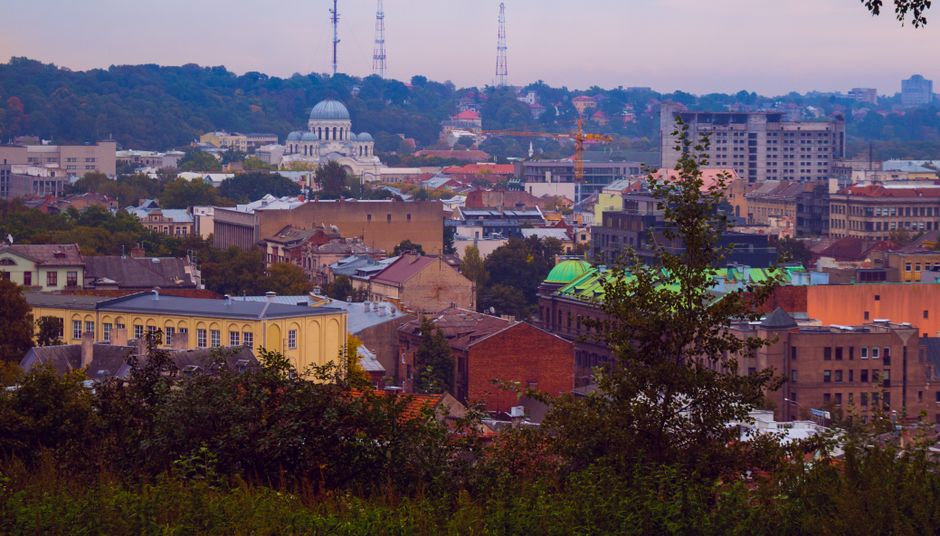
Kaunas, Lithuania’s second city, sits where the Neris flows into the Nemunas, the country’s great river. It has two faces. At the confluence, a compact Old Town of brick Gothic churches, a 14th-century castle and the white “swan” of the Town Hall; to the east, a New Town of wide boulevards built when Kaunas was Lithuania’s temporary capital between the world wars. Its modernist buildings from those years, from the Central Post Office to the huge Church of Christ’s Resurrection, became a UNESCO World Heritage Site in 2023. Add two old funiculars, the moving Ninth Fort memorial, the art of M. K. Čiurlionis, street murals and a passion for basketball, and Kaunas makes a rewarding stop of one or two days, about an hour from Vilnius.
Right now in Kaunas
- Wed 9–17°C 49–63°F Mostly clear
- Thu 11–19°C 52–65°F Clear
- Fri 10–15°C 51–59°F 4 mm Rain
Weather: MET Norway (CC BY 4.0) · Rates: ECB
Top tours in Kaunas
See all tours for Kaunas →
From local operators, with prices and reviews; you check availability and book on Viator, our partner. We may earn a commission at no extra cost to you. How we earn money
Kaunas at a glance
- Best for: interwar modernist architecture, a small Gothic Old Town, 20th-century history, Lithuanian art, street art and good-value food and coffee.
- How long: one full day for the Old Town and New Town; two days to add the Ninth Fort, Pažaislis Monastery and the museums.
- Best time: May to September for walking, riverside terraces and festivals; December for the Christmas lights on Town Hall Square.
- Getting in: trains from Vilnius take about 1–1¼ hours; Kaunas Airport, a Ryanair base, is about 40 minutes from the centre by city bus.
- Getting around: walk between the Old Town and the New Town along Vilniaus street and Laisvės alėja; buses and trolleybuses for the Ninth Fort and Pažaislis.
- Budget: one of the best-value cities in the Baltics; national museums are free on the last Sunday of the month.
Kaunas, area by area
The Old Town (Senamiestis)
The Old Town fills the tongue of land between the two rivers. Town Hall Square is its heart, ringed by merchants’ houses and the twin-towered Jesuit church, with the slim white Town Hall, nicknamed the White Swan, in the middle. Nearby are the Cathedral Basilica of Sts Peter and Paul, the Gothic Perkūnas House and the brick church of Vytautas the Great by the Nemunas. At the very tip stand the castle and the confluence park. Best for: history, churches and a slow evening walk.
The New Town and Laisvės alėja
Laisvės alėja (Freedom Avenue), a pedestrian boulevard lined with lime trees, runs about 1.6 km east from the Old Town to the blue-domed St Michael the Archangel’s Church, a former Russian Orthodox garrison church. The streets around it are full of 1920s and 1930s buildings: the Central Post Office, the Officers’ Club, banks, cinemas and apartment blocks. Best for: architecture, shopping, cafés and nightlife.
Žaliakalnis and Aleksotas
Žaliakalnis (Green Hill), on the slopes north of the New Town, has villas of the interwar elite, the Church of Christ’s Resurrection with its roof terrace, and the Sugihara House. Aleksotas, across the Nemunas, is the place to go for the classic view back over the Old Town’s roofs and spires, reached by an old funicular. Best for: views and quieter streets.
Top things to see in Kaunas
Prices and hours below were checked on the official sites in October 2026. They change, so check before you go. Many museums close on Mondays and national holidays.
Modernist Kaunas, a UNESCO World Heritage Site
Between 1919 and 1939, when Vilnius was part of Poland, Kaunas served as Lithuania’s capital and grew from a provincial garrison town into a modern city. Architects trained across Europe filled it with confident buildings in a local version of modernism and Art Deco. In 2023 UNESCO listed “Modernist Kaunas: Architecture of Optimism, 1919–1939”. Highlights to look for on a self-guided walk:
- The Central Post Office on Laisvės alėja, with folk-art motifs in its great hall.
- The Vytautas the Great War Museum building, with its tower and carillon, which shares its home with the M. K. Čiurlionis museum, and the nearby Officers’ Club (Karininkų ramovė).
- The Church of Christ’s Resurrection in Žaliakalnis, a vast white church begun in the 1930s, used as a radio factory in Soviet times and finished only in 2004. Its roof terrace has one of the best views in the city (small fee).
- Villas and apartment blocks on the streets of Žaliakalnis, and banks and the former Pienocentras dairy headquarters in the New Town.
The Ninth Fort
Built as part of the tsarist fortress ring around Kaunas, the Ninth Fort became a prison and, during the Nazi occupation, a place of mass murder: tens of thousands of people, most of them Jews from Kaunas and from across Europe, were killed here. The museum covers the fort’s prison history, the Soviet deportations and the Holocaust, and a huge concrete memorial from 1984 towers over the site. A new exhibition, “Saviours”, on the people who rescued Jews in Kaunas, opened in March 2026. It is a solemn visit; allow two hours.
Tickets and hours. As of October 2026, adults pay €8 and concessions €4, and entry is free for everyone on the last Sunday of the month. From 1 October to 31 March the museum opens Tuesday to Sunday 09:00–17:00; from April to September, Tuesday to Friday 09:00–17:00 and weekends 10:00–18:00. It is closed on Mondays and public holidays. The fort is about 7 km north of the centre, by city bus or taxi.
The M. K. Čiurlionis National Museum of Art
Mikalojus Konstantinas Čiurlionis (1875–1911) was a composer and painter whose dreamy, musical pictures of cosmic seas and sonatas in paint are a national treasure. The museum in the New Town holds the largest collection of his work, along with Lithuanian folk art. As of October 2026, a ticket costs €10 (€5 reduced), and it is free for everyone on the last Sunday of the month. It is open from Tuesday to Sunday, with longer hours on Wednesdays and Thursdays, and is closed on Mondays and national holidays. The museum also runs the quirky Devils’ Museum (A. Žmuidzinavičius Creations and Collections Museum) in Žaliakalnis, with thousands of devil figures from around the world. The Čiurlionis House-Museum is closed for reconstruction.
Kaunas Castle and the confluence
Built in the mid-14th century to guard the rivers against the Teutonic Order, Kaunas Castle is one of Lithuania’s oldest masonry castles. Its round south-eastern tower was rebuilt in 2010 and now holds a branch of the Kaunas City Museum, with a virtual reconstruction of the castle in the 15th century. Walk on to the confluence park at the tip of the Old Town, where the Neris and Nemunas meet, best at sunset.
Town Hall Square and the Old Town churches
The 16th-century Town Hall, rebuilt in baroque and classical style, is now used for weddings and exhibitions by the Kaunas City Museum. Around the square, see the Cathedral Basilica, Lithuania’s largest Gothic church, and the House of Perkūnas, a late Gothic merchants’ house with an extravagant brick gable named after the pagan god of thunder. The plain brick Vytautas the Great Church on the riverbank is one of the oldest churches in the country.
The funiculars and the Aleksotas viewpoint
Kaunas still has two funiculars from the 1930s, with their original wooden carriages. The Aleksotas funicular, near the Vytautas Bridge, climbs to a viewpoint over the Old Town and the rivers; a ride costs about €1–2. The Žaliakalnis funicular climbs from near Laisvės alėja towards the Church of Christ’s Resurrection, but it has been reported as temporarily closed, so check before you go. If either is not running, the walk up takes 10–15 minutes.
Pažaislis Monastery
On a peninsula by the Kaunas Lagoon, about 9 km east of the centre, Pažaislis is a 17th-century Camaldolese monastery with one of the finest Italian baroque church interiors in Northern Europe, all frescoes and coloured marble. It hosts the Pažaislis Music Festival in summer. Visits to the church are by guided tour or at set times, so check opening hours on the day.
Churches and cathedrals
- Christ's Resurrection Church, Kaunas
Museums
- M. K. Čiurlionis National Museum of Art
- Ninth Fort
Other sights
- Kaunas Town Hall
Viewpoints
- Aleksotas Funicular
Castles and forts
- Kaunas Castle
Monasteries and convents
- Pažaislis Monastery
More experiences in Kaunas
- Sugihara House: the former Japanese consulate where, in 1940, the diplomat Chiune Sugihara issued thousands of transit visas that saved Jewish refugees; now a small museum.
- Street art: Kaunas is covered with murals, from the “Wise Old Man” in the Old Town to the courtyards around Laisvės alėja; the city’s former role as European Capital of Culture in 2022 added many more.
- Basketball: Kaunas is home to Žalgiris, one of Europe’s great basketball clubs. Catching a game at the Žalgiris Arena, on an island in the Nemunas, is an experience even for non-fans.
- Riverside walks and cycling: paths run along both rivers and out to the Kaunas Lagoon; see our cycling guide and city sightseeing guide.
- Food and coffee: Kaunas has a strong café culture and a young food scene; try cepelinai and šaltibarščiai in a traditional restaurant and modern Lithuanian cooking in the New Town.
Activities and best months
- Boat tripsBoat trips sail on the Kaunas Lagoon and down the rivers to the resort towns of Kačerginė, Kulautuva and Zapyškis, to Raudondvaris, and about 40 km to the spa town of Birštonas; schedules and bookings through Nemuno turas or the Kaunas IN tourist information centre. Regular river transport has not run since 2019. · source
- City sightseeingKaunas IN's must-sees: the 14th-century castle tower and the confluence of the Nemunas and Neris, the renovated Town Hall ('White Swan') with a Kaunas City Museum exhibition and tourist information desk, the Aleksotas funicular to the observation deck, Vilniaus street and Laisvės alėja, the UNESCO-listed modernist city (Art Deco and Amsterdam School museums, the Čiurlionis art museum and the War Museum), Christ's Resurrection Basilica with its 360-degree roof terrace, Pažaislis monastery and the Ninth Fort memorial. · source
- CyclingKaunas has about 140 km of bike paths, including routes along the Nemunas and Neris; longer rides lead to the riverside resort towns of Kulautuva and Kačerginė. Bikes travel free on public transport marked with the 'Like Bike' sticker and on the Aleksotas funicular; rent from hotels, Ride&Mend or CityBee. · source
- WaterOn sunny days Kaunas goes to the Kaunas Lagoon or Lampėdžiai lake to swim, with the Wake Up wakeboard park and the UNO Adventure Park (one of the longest wakeboarding tracks in Europe, water jumps and a beach bar) at Lampėdžiai; Panemunė beach on the Nemunas is a city favourite, and the Vanduo Marse wakeboard park near Babtai has coaches for all ages. · source
Festivals and seasons in Kaunas
Spring brings the Kaunas Jazz festival, and in May the city celebrates its Kaunas City Days, with markets and concerts in the Old Town. In summer, the Pažaislis Music Festival fills the monastery and other venues with classical music, and outdoor terraces line Laisvės alėja. National holidays are marked here too: Statehood Day on 6 July, when people across the country sing the national anthem at 21:00, and Independence Restoration Day on 11 March. In December, Town Hall Square has a Christmas tree, lights and a small market. Check each year’s programme with Visit Kaunas, as festival dates move.
Day trips from Kaunas
- Rumšiškės: the Open-Air Museum of Lithuania, about 20 km east, with farmsteads, windmills and churches brought from every region; mainly a spring-to-autumn visit.
- Trakai Island Castle and Vilnius: Trakai is on the way to Vilnius, about an hour’s drive; Vilnius is about an hour by train for a day in the capital’s Old Town.
- Birštonas: a small spa town on a loop of the Nemunas, about 40 km south, with mineral-water spas and riverside walks.
- The Nemunas castles: drive west along the river to the red-brick church of Zapyškis and the castles and manors of Raudonė and Panemunė.
- The Curonian Spit: about three hours by car or train and ferry via Klaipėda; in summer a passenger boat runs down the Nemunas from Kaunas to Nida.
Getting to Kaunas and getting around
By air. Kaunas Airport (KUN), in Karmėlava about 14 km north-east of the centre, is a Ryanair base with flights to many European cities. City bus 29 runs to the centre and railway station in about 40 minutes for about €1; taxis and ride-hailing apps take about 20 minutes. Vilnius Airport, with more routes, is about 1¼ hours away by road.
By train and bus. LTG Link trains link Kaunas with Vilnius in about 1–1¼ hours, the fastest in under an hour. Trains to Poland pass through Kaunas on the way to the border at Mockava, where you change for Warsaw and Kraków. The bus station, next to the railway station south of the New Town, has frequent buses to Vilnius and Klaipėda and international coaches to Riga, Tallinn and Warsaw.
In town. The Old Town and New Town are best on foot: from Town Hall Square to St Michael’s Church is about a 30-minute walk. Buses and trolleybuses cover the rest of the city, including the Ninth Fort and Pažaislis; tickets cost about €1 a ride and are sold in ticketing apps such as m.Ticket. Check current fares with the city’s transport operator before you travel. Kaunas also has e-scooters, city bikes and cheap ride-hailing. By car, the A1 motorway links Kaunas with Vilnius and Klaipėda.
When to go and how long to stay
Kaunas has warm summers and cold winters, a little milder than Vilnius. The table uses the Lithuanian Hydrometeorological Service’s (LHMT) official 1991–2020 station data for Kaunas.
| Season | Average daily high | Average nightly low | Rain per month | What it’s like |
|---|---|---|---|---|
| Winter (Dec–Feb) | −1 to 1 °C | −6 to −3 °C | 37–48 mm | Cold, grey and short days, snow possible; Christmas on Town Hall Square |
| Spring (Mar–May) | 5 °C rising to 19 °C | −2 to 8 °C | 37–53 mm | Fresh and bright; Kaunas Jazz and City Days |
| Summer (Jun–Aug) | 22–24 °C | 11–14 °C | 66–88 mm | Warm, with thunderstorms; terraces, music festivals and river walks |
| Autumn (Sep–Nov) | 18 °C falling to 5 °C | 9 °C falling to 1 °C | 47–60 mm | Mild September, then damp and dark |
Kaunas gets about 650 mm of rain and snow a year, with July the wettest month, and about 1,880 hours of sunshine. July is the warmest month, with highs around 24 °C; January the coldest, with nights around −5 °C. Late May, June and September are the most comfortable months for walking the city.
Kaunas in 1 day
Start at Kaunas Castle and the confluence, then walk through the Old Town: Town Hall Square, the Cathedral Basilica and the House of Perkūnas. Ride the Aleksotas funicular for the view. After lunch, walk Laisvės alėja to St Michael’s Church, stopping at the Central Post Office and the Čiurlionis museum, and finish on the roof terrace of the Church of Christ’s Resurrection.
Kaunas in 2 days
Add the Ninth Fort in the morning of day 2, then Pažaislis Monastery and a walk by the Kaunas Lagoon, or the Sugihara House and the Devils’ Museum in Žaliakalnis. In the evening, catch a Žalgiris basketball game or a concert. With a third day, visit the Rumšiškės open-air museum or continue to Vilnius via Trakai.
Weather month by month
Averages from LHMT daily station data 1991–2020 (monthly means computed), Kaunas · Last reviewed 4 Oct 2026
Where to stay in Kaunas
- Old Town: small hotels and apartments around Town Hall Square and Vilniaus street; atmospheric and close to the castle and rivers.
- New Town: the widest choice, from modern chain hotels to apartments in interwar buildings, near Laisvės alėja’s cafés and bars.
- Near the stations: budget hotels handy for early trains, buses and the airport bus.
Kaunas charges a small city tax on overnight stays, reported as €1 per adult per night, collected by your hotel. Rooms are cheapest at weekends and fill up for big basketball games and concerts.
Practical tips for Kaunas
- Plan for Mondays: the Ninth Fort, the Čiurlionis museum and most other museums close on Mondays and national holidays.
- Use the last Sunday: the Ninth Fort and the Čiurlionis museum are free for everyone on the last Sunday of each month.
- Buying alcohol: shops sell alcohol only 10:00–20:00 Monday to Saturday and 10:00–15:00 on Sundays, to people aged 20 and over.
- Respect the memorials: the Ninth Fort is a place of mass murder; behave quietly and don’t climb on the monument.
- Money and language: Lithuania uses the euro and cards are accepted almost everywhere; English is common among younger people.
What to pack for Kaunas
Comfortable walking shoes for cobbles and hills, layers and a light rain jacket for summer showers, and a warm coat, hat and gloves from November to March. Bring a travel adapter for type C and F sockets if you come from outside continental Europe, and a contactless card for buses and shops.
What to pack
- City walking shoesLisbon and Porto are steep, with polished limestone cobbles that get slippery, so grippy soles matter.
- Day packs and anti-theft bagsA small zipped or anti-theft bag makes crowded trams and viewpoints less stressful.
- Dry bags and phone pouchesSpray soaks phones and cameras on open boats to the Algarve caves and on whale-watching trips.
- Fleeces and warm layersIt is cooler at sea than on land, especially on morning whale-watching trips.
- Rain jacketsA windproof, waterproof shell keeps you warm on open boats, where wind and spray cool you quickly.
- Reef-friendly sunscreenSun reflects off the water on cruises and cave tours.
- Travel adapters and convertersPortugal uses Type C and F sockets at 230 V, so most visitors from outside Europe need an adapter.
- Water bottles and hydration packsRiding in the Algarve and Alentejo heat needs more water than you expect.
- Water shoesKayak and small-boat trips to the Algarve grottoes land on rock and wet sand.
Kaunas travel FAQ
Is Kaunas worth visiting?
Yes. It has a pretty Old Town, one of Europe’s best collections of interwar modernist architecture (a UNESCO World Heritage Site since 2023), the Ninth Fort memorial and good museums, and it feels less touristy than Vilnius.
How many days do you need in Kaunas?
One full day covers the Old Town, Laisvės alėja and a funicular view. Two days let you add the Ninth Fort, Pažaislis Monastery and the Čiurlionis museum at a gentle pace.
How do I get from Vilnius to Kaunas?
By LTG Link train in about 1–1¼ hours, the fastest way, or by bus in about 1½ hours. By car, the A1 motorway takes about an hour. Kaunas is easy as a day trip from Vilnius, but it is nicer to stay a night.
How do I get from Kaunas Airport to the city?
City bus 29 runs from the airport to the centre and the railway station in about 40 minutes for about €1. A taxi or ride-hailing car takes about 20 minutes.
How much does the Ninth Fort cost?
As of October 2026, €8 for adults and €4 for concessions, free on the last Sunday of each month. From October to March it opens Tuesday to Sunday 09:00–17:00 and is closed on Mondays and public holidays.
What is Modernist Kaunas?
The buildings put up between 1919 and 1939, when Kaunas was Lithuania’s temporary capital: offices, churches, villas and apartment blocks in a local modernist and Art Deco style. UNESCO listed them in 2023 as “Modernist Kaunas: Architecture of Optimism, 1919–1939”. Start on Laisvės alėja and in Žaliakalnis.
Who was Čiurlionis?
M. K. Čiurlionis (1875–1911) was Lithuania’s great composer and painter, known for symbolic, musical paintings. The M. K. Čiurlionis National Museum of Art in Kaunas has the largest collection of his works; as of October 2026, entry costs €10.
Are the Kaunas funiculars running?
The Aleksotas funicular, with the best view over the Old Town, normally runs daily for about €1–2 a ride. The Žaliakalnis funicular has been reported as temporarily closed. Check locally, and if either is closed, walk up in 10–15 minutes.
When is the best time to visit Kaunas?
May to September, with highs of 19–24 °C, long evenings and outdoor terraces. December is atmospheric with the Christmas lights on Town Hall Square, though cold and dark by mid-afternoon.
Sources
- © OpenStreetMap contributors · ODbL · fetched 4 Oct 2026
- Wikidata · CC0 · fetched 4 Oct 2026
Sources and last review
Researched and last reviewed on 4 October 2026. Ninth Fort prices, hours and exhibitions: the Kaunas Ninth Fort Museum (9fortomuziejus.lt); Čiurlionis museum prices, hours and closures: ciurlionis.lt; Kaunas Castle: the Kaunas City Museum (kaunomuziejus.lt); UNESCO listing: Visit Kaunas; climate: the Lithuanian Hydrometeorological Service’s 1991–2020 station data for Kaunas. Funicular prices and the Žaliakalnis closure, airport bus 29, train journey times, local bus fares and the city tax come from secondary sources, because the official Visit Kaunas, Kaunas Airport and LTG Link pages could not be read, and are flagged for checking, as are festival months. Prices, timetables and rules change, so check the official links before you go. For another city of interwar and Hanseatic architecture, see our Gdańsk and Brno guides.
Plan your trip
Partner links: TravelerCenter may earn a commission if you book, at no extra cost to you.
🇱🇹 Useful Lithuanian phrases for Kaunas
All 38 Lithuanian phrases: restaurant, hotel, emergencies, romance (printable) →