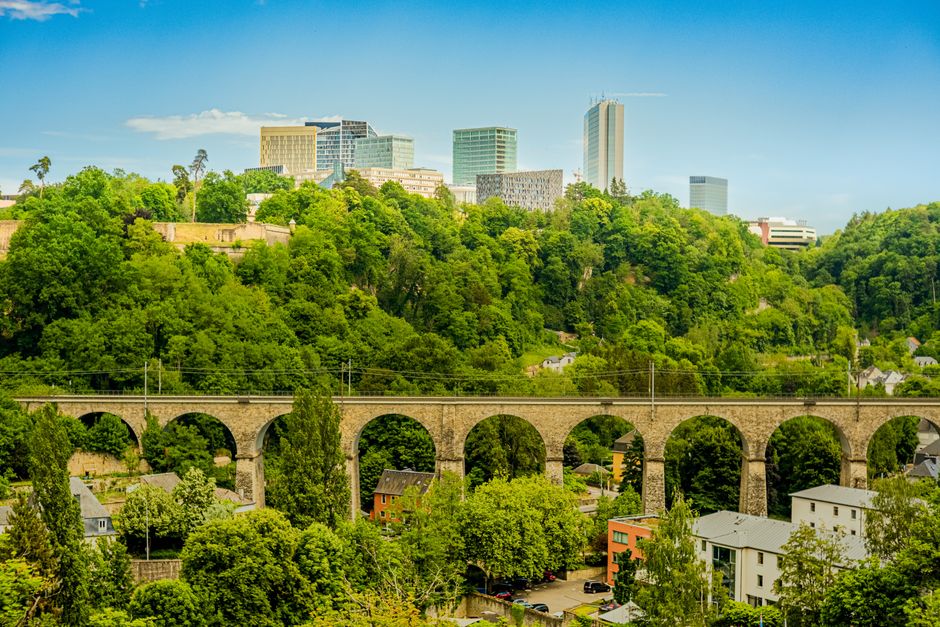
Luxembourg City is a capital built on cliffs. Its old town stands on a rocky plateau high above the green valleys of the Alzette and the Pétrusse, wrapped in the walls, bastions and tunnels of what was once one of Europe’s strongest fortresses, and the whole ensemble of old quarters and fortifications is a UNESCO World Heritage Site. Walk the Chemin de la Corniche, go underground in the Bock and Pétrusse casemates, look down on the medieval Grund, ride a free glass lift into the Pfaffenthal valley, then cross the red bridge to the glass towers of the European district and the Mudam art museum. It is small, safe and green, with excellent restaurants, and public transport is free. One full day covers the highlights; two or three let you add the museums, the valleys and an evening in the Grund, and the city makes an easy base for day trips around the Grand Duchy.
Right now in Luxembourg City
- Wed 9–21°C 48–70°F 9 mm Rain
- Thu 10–15°C 50–58°F 4 mm Mostly clear
- Fri 5–11°C 41–51°F 1 mm Cloudy
Weather: MET Norway (CC BY 4.0) · Air quality: OpenAQ
Top tours in Luxembourg City
See all tours for Luxembourg City →
From local operators, with prices and reviews; you check availability and book on Viator, our partner. We may earn a commission at no extra cost to you. How we earn money
Luxembourg City at a glance
- Best months: May to September for walks and terraces; late November to early January for the Christmas markets. Mean temperatures run from about 1–2 °C in January to about 18–19 °C in July and August (1991–2020 averages for Luxembourg Airport at Findel, MeteoLux), with afternoon highs around 25 °C in July.
- Days needed: 1 for the old town and casemates; 2–3 with the museums, the valleys and Kirchberg; more as a base for Vianden, the Mullerthal and the Moselle.
- Getting there: Luxembourg Airport is about 6 km away, and the free T1 tram runs from the terminal into the city; trains arrive at the central station from Paris (about 2 hours 10 minutes by TGV), Brussels, Metz, Strasbourg and Trier.
- Getting around: on foot, plus free trams, buses, lifts and a funicular to get between the plateau and the valleys.
- Budget level: hotels and restaurants are expensive, transport is free and museums are fairly cheap. See our Luxembourg country guide for money, entry rules and costs.
Luxembourg City’s areas and who each one suits
The city has 24 districts and about 137,700 inhabitants (31 December 2025), and covers 52.5 km², but visitors mostly stay within a few square kilometres. The key to understanding it is height: the old town (Ville Haute) sits around 300 m above sea level, and the valley quarters lie 50–70 m below.
- Ville Haute (the old town): the historic centre on the plateau, with the Grand Ducal Palace, the cathedral, Place Guillaume II and Place d’Armes, the main shopping streets and the Corniche. The best base for a short first visit.
- Grund: the old riverside quarter below the Corniche, with the Neumünster Abbey, stone bridges, gardens and atmospheric pubs. Quiet by day, lively in the evening.
- Clausen and Pfaffenthal: valley quarters below the Bock; Clausen’s old brewery site (the Rives de Clausen) is a nightlife hub, and Pfaffenthal has the Vauban towers and the bottom of the panoramic lift.
- Gare: the area around the central station, south of the Pétrusse valley, with many mid-range and budget hotels and good transport links, about 10–15 minutes’ walk from the old town. Some streets near the station feel rough late at night.
- Kirchberg: the plateau of EU institutions, banks, the Philharmonie, Mudam, the Fort Thüngen museum and the Auchan and Kirchberg shopping centres; business hotels are often cheaper at weekends.
- Limpertsberg and Belair: leafy residential districts with the Glacis, home of the Schueberfouer funfair and a regular flea market.
Top things to see in Luxembourg City
The Chemin de la Corniche and the Bock
The Corniche, called “the most beautiful balcony in Europe” by the Luxembourg writer Batty Weber, runs along the 17th-century ramparts from the Bock promontory to the Holy Ghost Citadel, with sweeping views over the Grund, the Alzette, Neumünster Abbey and the Rham plateau. It is free and open at all hours, and lovely at dusk. At its northern end, the Bock is the rock where Count Siegfried built his castle in 963, the founding of the city. From the Castle Bridge (1735) and the remains of the castle, you can continue along the Wenzel circular walk, which drops into the valleys past the old city walls and towers.
The Bock Casemates
The fortress builders dug some 23 km of underground galleries; after the fortress was dismantled in 1867, about 17 km survived. The Bock Casemates, carved into the rock by Austrian engineers in the 18th century, are the classic visit: an archaeological crypt with the remains of the first castle, gun galleries with loopholes over the valley, a 47-metre-deep well and a spiral descent under the road. As of October 2026, tickets cost €11 for adults, €9 for students and over-60s, €5.50 for children aged 4–12 and nothing for under-4s. Entry is by time slot and visits last up to 45 minutes. Opening times in 2026: from 09:45 with last admission at 19:00 in July and August, 17:00 from 28 March to 30 June and 1 September to 8 November, and 10:45–14:45 (last admission) from 9 November to 31 December; closed 25 December and 1 January. Buy tickets online, at the tourist office on Place Guillaume II or at the entrance on Montée de Clausen. The galleries are cool and have uneven steps, so wear good shoes and a layer.
The Pétrusse Casemates
Under Place de la Constitution, the Pétrusse Casemates reopened after major safety and restoration works with a new scenography and light installations. They date from the Spanish and Vauban periods and were used over the centuries as shooting ranges, mushroom farms, champagne cellars and air-raid shelters. As of October 2026, adults pay €12.60, students and over-60s €10.15 and children aged 4–12 €6.30; the LuxembourgPass is accepted. Hours follow the same pattern as the Bock, except that the low-season timetable (10:45–14:45 last admission) starts on 26 October 2026. Above them, Place de la Constitution has the golden Gëlle Fra war memorial and one of the best views of the Adolphe Bridge and the Pétrusse valley.
The Grand Ducal Palace and the old town squares
The Grand Ducal Palace on Rue du Marché-aux-Herbes, a Renaissance façade that was the town hall before becoming the official residence of the grand ducal family in 1890, is the city’s most photographed building, with a guard outside. Inside visits are only possible on the Luxembourg City Tourist Office’s 75-minute guided tours in summer (maximum 22 people), which take in the Grand Duke’s office, the dining room and the Salon des Rois. All 2026 tours are sold out; tickets for summer 2027, the 50th anniversary of the tours, go on sale in spring or summer 2027, online and at the tourist office. Nearby, Place Guillaume II (the “Knuedler”), with its equestrian statue and the town hall, hosts markets, while Place d’Armes is the café-lined “living room” of the city with summer concerts.
Notre-Dame Cathedral
Built by the Jesuits between 1613 and 1621 and later extended, the cathedral mixes late Gothic and Renaissance styles, with fine stained glass and a crypt holding the tombs of the grand ducal family and of John the Blind, King of Bohemia and Count of Luxembourg. It is open Monday to Saturday from 08:00 to 18:00 and Sunday from 08:00 to 19:00; entry is free, but respect services. An audio guide on the Sightseeing.lu app covers 36 points in five languages; bring headphones. During the Octave pilgrimage (17 April–2 May 2027), the cathedral is very busy.
The Grund, Neumünster Abbey and the valleys
Walk down from the Corniche, or take the free lift from the Plateau du Saint-Esprit, to the Grund, the old craftsmen’s quarter on the Alzette. The former Neumünster Abbey is now a cultural centre with exhibitions, concerts and a café terrace by the river; St John’s Church next door has a Black Madonna. Follow the riverside paths to Clausen, or south-west into the Pétrusse valley, a long park beneath the Adolphe Bridge and the viaduct, ideal for a walk or a jog.
The Pfaffenthal panoramic lift and Kirchberg
The free glass Pfaffenthal panoramic lift drops 71 m from the Pescatore park in the city centre to the Pfaffenthal valley, with superb views on the way. It runs every day from 05:45 to 01:00, except on the first Monday of each month, when it is out of service for maintenance from 09:00 until 05:45 the next morning. From the valley, walk under the red Grand Duchess Charlotte Bridge to the Pfaffenthal-Kirchberg station, where a free funicular climbs to the Kirchberg tram stop.
Mudam and the Fort Thüngen museum
On Kirchberg, Mudam, the contemporary art museum designed by I. M. Pei on the walls of Fort Thüngen, shows changing exhibitions and its collection in luminous galleries. As of October 2026 it is open Tuesday to Sunday from 10:00 to 18:00 (Wednesday until 21:00), closed Mondays; tickets cost €10, reduced €7, and admission is free for under-21s and on Wednesdays from 18:00 to 21:00. Next door, in the restored fort with its “three acorns” towers, the Musée Dräi Eechelen tells the story of the fortress and of national identity.
The national museum and the City Museum
The Nationalmusée um Fëschmaart (national museum of archaeology, history and art) in the old town covers everything from Gallo-Roman mosaics to modern art. It is open Tuesday to Sunday from 10:00 to 18:00, Thursday until 20:00, closed Mondays and on 1 January, 23 June, 1 November and 25 December. Individual admission is €7, or €12 for both the Nationalmusée and the Musée Dräi Eechelen on the same day; entry is free for under-26s, during the last hour before closing and on Thursday evenings from 17:30 to 20:00. Across the street, the Lëtzebuerg City Museum tells the city’s 1,000-year story in an old patrician house with a glass lift down through the rock; adults pay €5, and entry is free on Thursdays from 18:00 to 20:00. Also worth a look: the Villa Vauban art museum in its park, the Casino Luxembourg contemporary art space and the natural history museum (natur musée) in the Grund.
Walks, tours and the City Train
The city is made for walking, with signposted circular walks: the Wenzel walk (about 1,000 years of history in 100 minutes, through the valleys and walls), the Vauban walk through the outer fortifications and Pfaffenthal, and the Schuman walk through the European quarter. The tourist office sells guided walks such as the 2- to 3-hour City Promenade of the old town, offered most afternoons in October 2026, plus themed tours and e-bike tours. If you’d rather sit, the little City Train runs a 40-minute circuit through the old town and the valleys from the end of March to early November, starting from Montée de Clausen; as of October 2026 adults pay €14.50, children aged 4–12 €10, and a combined ticket with the Bock Casemates costs €23.50. A hop-on hop-off bus also runs. See our city sightseeing guide and our cycling guide for planning.
Day trips from Luxembourg City
Free public transport makes the capital a great base. Plan with the mobiliteit.lu app, and remember that rural buses are less frequent at weekends.
- Vianden: train to Ettelbruck, then a bus, about 1 hour 15 minutes in all. The castle is open daily from 10:00; adults pay €13.
- Mullerthal and Echternach: about an hour by bus; walk part of the Mullerthal Trail around Berdorf and finish in Echternach, the oldest town in the country.
- Clervaux: about an hour by direct train for The Family of Man photo exhibition in the castle (Wednesday to Sunday, 12:00–18:00, until 1 January 2027; €6).
- The Moselle and Schengen: buses to Remich and Schengen for wine tastings, river cruises in summer and the Schengen Museum.
- Esch-sur-Alzette and Belval: about 20–30 minutes by train for the blast furnaces and the Minett.
- Trier (Germany): Germany’s oldest city, with the Porta Nigra, under an hour by train; you need a cross-border ticket from the last Luxembourg station.
- Metz (France): about an hour by train, with its Gothic cathedral and the Centre Pompidou-Metz. For further French trips see Strasbourg.
Nearby destinations
- Middle Rhine Valley135 km
- Maastricht143 km
- Reims157 km
- Cologne159 km
- Strasbourg165 km
- Düsseldorf185 km
- Heidelberg187 km
- Brussels187 km
Getting there and getting around
From the airport
Luxembourg Airport (Findel) is about 6 km east of the centre. Since 2 March 2025 the T1 tram has run from the terminal through Kirchberg and the old town (Hamilius stop) to the central station and on to the Stadion at Gasperich; buses 16 and 29 also link the airport with the city centre and the central station. All are free, so just get on. A taxi is the quickest option late at night, but taxi fares in Luxembourg are not regulated and are expensive, so ask the price first.
By train
The central station (Gare Centrale) is south of the old town across the Pétrusse valley, about 10–15 minutes’ walk or a few minutes by tram or bus. TGVs run to Paris Gare de l’Est in about 2 hours 10 minutes, and direct trains link the city with Strasbourg (about 1 hour 33 minutes), Metz, Trier, Koblenz, Liège and Brussels (roughly three hours). The Pfaffenthal-Kirchberg station, linked to Kirchberg by the funicular, is handy for the north of the country.
Trams, buses, lifts and bikes
Inside Luxembourg, second-class travel on all trams, buses and trains is free, with no ticket needed; only first class on trains costs extra (€3 for two hours, €6 for a day). The single tram line runs every few minutes between the airport, Kirchberg, the old town and the central station. Dozens of city buses fill the gaps, and the free lifts and funicular take the effort out of the valleys. The city’s Vel’OH! bike-share has stations across town, with e-bikes to help on the hills. Driving in the centre is not worth it: the old town is largely pedestrian, car parks are expensive and the Park & Ride sites on the edge of town are linked by tram and bus.
Tickets, passes and saving money
The LuxembourgPass gives free entry or discounts at many sights in the city and across the country, including the Pétrusse Casemates. As of October 2026 it costs €23 for one day, €33 for two days and €39 for three days for one person, with cheaper rates per person for two people and groups. The national museums are free for under-26s and on Thursday evenings, Mudam is free for under-21s and on Wednesday evenings, and many of the best experiences, such as the Corniche, the lifts and the valley walks, cost nothing.
When to go and how long to stay
Luxembourg City is a year-round destination. Spring is fresh and green but showery; summer is warm, with afternoon highs around 25 °C in July, open-air concerts on Place d’Armes and long evenings in the Grund; autumn turns the valleys golden; winter is cold and grey, brightened by the Christmas markets from 20 November 2026 to 3 January 2027. MeteoLux records about 830 mm of rain a year at Findel, spread fairly evenly, and frequent fog from October to February. The big events are National Day on 23 June, with fireworks and street parties on the evening of the 22nd, the Schueberfouer funfair on the Glacis (20 August–8 September 2027) and the Octave pilgrimage and market after Easter (17 April–2 May 2027). Hotels are fullest and priciest midweek, when business travel and EU meetings peak.
1 day in Luxembourg City
Start at Place Guillaume II and the Grand Ducal Palace, see the cathedral, then walk to the Bock along the Corniche and visit the Bock Casemates. Have lunch in the Grund, walk along the Alzette to Clausen or take the lift back up, and visit the Pétrusse Casemates or the Nationalmusée in the afternoon. End with sunset views from Place de la Constitution and dinner in the old town.
2–3 days in Luxembourg City
On day two, take the Pfaffenthal lift down to the valley, walk under the red bridge, ride the funicular up to Kirchberg for Mudam and the Fort Thüngen museum, and return by tram; spend the evening at a concert in the Philharmonie or in the bars of Clausen. On day three, walk the Wenzel or Vauban trail, visit the City Museum and the Villa Vauban, or take a day trip to Vianden, Echternach or Trier.
Where to stay in Luxembourg City
- Old town: best for a short stay and for walking everywhere; boutique hotels, but the highest prices.
- Gare: good value and convenient for trains, trams and the airport; choose a hotel on a main street.
- Grund and Clausen: characterful small hotels and apartments in the valleys, close to restaurants and nightlife, but with steep climbs back up (or the lift).
- Kirchberg: modern business hotels near the tram, with lower prices on weekends and easy airport access.
- Budget: the youth hostel below the Bock in the Pfaffenthal valley, and campsites and cheaper hotels in the suburbs, all linked by free transport.
Book early for weekdays, National Day and the Schueberfouer period. Some communes add a small local tax to hotel bills.
Practical tips for Luxembourg City
- Tourist office: the Luxembourg City Tourist Office is on Place Guillaume II, where you can buy casemate and tour tickets and pick up walking maps.
- Time slots: casemate tickets are for a set time, and entry isn’t guaranteed more than 15 minutes late.
- Mondays: most museums close on Mondays, and the Pfaffenthal lift stops for maintenance on the first Monday of each month.
- Hills and steps: the drop between the old town and the valleys is steep; use the lifts and funicular.
- Language: French is the main language in shops and restaurants, but English is widely spoken. Say moien (hello) to start.
- Eating: the lunchtime plat du jour is the best-value meal; many restaurants close on Sundays or Mondays.
- Safety: the city is very safe; watch your bags on busy trams and around the station. Emergency number: 112.
What to pack for Luxembourg City
Comfortable shoes with good grip for cobbles, steps and the damp casemates; a rain jacket or umbrella in any season; a warm layer for the cool tunnels and for evenings; and a smarter outfit for fine dining or the Philharmonie. In winter, pack a warm coat, hat and gloves. Bring a plug adapter for type F/C sockets if you need one; see our plug adapter guide.
Luxembourg City travel FAQ
How much do the Bock Casemates cost?
As of October 2026, €11 for adults, €9 for students and over-60s, €5.50 for children aged 4–12 and free for under-4s. Entry is by time slot.
Are the Bock Casemates open in winter?
Yes, except on 25 December and 1 January. From 9 November to 31 December 2026 they open from 10:45, with last admission at 14:45.
Can you visit the Grand Ducal Palace?
Only on summer guided tours run by the tourist office. The 2026 tours are sold out; tickets for 2027, the 50th year of the tours, go on sale in spring or summer 2027.
How do I get from Luxembourg Airport to the city centre?
Take the free T1 tram from the terminal to the old town or the central station, or buses 16 or 29. No ticket is needed.
Is public transport free in Luxembourg City?
Yes. Second-class travel on trams, buses and trains is free for everyone, as are the panoramic lift and the funicular.
How many days do you need in Luxembourg City?
One full day for the old town, the Corniche and a casemate; two or three days to add the museums, Kirchberg and the valleys.
What is the Chemin de la Corniche?
A promenade on the old ramparts above the Grund, nicknamed “the most beautiful balcony in Europe”. It is free and always open.
Is the Pfaffenthal lift free?
Yes. It runs daily from 05:45 to 01:00, except on the first Monday of each month, when it is closed for maintenance from 09:00.
Which museums are free in Luxembourg City?
The Nationalmusée is free for under-26s and on Thursdays from 17:30, Mudam for under-21s and on Wednesdays from 18:00, and the City Museum on Thursdays from 18:00.
Is Luxembourg City worth visiting in winter?
Yes, for the Christmas markets (20 November 2026–3 January 2027) and the museums, but days are short, grey and cold, and the casemates have shorter hours.
Where should I stay in Luxembourg City?
The old town for atmosphere, the Gare area for value and transport, and Kirchberg for weekend deals on business hotels.
Can I visit Trier from Luxembourg City?
Yes. Trains take under an hour, but free travel ends at the border, so buy a cross-border ticket. See our Germany guide for more of the region, including Cologne.
Sources and last review
Researched and last reviewed on 4 October 2026. Casemate prices and hours, the Grand Ducal Palace tours, the panoramic lift, the cathedral hours, the City Train, the City Promenade, event dates and the city’s facts and figures come from the Luxembourg City Tourist Office; museum prices and hours from Mudam, the Nationalmusée and the Lëtzebuerg City Museum; free transport and fares from mobiliteit.lu; the airport tram from transports.public.lu and the airport buses from lux-Airport; the LuxembourgPass from Visit Luxembourg; climate averages from MeteoLux (Findel, 1991–2020); day-trip prices from Vianden Castle and the CNA. Train times to Brussels, Trier and Metz, day-trip journey times and some neighbourhood details come from secondary sources and are flagged for checking. Prices, timetables and rules change, so check the official sites before you travel.
Plan your trip
Partner links: TravelerCenter may earn a commission if you book, at no extra cost to you.
🇫🇷 Useful French phrases for Luxembourg City
All 38 French phrases: restaurant, hotel, emergencies, romance (printable) →