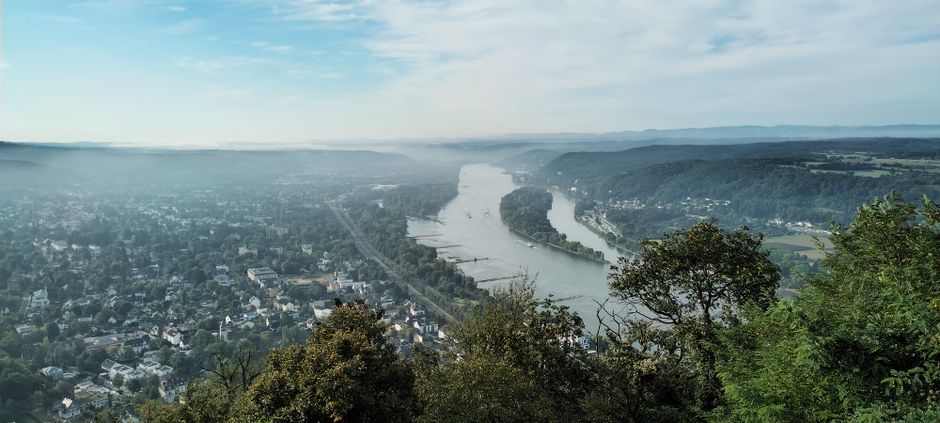
The Middle Rhine Valley is the stretch of the Rhine where the river cuts a deep, winding gorge through the slate hills between Bingen and Rüdesheim in the south and Koblenz in the north. Castles crown almost every crag, steep vineyards climb the slopes, half-timbered wine towns line the banks, and the Loreley rock rises at the river’s narrowest bend. It is the landscape that inspired Rhine Romanticism, and since 2002 it has been a UNESCO World Heritage Site. You come to cruise past the castles on a riverboat, tour the Marksburg and Rheinfels, hike the Rheinsteig and taste Riesling in Bacharach and Rüdesheim. It is an easy day trip from Frankfurt or Cologne, but best with two or three nights.
Right now in Middle Rhine Valley (Bacharach)
- Wed 11–22°C 51–72°F 5 mm Partly cloudy
- Thu 11–16°C 51–60°F 8 mm Partly cloudy
- Fri 7–13°C 45–56°F 3 mm Rain
Weather: MET Norway (CC BY 4.0) · Rates: ECB
Top tours in Middle Rhine Valley
See all tours for Middle Rhine Valley →
From local operators, with prices and reviews; you check availability and book on Viator, our partner. We may earn a commission at no extra cost to you. How we earn money
The Middle Rhine Valley at a glance
- Best for: castles, river cruises, wine towns, hiking with views and slow travel by train and boat.
- How long: 1 day for a cruise and one castle; 2–3 days to add hiking, wine and a second castle.
- Best time: May to mid-October, when the KD boats run their full timetable; September and October for the grape harvest and wine festivals.
- Getting in: Frankfurt airport, then trains along both banks; Koblenz and Mainz are the gateway cities.
- Good to know: there are no bridges between Mainz and Koblenz, so you cross the river by ferry. In winter, boats run rarely and some castles close or shorten their hours.
- Before you go: entry rules, money and general safety are in our Germany travel guide.
The valley, town by town
The UNESCO-listed Upper Middle Rhine Valley runs for about 64 km from the Mouse Tower at Bingen to the Deutsches Eck in Koblenz, with more than 40 castles, palaces and fortresses along the way. The west bank belongs to Rhineland-Palatinate; on the east bank, the southern end around Rüdesheim and Lorch is in Hesse. Here are the towns to know, from south to north.
Rüdesheim and Bingen
Rüdesheim am Rhein, at the gateway to the gorge, is the busiest wine town on the river, famous for the Drosselgasse, a narrow lane of wine taverns with live music. A cable car glides over the vineyards to the Niederwald Monument, a giant statue of Germania built after German unification in 1871, with a view down the valley. Across the river, Bingen has a quieter riverside and the Mouse Tower on its island. Ferries link the two towns. Best for: a lively first night and a cable-car view.
Bacharach
Many visitors’ favourite: a walled wine town of half-timbered houses, towers and old wine taverns under Stahleck Castle, which is now a youth hostel. Walk the town walls and up to the Gothic ruin of the Werner Chapel and the castle for the view. Best for: charm, wine and a quiet base.
Kaub and Oberwesel
Kaub faces Pfalzgrafenstein, a white toll castle shaped like a stone ship on an island in mid-river. Oberwesel, the “town of towers”, has one of the best-preserved town walls in Germany, below the Schönburg, which is now a castle hotel. Best for: photographers and town-wall walks.
St. Goar and St. Goarshausen
Twin towns facing each other at the heart of the gorge, linked by a car ferry. St. Goar lies under the vast ruins of Rheinfels Castle. St. Goarshausen sits below the Loreley rock and the castles of Katz and Maus. Best for: the Loreley and Rheinfels.
Boppard, Braubach and Koblenz
Boppard is a larger wine town with Roman walls, a riverside promenade and a chairlift to the Gedeonseck viewpoint over the river’s great loop. Braubach lies under the Marksburg. Koblenz, at the meeting of the Rhine and Moselle, has the Deutsches Eck monument and a cable car across the Rhine to the huge Ehrenbreitstein fortress. Best for: transport links, city comforts and the Marksburg.
Rhine cruises with KD
The classic way to see the gorge is from the deck of a riverboat. KD (Köln-Düsseldorfer), which celebrates its 200th anniversary in 2026, runs scheduled boats between Koblenz and Mainz, stopping at all the main towns, so you can hop off, visit a castle and continue later. A trip downstream (northwards) is faster than upstream against the current. Departure times, fares and rules below are from KD’s 2026 timetable and website, as checked in October 2026.
- Season: in 2026, the Middle Rhine scheduled service ran from 4 April to 18 October, with the full main-season timetable from 25 April to 4 October and fewer boats in April and in the last two weeks of October. Several departures run Tuesday to Sunday only.
- Loreley round trips: from Rüdesheim (first boat 9:00) and Boppard (first boat 10:00) to St. Goar and St. Goarshausen, several times a day, with stops so you can go ashore.
- Nostalgia route: the 1913 paddle steamer Goethe sailed between Koblenz and Rüdesheim from Tuesday to Sunday in the 2026 main season.
- Winter: from 19 October 2026 to 2 April 2027, a single daily round trip between Rüdesheim and St. Goarshausen runs only on days when enough passengers book; check KD’s operating days first.
Fares. KD prices go by zone. In the 2026 fare table, Rüdesheim to St. Goarshausen cost €28 one way or €31 return for an adult, Bacharach to St. Goarshausen €22 or €25, Boppard to St. Goarshausen €18 or €21, and Koblenz to Rüdesheim €62 or €67. Children under 6 travel free, children aged 6–13 pay €10 on scheduled boats, and on Wednesdays up to three children travel free with each paying adult. Over-65s get 20% off, students under 27 get 50% off, and holders of a Deutsche Bahn ticket or BahnCard get 20% off at KD ticket offices. A family ticket for the Loreley round trip from Boppard (2 adults and 2 children) is €51. Bikes cost €3.50 each way. Tickets are sold online, at the landing stages and on board (card only on board). Arrive 15 minutes early.
Low water. After a dry summer, the Rhine was low in early autumn 2026: the island castle of Pfalzgrafenstein was closed until further notice because of low water, and on Lake Constance, low water had suspended some boat routes. Check KD’s service updates on the day you travel. Other companies, such as Bingen-Rüdesheimer and the Loreley-Linie, run shorter trips too. See our boat trips guide.
Castles and sights
Prices and hours below were checked on the castles’ sites in October 2026. Many castles keep shorter hours or close in winter, so check before you go.
The Loreley
A slate cliff about 130 m high at a tight bend where the river is at its narrowest and deepest, once feared by boatmen for its currents and rocks. The legend of a golden-haired maiden who lured sailors to their deaths with her song was made famous by Heinrich Heine’s 1824 poem, and every boat plays the tune as it passes. On top, the redesigned Loreley plateau has a visitor centre, a park, an open-air stage and viewpoints over the valley. You can hike up from St. Goarshausen in about 45 minutes or take a bus in season. The view from the river is the classic one.
Marksburg
Above Braubach, the Marksburg is the only hilltop castle on the Middle Rhine never destroyed. It has a medieval herb garden, a kitchen, a knights’ hall and an armoury, and is owned by the German Castles Association. It can only be seen on a guided tour of about 50 minutes. As of October 2026, it was open 10:00–17:00 from 21 March to 1 November 2026, with English tours at 13:00 and 16:00 in summer, and 11:00–16:00 daily in winter (closed 24–25 December). Tickets cost €12 for adults, €8 for children up to 15 and €24 for a family; under-6s go free. Tickets are sold at the castle, and only groups need to book. Dogs are welcome. From Braubach station or the KD pier, it is a steep 20–30-minute walk up.
Rheinfels Castle
Once the largest castle on the Rhine, Rheinfels above St. Goar is now a vast ruin you explore on your own, including dark mine tunnels (bring a torch) and a small museum. As of October 2026, it was reported open daily in summer, and from 31 October on Fridays to Sundays only, 10:00–15:00, closing completely in snow and ice. Entry was €6 for adults and €3 for children aged 6–14. Its hotel and restaurant are on the same hill.
Pfalzgrafenstein
This 14th-century toll castle on an island off Kaub is reached by a small passenger ferry. In a normal year it opens Thursday to Sunday from mid-March to the end of October, on weekends only in November and February to mid-March, and closes in December and January. As of early October 2026, it was closed until further notice because of low water.
More castles, and Burg Eltz
Burg Rheinstein near Trechtingshausen is a romantic 19th-century restoration with furnished rooms. Stolzenfels Palace near Koblenz is a neo-Gothic Prussian summer palace, and the Ehrenbreitstein fortress above Koblenz is one of Europe’s largest. Many smaller castles are private, hotels or ruins seen only from outside. A short trip up the Moselle from Koblenz, Burg Eltz, a fairy-tale castle hidden in a forest valley, was open daily 9:30–17:00 from 29 March to 1 November 2026, with adult tickets at €14. It is closed in winter.
Viewpoints
- Deutsches Eck
Castles and forts
- Ehrenbreitstein Fortress
- Rheinfels Castle
Palaces
- Stolzenfels Castle
Museums
- Marksburg
Nature
- Loreley
Monuments
- Niederwalddenkmal
Hiking: the Rheinsteig and Rheinburgenweg
The Rheinsteig is a 320 km long-distance trail along the east bank from Bonn via Koblenz to Wiesbaden, on mostly narrow paths with steep climbs and descents through forests and vineyards and over spectacular viewpoints. It is marked in blue, with yellow access routes from the stations. The section through the UNESCO valley, from Koblenz to Rüdesheim, takes about a week, but you can easily hike one stage and return by train or boat. Favourite day stretches are Kaub to St. Goarshausen over the Loreley, and Braubach to the Marksburg and Lahnstein. On the west bank, the Rheinburgenweg (Rhine Castles Trail) links castles from Bingen to the Rolandsbogen near Remagen. There are also shorter circular “Traumschleifen” and premium loops. The trails are steep and can be slippery after rain, so wear proper shoes. See our hiking guide.
Wine and food
Vines have grown on the valley’s steep slate terraces since Roman times. The Middle Rhine is one of Germany’s smallest wine regions, best known for crisp, mineral Riesling, and many slopes are so steep they must be worked by hand. Rüdesheim and Assmannshausen belong to the neighbouring Rheingau region, and Assmannshausen is known for its pinot noir. Taste in the wine taverns of Bacharach, Oberwesel and Boppard, or at a family winery (Weingut). In autumn, look for Federweisser, the young, half-fermented new wine, served with onion tart. Wine festivals fill the towns from late summer to October, and in summer the “Rhine in Flames” (Rhein in Flammen) evenings light up the valley with fireworks and illuminated boat convoys. See our wine tasting guide.
More things to do
- Ring ticket in Rüdesheim: the Rüdesheim cable car to the Niederwald Monument, a walk through the forest, the chairlift down to Assmannshausen and a KD boat back. KD’s 2026 Ringticket cost €24 (children €12) from 4 April to 18 October.
- Cycling: the Rhine Cycle Route follows both banks on mostly flat paths, and you can put your bike on trains and boats. KD’s Tuesday and Thursday bike days let two cyclists travel on one ticket. See our cycling guide.
- Koblenz: the cable car over the Rhine to the Ehrenbreitstein fortress, the Deutsches Eck and the old town.
- The Moselle: a winding wine valley with Cochem’s castle and Burg Eltz, an easy add-on from Koblenz.
Activities and best months
- Boat tripsAprMayJunJulAugSepOctKD sails the UNESCO-listed Middle Rhine between Koblenz and Bingen/Rudesheim. Its Rudesheim-Loreley round trip runs several times a day from 4 April to 18 October 2026, calling at Bacharach and Oberwesel and passing the Mouse Tower, Reichenstein Castle and the Loreley rock, about 1 h 45 min each way with commentary. The historic paddle steamer Goethe also sails the valley. · source
- CyclingThe Rhine Cycle Route (EuroVelo 15) runs 1,450 km from the Alps to the North Sea, and through the Romantic Rhine both banks are ridable. The left bank from Bingen is continuous, easy and family-friendly (about 122 km). The right bank still has gaps between Kestert and St. Goarshausen, where the tourism board suggests taking the boat, ferry or train. · source
- HikingThe Rheinsteig runs 320 km on the right bank between Bonn, Koblenz and Wiesbaden, with narrow paths and steep climbs through forest and vineyards, marked in blue and easy to reach by rail and boat. On the left bank, the RheinBurgenWeg runs 202.7 km from Bingen past knights' castles. Shorter Traumschleifen loops of 5-20 km come in easy, medium and difficult grades. · source
- Wine tastingThe Middle Rhine wine region between Bingen and Bonn grows mainly Riesling, plus Muller-Thurgau, Kerner and Pinot Noir, on steep, rocky terraced slopes that give small but high-quality harvests. Near Bacharach, the top-rated Bacharacher Hahn vineyard (about 2 ha, 65-70% slope, Devonian slate) gives delicate, peachy Rieslings and is worked by the Toni Jost estate in the town. · source
Getting to and around the Middle Rhine
By air. Frankfurt airport is about an hour from Rüdesheim and Bingen by train or car, and 1.5 hours from Koblenz. Cologne/Bonn airport is about an hour from Koblenz.
By train. Railway lines run along both banks. On the west bank, regional trains link Koblenz, Boppard, St. Goar, Oberwesel, Bacharach and Bingen to Mainz. On the east bank, trains link Koblenz, Braubach, St. Goarshausen, Kaub, Lorch and Rüdesheim to Wiesbaden and Frankfurt. Koblenz and Mainz have long-distance trains from Frankfurt and Cologne. The Deutschland-Ticket (€63 a month in 2026) is valid on all regional trains in the valley, but not on KD boats. Combine train and boat: ride the boat one way and take the train back.
Crossing the river. There are no bridges between Mainz/Wiesbaden and Koblenz, so car and passenger ferries cross at Bingen–Rüdesheim, Lorch–Niederheimbach, Kaub, St. Goar–St. Goarshausen, Boppard–Filsen and other points. They run frequently during the day and stop in the evening, so check the last crossing.
By car. The B9 runs along the west bank and the B42 along the east bank. Both are scenic but slow in summer traffic, with paid parking in the towns. Trains along the river are frequent and noisy at night, so ask for a quiet room if you are sensitive to noise.
When to go and how long to stay
The Rhine gorge is sheltered, sunny and dry by German standards, which is why grapes ripen on its slopes. The table uses the 1991–2020 normals of the German Weather Service (DWD) for Geisenheim (111 m), next to Rüdesheim at the southern gateway of the valley.
| Season | Average high / low | Rain per month | What it’s like |
|---|---|---|---|
| Spring (Mar–May) | 11–20 °C / 3–10 °C | 30–50 mm | Boats start in April, blossom on the slopes, good hiking weather |
| Summer (Jun–Aug) | 24–26 °C / 13–15 °C | 48–58 mm | Warm and sunny, full boat timetable, Rhine in Flames fireworks, busiest season |
| Autumn (Sep–Nov) | 21 °C falling to 9 °C / 11 °C falling to 4 °C | 43–45 mm | Grape harvest and wine festivals, golden vineyards; boats end mid-October |
| Winter (Dec–Feb) | 5–7 °C / about 0 °C | 34–50 mm | Grey and quiet, few boats, some castles closed; Christmas markets in the towns |
Geisenheim gets only about 525 mm of precipitation a year and more than 1,700 hours of sunshine. Winter days are short and often foggy along the river.
The Middle Rhine in 2 days
Day 1: Rüdesheim: the cable car to the Niederwald Monument and the ring walk to Assmannshausen, then the Drosselgasse in the evening. Day 2: the morning KD boat to St. Goarshausen past Bacharach, Pfalzgrafenstein and the Loreley; cross to St. Goar for Rheinfels Castle; then the train to Braubach for the Marksburg, or back to Bacharach for the night.
The Middle Rhine in 4 days
Add a day hiking the Rheinsteig from Kaub over the Loreley, a wine-tasting afternoon in Bacharach or Boppard, and a final day in Koblenz with the fortress and an excursion up the Moselle to Burg Eltz (in season). Continue to Cologne or Heidelberg.
Weather month by month
Averages from DWD normals 1991–2020, Geisenheim (Rheingau) · Last reviewed 4 Oct 2026
Where to stay on the Middle Rhine
- Bacharach: the prettiest small base, with wine taverns and a station and pier.
- St. Goar: central for the Loreley and Rheinfels, with a castle hotel on the hill.
- Rüdesheim: lively, with lots of hotels and quick links to Frankfurt.
- Boppard: a larger town with a promenade, good for hikers.
- Koblenz: a city base with long-distance trains, the fortress and the Moselle on the doorstep.
- A castle hotel: the Schönburg in Oberwesel, Burg Rheinfels and others offer a night in a real castle; book well ahead.
Practical tips for the Middle Rhine
- Boat one way, train back: it saves time, as boats are slow upstream.
- Check the season: outside April to mid-October, boats and many castles have limited days. Plan winter trips around the Marksburg and the towns.
- Watch the water level: very low or high water can cancel boats and close riverside sights.
- Ferries: note the last ferry crossing of the day, often in the early evening.
- Cash and cards: cards are widely accepted, and KD takes cards only on board, but carry some cash for small taverns and ferries.
- Footwear: castle paths are steep and cobbled.
What to pack for the Middle Rhine
Comfortable shoes with grip for the steep castle paths and the Rheinsteig, a light rain jacket, a sun hat and sunscreen for the open boat decks, a warm layer for breezy mornings on the water, a small torch for the Rheinfels tunnels, and a day pack. See our guides to hiking shoes and rain jackets.
What to pack
- City walking shoesQuinta visits and harvest days mean steep terraces, gravel and cellar floors.
- Day packs and anti-theft bagsA 20–30 litre pack carries layers, water, a head torch and snacks on full-day levada walks.
- Dry bags and phone pouchesSpray soaks phones and cameras on open boats to the Algarve caves and on whale-watching trips.
- Fleeces and warm layersIt is cooler at sea than on land, especially on morning whale-watching trips.
- HeadlampsLevada routes such as PR1 and PR9 pass through long, dark, wet tunnels.
- Hiking shoes and bootsMadeira's levadas and the Azores' crater rims are wet, rocky and slippery, so grippy shoes matter more than anywhere else in Portugal.
- Rain jacketsA windproof, waterproof shell keeps you warm on open boats, where wind and spray cool you quickly.
- Reef-friendly sunscreenSun reflects off the water on cruises and cave tours.
- Trekking polesLong stone staircases and steep descents on Madeira's peaks and the Azores' crater rims are easier on the knees with poles.
- Water bottles and hydration packsRiding in the Algarve and Alentejo heat needs more water than you expect.
- Water shoesKayak and small-boat trips to the Algarve grottoes land on rock and wet sand.
- Wine bottle travel protectorsPort and Douro wines bought at the quintas travel home safely in checked luggage with padded bottle protectors.
Middle Rhine Valley travel FAQ
When do the KD Rhine cruises run?
In 2026, the Middle Rhine service ran from 4 April to 18 October, with the full timetable from 25 April to 4 October. From 19 October 2026 to 2 April 2027, one daily trip between Rüdesheim and St. Goarshausen runs only if enough passengers book.
Which is the best stretch of the Rhine to cruise?
Rüdesheim or Bingen to St. Goar or St. Goarshausen, past Bacharach, Pfalzgrafenstein and the Loreley. It takes about two hours downstream, and the 2026 adult fare from Rüdesheim to St. Goarshausen was €28 one way.
Do I need to book a Rhine cruise in advance?
Not for scheduled boats as an individual traveller: buy at the pier or online. KD recommends booking for groups of 10 or more, and for events and dinner cruises.
Is the Middle Rhine worth visiting in winter?
For a quiet trip, yes, by train: the towns, wine taverns, Christmas markets and the Marksburg stay open. But boats rarely run, and Pfalzgrafenstein, Burg Eltz and many smaller sights close or cut their hours.
Can you visit the Marksburg without a tour?
No, the interior can only be seen on a guided tour of about 50 minutes. As of October 2026, English tours ran at 13:00 and 16:00 in summer, and tickets cost €12 for adults.
How do you get up to the Loreley?
Hike up from St. Goarshausen in about 45 minutes, drive, or take a seasonal bus. The plateau has a visitor centre, a park and viewpoints over the river.
How long is the Rheinsteig?
About 320 km, from Bonn via Koblenz to Wiesbaden on the east bank. The UNESCO section from Koblenz to Rüdesheim takes about a week, but most visitors walk one stage and return by train or boat.
Are there bridges over the Middle Rhine?
No, not between Mainz/Wiesbaden and Koblenz. Car and passenger ferries cross at several towns, including Bingen–Rüdesheim, Kaub and St. Goar–St. Goarshausen.
What wine is the Middle Rhine known for?
Riesling, grown on steep slate slopes and often dry and mineral. Assmannshausen, in the neighbouring Rheingau, is known for pinot noir, and autumn brings Federweisser, the cloudy new wine.
Is the Middle Rhine a good day trip from Frankfurt?
Yes. Take the train to Rüdesheim or Bingen, cruise to St. Goarshausen, and return by train along the river. It is a long but rewarding day, and staying one night is more relaxed.
Where should I stay in the Middle Rhine Valley?
Bacharach or St. Goar for charm and a central location, Rüdesheim for nightlife and links to Frankfurt, and Koblenz for a city base with fast trains.
Nearby destinations
- Cologne79 km
- Frankfurt82 km
- Düsseldorf112 km
- Heidelberg132 km
- Luxembourg City135 km
- Maastricht147 km
- Strasbourg199 km
- Stuttgart210 km
Sources and last review
Researched and last reviewed on 4 October 2026. Cruise seasons, timetables, fares and discounts: KD Köln-Düsseldorfer’s 2026 timetable and website; UNESCO listing, castles and ferries: Romantischer Rhein Tourismus (the Romantic Rhine tourist board); Rheinsteig: the official Rheinsteig site; Marksburg hours and prices: the German Castles Association; Pfalzgrafenstein status: the World Heritage valley’s official site; Burg Eltz: the castle’s own site; Deutschland-Ticket: the official Deutschland-Ticket site; climate: German Weather Service (DWD) 1991–2020 normals for Geisenheim from the WMO climate normals collection. Prices, timetables and rules change, so check the official links before you go. For entry rules, money and general safety, see our Germany travel guide.
Plan your trip
Partner links: TravelerCenter may earn a commission if you book, at no extra cost to you.
🇩🇪 Useful German phrases for Middle Rhine Valley
All 38 German phrases: restaurant, hotel, emergencies, romance (printable) →