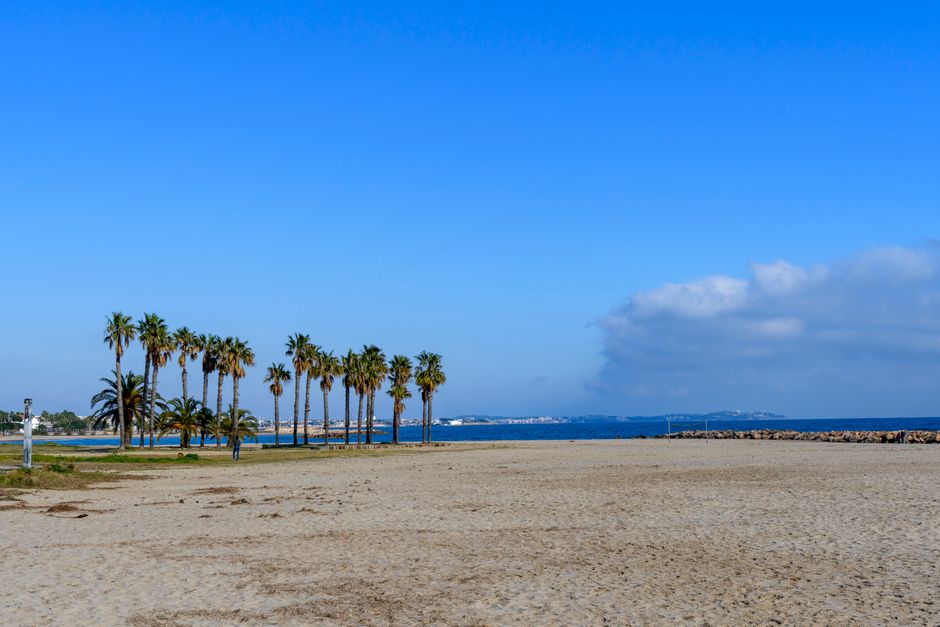
The Costa Daurada, the “golden coast”, is the long, sandy shore of southern Catalonia, running roughly from Cunit, south of Barcelona, past Tarragona to the Ebro Delta. Where the Costa Brava is rocky, this coast is gentle: wide beaches of fine golden sand, shallow water that suits small children, and a dry, sunny climate. It mixes very different trips in one place. Tarragona was the Roman capital of much of Spain, and its amphitheatre by the sea is a UNESCO World Heritage site. Salou and Cambrils are family beach resorts, with the PortAventura World theme parks between them. Reus is Gaudí’s birthplace, and inland lie the great Cistercian monastery of Poblet and the steep vineyards of the Priorat. The best months are June and September, and October is still lovely, with Halloween at PortAventura.
Right now in Costa Daurada (Salou)
- Wed 18–24°C 64–74°F 2 mm Light showers
- Thu 17–23°C 63–73°F Clear
- Fri 12–20°C 54–68°F Mostly clear
- Mon 12 Oct National Day of Spain (Fiesta Nacional de España)
Weather: MET Norway (CC BY 4.0) · Sea temperature: NOAA CoastWatch · Air quality: OpenAQ · Rates: ECB · Holidays: Nager.Date
Top tours in Costa Daurada
See all tours for Costa Daurada →
From local operators, with prices and reviews; you check availability and book on Viator, our partner. We may earn a commission at no extra cost to you. How we earn money
Costa Daurada at a glance
- Best for: family beach holidays, theme parks, Roman history, wine country and seafood.
- How long: 3–4 days for Tarragona, a beach and a day at PortAventura; a week to add Poblet, the Priorat and the Ebro Delta.
- Best time: June and September for the beach; spring and October for sightseeing and wine. July and August are hot and busy.
- Getting there: Reus airport, Barcelona airport (about 1 hour 15 by road), high-speed trains to Camp de Tarragona and regional trains along the coast.
- Getting around: trains and buses link Tarragona, Salou, Cambrils and PortAventura; a car is best for Poblet and the Priorat.
- Before you go: entry rules, money, trains and general safety are on our Spain travel guide.
Costa Daurada’s towns and who each one suits
The heart of the coast is the triangle of Tarragona, Reus and Salou–Cambrils, all within about 20 minutes of each other. North of Tarragona are quieter resorts such as Torredembarra and Calafell; south of Cambrils the coast becomes wilder towards L’Ametlla de Mar and the Ebro Delta.
Tarragona
A real city of about 140,000 people on a hill above the sea, with Roman monuments woven into its medieval old town, a cathedral at the top, the Rambla Nova for strolling and the fishermen’s quarter of El Serrallo for seafood. It has a city beach, El Miracle, below the amphitheatre, and better ones a short drive north. Best for history lovers, couples and anyone who wants city life with a beach nearby.
Salou and La Pineda
The coast’s biggest resort, with long sandy beaches, a seafront promenade with fountains, plenty of family hotels and apartments, and the PortAventura parks next door. Small rocky coves lie around the Cap de Salou headland. La Pineda, in Vila-seca, is a quieter beach strip nearby. Best for families and theme-park trips.
Cambrils
A working fishing port that grew into a resort without losing its character. The harbour is lined with some of the best seafood restaurants on the coast, and the beaches are long and calm. Calmer than Salou and good for couples, food lovers and families with small children.
Reus and the inland towns
Reus, 10 km inland, is a lively shopping town with fine Modernista mansions, the Gaudí Centre and the local tradition of vermouth. Further inland, Montblanc keeps its medieval walls, and the Priorat villages perch above their vineyards. Best for a short, cheaper city stay or a wine-country base.
Top things to see on the Costa Daurada
Prices and hours below were checked on the official sites in October 2026, unless we say otherwise; check again before you go. Tarragona’s Roman sites change to winter hours on 27 October.
Roman Tarragona (Tàrraco)
Tàrraco was one of the main cities of Roman Spain, and its remains became the UNESCO World Heritage site “Archaeological Ensemble of Tàrraco” in 2000. The amphitheatre, built in the 2nd century beside the beach, is the most photogenic; uphill, you can walk through the vaults of the circus, where chariot races were held, and climb the Praetorium tower for views over the city. The Archaeological Promenade follows the Roman and later walls around the old town, and the Colonial Forum preserves part of the lower city’s square. The city’s History Museum (MHT) runs these sites. As of October 2026 entry costs €5 per site or €15 for a combined ticket to five (the Archaeological Promenade, Circus and Praetorium, Colonial Forum, amphitheatre and Casa Canals); under-12s go free, and ages 12–17, students and retired people pay half. Until 26 October the sites open Tuesday to Saturday 9:00–20:45 and on Sundays and holidays 9:00–14:30; from 27 October they close earlier (around 18:30–20:00 on weekdays). They are closed on Mondays, entry is free on the last Tuesday of each month, and 10–11 October 2026 are open days for the European Heritage Days. Casa Castellarnau is closed for works.
Tarragona Cathedral and the Devil’s Bridge
The cathedral, begun in the 12th century at the top of the old town where the Roman temple once stood, mixes Romanesque and Gothic, with a beautiful cloister. About 4 km north of the centre, the Ferreres aqueduct, known as the Pont del Diable, is a two-tier Roman aqueduct in a pine wood that you can walk across; access is free.
PortAventura World
One of Europe’s biggest resorts of its kind, between Salou and Vila-seca, with three parks: PortAventura Park, with themed areas from the Mediterranean to China and roller coasters such as Shambhala and Dragon Khan; Ferrari Land, with Europe’s tallest vertical accelerator coaster, Red Force; and Caribe Aquatic Park, the water park, open in the warm months. As of October 2026 the park is in its Halloween season, which runs from 19 September to 15 November 2026, with themed shows, a parade and haunted “passages of terror” that cost extra (from €6.90 each, or bundles from €11.90). The official site lists one-day PortAventura Park tickets from €43 for adults aged 11–59 and from €39 for children aged 4–10 and over-60s, with online offers from €37; one day in PortAventura Park plus Ferrari Land from €63; and Ferrari Land alone from €21. Prices change by date, so buy online in advance for the best rate. After Halloween comes the Christmas season, and the parks close for part of the winter; check the official calendar for opening times on your date.
Poblet Monastery
About 45 minutes inland, the Royal Monastery of Santa Maria de Poblet is one of the largest Cistercian monasteries in Europe and a UNESCO World Heritage site, with a Romanesque-Gothic cloister, the royal tombs of the Crown of Aragon and a working community of monks. Visits are self-guided with the free official app (bring headphones). As of October 2026 tickets cost €10.50 (€7.50 reduced), and from 15 September to 14 June it opens Monday to Saturday 10:00–12:30 and 15:00–18:00, and on Sundays and holidays 10:30–12:30 and 15:00–18:00; tickets are sold until half an hour before closing. The Ruta del Cister ticket for €18 adds the monasteries of Santes Creus and Vallbona. Combine Poblet with the walled town of Montblanc nearby.
Reus and the Gaudí Centre
Antoni Gaudí was born in Reus in 1852, and 2026, the centenary of his death, is the city’s Gaudí Year, with exhibitions, talks and guided walks. The Gaudí Centre on the market square explains his ideas with models and interactive displays; check its own site for prices and hours, which we could not read. Reus also has a Modernisme route past dozens of mansions, the finest being the Casa Navàs by Lluís Domènech i Montaner.
More to see
- Cap de Salou: a pine-covered headland with small coves and a coastal path between Salou and La Pineda.
- Montblanc: a medieval town with almost complete walls, linked to the legend of Saint George and the dragon.
- Siurana: a dramatic cliff-top village above a reservoir, famous for rock climbing.
- Altafulla: a pretty village with a castle and a fishermen’s quarter by the beach, north of Tarragona, near the Roman villa of Els Munts.
- Ebro Delta: a natural park of rice fields, lagoons, sand spits and flamingos, about an hour south.
Other things to do on the Costa Daurada
Beaches
The beaches are long, sandy and shelving gently, ideal for families: Llevant and Ponent in Salou, La Pineda, the beaches of Cambrils, and Platja Llarga and La Mora just north of Tarragona, backed by pine woods. For something wilder, head south to the coves of L’Ametlla de Mar or the empty sands of the Ebro Delta. See our beaches guide.
Wine tasting in the Priorat and Montsant
An hour inland, the Priorat is one of only two Spanish wine regions with the top DOQ/DOCa status, alongside Rioja, famous for powerful reds from old vines on steep slate terraces called llicorella. Visit the ruined charterhouse of Scala Dei, where monks first planted the vineyards, and book tastings at wineries in Gratallops, Porrera or Poboleda. The surrounding Montsant region makes excellent, better-value wines. Do not drink and drive on the winding roads: book a tour or share the driving. See our wine tasting guide.
Cycling, walking and boat trips
The flat Ebro Delta is perfect by bike, and the Prades and Montsant mountains inland have good walking. Along the coast, boats from Salou and Cambrils run in season to the coves of Cap de Salou and, in summer, to L’Ametlla de Mar. See our cycling, hiking and boat trips guides.
Food and castells
Try romesco, the local sauce of peppers and nuts, with grilled fish or the spring onions called calçots (winter and early spring); arròs negre and seafood in Cambrils and El Serrallo; and Reus vermouth before lunch. This is also the heartland of castells, the human towers on UNESCO’s intangible heritage list: see them at Tarragona’s Santa Tecla festival in September and at other town fiestas.
Day trips and onward travel
Barcelona
Regional trains from Tarragona reach Barcelona in about an hour to an hour and a half, and high-speed trains from Camp de Tarragona are faster. It makes an easy day trip, or combine a few nights in each. See our Barcelona guide.
The Ebro Delta and Valencia
The Ebro Delta natural park, around Deltebre and Amposta, is a full day by car. Further south, trains continue down the coast to Valencia in about 2–3 hours.
Nearby destinations
- Sitges77 km
- Peñíscola85 km
- Barcelona112 km
- Zaragoza167 km
- Andorra la Vella173 km
- Girona191 km
- Valencia204 km
- Costa Brava221 km
Getting there and getting around
By air
Reus airport (REU), run by Aena, is just east of Reus and has mainly seasonal and low-cost flights. Aena lists Reus Transport line 50 to Reus centre via the train and bus stations; BusPlana coaches to PortAventura, Salou and Cambrils, timed with flights; and Hispano Igualadina coaches to Tarragona and Barcelona. There is no direct bus to Camp de Tarragona high-speed station: take line 50 to Reus bus station and change. Barcelona airport, with far more flights, is about 1 hour 15 by road.
By train
High-speed AVE and Avlo trains on the Madrid–Barcelona line stop at Camp de Tarragona, about 10 km inland, with buses to Tarragona, Salou and Reus. Regional Rodalies trains on lines R14, R15 and R16 run from Barcelona to Tarragona, and the R16 continues to Salou-PortAventura and Cambrils on the newer inland track, according to secondary sources. Rodalies had serious disruption in 2026, so check Renfe and Rodalies de Catalunya before you travel. PortAventura also sells ticket-and-train packages from AVE and long-distance stations.
Buses and driving
Local and regional buses link Tarragona, Reus, Salou, Cambrils and PortAventura frequently. A car is the easy way to reach Poblet, Montblanc, the Priorat and the Ebro Delta; the AP-7 and A-7 run along the coast. Tarragona has a low-emission zone (ZBE); check the city’s rules if you drive into the centre, or use the car parks at its edge.
When to go and how long to stay
The Costa Daurada is one of the driest and sunniest parts of Catalonia, with hot summers and mild winters. The table uses AEMET’s 1991–2020 climate normals for the Reus airport weather station, a few kilometres inland at 71 m: average daily highs and lows, and days with at least 1 mm of rain. Nights by the sea are a little milder than the lows shown.
| Season | Average high / low | Rainy days per month | What it’s like | Good for |
|---|---|---|---|---|
| Winter (Dec–Feb) | 15–16 °C / 4–5 °C | 3–4 | Mild, clear days, cold nights; resorts quiet and many hotels closed | Tarragona, Poblet, calçots season |
| Spring (Mar–May) | 18–24 °C / 7–13 °C | 4–5 | Sunny and fresh; the beach season starts at Easter | Sightseeing, walking, wine, Tarraco Viva |
| Summer (Jun–Aug) | 28–31 °C / 17–21 °C | 2–3 | Hot, sunny and humid by the sea; busiest in August | Beaches, theme parks, evenings out |
| Autumn (Sep–Nov) | 27 °C falling to 19 °C / 17 °C falling to 8 °C | 5–6 | Warm sea in September; the year’s heaviest rain in September and October, often in short storms | Beaches in September, Halloween, wine harvest |
The sea is warmest from July to September. Autumn storms can be intense: follow Civil Protection alerts if heavy rain is forecast. These are long-term averages; recent summers have often been hotter.
Events worth planning around
- May: Tarraco Viva, Tarragona’s Roman history festival, with re-enactments at the monuments.
- Around 23 September: Santa Tecla, Tarragona’s main festival, with human towers, giants and fire runs.
- 19 September–15 November 2026: Halloween at PortAventura World, then the Christmas season.
- 2026: Gaudí Year in Reus, with events all year.
How long to stay: 3, 5 and 7 days
3 days: Day 1, Roman Tarragona: the amphitheatre, circus, Praetorium and walls, then dinner in El Serrallo. Day 2, PortAventura World. Day 3, a beach morning in Salou or Cambrils and a seafood lunch by Cambrils harbour.
5 days: add Reus and the Gaudí Centre, and a day inland to Poblet and Montblanc. 7 days: add a wine day in the Priorat with Scala Dei and Siurana, and a day cycling in the Ebro Delta.
Where to stay on the Costa Daurada and the tourist tax
- Tarragona: for history, restaurants and train links; city hotels open all year.
- Salou or La Pineda: for families and PortAventura, with the most beach hotels and apartments.
- PortAventura World hotels: themed hotels inside the resort, with park access included in some packages.
- Cambrils: calmer, with the best seafood.
- Priorat: small wine hotels and rural houses, for a car-based stay.
Catalonia charges a tourist tax on every night in tourist accommodation, collected by the hotel or rental. Since 1 April 2026, outside Barcelona city, the Agència Tributària de Catalunya lists these rates per person per night: €4.50 in 5-star hotels and luxury campsites, €1.80 in 4-star hotels, €1.75 in tourist flats, €0.90 in other hotels and campsites, and €0.80 in youth hostels. A higher special rate of €5–10 applies only to establishments in the areas of a tourist recreation centre where gambling is permitted. The tax applies from age 17, for up to 7 nights in the same place, and rises on 1 April 2027. Towns may add a local surcharge of up to €4 from 1 October 2026, but as of October 2026 none of the Costa Daurada towns, including Tarragona, Salou and Cambrils, appears on the agency’s list of towns that have approved one; check with your accommodation.
Practical tips for the Costa Daurada
- Buy park tickets online: PortAventura prices vary by date and are lower in advance.
- Mind Mondays: Tarragona’s Roman sites close on Mondays; go on the last Tuesday of the month for free entry.
- Check the trains: Rodalies had serious disruption in 2026.
- Watch the weather in autumn: heavy-rain alerts can close monuments and roads for a day.
- Language: Catalan is spoken alongside Spanish.
- Emergencies: call 112.
What to pack for the Costa Daurada
For the beach, pack swimwear, a quick-dry towel, a sun hat, sunglasses and high-factor sunscreen; the sand is soft, so sandals are enough. For PortAventura, bring comfortable trainers, a small bag (large bags go in lockers), a refillable bottle and a light waterproof for the water rides. For Tarragona’s ruins and the walled towns, comfortable walking shoes with grip. In autumn and spring add a warm layer for evenings and a compact umbrella, as storms can be sudden. If you are planning wine tastings, a cool bag keeps bottles safe in a hot car.
Costa Daurada travel FAQ
Where is the Costa Daurada?
On the coast of southern Catalonia, mainly in the province of Tarragona, from south of Barcelona to around the Ebro Delta. Its main towns are Tarragona, Salou and Cambrils.
Is the Costa Daurada good for families?
Very. The beaches are wide and shallow, the resorts are geared to families, and PortAventura World is next to Salou.
How much are PortAventura tickets?
As of October 2026 the official site lists one day in PortAventura Park from €43 for adults and €39 for children aged 4–10 and over-60s, with online offers from €37, and one day in PortAventura Park plus Ferrari Land from €63. Prices vary by date.
When is Halloween at PortAventura?
From 19 September to 15 November 2026. The haunted passages are paid extras, from €6.90 each.
How much does it cost to see Roman Tarragona?
As of October 2026, €5 per site or €15 for a combined ticket to five sites, half price for ages 12–17 and students, and free for under-12s. Entry is free on the last Tuesday of each month; the sites close on Mondays.
How do I get from Barcelona to the Costa Daurada?
By regional train to Tarragona, Salou or Cambrils, by high-speed train to Camp de Tarragona and then a bus, or by car on the AP-7 in about an hour. Check for rail disruption before you go.
Is there a tourist tax on the Costa Daurada?
Yes, the Catalan tax: as of October 2026, from €0.80 in youth hostels to €4.50 in 5-star hotels per person per night, from age 17 and for up to 7 nights. No Costa Daurada town had added a local surcharge as of October 2026.
Salou or Cambrils: which is better?
Salou for theme parks, nightlife and the biggest choice of hotels; Cambrils for a calmer stay, a real fishing port and the best seafood. They are 15 minutes apart.
What is the best time to visit the Costa Daurada?
June and September for the beach; spring and October for sightseeing, wine and theme parks without the heat.
Sources and last review
Researched and last reviewed on 4 October 2026. Roman Tarragona prices and hours: Tarragona’s History Museum (Ajuntament de Tarragona); PortAventura World tickets and season dates: the resort’s official site; Poblet: the monastery’s official site; Gaudí Year: the Ajuntament de Reus; tourist tax and local surcharges: the Agència Tributària de Catalunya; airport buses: Aena; climate: AEMET 1991–2020 normals for Reus airport, as published by the WMO. Rodalies line details, the Gaudí Centre’s prices and hours and the PortAventura winter closure could not be read on an official page and are flagged for checking. Prices, hours and timetables change, so check the official sites before you go. For entry rules, money and general safety, see our Spain travel guide.
Plan your trip
Partner links: TravelerCenter may earn a commission if you book, at no extra cost to you.
🇪🇸 Useful Spanish phrases for Costa Daurada
All 38 Spanish phrases: restaurant, hotel, emergencies, romance (printable) →