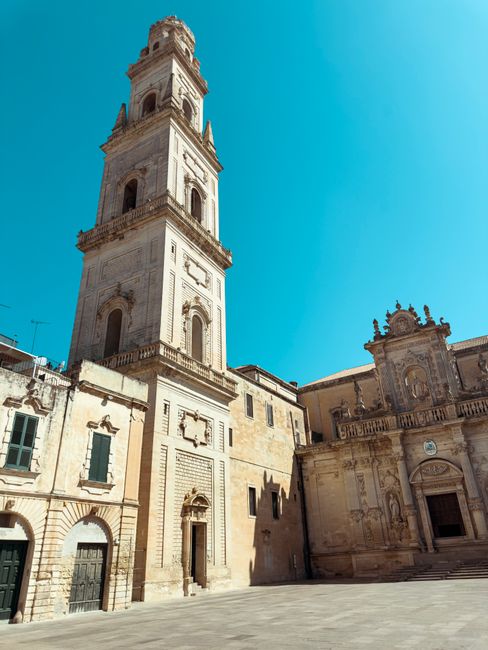
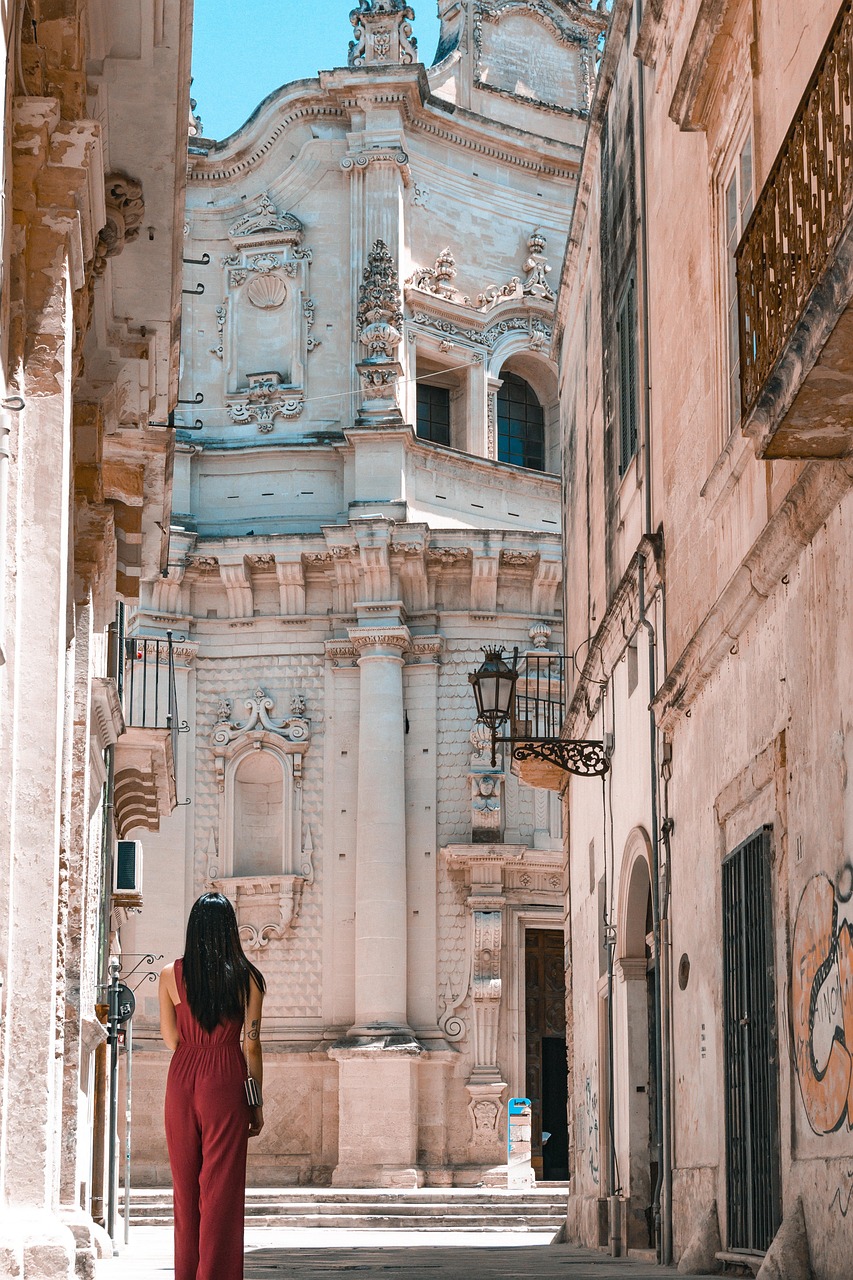
Lecce is the baroque jewel of southern Apulia, a honey-coloured city near the tip of Italy’s heel that is often called the “Florence of the South”. Its secret is the local limestone, pietra leccese, soft enough to carve like wood when freshly quarried, which 17th-century architects and stonemasons turned into façades crowded with cherubs, dragons, flowers and saints. The old town is compact, mostly car-free and made for slow walks: a Roman amphitheatre sunk into the main square, the theatrical Piazza del Duomo, the exuberant Basilica of Santa Croce, and lanes full of papier-mâché workshops, cafés and wine bars. Lecce is also the natural base for the Salento, with Adriatic and Ionian beaches each half an hour away. The best months are May, June, September and October.
Right now in Lecce
- Wed15–26°C60–79°F2 mm rain
- Thu19–27°C66–80°F2 mm rain
- Fri22–25°C71–77°F3 mm rain
Top tours in Lecce
See all tours for Lecce →
From local operators, with prices and reviews; you check availability and book on Viator, our partner. We may earn a commission at no extra cost to you. How we earn money
Lecce at a glance
- Best for: baroque architecture, evening strolls and food, crafts, and a city base for the Salento beaches.
- How long: 1–2 days for the city; 4–5 days with beach days and trips to Otranto and Gallipoli.
- Best time: May–June and September–October. July and August are hot and the coast is crowded; winter is mild and quiet.
- Book ahead: hotels for late August (the feast of Sant’Oronzo and the Salento festivals) and summer weekends.
- Getting in: Brindisi airport is about 40 minutes away by road; trains run from Bari in about 1½ hours and directly from Rome, Bologna and Milan.
- Before you go: entry rules, money, trains and general safety are on our Italy travel guide.
Lecce’s neighbourhoods and who each one suits
The historic centre sits inside the line of the old walls, with three surviving gates, Porta Napoli, Porta Rudiae and Porta San Biagio. You can cross it on foot in 15 minutes; the station is a 10–15-minute walk to the south-west.
Piazza Sant’Oronzo and the centre
The main square, with the half-excavated Roman amphitheatre, the column of the city’s patron saint Oronzo and the old Sedile, is the meeting point for the evening passeggiata. Shopping streets lead off it towards Santa Croce and the Castello di Carlo V. Best for: first-timers who want to walk everywhere.
Piazza del Duomo and the western lanes
West of Via Vittorio Emanuele, the closed square of the cathedral opens through a single gateway like a stage set. Around it and towards Porta Rudiae, quieter lanes hold palazzi turned into boutique B&Bs, churches such as San Matteo and Santa Chiara, and small restaurants. Best for: couples and a romantic, atmospheric stay.
Outside the walls
Just outside the old town, the 19th- and 20th-century streets around the public gardens and Viale Lo Re have larger hotels, easier parking and better access for drivers, five to ten minutes’ walk from the centre. Best for: road trippers and families with a car.
Top things to see in Lecce
Prices and hours below were checked on the official sites in October 2026, unless we say otherwise; check again before you go. Churches ask for covered shoulders and knees and may close to visitors during services.
The Basilica of Santa Croce
The symbol of Lecce baroque: a façade on which generations of craftsmen, finished by Giuseppe Zimbalo in the 17th century, carved a riot of figures, from caryatids and griffins to a great rose window framed by fruit and flowers. Look closely at the balcony supports: they include Turks and mythical beasts. The interior is bright and calm by comparison. Santa Croce is one of the five sites on the LeccEcclesiae ticket (see below), and it has its own ticket desk.
Piazza del Duomo and the LeccEcclesiae ticket
The cathedral square is enclosed on three sides by the Duomo with its 70-metre bell tower, the bishop’s palace and the old seminary, which houses a museum of sacred art. The LeccEcclesiae circuit, run by ArtWork with the Archdiocese of Lecce, covers the Duomo, Santa Croce, San Matteo, Santa Chiara and the Antico Seminario with its museum. As of October 2026 the ticket costs €11 (€5 for ages 12–17, €24 for a family), or €21 (€13 reduced) including the climb up the bell tower. Tickets are valid for 15 days and are sold online at chieselecce.it, at the central ticket office in the Antico Seminario at Piazza del Duomo 5 and at Santa Croce. The sites open daily 9:00–21:00 in summer and 9:00–18:00 in winter, with last entry 15 minutes before closing.
The Roman amphitheatre and theatre
Rediscovered in the early 20th century, the 2nd-century amphitheatre once held around 20,000 spectators; only part of it has been dug out, and you see it from the railings around Piazza Sant’Oronzo for free. A short walk away, a small Roman theatre and its museum survive behind a palazzo near the church of Santa Chiara.
San Matteo, Santa Chiara and the smaller churches
Two more churches on the LeccEcclesiae ticket are worth the detour. San Matteo has an unusual façade that curves outwards below and inwards above, like a wave in stone. Santa Chiara, near the Roman theatre, hides a ceiling of painted papier-mâché that looks like carved wood. Walking between them you pass dozens of other churches and palazzi; look up at the carved balconies, which are some of the finest details in the city.
Museo Faggiano and underground Lecce
When a family began fixing a sewer pipe in their house in 2001, they uncovered layer after layer of history: Messapian tombs, Roman granaries, a medieval Knights Templar room and a convent. The private Museo Faggiano now lets you climb down through them. It is a small, family-run museum; check opening hours and prices on its own site before you go.
More to see
- Castello di Carlo V: the 16th-century castle of the emperor Charles V, now used for exhibitions and a papier-mâché museum.
- Museo Castromediano: the provincial archaeological museum, with Messapian and Greek finds, just outside the walls.
- Porta Napoli: the triumphal arch built in honour of Charles V, the grandest of the city gates.
- Chiesa dei Santi Niccolò e Cataldo: a Norman church with a baroque façade in the monumental cemetery.
Other things to do in Lecce
Papier-mâché and crafts
Lecce has a long tradition of cartapesta, papier-mâché statues of saints and nativity figures, born to decorate churches cheaply. Workshops in the old town still make them, and you can watch artisans at work and buy small pieces. Look also for local ceramics and the stone carvings made from pietra leccese.
Food and wine
Start the day like the Leccesi with a pasticciotto, a warm shortcrust tart filled with custard, and an iced almond-milk coffee, caffè leccese, in summer. At lunch, try a rustico, puff pastry with mozzarella and béchamel, then ciceri e tria, pasta with chickpeas and crispy fried pasta, or orecchiette. The Salento makes robust red wines from Negroamaro and Primitivo, and rosés; wine bars in the old town pour them by the glass, and several estates nearby offer tastings. See our wine tasting guide.
Walking and cycling
The best way to see the city is a slow evening walk from Porta Napoli through Piazza Sant’Oronzo to Santa Croce and the Duomo, when the stone glows golden; see our city sightseeing guide. The flat countryside of olive groves and dry-stone walls around Lecce is good for gentle bike rides; see our cycling guide.
Day trips from Lecce: the Salento
Beaches
The nearest sea is San Cataldo, about 15 minutes away on the Adriatic. Further south along that coast, Torre dell’Orso and the sea stacks of Sant’Andrea have white sand and clear water, about 40 minutes by car. On the Ionian side, Porto Cesareo and Punta Prosciutto have shallow, Caribbean-coloured water about 30–45 minutes away. Rocky coves near Otranto and Castro are good for snorkeling. See our beaches guide.
Otranto, Gallipoli and Santa Maria di Leuca
Otranto, on the Adriatic, is a walled town with a cathedral whose 12th-century floor mosaic shows a vast Tree of Life. Gallipoli, on the Ionian, is an old town on an island joined by a bridge, with sunset bars on the walls. Santa Maria di Leuca, with its lighthouse, marks the tip of the heel; boat trips explore the sea caves along the coast. Each is about 45 minutes to an hour by car; local trains also run from Lecce to Otranto and Gallipoli. See our boat trips guide.
The Valle d’Itria and Matera
Ostuni, the white town, is about an hour north by train or car, and the trulli of the Valle d’Itria about an hour and a half by car; both are better as part of a route through Apulia. Matera, with its cave dwellings, is about two and a half hours away and deserves at least a night.
Nearby destinations
- Alberobello92 km
- Matera137 km
- Albanian Riviera139 km
- Durrës152 km
- Berat156 km
- Apulia158 km
- Corfu167 km
- Tirana176 km
Getting there and getting around
By plane
Brindisi airport (BDS) is the closest, about 40 minutes away by road, with buses to Lecce and to Brindisi station. Bari airport (BRI) has more flights but is about two hours away; take the train from Bari Centrale.
By train
Lecce is the end of Trenitalia’s Adriatic main line. Frecciarossa, Frecciargento and Intercity trains run direct from Rome, Bologna and Milan, and regional trains link Lecce with Brindisi, Ostuni and Bari, about 1½ hours away. The Ferrovie del Sud Est (FSE) runs local trains into the Salento, to Otranto, Gallipoli and smaller towns, with buses replacing trains on some routes; check its timetables. The station is a 10–15-minute walk from the old town.
Walking
Inside the walls, everything is within walking distance on flat stone paving. Local buses link the station, the centre and San Cataldo beach.
Driving, the ZTL and parking
The historic centre is a limited-traffic zone (ZTL) watched by cameras. The City of Lecce opens the gates to general traffic only in set time windows on weekdays and keeps them closed on Sundays and holidays, and some streets, such as those around Porta Napoli, are closed around the clock; the rules were tightened again in 2026. Do not drive in unless your hotel inside the walls has registered your number plate. Park in the car parks and paid street spaces just outside the walls and walk in. A car is very useful for the beaches and villages of the Salento.
When to go and how long to stay
Lecce has a hot, dry Mediterranean climate with long summers and mild winters. The table uses the WMO 1991–2020 climate normals of the Italian Air Force station for Lecce, at the Galatina air base about 15 km south of the city, the same station quoted on our Apulia guide: average daily highs and lows, and days with at least 1 mm of rain. October and November are the wettest months. Recent summers have often been hotter than the averages.
| Season | Average high / low | Rainy days per month | What it’s like | Good for |
|---|---|---|---|---|
| Winter (Dec–Feb) | 13–14 °C / 4–5 °C | 7–8 | Mild days, chilly nights; quiet, with Christmas markets | Sightseeing, low prices, the December crafts fair |
| Spring (Mar–May) | 16–25 °C / 6–12 °C | 4–7 | Warm and green, wildflowers in the countryside | Walking, cycling, day trips |
| Summer (Jun–Aug) | 30–33 °C / 17–20 °C | 2–3 | Hot and dry; the coast is busy, evenings are lively | Beaches, festivals, late dinners |
| Autumn (Sep–Nov) | 28 °C falling to 18 °C / 16 °C falling to 9 °C | 5–8 | Warm sea in September, more rain from October | Swimming, wine harvest, city breaks |
The sea is warm enough for most people from June to early October. In July and August, sightsee early and late and spend the hot middle of the day at the beach.
Events worth planning around
- 24–26 August: the feast of Sant’Oronzo, the city’s patron, with processions, illuminations, a fair and fireworks.
- Summer: the Notte della Taranta festival of pizzica folk music tours the Salento and ends with a huge concert at Melpignano in late August.
- December: the Fiera di Santa Lucia, a fair of papier-mâché and nativity figures around Christmas.
How long to stay: 1-, 2- and 4-day plans
1 day: a pasticciotto breakfast, Piazza Sant’Oronzo and the amphitheatre, Santa Croce, then the Duomo, the seminary museum and the bell tower; in the afternoon the Museo Faggiano and Porta Rudiae, and an evening stroll and dinner in the old town.
2 days: add San Matteo and Santa Chiara, the Castello di Carlo V, a papier-mâché workshop and a wine bar. 4 days: add a beach day at Torre dell’Orso or Porto Cesareo, and a day for Otranto, or Gallipoli at sunset.
Where to stay in Lecce and the tourist tax
- Inside the walls: boutique hotels and B&Bs in restored palazzi, often with roof terraces; the most atmospheric choice.
- Just outside the walls: larger hotels with parking, a few minutes’ walk from the sights.
- A masseria nearby: a fortified farmhouse hotel in the countryside, with a pool; you need a car.
- On the coast: Otranto or a Salento beach town if the sea comes first.
The City of Lecce charges a tourist tax (imposta di soggiorno) per person per night, for up to 5 consecutive nights (7 for short-term rentals); under-12s are exempt. The rates in force from 1 April 2026 are, from April to October, €4 in 1- to 3-star hotels, €4.50 in 4-star hotels and historic residences, €5 in 5-star hotels, €3 in B&Bs and guesthouses and €2.50 in short-term rentals, with lower rates from November to March. It is paid at your accommodation.
Practical tips for Lecce
- Siesta hours: many shops and some churches close from about 13:00 to 16:30; plan museums and lunch for the middle of the day.
- Buy one church ticket: the LeccEcclesiae pass covers the five main churches and museum for 15 days.
- Respect the ZTL: cameras fine automatically; ask your hotel about access before you arrive.
- Plan beach days by wind: if the north wind blows, head to the Ionian coast; if it comes from the south, the Adriatic is calmer.
- Emergencies: call 112.
What to pack for Lecce
Bring comfortable, flat shoes: the polished limestone paving is slippery when wet. In summer pack light, breathable clothes, a sun hat, sunglasses, high-factor sunscreen and a refillable bottle, plus a swimsuit, a quick-dry towel and water shoes for the rocky coves. A scarf or light shirt covers shoulders in churches. From October to April add a light jacket and an umbrella for showers, and a warmer layer for evenings.
Lecce travel FAQ
Is Lecce worth visiting?
Yes. It is one of Italy’s most beautiful baroque cities, relaxed, walkable and full of good food, and the best base for the beaches and towns of the Salento.
How many days do you need in Lecce?
One full day covers the main sights; two let you enjoy the city slowly. Stay four or five days to add beaches, Otranto and Gallipoli.
How much is the LeccEcclesiae ticket?
€11 (€5 for ages 12–17) for the Duomo, Santa Croce, San Matteo, Santa Chiara and the Antico Seminario museum, or €21 with the bell tower climb, as of October 2026. It is valid for 15 days.
What are the opening hours of Lecce’s churches?
The LeccEcclesiae sites open every day, 9:00–21:00 in summer and 9:00–18:00 in winter, with last entry 15 minutes before closing. Visits pause during services.
How do I get to Lecce?
Fly into Brindisi, about 40 minutes away, or Bari, then take the train. Direct trains also run from Rome, Bologna and Milan, and from Bari in about 1½ hours.
Can I drive into Lecce’s old town?
Not without permission. The historic centre is a camera-controlled ZTL; only vehicles registered by residents or hotels inside the walls may enter in set windows. Park outside the walls.
How much is the tourist tax in Lecce?
From April to October 2026, €4 a night in 1- to 3-star hotels, €4.50 in 4-star, €5 in 5-star and €3 in B&Bs, for up to 5 nights; under-12s are exempt.
Which beaches are closest to Lecce?
San Cataldo, about 15 minutes away, is the nearest; Torre dell’Orso on the Adriatic and Porto Cesareo on the Ionian are among the most beautiful, each within about 45 minutes by car.
Do I need a car in Lecce?
Not for the city, which is best on foot. For the Salento beaches, masserie and villages, a car makes life much easier, although local trains reach Otranto and Gallipoli.
What food is Lecce famous for?
The pasticciotto custard tart, the rustico pastry, ciceri e tria, orecchiette, iced caffè leccese with almond milk, and Negroamaro and Primitivo wines.
Is Lecce or Bari a better base for Apulia?
Bari is better for the north and centre, the Valle d’Itria and Matera; Lecce is better for the Salento’s beaches and towns. On a week-long trip many people stay a few nights in each.
Plan your trip
Partner links: TravelerCenter may earn a commission if you book, at no extra cost to you.
🇮🇹 Useful Italian phrases for Lecce
All 38 Italian phrases: restaurant, hotel, emergencies, romance (printable) →
Sources · last reviewed 4 October 2026
Researched and last reviewed on 4 October 2026. LeccEcclesiae prices, hours and validity: chieselecce.it, the official site of the church circuit; tourist tax: the City of Lecce’s published rates from 1 April 2026; ZTL: the City of Lecce’s notices; climate: WMO 1991–2020 normals of the Italian Air Force station for Lecce. The Museo Faggiano and other museum hours, airport buses and train times are general information flagged for checking, as on our Apulia guide. Prices, hours and timetables change, so check the official sites before you go. For entry rules, money and general safety, see our Italy travel guide.
Data: Weather: MET Norway (CC BY 4.0) · Sea temperature: NOAA CoastWatch · Rates: ECB · Costs: World Bank ICP and price levels · Wikidata (CC0)