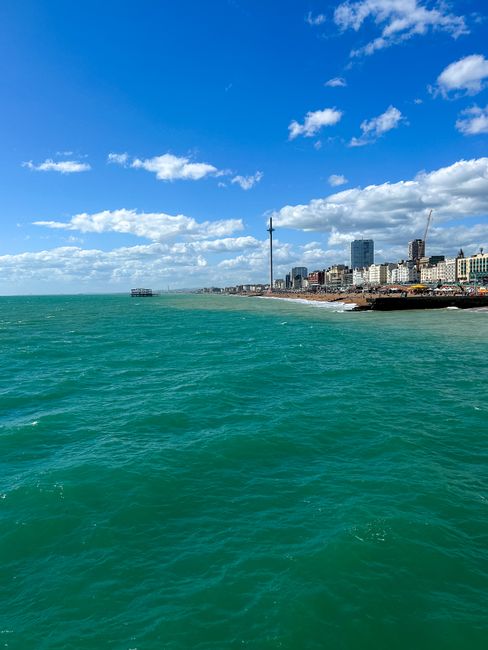
Brighton is England’s most cheerful seaside city: a long pebble beach, a Victorian pier full of rides and arcades, an Indian-style palace built for a pleasure-loving king, and a tangle of lanes packed with independent shops, cafés and bars. You come to walk the seafront from the Palace Pier to Hove, explore the Royal Pavilion, browse the Lanes and North Laine, rise 138 metres above the coast on the i360, eat fish and chips on the beach and walk on the white cliffs and green hills of the South Downs. It is about an hour from London by train, so it works as a day trip, but Brighton’s relaxed, creative, famously open-minded spirit is best enjoyed over a night or two. Give it one day for the classic sights, or three to add the Downs, the Seven Sisters cliffs and the towns along the coast.
Right now in Brighton
- Wed12–16°C53–61°F12 mm rain
- Thu9–15°C49–58°FClear
- Fri13–18°C55–64°F13 mm rain
Top tours in Brighton
See all tours for Brighton →
From local operators, with prices and reviews; you check availability and book on Viator, our partner. We may earn a commission at no extra cost to you. How we earn money
Brighton at a glance
- Best for: seaside fun, the Royal Pavilion, independent shopping, food and nightlife, LGBTQ+ travellers, festivals, coastal and downland walks, and easy weekend breaks from London.
- How long: 1 day for the Pavilion, the pier and the Lanes; 2–3 days to add Hove, the i360, the South Downs and the Seven Sisters.
- Best time: May to September for beach days and festivals; early August for Pride; spring and autumn for quieter streets and lower hotel prices.
- Getting in: trains from London Victoria and London Bridge take about an hour, and Gatwick Airport is on the same line; Brighton station is a 15-minute walk downhill to the sea.
- Getting around: on foot along the seafront and through the lanes, and by Brighton & Hove buses for Hove, Kemptown and the Downs. As of October 2026, an adult ticket to the Royal Pavilion cost £21.50.
- Before you go: entry rules, money and general safety are in our United Kingdom travel guide.
Brighton, area by area
Brighton and its neighbour Hove form one city, Brighton & Hove, stretched along about 13 km of coast between the sea and the rolling South Downs. The station sits on the hill at the top of town; from there, Queen’s Road runs straight down to the clock tower and the sea, with North Laine on your left and the Lanes and the Royal Pavilion a few minutes further on. Almost everything a visitor needs is within a 20-minute walk.
The Lanes
The oldest part of Brighton, once the fishing village of Brighthelmstone, is a maze of narrow alleys, or “twittens”, between North Street and the seafront. They are lined with jewellers, antique dealers, boutiques, pubs and restaurants, opening into small squares where you can sit outside. Best for: browsing, rings and vintage jewellery, and dinner in a hidden courtyard.
North Laine
Between the station and the Royal Pavilion, North Laine is a grid of colourful streets, including Kensington Gardens, Gardner Street, Sydney Street and Bond Street, with more than 300 independent shops, record stores, vintage clothes, street art, vegan cafés and pubs. It is busiest and most fun on Saturdays, when Gardner Street closes to traffic. Best for: vintage shopping, coffee and people-watching.
The seafront and the piers
The promenade runs the length of the city, with the Palace Pier in the middle, the i360 tower and the skeleton of the West Pier to the west, and the arches beneath the road filled with bars, galleries, fishing huts and shops. In summer, the beach between the piers is the heart of the city. Best for: first visits, sea views and seaside fun.
Kemptown
East of the Palace Pier, Kemptown has grand Regency squares and crescents near the sea and, along St James’s Street, the city’s main LGBTQ+ village with bars, cafés and small shops. Further east are Volk’s Electric Railway, the Undercliff Walk and Brighton Marina. Best for: nightlife, good-value guesthouses and walks along the cliffs.
Hove
West of the i360, Hove is calmer and more residential, with wide lawns and the colourful beach huts along its promenade, the cream terraces of Brunswick Town and Adelaide Crescent, and good restaurants on Church Road and in Western Road. Best for: families, quieter stays and seaside walks and cycle rides.
Top things to see in Brighton
Prices and hours below were checked on the official sites in October 2026. They change, so check before you go.
The Royal Pavilion
Brighton’s most extraordinary building is a seaside pleasure palace created for the Prince Regent, later King George IV, and transformed by the architect John Nash from 1815 into its present form, with onion domes and minarets outside inspired by Indian architecture and lavish Chinese-style interiors. Highlights are the Banqueting Room with its huge dragon chandelier, the Music Room and the Great Kitchen. During the First World War it served as a hospital for wounded Indian soldiers, a story told inside. Around it, the Royal Pavilion Garden has been restored to its Regency planting and is free to walk through.
Tickets. As of October 2026, an adult ticket costs £21.50 and a child (5–18) £13, with 5% off when you book online; families with at least one adult and two children get one child ticket free. Standard tickets are valid for a year, so you can return free. From October to March the palace opens daily 10:00–17:15 (last admission 16:30), and from April to September 9:30–17:45 (last admission 17:00). It closes on 25 and 26 December and 1 January, and from 14:30 on 24 December. An official guided tour runs every Saturday at 14:00, and an audio guide costs £4. If you arrive by train, keep your rail ticket: the National Rail 2for1 offer admits two people for one ticket.
Brighton Palace Pier
Opened in 1899, the Palace Pier stretches more than 500 metres out to sea with its funfair rides at the end, arcades, a helter skelter, doughnut and candy-floss kiosks, a bar and the Palm Court restaurant. It is the classic Brighton photo, especially at dusk when the lights come on. As of October 2026 the pier charges a £1 admission fee per person from March to October at peak times (free for under-2s and anyone with a rides wristband); outside those times entry is free. An unlimited-rides wristband for anyone over 1.2 metres costs £30 on the day or from £24 online, and £24 or from £19.20 online for children under 1.2 metres. Hours change daily and with the weather: in October 2026, for example, it opened 12:00–17:30 on weekdays and until 20:00–21:00 at weekends. Some rides close in strong winds.
Brighton i360 and the West Pier
The Brighton i360 is a slim tower on the seafront with a glass viewing pod that glides slowly up to 138 metres, giving views along the coast to the Seven Sisters and the Isle of Wight on clear days and inland over the South Downs. Each flight lasts about 25 minutes, with a bar on board. As of October 2026 it is open and run by the Nightcap group. Hours vary by season, roughly 11:00 to 18:00 or 18:30 in October, shorter in winter; it is closed on some Mondays and Tuesdays in November, on 25 December and for its annual maintenance break from 4 to 28 January 2027. The venue is card-only, family tickets start from £25, and the “360 Extreme” lets the brave walk on top of the pod. Check today’s hours and prices on the official site, and arrive 20 minutes before your slot. Next to it stand the rusting iron remains of the West Pier of 1866, closed in 1975 and wrecked by storms and fire in 2003, now one of the most photographed ruins in England.
The Lanes and North Laine
Brighton’s two shopping quarters are attractions in themselves and free to explore. Start in the Lanes for jewellery shops and old pubs, cross North Street into North Laine for vintage clothes, records and street art, and stop for coffee or brunch wherever you like. Look out for the city’s murals, including the work of local street artists on the side streets around Trafalgar Street. See our city sightseeing guide.
Brighton Museum and Art Gallery
In the Royal Pavilion Garden, the city museum has fine collections of 20th-century design and decorative art, fashion, world art and the story of Brighton. As of October 2026 it opens Tuesday to Sunday 10:00–17:00 (closed on Mondays except bank holidays), and an adult ticket costs £10.50 and a child £5; like the Pavilion’s, standard tickets give free return visits for a year. The same trust runs the quirky Booth Museum of Natural History, Preston Manor and the Hove Museum of Creativity.
Volk’s Electric Railway
Opened by the engineer Magnus Volk in 1883, this little seafront railway is the oldest operating electric railway in the world. It runs about 2 km along the beach from near the Palace Pier towards Black Rock and the Marina, a short, fun ride for children. It is seasonal, running roughly from spring to early autumn and closed in winter, so check the operating days before you go.
Brighton beach: pebbles, swimming and safety
Brighton’s beach is pebbles, not sand, so bring something to sit on and shoes you can wear into the water; the shingle shelves quite steeply, and at low tide strips of sand appear in places. The sea is coolest in spring and warmest in August and September. Swim between the piers or near the lifeguard posts in the summer season, never off the end of the groynes, and stay away from the pier structures. If you get into trouble in the water, float on your back and call for help; on land, call 999 and ask for the Coastguard. Barbecues, glass and some activities have rules on the beach, so look for the signs. The hidden gem is a dip early on a calm summer morning, when the sea is still and the city is waking up.
Things to do in Brighton
Walk or cycle the seafront
A flat promenade and cycle lane run for kilometres along the coast, from the beach huts of Hove past the piers to the Marina. Keep going east on the Undercliff Walk below the chalk cliffs to the old village of Rottingdean, about 5 km from the Palace Pier, with its tea rooms and pubs, and take the bus back. See our cycling guide.
Get up onto the South Downs
The South Downs National Park starts at the edge of the city. At weekends and on bank holidays, the city’s “Breeze” buses run up to the hills: the 77 to Devil’s Dyke, a dramatic dry valley with huge views, in about 30 minutes; the 78 to Stanmer Park; and the 79 to Ditchling Beacon. As of October 2026 a £5 Breeze return covered the trip, and you can walk along the South Downs Way between the stops. See our hiking guide.
Eat and drink like a local
Eat fish and chips on the beach (watch out for the gulls), try the fresh fish from the huts under the arches by the Fishing Museum, and go for brunch in North Laine. Brighton has one of the best vegetarian and vegan food scenes in Britain, plenty of local craft beer and wine from the Sussex vineyards on the Downs.
Festivals and Pride
The Brighton Festival and the Brighton Fringe fill the city with theatre, music, comedy and art every May. Brighton & Hove Pride, one of the UK’s biggest Pride celebrations, usually takes over the first weekend of August, with a parade through the city and a ticketed festival in Preston Park; in 2026 it ran on 1 and 2 August, and the 2027 dates had not been announced in October 2026. Book accommodation months ahead for Pride weekend.
Nights out
Brighton has a lively student and music scene: comedy and live music in small venues, clubs under the seafront arches, cocktail bars in the Lanes and the friendly bars of Kemptown. The Theatre Royal and the Brighton Dome stage plays, concerts and shows all year.
Getting to Brighton
By train from London. Southern and Thameslink trains run from London Victoria and London Bridge (Thameslink also from St Pancras, Farringdon and City Thameslink) to Brighton several times an hour. The fastest trains take about an hour, slower stopping services up to about 1 hour 30 minutes. Rail fares in England are frozen until March 2027, and a railcard saves a third; see our London guide for the capital and our UK guide for railcards.
By air. Gatwick Airport is on the main line between London and Brighton, with direct trains taking about 30 minutes. From Heathrow, take the train into London and change, or a direct coach.
Along the coast. Trains run west to Worthing, Chichester and Portsmouth and east to Lewes and Eastbourne.
By car. Brighton is at the end of the A23 and M23 from London, about 85 km. Parking in the centre is expensive and fills up on sunny weekends, so use the train if you can. Brighton’s ultra low emission zone around North Street and Western Road applies only to buses, so there is no charge for visitors’ cars.
Getting around Brighton
Walk: the centre and the seafront are compact, though the streets climb steeply from the sea to the station. Brighton & Hove Buses run a dense network across the city, out to Rottingdean and the Downs, and along the coast to the Seven Sisters and Eastbourne. As in the rest of England outside London, a single bus fare is capped at £3 until 1 January 2027, and at £2 for all of 2027, and a day ticket costs a few pounds more; pay by contactless card or on the operator’s app. The BTN BikeShare scheme has bikes and e-bikes to hire around the city, and the seafront has a long cycle lane.
When to go and how long to stay
Brighton has one of the mildest climates in Britain: warm but rarely hot summers cooled by the sea breeze, mild winters with few frosts, and some of the sunniest weather in the country. The table uses the Met Office 1991–2020 averages for Shoreham Airport (about 2 m above sea level), the nearest station, about 10 km west of the city centre on the same coast.
| Season | Average high / low | Rainy days per month | What it’s like |
|---|---|---|---|
| Spring (Mar–May) | 10–16 °C / 4–8 °C | 8–9 | Fresh, bright days, cold sea, the Brighton Festival and Fringe in May |
| Summer (Jun–Aug) | 19–21 °C / 11–13 °C | about 8 | Beach season, long evenings on the seafront, Pride in early August, busiest and priciest |
| Autumn (Sep–Nov) | 19 °C falling to 12 °C / 11 °C falling to 5 °C | 8–13 | Warmest sea in September, quieter streets, windy and wetter from October |
| Winter (Dec–Feb) | 8–9 °C / 2–3 °C | 10–13 | Mild but grey and windy, dramatic seas, cosy pubs, some attractions on shorter hours |
Shoreham records about 750 mm of rain a year, falling on about 119 days. October to January are the wettest months, with 80–90 mm each, while spring and early summer are dry, with about 45 mm a month. In practice, June to September is best for the beach, and May and September for a balance of good weather and fewer crowds.
Brighton in 1 day
Walk down from the station through North Laine, then visit the Royal Pavilion and its garden. Lunch in the Lanes, then head to the seafront for the Palace Pier and a stroll west past the West Pier to the i360 for the view. End with fish and chips on the beach at sunset and a drink in a bar under the arches.
Brighton in 3 days
Add Brighton Museum, Kemptown and a walk along the Undercliff to Rottingdean on the second day, with a show or comedy in the evening. On the third day, take the bus to the Seven Sisters and walk the clifftops to Birling Gap, or ride up to Devil’s Dyke for a walk on the South Downs, and finish in Hove with a sunset by the beach huts.
Day trips from Brighton
The most spectacular is the walk along the Seven Sisters, a rollercoaster of white chalk cliffs between Cuckmere Haven and Birling Gap, ending at Beachy Head, the highest chalk sea cliff in Britain, with its red-and-white lighthouse below. The 12X bus runs along the coast to the Seven Sisters and Eastbourne every day except Sunday, and on Sundays and bank holidays the 13X goes to Birling Gap and Beachy Head too. Keep well back from the edges: the cliffs are crumbling and have no fences.
Closer to town, Lewes, 15 minutes by train, is a hilly county town with a Norman castle, Anne of Cleves House and independent shops, and is famous for its bonfire night on 5 November. Arundel, about an hour west, has a huge castle above the river Arun. Rottingdean, Ditchling and the Sussex vineyards are easy half days. London is only about an hour away, so it is easy to combine both: see our London travel guide. For more of southern England, see our guides to Bath and Cornwall.
Where to stay in Brighton
- On the seafront: grand Victorian hotels and modern hotels with sea views, a short walk from the piers and the Lanes.
- The Lanes and North Laine: boutique hotels and apartments in the middle of the action; can be noisy at weekends.
- Kemptown: characterful guesthouses in Regency terraces, often better value, close to the nightlife of St James’s Street.
- Hove: quieter hotels and apartments by the lawns and beach huts, good for families and longer stays.
Prices jump on summer weekends, Pride weekend and during big concerts and conferences, so book early; Sunday to Thursday nights are much cheaper.
Practical tips for Brighton
- Use the 2for1: with a dated rail ticket, two people get into the Royal Pavilion for the price of one.
- Book wristbands online: pier ride wristbands are cheaper in advance and include free admission.
- Mind the gulls: herring gulls snatch food from hands; eat with your back to a wall or under cover.
- Come by train: parking is expensive and limited; the station is a walk from everything.
- Check the wind: the i360, pier rides and the cliff walks can close or be unpleasant in strong winds.
- Go card-only: many places, including the i360, do not take cash; contactless works on the buses too.
What to pack for Brighton
Comfortable shoes for the hills between the station and the sea, water shoes or sandals for the pebbles, a towel or beach mat, sunscreen and sunglasses in summer, a windproof jacket for the seafront in any season and a waterproof for the Downs. For the clifftop walks, take walking shoes with grip, water and a snack.
Brighton travel FAQ
How do I get from London to Brighton?
By train from London Victoria or London Bridge, or on Thameslink from St Pancras and the City. The fastest trains take about an hour, and there are several an hour; Gatwick Airport is about 30 minutes from Brighton on the same line.
How much does it cost to visit the Royal Pavilion?
As of October 2026, £21.50 for adults and £13 for children aged 5–18, with 5% off online. Tickets are valid for a year of return visits, and the National Rail 2for1 offer admits two people for one ticket.
Is Brighton Palace Pier free?
Not always. As of October 2026 the pier charges £1 per person at peak times from March to October; under-2s and anyone with a rides wristband go free, and there is no charge in winter or once the attractions start closing in the evening.
Is the Brighton i360 open?
Yes, as of October 2026. Flights of about 25 minutes rise to 138 metres. Hours change with the season, it closes on some winter weekdays, and it shuts for maintenance from 4 to 28 January 2027, so check the official calendar before you go.
Is Brighton beach sandy?
No, it is a pebble beach that shelves into the sea, with a little sand at low tide. Bring water shoes and something soft to sit on.
Can you swim in the sea at Brighton?
Yes, and many locals swim all year. In summer, swim near the lifeguard posts, keep away from the piers and groynes, and in an emergency call 999 and ask for the Coastguard.
When is Brighton Pride?
Usually on the first weekend of August; in 2026 it took place on 1 and 2 August. The 2027 dates had not been announced in October 2026, so check the official Brighton & Hove Pride website.
Is Brighton a good day trip from London?
Yes. With trains of about an hour, you can see the Pavilion, the Lanes and the pier in a day, but staying a night lets you enjoy the evenings and add the South Downs or the Seven Sisters.
How do I get to the Seven Sisters from Brighton?
By the 12X bus along the coast towards Eastbourne, which stops at the Seven Sisters Country Park, or on Sundays and bank holidays by the 13X, which also serves Birling Gap and Beachy Head. The ride takes about an hour.
Is there a clean air zone charge for cars in Brighton?
No. Brighton’s ultra low emission zone in the centre applies only to buses. Parking is the bigger cost, so the train is usually the easier choice.
How many days do you need in Brighton?
One day covers the Royal Pavilion, the Lanes and the pier. Two or three days let you add Hove, the i360, the museums and a day on the South Downs or the Seven Sisters.
When is the best time to visit Brighton?
June to September for beach weather, May for the festivals, and early August for Pride. Spring and autumn are quieter and cheaper, and winter is mild but windy.
Nearby destinations
- London76 km
- Oxford130 km
- Cambridge155 km
- Bath167 km
- Cotswolds171 km
- Stratford-upon-Avon187 km
- Normandy190 km
- Jurassic Coast201 km
Plan your trip
Partner links: TravelerCenter may earn a commission if you book, at no extra cost to you.
Sources · last reviewed 4 October 2026
Researched and last reviewed on 4 October 2026. Royal Pavilion and Brighton Museum prices and hours: Brighton & Hove Museums (the Royal Pavilion & Museums Trust); pier admission fee, wristbands and hours: Brighton Palace Pier; i360 hours: Brighton i360; Breeze buses to the Downs and the bus-only low emission zone: Brighton & Hove City Council; bus fare cap: the Department for Transport; Pride: Brighton & Hove Pride; climate: Met Office 1991–2020 averages for Shoreham Airport. Prices, timetables and rules change, so check the official links before you go. For entry rules, money and general safety, see our United Kingdom travel guide; for the capital, our London guide; and for more of southern England, our guides to Bath and the Cotswolds.
Data: Weather: MET Norway (CC BY 4.0) · Sea temperature: NOAA CoastWatch · Air quality: OpenAQ · Rates: ECB · Costs: World Bank ICP and price levels · Wikidata (CC0)