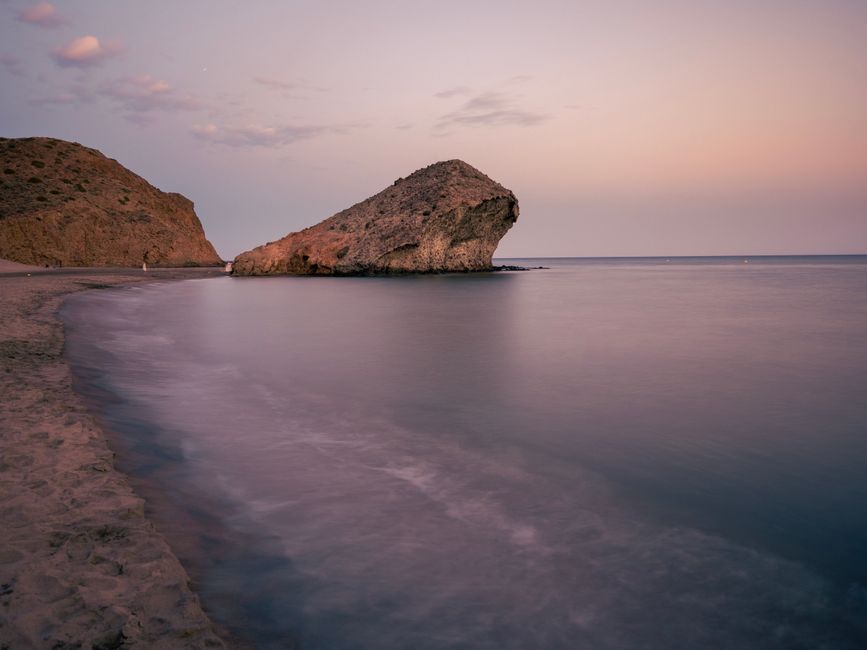
Cabo de Gata is the wild, sun-baked south-eastern corner of Andalusia, just east of the city of Almería. Its natural park, the Parque Natural Cabo de Gata-Níjar, protects volcanic hills, dark lava cliffs, sand dunes and some of the emptiest, clearest beaches on the Spanish Mediterranean, together with a marine reserve that is one of the best places in Spain to snorkel. Instead of resorts there are low white fishing villages such as San José, Las Negras and Agua Amarga, an abandoned gold-mining village at Rodalquilar, and the pottery town of Níjar in the hills. For the rest of Andalusia, see our Granada guide.
Right now in Cabo de Gata (Los Escullos)
- Wed21–24°C70–75°F3 mm rain
- Thu19–26°C67–79°FPartly cloudy
- Fri21–24°C70–76°F1 mm rain
- Mon 12 Oct National Day of Spain (Fiesta Nacional de España)
Top tours in Cabo de Gata
See all tours for Cabo de Gata →
From local operators, with prices and reviews; you check availability and book on Viator, our partner. We may earn a commission at no extra cost to you. How we earn money
Cabo de Gata at a glance
- Best for: wild beaches and coves, snorkeling and diving, coastal walks, volcanic landscapes, birdwatching at the salt flats and quiet whitewashed villages.
- How long: 3–4 days for the beaches around San José and the lighthouse; a week to see the whole coast from the salt flats to Agua Amarga and Carboneras.
- Best time: May, June, September and October. July and August are hot and busy, and access to the best-known beaches is limited in summer.
- Getting there: Almería airport is about 25 km from San José; Almería city has buses to the villages, and trains and coaches from Granada and Madrid.
- Getting around: a car is close to essential; buses to the villages are few, and many beaches are reached on dirt roads or on foot.
- Before you go: entry rules, money, trains and general safety are on our Spain travel guide.
Cabo de Gata’s villages and who each one suits
The park runs for about 60 km of coast, from the salt flats south-east of Almería round the cape itself and north to Agua Amarga, with Carboneras just beyond. Most of it lies in the large municipality of Níjar.
San José
The park’s main village and the most practical base: a sandy town beach, a small marina, restaurants, dive centres, a supermarket and the bus to Almería. The famous wild beaches of Los Genoveses and Mónsul are a few kilometres south-west along a dirt road. Good for first-timers, families and anyone without a car for every day.
La Isleta del Moro and Los Escullos
La Isleta del Moro is a tiny fishing village on a rocky point, with boats pulled up on the beach and a couple of fish restaurants. Next door, Los Escullos has a small beach beside a fossil dune and the 18th-century Castillo de San Felipe. Both suit couples who want peace and snorkeling straight off the rocks.
Rodalquilar and Las Negras
Rodalquilar sits in the crater of an ancient volcano, around the ruins of its gold mines, with a long beach, El Playazo, a short drive away. Las Negras, named after the dark volcanic hill of Cerro Negro, is a laid-back village with a pebbly beach and a slightly bohemian feel; it is the starting point for the hidden Cala de San Pedro. Good for walkers, independent travellers and small rural hotels.
Agua Amarga, Carboneras and Níjar
Agua Amarga, in the north of the park, is the most stylish village, with a perfect sandy bay, boutique hotels and good restaurants; it suits couples and families. Carboneras, just outside the park, is a working town with a fishing port and the beautiful Playa de los Muertos nearby. Inland, Níjar is a white hill town famous for pottery and woven jarapa rugs, a good choice for a quieter stay away from the beach.
Top things to see in Cabo de Gata
Prices and hours below were checked on the official sites in October 2026, unless we say otherwise; check again before you go. Most of Cabo de Gata’s sights are natural and free; the main thing to plan around is beach access in summer.
Los Genoveses and Mónsul beaches
South-west of San José, a dirt road leads to the park’s most famous beaches. Los Genoveses is a wide, golden bay backed by dunes and pines, with no buildings in sight. Mónsul has grey sand, a big sand dune and a strange lava rock standing in the water; it appeared in Indiana Jones and the Last Crusade. Between and beyond them are the smaller beaches of El Barronal, Media Luna and Cala Carbón. Please keep off the Mónsul dune: the Junta de Andalucía has fenced it to let it recover.
Summer access: in 2026 the Junta de Andalucía regulated access by car to Genoveses, El Barronal, Mónsul, Media Luna and Cala Carbón from 20 June to 27 September. In that period cars can enter only until the beach car parks are full; then a barrier closes the road, and the only ways in are on foot, by bike or on the shuttle bus from San José. A parking fee is charged in summer (it was €6 in 2024). Outside the summer period, as in October, you can drive in freely, but go early at weekends. The walk from San José to Los Genoveses takes about an hour on a coastal path.
The lighthouse and Arrecife de las Sirenas
The cape itself is a dramatic headland of volcanic rock with the Cabo de Gata lighthouse at its tip. Below the lighthouse viewpoint, the jagged rocks of the Arrecife de las Sirenas, the “Mermaids’ Reef”, rise out of the sea; the name is said to come from the monk seals that once lived here. The road from the village of Cabo de Gata runs past the salt flats and the tiny hamlet of La Almadraba de Monteleva to the lighthouse. Beyond it, the track over the hills to the Vela Blanca watchtower and San José is closed to cars, but makes a fine walk.
The salt flats and flamingos
The Salinas de Cabo de Gata, working salt pans behind the long beach between the village of Cabo de Gata and the lighthouse, are one of the most important wetlands in Andalusia. Greater flamingos feed here for much of the year, along with avocets, herons and many migrating birds in spring and autumn. Free roadside hides look over the water; come early or late in the day. In 2026 the Junta de Andalucía is restoring the wetland, with new fencing, renovated hides and new nesting islands.
Rodalquilar and the Casa de los Volcanes
Gold was mined at Rodalquilar until 1966, and the ruins of the processing plant still climb the hillside above the village. In one of the old mine buildings, the ecomuseum La Casa de los Volcanes explains the park’s volcanic geology and its mining history. As of October 2026 it opens Tuesday to Sunday, 10:00–14:00, from 16 September to 30 June, and also 19:00–21:00 from 1 July to 15 September. Walk up through the ruins for views over the crater.
Níjar village
Níjar, on the slopes of the Sierra Alhamilla about 30 km north-west of San José, is one of the prettiest white villages in eastern Andalusia. Its lanes are lined with workshops selling hand-painted pottery and colourful jarapa rugs, made here for centuries. The museum La Casa de los Artesanos tells the story of these crafts, and the Museo del Agua explains how water was managed in this dry land.
More to see
- Cala de San Pedro: a remote cove with a ruined castle and a small community living off-grid, reached only on foot from Las Negras (about an hour each way on a hilly path) or by boat from Las Negras in summer.
- Playa de los Muertos: a long beach of white pebbles and turquoise water south of Carboneras, reached by a steep path of about 15 minutes from the roadside car park.
- Agua Amarga and Cala del Plomo: a lovely sandy bay in the village, and a quieter cove a few kilometres south along a dirt track.
- Los Escullos fossil dune: sand turned to stone, carved into odd shapes by the wind, beside the Castillo de San Felipe.
Other things to do in Cabo de Gata
Snorkeling and diving in the marine reserve
The sea off the park is the Cabo de Gata-Níjar marine reserve, with clear water, posidonia seagrass meadows, volcanic rock walls, groupers, octopus and colourful fish. Snorkeling and swimming are allowed everywhere without a permit; good spots include La Isleta del Moro, Los Escullos, the rocks at the end of the San José beaches and the coves near Agua Amarga. Scuba diving is regulated by the Spanish state’s reserve rules: dives need an authorisation, usually arranged by the local dive centres, divers must show experience of at least 25 dives (one in the last 12 months), and night dives and dives from the shore are not allowed. Fishing and taking any marine life are banned. See our snorkeling and diving guides.
Walking the coast
Níjar’s tourist office counts 63 km of signposted trails in the municipality. The best known follow the coast: from San José to Los Genoveses and on to Mónsul; from the lighthouse over the hills to the Vela Blanca tower; from Las Negras to Cala de San Pedro; and from Agua Amarga to Cala del Plomo. Paths are rocky and there is almost no shade, so walk in the morning, carry plenty of water and avoid the midday heat from June to September. See our hiking guide.
Kayaking and boat trips
Kayak trips from San José, La Isleta, Las Negras and Agua Amarga paddle along the cliffs to caves and coves you cannot reach on foot, and in summer small boats run from San José and Las Negras along the coast. From 20 June to 27 September 2026, kayaks and canoes could not go out in groups of more than five without an authorisation from the Junta, so choose an operator that follows the rules. See our boat trips guide.
The Geopark and the visitor centres
Cabo de Gata-Níjar is a UNESCO biosphere reserve and a UNESCO Global Geopark, recognised for its volcanic landscapes. The Las Amoladeras visitor centre, on the road from Retamar to Cabo de Gata village, has displays on the park’s ecosystems and how people have adapted to them,; hours vary by season (see the Junta’s Ventana del Visitante). The beaches here are among the best in Spain; see our beaches guide.
Day trips and onward travel
Almería city and the Tabernas desert
Almería, about 40 minutes from San José by car, has a great Moorish fortress, the Alcazaba, and good tapas bars. About 30 km north of the city, the Tabernas desert, often called Europe’s only desert, was the setting for many 1960s and 1970s westerns; some of the old film sets are now theme parks.
Mojácar and Granada
Mojácar, a white hilltop village above a long beach, is about 30 minutes north of Carboneras. Granada, with the Alhambra, is roughly two and a half hours from San José by car, and makes a natural next stop on a tour of Andalusia; buses and trains link Almería and Granada.
Nearby destinations
- Sierra Nevada115 km
- Granada143 km
- Alicante211 km
- Málaga213 km
- Benidorm247 km
- Costa del Sol258 km
- Marbella258 km
- Córdoba267 km
Getting there and getting around
By air
Almería airport (LEI), run by Aena, is 9 km east of Almería city and the closest airport to the park: about 25 km from San José and even closer to the salt flats. Aena lists Surbus city bus line 30, which runs every day of the year from the airport to Almería city centre in about 35 minutes. Málaga airport has many more flights but is about three hours’ drive away.
Buses from Almería
Buses leave from Almería’s Estación Intermodal, the joint bus and train station. Autocares Bernardo runs the line to San José: as of October 2026, departures from Almería are at 10:00, 13:15 and 18:30 Monday to Saturday, and 10:00 and 18:30 on Sundays and holidays, with a fare of €3.10 (€2.06 with the Almería transport consortium card). The same company also serves La Isleta del Moro on some weekdays. The consortium’s lines also reach Cabo de Gata village (M-202), Rodalquilar (M-203) and Agua Amarga and Carboneras (M-213). Services are few, so check timetables first.
Driving and parking
A car gives you the freedom to move between villages and beaches, which are linked by winding roads through the hills; there is no coast road all the way round. Some beaches are reached on dirt tracks, fine for normal cars driven slowly. Park only in marked areas, never on the verges or off the tracks, and remember that in summer the busiest beach roads close once their car parks are full. Almería is linked to Granada and Madrid by trains and Alsa coaches.
When to go and how long to stay
Cabo de Gata has a hot semi-desert climate: very little rain, long sunny days and mild winters, often with a strong wind. The table uses AEMET’s 1991–2020 climate normals for the Almería airport weather station, at 21 m on the coast about 12 km west of Cabo de Gata village and 25 km from San José: average daily highs and lows, and days with at least 1 mm of rain. The station records only about 200 mm of rain a year, on 25 days.
| Season | Average high / low | Rainy days per month | What it’s like | Good for |
|---|---|---|---|---|
| Winter (Dec–Feb) | 17–18 °C / 9–10 °C | 3 | Mild and sunny with cool evenings and occasional windy days; villages quiet, some hotels closed | Walking, birdwatching, Níjar and Almería |
| Spring (Mar–May) | 19–24 °C / 11–16 °C | 2–3 | Warm and bright; wild flowers after any rain; sea still cool | Hiking, flamingos, quiet beaches |
| Summer (Jun–Aug) | 28–31 °C / 19–23 °C | 0–1 | Hot, dry and very sunny; busy villages and regulated beach access | Swimming, snorkeling, boat trips |
| Autumn (Sep–Nov) | 28 °C falling to 20 °C / 20 °C falling to 12 °C | 2–3 | Warm sea in September and October; most of the year’s rain falls from October to December | Swimming, diving and walking |
The sea is warmest from July to October. With little shade, summer afternoons feel hotter than the averages suggest.
Events worth planning around
- Easter: the first busy weekend of the year; book rooms early.
- June: Moors and Christians festivities in Carboneras, around the feast of San Antonio.
- 20 June to late September: regulated car access to Los Genoveses and Mónsul (dates set each year by the Junta).
- Spring and autumn: bird migration at the salt flats.
How long to stay: 3, 5 and 7 days
3 days: base yourself in San José. Day 1, walk or drive to Los Genoveses and Mónsul and swim. Day 2, the salt flats, the lighthouse and the Arrecife de las Sirenas, with sunset at the cape. Day 3, snorkel at La Isleta del Moro and visit Rodalquilar and the Casa de los Volcanes.
5 days: add two nights in Las Negras or Agua Amarga, the walk to Cala de San Pedro and an afternoon at Playa de los Muertos. 7 days: add Níjar’s pottery workshops, a kayak or dive trip, and a day in Almería or the Tabernas desert.
Where to stay in Cabo de Gata and the tourist tax
- San José: the widest choice of hotels, apartments and restaurants, close to the best beaches and on the bus line.
- Agua Amarga: boutique hotels and a beautiful bay; the most upmarket base.
- Las Negras or Rodalquilar: relaxed villages for walkers, with small hotels and rural houses.
- La Isleta del Moro: a handful of rooms in a real fishing village, for peace and snorkeling.
- Cortijos and Níjar: restored farmhouses in the countryside and village houses in Níjar, for a car-based stay.
There is no tourist tax in Andalusia as of October 2026, so nothing is added to your hotel bill for it. Rooms are limited, so book early for summer and Easter. Wild camping is not allowed in the park; use the official campsites.
Practical tips for Cabo de Gata
- Bring everything to the beach: the wild beaches have no bars, shops, shade or toilets; take water, food and a parasol, and take your rubbish home.
- Go early in summer: the car parks at Los Genoveses and Mónsul fill fast; arrive early or take the shuttle bus from San José.
- Respect the park: keep off the dunes, do not pick plants or take stones, and do not drive or park off the tracks.
- Heat and sun: there is almost no shade; walk early, carry at least two litres of water each, and avoid long hikes at midday in summer.
- Cash and fuel: the villages are small; fill up with petrol before you set off and carry some cash.
- Emergencies: call 112.
What to pack for Cabo de Gata
Pack for strong sun and rocky ground. Bring a wide-brimmed hat, sunglasses, high-factor sunscreen and a reusable water bottle, plus a beach parasol or shade tent if you plan to spend the day on the wild beaches. Water shoes help on the pebbles and volcanic rocks, and a snorkel mask is a must: the water is very clear. For the coastal paths, wear walking shoes or sturdy sandals with a good grip and carry a small backpack for water and snacks. Add binoculars for the flamingos and a windproof layer for breezy evenings.
Cabo de Gata travel FAQ
Where is Cabo de Gata?
In the province of Almería in south-eastern Andalusia, starting about 30 km east of Almería city. Most of the natural park lies in the municipality of Níjar.
Can I drive to Los Genoveses and Mónsul beaches?
Yes, outside summer. In 2026 car access was regulated from 20 June to 27 September: cars could enter until the car parks were full, then a barrier closed the road and the way in was on foot, by bike or on the shuttle bus from San José.
What is the best beach in Cabo de Gata?
Los Genoveses and Mónsul are the most famous, and Playa de los Muertos near Carboneras has the clearest water. For something quieter, walk to Cala de San Pedro or Cala del Plomo.
Can I get to Cabo de Gata without a car?
Yes, to San José: as of October 2026 Autocares Bernardo runs three buses a day from Almería on weekdays and Saturdays (two on Sundays) for €3.10. Other villages have consortium buses, but they are infrequent, so a car is much easier.
Do I need a permit to snorkel or dive?
Not to snorkel or swim. Scuba diving in the marine reserve needs an authorisation, which local dive centres arrange, and divers need at least 25 logged dives. Night dives and shore dives are not allowed.
Where can I see flamingos in Cabo de Gata?
At the Salinas de Cabo de Gata, the salt flats between Cabo de Gata village and the lighthouse, from free roadside hides. Early morning and late afternoon are best.
Is there a tourist tax in Cabo de Gata?
No. Andalusia does not charge a tourist tax as of October 2026.
When is the best time to visit Cabo de Gata?
May, June, September and October, when the sea is pleasant, the trails are not too hot and the beaches are quieter. Winter is mild and sunny, good for walking.
Which airport is closest to Cabo de Gata?
Almería airport, about 25 km from San José. City bus line 30 links it with Almería centre in about 35 minutes, where buses leave for the villages; most visitors hire a car.
Plan your trip
Partner links: TravelerCenter may earn a commission if you book, at no extra cost to you.
🇪🇸 Useful Spanish phrases for Cabo de Gata
All 38 Spanish phrases: restaurant, hotel, emergencies, romance (printable) →
Sources · last reviewed 4 October 2026
Researched and last reviewed on 4 October 2026. Beach access rules and the kayak limit: the Junta de Andalucía’s Consejería de Sostenibilidad y Medio Ambiente; visitor centres: the Junta’s Ventana del Visitante; diving and snorkeling rules: the Spanish state order regulating the Cabo de Gata-Níjar marine reserve (BOE); trails and village information: the Ayuntamiento de Níjar and Turismo Níjar; Casa de los Volcanes: the ecomuseum’s own site; airport bus: Aena; buses to San José: Autocares Bernardo and the Almería transport consortium; climate: AEMET 1991–2020 normals for Almería airport, as published by the WMO. The summer parking fee is the 2024 figure from the Ayuntamiento de Níjar, and driving times and the Carboneras festivities come from secondary sources and are flagged for checking. Prices, hours and timetables change, so check the official sites before you go. For entry rules, money and general safety, see our Spain travel guide.
Data: Weather: MET Norway (CC BY 4.0) · Sea temperature: NOAA CoastWatch · Rates: ECB · Holidays: Nager.Date · Costs: World Bank ICP and price levels · Wikidata (CC0)