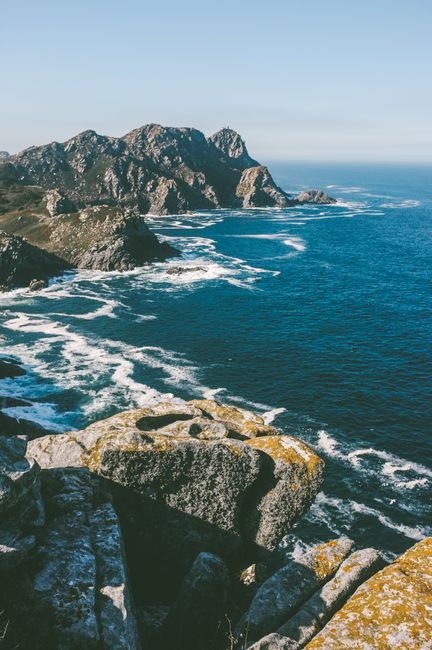
The Rías Baixas are the four long, sheltered sea inlets of south-western Galicia, between Muros and the Portuguese border: the rías of Muros e Noia, Arousa, Pontevedra and Vigo. They are Galicia at its most relaxed: pine-fringed beaches of white sand, fishing villages where granite grain stores stand by the water, mussel rafts dotting calm bays, and the vineyards that make crisp albariño wine. Offshore lie the Cíes Islands, part of the Atlantic Islands of Galicia National Park, with one of Spain’s most beautiful beaches. Pontevedra has a lovely pedestrian old town, and Vigo is the big port city and the gateway to the islands. It is about an hour south of Santiago de Compostela, and the best months are June and September.
Right now in Rías Baixas (Sanxenxo)
- Wed15–22°C60–72°FMostly clear
- Thu14–22°C57–71°FPartly cloudy
- Fri12–21°C53–70°FClear
- Mon 12 Oct National Day of Spain (Fiesta Nacional de España)
Top tours in Rías Baixas
See all tours for Rías Baixas →
From local operators, with prices and reviews; you check availability and book on Viator, our partner. We may earn a commission at no extra cost to you. How we earn money
Rías Baixas at a glance
- Best for: beaches and islands, seafood, albariño wine, fishing villages, coastal walks and the Portuguese Camino.
- How long: 3–4 days for Pontevedra, Combarro, Cambados and the Cíes; a week to add Baiona, O Grove and the quieter northern ría.
- Best time: June and September; July and August are warmest and busiest. The Cíes need a permit in high season.
- Getting there: fly to Vigo or Santiago, or take the train along the Atlantic axis from Santiago and A Coruña to Pontevedra and Vigo.
- Getting around: trains and buses link the main towns, but a car makes the villages, beaches and wineries far easier.
- Before you go: entry rules, money, trains and general safety are on our Spain travel guide.
Rías Baixas towns and who each one suits
Each ría has its own character. The Ría de Vigo, the southernmost, is the busiest, with the city of Vigo and the Cíes at its mouth. The Ría de Pontevedra has Pontevedra at its head and the beach resort of Sanxenxo on its northern shore. The Ría de Arousa, the largest, is the heart of albariño country around Cambados. The Ría de Muros e Noia, in A Coruña province, is quieter, with granite towns and wild beaches.
Pontevedra
A small provincial capital that turned its centre over to pedestrians, with granite squares, arcades, tapas bars and churches. It is a pleasant, central base with a station on the main railway line, good for travellers without a car and anyone who likes an evening stroll more than a beach resort.
Vigo and Baiona
Vigo is Galicia’s largest city and a working port, with a lively old quarter, oyster sellers on the Rúa da Pedra, views from O Castro hill and boats to the Cíes. Baiona, at the mouth of the ría, is a handsome old fishing town with a walled fortress on the headland and good beaches. Vigo suits city lovers and island-hoppers; Baiona, couples and families.
Sanxenxo, O Grove and A Toxa
Sanxenxo is Galicia’s main summer resort, with sandy beaches, a marina and nightlife, very busy in August. O Grove, on a peninsula between two rías, is a seafood town famous for its October festival; the bridge to the little island of A Toxa leads to a spa resort and a chapel covered in scallop shells. Between them runs the great beach of A Lanzada. Best for beach holidays and families.
Cambados and the Illa de Arousa
Cambados, the capital of albariño, has a stately square in front of the Pazo de Fefiñáns, wine shops and seafront restaurants. The Illa de Arousa, joined to the mainland by a long bridge, has calm, clear beaches and the Carreirón natural park. Good for wine lovers, slow travellers and cyclists.
Top things to see in the Rías Baixas
Prices and hours below were checked on the official sites in October 2026, unless we say otherwise; check again before you go. Most sights here are free; the islands are the one place where you must plan ahead.
The Cíes Islands
Three granite islands at the mouth of the Ría de Vigo, sheer cliffs on the ocean side and white beaches facing the land. Rodas beach, a curve of sand joining two of the islands in front of a lagoon, is the famous one; paths climb through pine woods to the lighthouse and to cliffs full of seabirds. The Cíes are part of the Atlantic Islands of Galicia National Park, declared in 2002 with Ons, Sálvora and Cortegada. Visitor numbers are capped. In high season, which in 2026 means Easter week (27 March–5 April) and 15 May–15 September, about 1,600–1,800 visitors a day are allowed, and you first need a free authorisation from the Xunta de Galicia on its online booking system: choose your date and group, and within two hours of getting a provisional code buy your ferry ticket from an authorised boat company, or the code lapses. Boats leave from Vigo, Cangas and Baiona. You can cancel an authorisation up to 15 days before your visit. For the rest of the year, including October 2026, the islands can only be visited in an organised group with an accredited guide, booked through the authorised boat companies, with a lower daily limit. There is a campsite in summer; it arranges the authorisation for its guests. Take water and food, and expect no shade on the beaches.
Pontevedra’s old town and museum
Wander through the squares of A Leña, Ferrería and Verdura, past the round, shell-shaped Sanctuary of A Peregrina, the patron of the Portuguese Way, and the Gothic-Renaissance basilica of Santa María a Maior. The Museo de Pontevedra, run by the provincial council, spreads across several buildings with Galician art, archaeology, silverwork and prehistoric gold jewellery. As of October 2026 entry is free. The Castelao and Sarmiento buildings open Tuesday to Saturday 10:00–21:00 and on Sundays and holidays 11:00–14:00, closed Mondays. The roofless Gothic ruins of Santo Domingo, part of the museum, open from 15 March to 31 October, Tuesday to Saturday 10:00–14:00 and 16:00–19:30 and Sundays 11:00–14:00, and close in winter.
Combarro
A fishing village on the Ría de Pontevedra, a few kilometres from the city, where a row of hórreos, granite grain stores raised on stilts, stands right at the water’s edge beside stone crosses and narrow lanes cut into the rock. It is one of the most photographed places in Galicia. Come early or late in summer, when tour coaches fill the lanes, and stay for grilled fish on the waterfront.
Cambados and the albariño wineries
The Rías Baixas wine region is the home of albariño, a fresh, aromatic white grown on high pergolas to keep the grapes away from the damp ground. Cambados, in the Val do Salnés sub-zone, is its capital: see the Pazo de Fefiñáns and its square, the ruined church of Santa Mariña de Dozo, and the town’s wine shops and bars. Many wineries around Cambados, Meis and Meaño offer tours and tastings, usually by appointment; the Rías Baixas wine route links them. In early August the town holds the Fiesta del Albariño. See our wine tasting guide.
Baiona
In March 1493 the caravel Pinta sailed into Baiona, the first ship to bring news of Columbus’s voyage to Europe; a replica sits in the harbour. The walled Monterreal fortress on the headland, now a Parador hotel, has a walk round its ramparts with views out to the Cíes. Along the old town’s streets are seafood bars, and the coast road south to A Guarda passes wild Atlantic shores.
More to see
- Ons Island: the other national-park island, with a small village, beaches, cliffs and walking paths; boats from Bueu, Sanxenxo and Portonovo, with a limit of 1,300 visitors a day in high season.
- A Lanzada: a 2 km Atlantic beach between Sanxenxo and O Grove, with a hermitage on the rocks at its southern end.
- Vigo’s old town and O Castro: the fishermen’s quarter of the Berbés, the oyster stalls and the fortress park above the city.
- Armenteira monastery: a Cistercian monastery in the hills above the Ría de Arousa, at the end of the Stone and Water Route, a riverside walk past old mills.
- Muros and Noia: granite arcades and seafront towns on the northernmost ría, with wild beaches beyond Monte Louro.
Other things to do in the Rías Baixas
Beaches and surfing
The beaches inside the rías are sheltered and calm, good for families; those facing the open Atlantic, such as A Lanzada, Patos near Nigrán and the Cíes’ western side, get waves. The water is cool even in August, rarely much above 20 °C. See our beaches and surfing guides.
Boat trips and the mussel rafts
Besides the island ferries, boat companies in O Grove, Cambados, Vilanova and Sanxenxo run trips round the ría to see the bateas, wooden mussel rafts, often with a tasting of mussels and albariño on board. Small passenger ferries also cross the Ría de Vigo to Cangas and Moaña. See our boat trips guide.
Walking the Portuguese Camino by the sea
The Portuguese Way to Santiago crosses the region, and its coastal route follows the shore from A Guarda through Baiona and Vigo before joining the central route at Redondela and continuing through Pontevedra. A variant known as the Spiritual Variant leaves Pontevedra via Combarro and Armenteira and finishes with a boat up the Ría de Arousa. See our hiking guide, and our Santiago guide for the end of the Camino.
Seafood
This is one of Europe’s great seafood coasts. Try mussels, clams, scallops, razor clams, octopus á feira, goose barnacles (percebes) and, in Vigo, oysters from the street stalls. Markets such as Pontevedra’s, by the river, are good for a look in the morning.
Day trips and onward travel
Santiago de Compostela
The pilgrim city, with its cathedral and granite old town, is about an hour by train from Pontevedra and Vigo, an easy day trip or the next stop. See our Santiago de Compostela guide.
Portugal
The border is under an hour south of Vigo, across the Minho river at Tui and Valença, whose walled towns face each other. Porto is about 2 hours by road or train from Vigo, and its airport is another option for flights; see our Portugal guide.
Nearby destinations
- Santiago de Compostela61 km
- Porto136 km
- Douro Valley170 km
- Coimbra242 km
Getting there and getting around
By air
Vigo airport (VGO), at Peinador, is about 10 km from the city centre; according to Aena it is served by Vitrasa city buses (line A). Santiago airport (SCQ) has more flights and is about an hour by road from Pontevedra; city bus 6A links it with Santiago’s train station, from where trains run south. Porto airport, in Portugal, is about 1½–2 hours by road from Vigo.
By train
Renfe’s Atlantic axis line links A Coruña, Santiago, Pontevedra and Vigo-Urzáiz: Santiago to Pontevedra or Vigo takes about an hour, and Pontevedra to Vigo well under half an hour. High-speed trains from Madrid reach Vigo and Pontevedra via Ourense or Santiago. Times are approximate; check Renfe for your date.
Buses and driving
Regional buses link Pontevedra and Vigo with Sanxenxo, O Grove, Cambados, Combarro and Baiona, but services thin out after summer. A car makes everything easier, especially for wineries and beaches; in summer, parking in Sanxenxo, Combarro and near the ferry ports is tight. Vigo activated low-emission zones in the centre, Praza de Portugal, Bouzas and O Calvario in September 2026, with a grace period before fines; older petrol and diesel cars are affected, so check the council’s rules if you drive in.
When to go and how long to stay
The Rías Baixas have a mild Atlantic climate: warm, mostly dry summers and wet, mild winters, with more rain than almost anywhere else in Spain but also plenty of summer sunshine. The table uses AEMET’s 1991–2020 climate normals for the Pontevedra weather station, at 108 m beside the city, near the head of the Ría de Pontevedra: average daily highs and lows, and days with at least 1 mm of rain. The outer coast and islands are breezier and a little cooler in summer.
| Season | Average high / low | Rainy days per month | What it’s like | Good for |
|---|---|---|---|---|
| Winter (Dec–Feb) | 14–15 °C / 6–7 °C | 11–15 | Mild but often wet and grey, with Atlantic storms | Seafood, Pontevedra and Vigo, quiet villages |
| Spring (Mar–May) | 17–21 °C / 8–11 °C | 11–13 | Green and changeable, sunnier by May | Walking the Camino, wineries, Combarro without crowds |
| Summer (Jun–Aug) | 23–25 °C / 13–15 °C | 5–7 | Warm, sunny and the driest season; cool sea; busiest | Beaches, the Cíes and Ons, festivals |
| Autumn (Sep–Nov) | 23 °C falling to 16 °C / 14 °C falling to 9 °C | 8–15 | Fine September; rain returns from October | Beaches in September, grape harvest, the seafood festival |
Pontevedra averages about 1,590 mm of rain a year on about 130 days, with October to January the wettest months, and nearly 300 hours of sunshine in July. These are long-term averages; recent summers have often been warmer.
Events worth planning around
- Early September: Pontevedra’s Feira Franca, a medieval fair in the old town, after a summer of town fiestas.
- Early August: the Fiesta del Albariño in Cambados.
- October: the Festa do Marisco, O Grove’s seafood festival, with tasting tents by the port (1–12 October in 2026).
How long to stay: 3, 5 and 7 days
3 days: base yourself in Pontevedra. Day 1, the old town and the museum, then Combarro at sunset. Day 2, Cambados and a winery, with a swim at A Lanzada. Day 3, the Cíes Islands by boat from Vigo, with your authorisation booked in advance in high season.
5 days: add Baiona and Vigo’s old town, and a mussel-raft boat trip from O Grove. 7 days: add Ons Island, the Illa de Arousa, and a drive round the northern ría to Muros and Noia, or a day in Santiago.
Where to stay in the Rías Baixas and the tourist tax
- Pontevedra: central, walkable and on the railway; the best base without a car.
- Vigo: the most hotels, city life and the Cíes boats.
- Sanxenxo or O Grove: beach hotels and apartments for summer holidays.
- Cambados: small hotels and wine-country guesthouses.
- Baiona: a pretty seaside town, with a Parador in its fortress.
In Galicia each town council decides whether to charge a tourist tax, as a surcharge on the Galician tax on tourist stays. Vigo started charging on 1 October 2026: under the city’s tax ordinance, rates run from €0.73 per person per night in hostels, campsites, rural houses, tourist apartments and holiday homes to €1.82 in four-star superior and five-star hotels (€1.46 in three- and four-star hotels and tourist-use homes, €1.09 in one- and two-star hotels and guesthouses). Until 30 June 2027 only the first two nights are charged; after that, up to five. Under-18s and some other guests are exempt, and it is collected by your accommodation. Press reports quote the rates as €0.80–2. O Grove proposed its own tax of €1–2.50 in early 2026, but we could not confirm on an official page whether it is in force. We found no tourist tax as of October 2026 in Pontevedra, Sanxenxo, Cambados, Baiona or A Illa de Arousa, but rules are changing fast in Galicia, so ask your accommodation when you book. Santiago has charged €1–2.50 since 1 October 2025.
Practical tips for the Rías Baixas
- Book the Cíes early: in high season, get your Xunta authorisation first, then buy the boat ticket within two hours.
- Islands are protected: take your rubbish home, stay on the paths and do not pick plants or shells.
- Meal times: lunch is from about 14:00 and dinner from 21:00; many seafood places close one day a week.
- Language: Galician is spoken alongside Spanish, and place names are signed in Galician.
- Out of season: some beach hotels in Sanxenxo and O Grove close from October to Easter.
- Emergencies: call 112.
What to pack for the Rías Baixas
Pack a light waterproof jacket and an umbrella at any time of year, plus a warm layer for breezy evenings and boat trips, even in summer. For the islands bring comfortable shoes for the paths, a sun hat, high-factor sunscreen and a water bottle, as there is little shade. A swimsuit and a towel are a must in summer; the sea is cool, so some swimmers like a thin wetsuit. Shoes with good grip help on wet granite streets in Pontevedra and Combarro.
Rías Baixas travel FAQ
Where are the Rías Baixas?
On the south-west coast of Galicia, in north-west Spain, from Muros and Noia south to Vigo and Baiona, near the Portuguese border; mostly in Pontevedra province.
Do I need a permit to visit the Cíes Islands?
Yes, in high season (Easter week and 15 May–15 September): a free authorisation from the Xunta de Galicia online, then a ferry ticket from an authorised company within two hours. The rest of the year, visits are only in guided groups booked through the boat companies.
Where do boats to the Cíes leave from?
From Vigo, Cangas and Baiona, run by the authorised boat companies listed by the national park. Ons boats leave from Bueu, Sanxenxo and Portonovo.
Is there a tourist tax in the Rías Baixas?
In Vigo, yes: since 1 October 2026, €0.73–1.82 per person per night under the city’s ordinance, on the first two nights only until June 2027. We found none in the other main towns as of October 2026, but O Grove has proposed one; ask when you book.
What is the best base in the Rías Baixas?
Pontevedra, for its old town, central position and trains. For beaches choose Sanxenxo or O Grove, for wine Cambados, and for the Cíes Vigo or Baiona.
Can I visit the Rías Baixas from Santiago de Compostela?
Yes. Trains reach Pontevedra and Vigo in about an hour, so Pontevedra’s old town is an easy day trip, but the villages, wineries and islands are worth a few nights.
When is the best time to visit the Rías Baixas?
June and September, for warm, mostly dry weather without the August crowds. July and August are the sunniest months; from October to March expect rain on about half the days.
Is the Museo de Pontevedra free?
Yes, as of October 2026. Its main buildings open Tuesday to Saturday 10:00–21:00 and on Sundays and holidays 11:00–14:00, and close on Mondays.
Plan your trip
Partner links: TravelerCenter may earn a commission if you book, at no extra cost to you.
🇪🇸 Useful Spanish phrases for Rías Baixas
All 38 Spanish phrases: restaurant, hotel, emergencies, romance (printable) →
Sources · last reviewed 4 October 2026
Researched and last reviewed on 4 October 2026. Cíes and Ons visitor limits, seasons and the authorisation system: the Atlantic Islands of Galicia National Park and the Xunta de Galicia’s booking site; museum prices and hours: the Museo de Pontevedra (Deputación de Pontevedra); Vigo tourist tax: the City of Vigo’s tax ordinance; airport bus: Aena; climate: AEMET 1991–2020 normals for Pontevedra, as published by the WMO. The O Grove tax proposal, Vigo’s low-emission zones, train journey times and event dates come from press reports and other secondary sources and are flagged for checking. Prices, hours and timetables change, so check the official sites before you go. For entry rules, money and general safety, see our Spain travel guide.
Data: Weather: MET Norway (CC BY 4.0) · Sea temperature: NOAA CoastWatch · Air quality: OpenAQ · Rates: ECB · Holidays: Nager.Date · Costs: World Bank ICP and price levels · Wikidata (CC0)