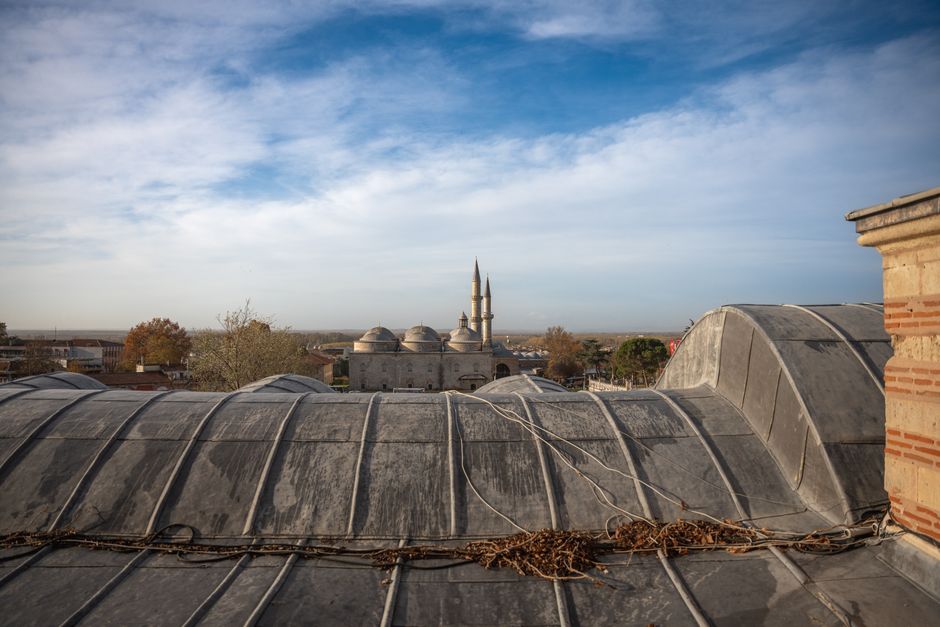
Edirne, the old Adrianople, was the capital of the Ottoman Empire for nearly a century before the conquest of Constantinople, and it still has the empire’s finest mosque: the Selimiye, the masterpiece of the great architect Sinan and a UNESCO World Heritage Site, freshly restored and reopened in June 2026. Around it, a compact, friendly city near the borders with Greece and Bulgaria offers three more great mosques, a 15th-century hospital that is now a museum of Ottoman medicine, Ottoman bridges over the Tunca and Meriç rivers, a covered bazaar by Sinan, and the famous fried liver of Edirne. Every summer it hosts Kırkpınar, the world’s oldest oil-wrestling tournament. Edirne is an easy day trip from Istanbul, but an overnight stay lets you see the Selimiye lit up at night and the sunset from the Meriç bridge, and it is a natural stop on the way to Greece or Bulgaria.
Right now in Edirne
- Wed11–25°C51–77°FClear
- Thu11–25°C53–77°FPartly cloudy
- Fri13–27°C55–80°FClear
Top tours in Edirne
See all tours for Edirne →
From local operators, with prices and reviews; you check availability and book on Viator, our partner. We may earn a commission at no extra cost to you. How we earn money
Edirne at a glance
- Best months: April to June and September to October. July and August are hot (average highs around 33 °C); winters are cold, with frosty nights.
- Days needed: a long day trip from Istanbul covers the Selimiye and the centre; 1 night (2 days) adds the Bayezid II complex, Karaağaç and the sunset over the Meriç.
- Getting there: buses from Istanbul in about 2½–3 hours; a new high-speed rail section to Edirne is due to open in October 2026; road crossings from Bulgaria (Kapıkule) and Greece (Pazarkule and İpsala).
- Getting around: the centre is walkable; city buses and dolmuş for Karaağaç and the bus station; a taxi or a long walk for the Bayezid II complex.
- Budget level: low. Most mosques are free, the museums are cheap, and hotels and food cost much less than in Istanbul.
- Before you go: visas, money and transport around the country are in our Türkiye travel guide.
Edirne’s areas and who each one suits
Almost everything is in or near the centre, a small grid of streets between the Selimiye on its hill, the Old Mosque and the Üç Şerefeli Mosque, with the pedestrian Saraçlar Street, the Ali Paşa Bazaar and the main square (Hürriyet Meydanı) at its heart. Stay here if you are on foot. To the south-west, Kaleiçi, the old walled town, is a grid of quiet lanes with old wooden and brick houses, small guesthouses and cafés. North and west of the centre, the Tunca river loops around Sarayiçi, the island meadow where the Ottoman palace stood and where Kırkpınar is held, and the Bayezid II complex stands on its far bank. South across the Tunca and Meriç bridges lies Karaağaç, a leafy riverside suburb with the old railway station and student cafés, on the road to the Greek border. Best for: the centre for a first short visit; Kaleiçi for character; a riverside hotel or Karaağaç for a quieter, greener stay.
Top things to see in Edirne
Ministry museum prices below are those for foreign visitors as of October 2026, from the Ministry of Culture and Tourism (muze.gov.tr), which prices state sites in euros. Mosques are free. The ministry usually switches to shorter winter hours in late October or November, so check before your visit.
The Selimiye Mosque and complex
Built by Sinan for Sultan Selim II between 1568 and 1575, when the architect was in his eighties, the Selimiye was meant to outdo Hagia Sophia, and Sinan himself called it his masterpiece. Its single great dome, resting on eight piers, seems to float over one vast, light-filled space, and four slender minarets, each with three balconies, rise from the corners; the mihrab is set in a recess faced with superb İznik tiles, and the marble sultan’s lodge and the raised muezzins’ platform in the centre are works of art in themselves. The mosque and its complex, with its madrasas, library and covered market, were listed by UNESCO as a World Heritage Site in 2011.
Restoration (as of October 2026): a four-year restoration by Türkiye’s General Directorate of Foundations (Vakıflar), the most comprehensive in the building’s history, strengthened the main dome and minarets, renewed the lead roofs, cleaned and repaired the tiles, restored the painted decoration of the domes, the woodwork and the doors, and laid new carpets. The mosque was officially reopened for worship on 12 June 2026, so you can now see the interior in full again. Scars from the shelling of the Balkan Wars in 1913 were deliberately kept.
How to visit: entry is free. The Selimiye is a working mosque, so visitors are not admitted during the five daily prayers, and you should avoid Friday noon. Women cover their hair; everyone covers shoulders and knees; shoes come off at the door. Keep your voice down and don’t photograph people praying. Below the mosque, the Selimiye Arasta, a long covered market built by Sinan’s pupil Davud Ağa, sells souvenirs, towels and Edirne’s fruit-shaped soaps. In the mosque’s former Dar-ül Hadis madrasa, the Turkish and Islamic Arts Museum (€3, open daily 09:00–19:00, ticket office until 18:30, as of October 2026) displays calligraphy, woodwork, weapons and memorabilia of the Kırkpınar wrestlers. The Archaeology and Ethnography Museum, 50 m from the mosque’s east gate, is listed as open daily at the same hours.
The Old Mosque (Eski Cami)
The oldest of Edirne’s great mosques, finished in 1414, is a square building with nine domes and huge calligraphic inscriptions painted on its walls, among the largest in the Islamic world. A piece of the black stone of the Kaaba is set beside the mihrab. Next door, the Rüstem Paşa caravanserai by Sinan is now a hotel, and the Bedesten, the old covered market, still sells textiles and household goods. Free; visits outside prayer times.
The Üç Şerefeli Mosque
Built between 1438 and 1447, this mosque was a bold experiment that led to the great Ottoman domed mosques: its central dome was the largest of its day, and it is named after its tallest minaret, which has three balconies (şerefe) reached by three separate staircases. Its four minarets are each decorated differently. Free; visits outside prayer times.
The Bayezid II Complex Health Museum
On the far bank of the Tunca, about 2 km north-west of the centre, the complex of Sultan Bayezid II (1484–88) was a mosque, a soup kitchen, a medical school and a hospital (darüşşifa) in one. The hospital, with a domed, hexagonal hall around a fountain, treated mental illness with music, the sound of water and scents as well as medicine, and today it is the Sultan Bayezid II Complex Health Museum, run by Trakya University, with tableaux of Ottoman doctors and musicians and a very good presentation of the history of medicine; it won the Council of Europe’s museum prize in 2004. According to the Edirne Governorate, it is open 09:30–18:00, closed on Mondays, and until 22:30 on Thursdays, Fridays and Saturdays as a night museum. Tickets are cheap and priced in lira. Walk there along the river and the old bridges in about 30 minutes, or take a taxi.
The Meriç bridge at sunset
The Meriç (Evros) river marks the border with Greece just west of the city. The elegant Ottoman bridge over it, finished in the 1840s, with a little balcony pavilion in the middle, is where Edirne goes to watch the sun set over the river and the poplar woods; the tea gardens and fish restaurants along the banks are busy on summer evenings. The older Tunca bridges, a short walk back towards the centre, are also lovely in evening light.
Karaağaç, the old station and the Lausanne Monument
About 4 km south-west of the centre, Karaağaç grew up around the grand railway station built in 1914 on the line to Europe, which ran through Greek territory here after the First World War. The Treaty of Lausanne in 1923 returned Karaağaç to Türkiye, and the station building is now the rectorate of Trakya University, with an old locomotive outside. In front of it, the Lausanne Monument and the small Lausanne Museum commemorate the treaty that founded the Republic’s borders. The road continues to the Pazarkule border crossing with Greece.
The Ali Paşa Bazaar and Kaleiçi
The long, vaulted Ali Paşa Bazaar, another work by Sinan (1569), with striped red-and-white arches, was rebuilt after a fire in 1992 and is the place to buy almond paste, soaps, slippers and textiles. Behind it, the lanes of Kaleiçi, the old town inside the vanished Roman and Byzantine walls, keep a few towers and many old houses. The Hıdırlık Bastion on a hill west of the centre, a fort of the Balkan Wars, is now the ministry’s Balkan History Museum, listed as open daily 09:00–19:00.
Kırkpınar oil wrestling
Kırkpınar, held every summer since 1362 according to tradition, is the oldest continuously held sports competition in the world and is on UNESCO’s list of Intangible Cultural Heritage. Hundreds of pehlivan (wrestlers), dressed only in tight leather trousers (kispet) and covered in olive oil, wrestle in the open field of Sarayiçi to the sound of drums and pipes, until the champion (başpehlivan) wins the golden belt. The festival week includes parades, concerts and folk dancing.
Dates: the 665th Kırkpınar festival ran from 29 June to 5 July 2026, with the wrestling on 3–5 July at the Sarayiçi arena, according to Edirne Municipality’s programme. For 2027, the mayor has announced the 666th Kırkpınar for 28 June to 4 July 2027, again at Sarayiçi; the wrestling is normally on the last three days. Tickets for the main days are sold through the municipality’s channels and sell out; hotels fill up months ahead. A large reconstruction of the Ottoman Edirne Palace at Sarayiçi has been announced for completion at the end of 2027; the municipality says Kırkpınar stays at Sarayiçi for 2027.
Other things to do in Edirne
- Eat tava ciğer: Edirne’s famous fried liver, sliced paper-thin, fried crisp and served with fried dried chillies, onions and tomato, is eaten at lunchtime in small specialist restaurants around the centre and Saraçlar Street. Wash it down with ayran.
- Sweet things: badem ezmesi (almond paste) and deva-i misk (a spiced sweet paste) are the classic souvenirs, alongside the colourful fruit-shaped soaps (meyve sabunu).
- River walks: follow the Tunca along its old stone bridges from the centre to the Bayezid II complex and Sarayiçi.
- Night views: the Selimiye is floodlit at night; the square below it is lively on summer evenings.
- Festivals: as well as Kırkpınar, the spring Kakava (Hıdrellez) festival of the Roma community on 5–6 May fills Sarayiçi with music and bonfires.
- See our city sightseeing guide for more city-break ideas.
Day trips and onward travel
- From Istanbul: Edirne is the classic day trip from Istanbul, but it is a long day: leave early and take an evening bus back, or stay the night.
- To Bulgaria: the Kapıkule crossing, about 18 km west, is Türkiye’s busiest road border, open 24 hours, leading to Svilengrad and on to Plovdiv and Sofia.
- To Greece: the Pazarkule crossing, just beyond Karaağaç, leads to Kastanies and Orestiada on the Greek side; the main İpsala crossing, about 115 km south, is on the motorway to Alexandroupoli and Thessaloniki. Opening hours and whether you can cross on foot vary, so check with the border authorities before you go.
- EES: Greece and Bulgaria are in the Schengen area, so non-EU travellers are registered in the EU’s Entry/Exit System (fingerprints and a photo) when they cross; it has been fully operational since 10 April 2026. Allow extra time, especially at Kapıkule in summer and at holiday weekends.
Nearby destinations
Getting there and getting around
By bus from Istanbul
Buses run frequently from Istanbul’s main bus terminal at Esenler and from other stops on the European side to Edirne in about 2½–3 hours, depending on traffic; several companies run hourly or better through the day. Edirne’s bus terminal is on the edge of the city, east of the centre; service minibuses, city buses and taxis link it to the centre. Book the return in advance on Friday and Sunday evenings and around holidays.
By train
For years, the only trains to Edirne were slow regional services from Halkalı in Istanbul, taking about 4 hours. Türkiye is building a high-speed line from Halkalı to Kapıkule on the Bulgarian border, and according to the Ministry of Transport, its longest section, the 153 km from Çerkezköy to Kapıkule via Lüleburgaz, Babaeski and a rebuilt Edirne station, is due to open on 9 October 2026, for passengers and freight at up to 200 km/h. The section from Çerkezköy into Istanbul is still under construction; once the whole line is finished, Halkalı to Kapıkule should take about 1½ hours. Timetables and fares for the new service had not been published when we checked; look on TCDD Taşımacılık’s website or app before you travel.
By car
The O-3 motorway runs from Istanbul to Edirne and Kapıkule in about 2½ hours (230 km), with tolls paid by HGS tag. Parking in the centre is limited; use a hotel car park.
Getting around
The centre, the Selimiye, the Old Mosque, the Üç Şerefeli and the bazaars are all within a 10-minute walk of each other. The Bayezid II complex is a pleasant 30-minute riverside walk or a short taxi ride. City buses and dolmuş run to Karaağaç and the bus station; taxis are cheap and metered.
When to go and how long to stay
Edirne has a continental-Mediterranean climate: hot, dry summers, cold winters with frequent frost and occasional snow, and changeable springs and autumns. Spring and autumn are the best seasons for walking between the mosques; early summer brings Kırkpınar and the city’s busiest week. Rain is spread through the year, about 620 mm on about 69 days. Edirne is busy with Turkish visitors at weekends and with Bulgarian and Greek shoppers crossing the border; weekdays are calmer.
| Season | Average high / low | Rain | What it’s like |
|---|---|---|---|
| Spring (Mar–May) | 14–26 °C / 4–12 °C | 44–57 mm a month | Fresh and green; good for walking; the Kakava festival in May. |
| Summer (Jun–Aug) | 30–33 °C / 16–18 °C | 22–46 mm a month | Hot and sunny; Kırkpınar in late June or early July; evenings by the river. |
| Autumn (Sep–Nov) | 14–28 °C / 5–14 °C | 39–66 mm a month | Warm September, cooler and wetter by November; quiet and pleasant. |
| Winter (Dec–Feb) | 7–10 °C / 0–1 °C | 53–68 mm a month | Cold, foggy and frosty, with occasional snow; few visitors. |
Temperatures and rainfall are the WMO 1991–2020 climate normals for the Edirne weather station, supplied by Türkiye’s State Meteorological Service (MGM). Edirne gets about 1,930 hours of sunshine a year, most of it from May to September.
Edirne as a day trip from Istanbul
Take an early bus (around 07:00–08:00) to arrive by mid-morning. Start with the Selimiye and the Turkish and Islamic Arts Museum, eat tava ciğer for lunch, then see the Old Mosque, the Üç Şerefeli and the Ali Paşa Bazaar, buy almond paste and soaps, and take an evening bus back. You will have to skip the Bayezid II complex or Karaağaç.
Edirne in 1 night (2 days)
Day one: the Selimiye, the Old Mosque and the Üç Şerefeli, the bazaars and lunch; late afternoon walk along the Tunca bridges to Sarayiçi and on to the Meriç bridge for sunset; dinner and the floodlit Selimiye. Day two: the Bayezid II Complex Health Museum in the morning (closed Mondays), Karaağaç, the old station and the Lausanne Monument, and the Hıdırlık Bastion; then head back to Istanbul or on to Greece or Bulgaria.
Where to stay in Edirne
The centre near the Selimiye and Saraçlar Street has the most hotels, from simple ones to restored historic buildings, including the Rüstem Paşa caravanserai by the Old Mosque. Kaleiçi has small guesthouses in old houses. Riverside hotels near the Meriç and Tunca and in Karaağaç are quieter. Prices jump during Kırkpınar week, when you need to book months ahead, and on holiday weekends. Hotel bills include Türkiye’s accommodation tax (cut to 1% until the end of 2026).
Practical tips for Edirne
- Plan around prayer times: the mosques close to visitors during prayers; Friday late morning to mid-afternoon is the worst time.
- Carry a scarf: women need to cover their hair in the mosques, and everyone needs covered shoulders and knees.
- Check museum days: the Bayezid II Health Museum is closed on Mondays.
- Book Kırkpınar early: hotels and tickets go months ahead.
- Carry your passport: Edirne is a border city, and police and gendarmerie checks are common on roads near the frontier.
- Don’t photograph military areas or border installations.
- Pay in lira: there is no service charge on restaurant bills, and tipping is voluntary. Emergencies: call 112.
What to pack for Edirne
Comfortable walking shoes, a scarf and clothes covering shoulders and knees for the mosques, a sun hat and water bottle in summer, a light jacket for river evenings, a warm coat, hat and gloves from November to March, and your passport if you plan to cross into Greece or Bulgaria.
Edirne travel FAQ
Is the Selimiye Mosque open to visitors?
Yes. After a four-year restoration by the General Directorate of Foundations, it was officially reopened on 12 June 2026. Entry is free outside prayer times; dress modestly and take off your shoes.
Why is the Selimiye Mosque famous?
It is the masterpiece of the Ottoman architect Sinan, built in 1568–1575 for Selim II, with one of the largest domes of the Ottoman world over a single, unified space. It is a UNESCO World Heritage Site with its complex.
Can I visit Edirne as a day trip from Istanbul?
Yes. Buses take about 2½–3 hours each way, so leave early and you can see the Selimiye, the Old Mosque, the Üç Şerefeli and the bazaars. Stay a night if you also want the Bayezid II complex and the Meriç sunset.
Is there a train from Istanbul to Edirne?
The Çerkezköy–Kapıkule section of the new Halkalı–Kapıkule high-speed line, through Edirne, is due to open on 9 October 2026. The Istanbul end is still being built. Check TCDD Taşımacılık for the new timetable and fares; until it settles, the bus is the simplest option.
When is Kırkpınar in 2027?
Edirne’s mayor has announced the 666th Kırkpınar for 28 June to 4 July 2027 at Sarayiçi; the wrestling is normally on the last three days. In 2026 the wrestling was on 3–5 July.
How much is the Bayezid II Health Museum?
It is run by Trakya University and charges a modest ticket in lira; check the price at the door. It is open 09:30–18:00, closed on Mondays, and until 22:30 on Thursdays to Saturdays.
What is tava ciğer?
Edirne’s speciality: calf’s liver sliced very thin, fried until crisp and served with fried dried chillies, onion and tomato. Try it at lunchtime at one of the specialist restaurants in the centre.
How do I get from Edirne to Greece?
By road through the Pazarkule–Kastanies crossing just beyond Karaağaç, or the İpsala–Kipoi crossing on the motorway to Alexandroupoli and Thessaloniki. Non-EU travellers are registered in the EU’s Entry/Exit System on arrival in Greece.
Is Kapıkule the border with Greece?
No. Kapıkule is the border with Bulgaria, about 18 km west of Edirne. The crossings to Greece are Pazarkule and İpsala.
How many days do you need in Edirne?
A full day covers the main mosques and the bazaars; one night lets you add the Bayezid II complex, Karaağaç and the sunset over the Meriç.
Plan your trip
Partner links: TravelerCenter may earn a commission if you book, at no extra cost to you.
🇹🇷 Useful Turkish phrases for Edirne
All 38 Turkish phrases: restaurant, hotel, emergencies, romance (printable) →
Sources · last reviewed 4 October 2026
Researched and last reviewed on 4 October 2026. Selimiye restoration and reopening: the General Directorate of Foundations (vgm.gov.tr). Ministry museum prices and hours: the Ministry of Culture and Tourism (muze.gov.tr). Health Museum hours: the Edirne Governorate. Kırkpınar 2026 programme: Edirne Municipality; the 2027 dates come from the mayor’s statement as reported by local press. The Çerkezköy–Kapıkule rail opening: the Minister of Transport, as reported by Anadolu Agency. EES: the European Commission. Climate: WMO 1991–2020 normals for Edirne (MGM data). Bus times, border-crossing arrangements and the Health Museum ticket price are flagged for checking. For visas, money and safety, see our Türkiye travel guide.
Data: Weather: MET Norway (CC BY 4.0) · Rates: ECB · Costs: World Bank ICP and price levels · Wikidata (CC0)