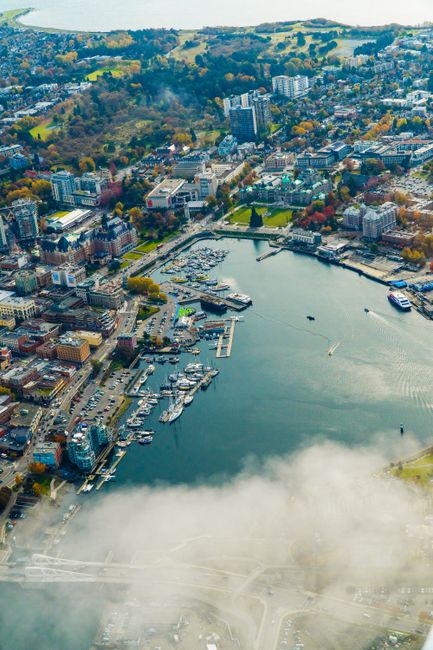
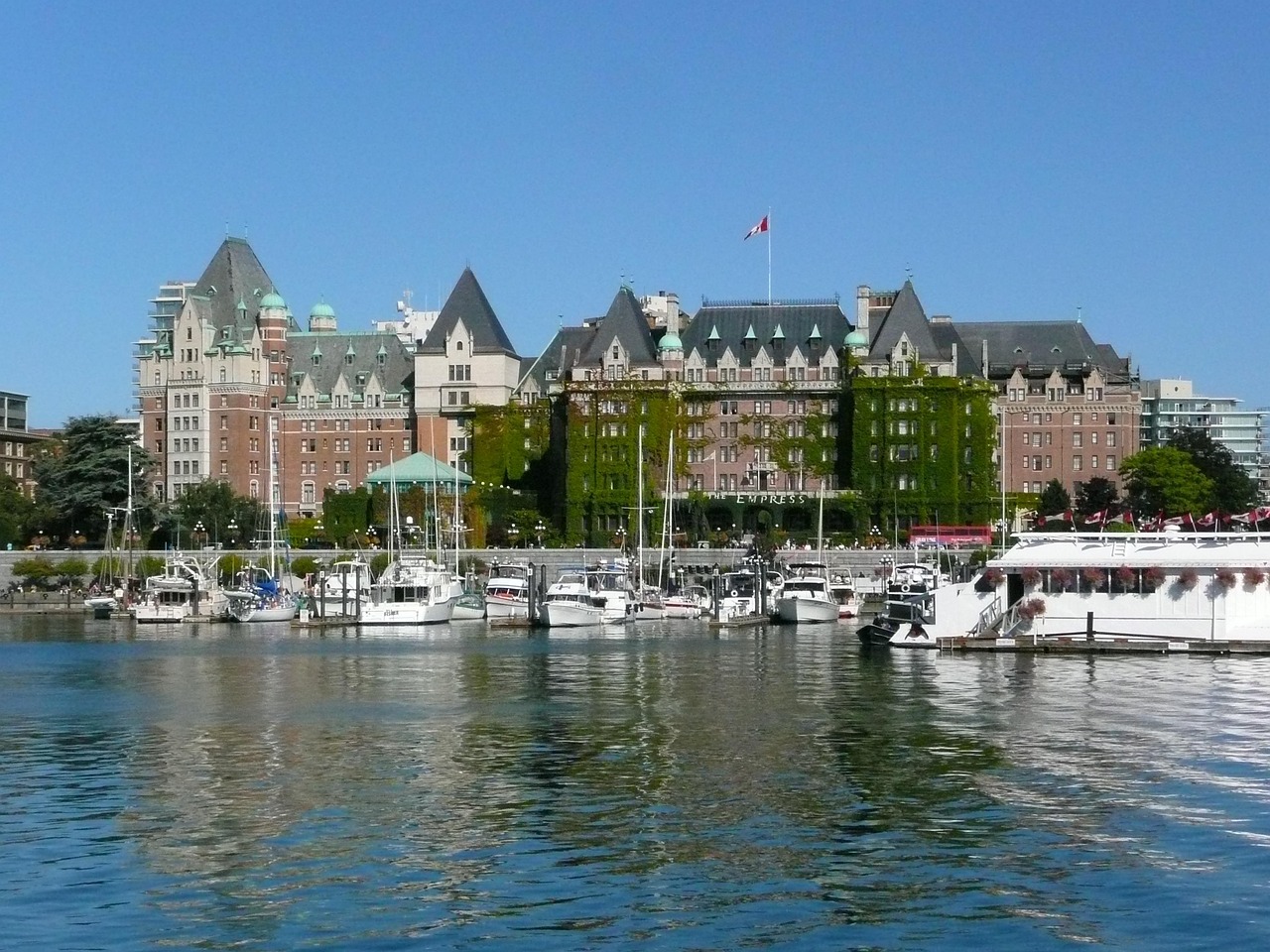
Victoria, the capital of British Columbia, sits at the southern tip of Vancouver Island, looking across the Strait of Juan de Fuca to the snowy Olympic Mountains of Washington State. Its compact downtown wraps around the Inner Harbour, where floatplanes, water taxis and whale-watching boats come and go in front of the domed Parliament Buildings and the ivy-clad Fairmont Empress hotel. Founded as a Hudson’s Bay Company fort in 1843 on the lands of the Lekwungen-speaking Songhees and Esquimalt peoples, it keeps Canada’s oldest Chinatown, Victorian mansions, tea rooms and gardens that bloom almost all year, thanks to the mildest and driest climate in Canada. About 92,000 people live in the city and some 400,000 in Greater Victoria. Visitors come for the Royal BC Museum, the world-famous Butchart Gardens, orca and humpback whale watching, seafood at Fisherman’s Wharf and cycling along the shore, and the city is the arrival point for ferries and floatplanes from Vancouver and Seattle.
Right now in Victoria
- Tue 10–16°C 51–60°F Cloudy
- Wed 9–16°C 49–60°F Fog
- Thu 12–18°C 53–64°F 2 mm Mostly clear
- Mon 12 Oct Thanksgiving
Weather: MET Norway (CC BY 4.0) · Sea temperature: NOAA CoastWatch · Air quality: OpenAQ · Rates: ECB · Holidays: Nager.Date
Top tours in Victoria
See all tours for Victoria →
From local operators, with prices and reviews; you check availability and book on Viator, our partner. We may earn a commission at no extra cost to you. How we earn money
Victoria at a glance
- Best months: May to September for sunshine, gardens in full flower and the best whale watching; April and October for quieter streets and lower prices.
- Time needed: two days for the Inner Harbour, the Royal BC Museum, the Parliament Buildings and Butchart Gardens; three or four with whale watching, Craigdarroch Castle and the coast.
- Getting there: BC Ferries from Tsawwassen (Vancouver) to Swartz Bay, 32 km (20 miles) north of downtown; floatplanes and helicopters land right in the harbour; ferries from Port Angeles and Seattle dock downtown.
- Costs (as of October 2026): prices are in Canadian dollars; a bus ride is $3 (about US$2.15) and a DayPASS $6; the Royal BC Museum is $32 for adults; Butchart Gardens is $36.75 in October. Shops add 5% GST plus 7% PST; hotels add about 16% in taxes.
- Before you go: entry rules (eTA or visa), money and driving in Canada are in our Canada travel guide.
Victoria neighbourhoods and who each one suits
The Inner Harbour and downtown
Everything starts at the Inner Harbour: the stone causeway in front of the Empress, buskers and artists in summer, and the terminals for the Coho and Clipper ferries, floatplanes and harbour ferries. Behind it, Government Street and the old brick streets of Old Town have shops, pubs, Munro’s bookshop and Bastion Square. This is the best base for a short stay without a car; nearly every sight is a walk away.
Chinatown and Fan Tan Alley
Victoria’s Chinatown, at the north end of downtown, is the oldest in Canada, founded in 1858 during the Fraser River gold rush. Walk under the Gate of Harmonious Interest and squeeze through Fan Tan Alley, a passage barely a metre wide that once led to gambling dens and now has tiny shops. Good for food and a short wander.
James Bay and Fairfield
South of the Parliament Buildings, James Bay is a quiet residential area of heritage houses and B&Bs between the harbour and Beacon Hill Park, with Fisherman’s Wharf and the cruise-ship terminal at Ogden Point at its western edge. Fairfield, farther east, leads to the shore at Dallas Road, Ross Bay Cemetery and Cook Street Village’s cafes. Ideal for couples and walkers who want calm streets close to the centre.
Rockland, Oak Bay and the Saanich Peninsula
Uphill from downtown, Rockland has grand Victorian homes, Craigdarroch Castle and Government House gardens. Oak Bay, east of the city, is a genteel seaside district with a village high street and a marina. North of the city, the rural Saanich Peninsula holds Butchart Gardens, wineries, farm stands, the airport, the town of Sidney and the Swartz Bay ferry terminal.
Top things to see in Victoria
BC Parliament Buildings
Completed in 1898 and outlined by more than 3,000 light bulbs at night, the Parliament Buildings face the Inner Harbour and are still home to the Legislative Assembly of British Columbia. Guided tours are free and last about 40 minutes; no booking is needed for individuals, just arrive 10 minutes before a tour at the Tour Desk inside the main entrance. The buildings are open from 8:30 a.m. to 4:30 p.m., Monday to Friday, for guided and self-guided visits, and closed at weekends and on holidays (including Thanksgiving Monday, 12 October 2026). Tour times change every week around school and group bookings, and the week’s schedule is posted on Friday afternoons; in early October 2026 there were two to four public tours a day. Expect security screening. Groups of 15 or more can book online.
Royal BC Museum
Next to the Parliament Buildings, the province’s main museum covers the natural and human history of British Columbia; allow 2 to 4 hours. The Natural History Gallery on the second floor recreates coastal forests, shorelines, deltas and the Ice Age past. On the third floor, the human history galleries are being reworked with First Nations and other communities, so some older displays have closed in recent years; what is open includes Old Town, the much-loved recreated streets of a turn-of-the-century town (reopened in 2023 with new stories, such as those of Black sleeping-car porters and Japanese Canadian photographers), the Jonathan Hunt House, an exhibit on living Indigenous languages, and a replica of Captain Vancouver’s HMS Discovery. Until 3 January 2027, the touring exhibition Ancient Egypt: Obsessed with Life is on the second floor, included in admission. Outside, Thunderbird Park has totem poles and the 1852 Helmcken House. The museum is open daily from 10 a.m. (until 5 or 6 p.m., depending on the day), closed on 25 December and 1 January. Admission: adults $32 (about US$23), seniors (65+) and youth (6–18) $22, students $19, children 5 and under and Indigenous people free; buy online to skip the line. IMAX combination tickets cost more.
Butchart Gardens
About 21 km (13 miles) north of downtown in Brentwood Bay, the Butchart family turned a worn-out limestone quarry into one of the world’s most famous gardens, starting in 1904: the Sunken Garden, the Rose Garden, the Japanese and Italian gardens and the Ross Fountain. The gardens are open all year, and the flowers change with the seasons, from spring bulbs to summer roses, autumn colour and, in December, Christmas lights. Prices include tax and change by month; there are no senior or student discounts.
| Butchart Gardens 2026/27 | Gate hours | Adult (18+) | Youth (13–17) | Child (5–12) |
|---|---|---|---|---|
| October 2026 | 9 a.m.–4 p.m. | $36.75 | $18.38 | $3 |
| November 2026 | 10 a.m.–4:30 p.m. | $28.60 | $14.30 | $3 |
| 1 Dec 2026–6 Jan 2027 (closed 25 Dec) | 3–9 p.m. | $41 | $20.50 | $5 |
| 7–17 Jan 2027 (closed 18–31 Jan) | 10 a.m.–4:30 p.m. | $25.20 | $12.60 | $3 |
| February–March 2027 | 10 a.m.–4:30 p.m. (Feb); 9 a.m.–4 p.m. (Mar) | $33.75 | $16.88 | $3 |
| April / May 2027 | 9 a.m.–5 p.m. | $42.25 / $45.60 | $21.13 / $22.80 | $3 / $5 |
The hours are gate times: you can stay for an hour after the gates close. Children under 5 are free. Tour buses and BC Transit buses run from downtown; by car, it is a 30-minute drive.
Craigdarroch Castle
Built in the late 1880s for coal baron Robert Dunsmuir, this Victorian mansion has four floors of carved woodwork, stained glass and period furniture, and a tower with views over the city. It is a 2 km (1.2-mile) walk uphill from downtown along Fort Street, or a short bus ride. The castle is open Wednesday to Sunday, 10 a.m. to 4:30 p.m. (ticket sales end 45 minutes before closing), closed 25 and 26 December and 1 January. Admission: adults $23.50, seniors (65+) and post-secondary students $21, youth (12–17) $15.50, children (4–11) $10.50, under-4s free with a paying adult. Parking on site is free. There are no ramps or elevators, so it is not wheelchair accessible.
Fisherman’s Wharf and the waterfront walk
A 20-minute walk west of the Inner Harbour (or a ride on the little harbour ferries), Fisherman’s Wharf is a cluster of brightly painted floating homes, fish-and-chip and taco kiosks and whale-watching docks, where harbour seals often swim between the boats. Do not feed them. From there, the shoreline path continues past the Ogden Point breakwater to Dallas Road, a clifftop walk with views across to the Olympic Mountains, past the Mile Zero marker of the Trans-Canada Highway and on to Beacon Hill Park, the city’s big central park with gardens, ponds and a petting farm in summer.
Parks and gardens
- Beacon Hill Park
- Thunderbird Park
Museums
- Art Gallery of Greater Victoria
- Craigdarroch Castle
- Emily Carr House
- Helmcken House
- Royal British Columbia Museum
Activities and best months
- Boat tripsWhale-watching operators such as Prince of Whales and Eagle Wing Tours run 3-hour-plus tours from Victoria's Inner Harbour (Eagle Wing from $179 plus taxes and fees, seasonal prices). · source
- City sightseeingThe BC Parliament Buildings offer free guided tours of about 40 minutes, Monday to Friday 8:30 a.m.-4:30 p.m., from the Tour Desk facing the Inner Harbour; the Royal BC Museum's Natural History Gallery and Craigdarroch Castle (Wednesday to Sunday) are nearby. · source
Other things to do in Victoria
Whale watching: orcas and humpbacks
Victoria is one of the best whale-watching bases on the west coast: boats leave the Inner Harbour and Fisherman’s Wharf for the Salish Sea and the Strait of Juan de Fuca, where Bigg’s (transient) orcas, which hunt seals and sea lions, are seen in every month, and humpback whales have returned in big numbers, mostly from spring to autumn. The endangered Southern Resident orcas are seen less often. Choose between covered boats and fast open Zodiacs (with flotation suits). The main season runs from about April to October, with trips continuing in winter on calm days. Tours take about 3 hours; Eagle Wing Tours, for example, starts at $179 per adult plus taxes and fees, with seasonal pricing. Federal rules require boats to keep their distance from whales, especially the endangered resident orcas.
- Afternoon tea: the Empress has served tea for over a century; several smaller tea rooms are cheaper.
- Cycling: the Galloping Goose Regional Trail, a converted railway line, runs west through the suburbs toward Sooke, and the Lochside Trail runs north to the Swartz Bay ferries.
- Kayaking: paddle the Inner Harbour and the Gorge Waterway, a calm tidal inlet, from rentals downtown.
- Emily Carr House: the James Bay birthplace of Canada’s best-known early modern painter.
- Food and drink: craft breweries in the old warehouses, oysters and Dungeness crab, and the Saanich Peninsula’s farm-gate stands and cideries.
Day trips from Victoria
Sooke and the Juan de Fuca coast
West of the city, Highway 14 runs along the coast to Sooke and beyond to the beaches of Juan de Fuca Provincial Park, with rainforest trails, tide pools at Botanical Beach near Port Renfrew, and storm watching in winter. On the way, East Sooke Regional Park has fine coastal hiking.
The Malahat and the Cowichan Valley
North of the city, the Trans-Canada Highway climbs over the Malahat, a mountain pass where winter tires are required on signed sections from 1 October to 30 April. At the top, the Malahat SkyWalk spirals above the forest with views over the Saanich Inlet. Beyond, the Cowichan Valley has wineries, the totem poles of Duncan and the riverside village of Cowichan Bay. In October and November, Goldstream Provincial Park, 20 minutes from downtown, is the place to watch chum salmon spawning and the bald eagles that feed on them.
Tofino and the west coast
Tofino and the beaches of Pacific Rim National Park Reserve are a long drive away, about 4.5 to 5 hours via Nanaimo and Highway 4, so plan at least two nights there (see our Tofino guide). The Gulf Islands, reached from Swartz Bay, are a slower, artsier escape. Across the strait, Port Angeles is the gateway to Olympic National Park in Washington State.
Nearby destinations
- Olympic National Park85 km
- Vancouver95 km
- Seattle119 km
- Whistler191 km
- Tofino203 km
- Mount Rainier National Park213 km
Getting there and getting around
By ferry from Vancouver (Tsawwassen–Swartz Bay)
BC Ferries’ big car ferries cross from Tsawwassen, south of Vancouver, to Swartz Bay in about 1 hour 35 minutes, threading through the Gulf Islands; sailings are frequent in summer and roughly every two hours in quieter months. Fares effective 16 June 2026: adults (12+) $21, children 5–11 $10.50, under-5s free, and $89 for a standard car (driver not included), plus a 5% fuel surcharge. Prepaid Saver fares can drop to $15 per passenger and from $34 to $84 for a car on quieter sailings. To guarantee a car space without prepaying, add a $20 reservation and pay the terminal fare on the day; this is wise on summer Fridays, Sundays and long weekends. Foot passengers can simply turn up. From Swartz Bay, BC Transit’s route 70 and 70X buses run downtown in about an hour. Ferries also link Horseshoe Bay (West Vancouver) and Tsawwassen with Nanaimo, a 1.5-hour drive north of Victoria.
By floatplane and helicopter
The fastest way between the two downtowns: Harbour Air seaplanes fly from Vancouver’s downtown harbour (and from the south terminal at YVR) to Victoria’s Inner Harbour in roughly 35 minutes, with fares often from about $199 including tax and fees on sale; its network also reaches Seattle’s Lake Union, Nanaimo, Whistler and Tofino. Helijet helicopters fly from Vancouver Harbour to a heliport near Ogden Point. Baggage limits are tight on both.
From Seattle and Port Angeles
Two US ferries dock in the Inner Harbour. Black Ball Ferry Line’s MV Coho carries cars and foot passengers between Port Angeles and Victoria in 90 minutes. Fares are in US dollars: US$25 for adults, US$12.50 for children 5–11, US$88 for a car and driver, plus a vehicle reservation fee (US$12 online); bikes travel free. In early October 2026 there are three sailings a day each way, fewer in winter, and the Coho is out of service for annual maintenance from 4 January to 3 February 2027. The passenger-only Victoria Clipper runs between Seattle’s Pier 69 and Victoria in about 2 hours 45 minutes to 3 hours; fares vary by date. Both are international crossings: you go through Canadian border control on arrival in Victoria and US border formalities before boarding for the United States, so carry a passport (US and Canadian citizens may use a NEXUS card, passport card or enhanced driver’s licence instead) and check our United States travel guide for US entry rules.
By air and from Victoria Airport (YYJ)
Victoria International Airport (YYJ) is near Sidney, about 25 km (16 miles) north of downtown, with flights across western Canada, to Toronto and to a few US cities. BC Transit routes 87 and 88 serve the airport, with up to 28 departures a day, connecting at McTavish Exchange with routes 70 and 72 to Swartz Bay and downtown. Because you change buses, budget $6 for the trip downtown (a DayPASS covers it). A taxi takes about 25 to 30 minutes.
Buses and getting around the city
Downtown Victoria is small and flat enough to walk; bring a bike or rent one for the shoreline paths. BC Transit runs the Victoria Regional Transit System:
| BC Transit Victoria fare | Adult (19–64) | Senior (65+) / youth (13–18) | Notes |
|---|---|---|---|
| Single ride | $3 | $3 | Children 12 and under free |
| DayPASS | $6 | $6 | Unlimited rides that day |
| 30-day pass | $85 | $45 | Valid ID may be required for the concession pass |
| 10 tickets | $30 | Paper tickets | |
Pay with the Umo app or a reloadable Umo card (load fares before you board), by tapping a contactless bank card where readers are installed, or with cash (exact change). The little harbour ferries that putter around the Inner Harbour to Fisherman’s Wharf and up the Gorge run mainly from spring to autumn. You do not need a car downtown, but one is handy for Butchart Gardens at off-peak times, Sooke and the Cowichan Valley.
When to go and how long to stay
Victoria sits in the rain shadow of the Olympic Mountains, so it gets far less rain than Vancouver: about 880 mm (35 in) a year at the airport, and noticeably less downtown. Summers are dry and sunny but rarely hot, with sea breezes keeping highs near 22 °C (72 °F); July averages under 20 mm (0.8 in) of rain. Spring arrives early: cherry and plum blossoms appear in February and March, when most of Canada is still frozen. Winters are mild, grey and damp, with a little snow most years, about 40 cm (16 in) a season, which can briefly bring the city to a standstill. Peak season runs from late June to early September, when cruise ships call almost daily and hotels are expensive; May, June and September are the sweet spot.
| Season | Average high | Average low | What it’s like |
|---|---|---|---|
| Spring (Mar–May) | 11–17 °C (51–62 °F) | 3–7 °C (37–45 °F) | Early blossoms and tulips; showers become rarer by May. |
| Summer (Jun–Aug) | 20–22 °C (68–72 °F) | 10–11 °C (50–52 °F) | Dry and sunny; cool evenings by the water; peak whale season. |
| Autumn (Sep–Nov) | 20 °C falling to 10 °C (67 to 49 °F) | 9 to 3 °C (48 to 37 °F) | September often warm and calm; rain returns from mid-October. |
| Winter (Dec–Feb) | 7–9 °C (45–48 °F) | 1–2 °C (34–35 °F) | Mild, wet and windy; occasional snow; the quietest and cheapest months. |
Figures are Environment and Climate Change Canada’s 1981–2010 climate normals for the Victoria International Airport station on the Saanich Peninsula. Downtown is a little milder in winter and drier.
Events worth planning around
- Royal Victoria Marathon (October, Thanksgiving weekend): road closures downtown and along Dallas Road.
- Butchart Gardens Christmas (1 December to 6 January): the gardens lit up in the evenings.
- Victoria Day (the Monday before 25 May): a big parade downtown for the holiday named after the queen the city is named after.
- Canada Day (1 July): celebrations and fireworks on the Inner Harbour.
- Summer festivals: the Victoria Fringe Festival in late summer, outdoor concerts, and the Butchart Gardens’ Saturday-night fireworks in July and August.
Dates change every year; check the organizers’ websites before you book.
How long to stay: 2, 3 and 4 days
- Two days: the Inner Harbour, a Parliament tour (weekdays) and the Royal BC Museum; Chinatown and Fan Tan Alley; Butchart Gardens in the late afternoon.
- Three days: add a whale-watching trip, Fisherman’s Wharf and the Dallas Road walk to Beacon Hill Park.
- Four days: add Craigdarroch Castle and a drive over the Malahat to the Cowichan Valley, or west to Sooke.
Where to stay in Victoria and the taxes on your bill
- Inner Harbour: waterfront hotels with views of the Parliament Buildings, steps from the ferries and floatplanes.
- Downtown and Old Town: boutique hotels and good-value chains near restaurants and Chinatown.
- James Bay and Rockland: heritage B&Bs on quiet streets, a short walk from the harbour.
- Sidney and the Saanich Peninsula: handy for early ferries and flights, and close to Butchart Gardens.
Taxes: prices are shown before tax. Most goods and services carry 5% GST plus 7% PST. Hotel rooms and other short-term rentals pay 8% PST, a 3% Municipal and Regional District Tax (MRDT) in the City of Victoria (2% in neighbouring Saanich and Oak Bay, 3% in Sidney) and 5% GST, so expect about 16% on top of the room rate in the city. Downtown hotel parking costs extra. Some attractions, such as Butchart Gardens, quote prices with tax included.
Practical tips for Victoria
- Time zone: Pacific Time, the same as Vancouver and Seattle; clocks go back on 1 November 2026.
- Cruise days: on summer days with several ships at Ogden Point, the Inner Harbour, Butchart Gardens and the museum are busiest from late morning to late afternoon.
- Ferry timing: book car spaces on BC Ferries for summer weekends and holidays, and allow plenty of time to reach Swartz Bay (about 30 minutes’ drive from downtown).
- Tipping: 15–20% in restaurants, before tax.
- Safety: Victoria is generally safe; there is visible homelessness downtown, especially around Pandora Avenue. On the shore, watch for slippery rocks and drifting logs at high tide, and keep well back from seals and sea lions.
- Emergencies: call 911.
What to pack for Victoria
Pack layers whatever the season: summer days are warm, but evenings and boat trips are cool and windy, so bring a fleece and a windproof jacket for whale watching. From October to April add a waterproof jacket with a hood and shoes that can handle puddles. Comfortable walking shoes matter most, since the city is best seen on foot. Sunscreen, sunglasses and a hat for summer, and binoculars if you plan to watch whales or birds.
What to pack
- City walking shoesLisbon and Porto are steep, with polished limestone cobbles that get slippery, so grippy soles matter.
- Day packs and anti-theft bagsA small zipped or anti-theft bag makes crowded trams and viewpoints less stressful.
- Dry bags and phone pouchesSpray soaks phones and cameras on open boats to the Algarve caves and on whale-watching trips.
- Fleeces and warm layersIt is cooler at sea than on land, especially on morning whale-watching trips.
- Rain jacketsA windproof, waterproof shell keeps you warm on open boats, where wind and spray cool you quickly.
- Reef-friendly sunscreenSun reflects off the water on cruises and cave tours.
- Travel adapters and convertersPortugal uses Type C and F sockets at 230 V, so most visitors from outside Europe need an adapter.
- Water shoesKayak and small-boat trips to the Algarve grottoes land on rock and wet sand.
Victoria travel FAQ
How do I get from Vancouver to Victoria?
Take BC Ferries from Tsawwassen to Swartz Bay (about 1 hour 35 minutes; $21 per adult, $89 per car, plus fuel surcharge), then a bus or drive 30 minutes to downtown. A Harbour Air floatplane or Helijet helicopter is faster, about 35 minutes harbour to harbour.
Do I need to reserve the BC Ferries sailing to Victoria?
Foot passengers do not. Drivers should book on summer weekends and holidays: either prepay a fare or pay a $20 reservation and the normal fare at the terminal.
How much is Butchart Gardens?
It depends on the month: $36.75 for adults in October 2026, $28.60 in November and $41 during the Christmas lights. Prices include tax; children 5–12 pay $3 to $5. The gardens close from 18 to 31 January 2027.
Are tours of the BC Parliament Buildings free?
Yes. Free 40-minute guided tours run on weekdays between 8:30 a.m. and 4:30 p.m.; no booking is needed for individuals. Times change weekly, and the buildings are closed at weekends and on holidays.
Is the Royal BC Museum open in 2026?
Yes, daily from 10 a.m. Adults pay $32. The Natural History Gallery and Old Town are open, the human history galleries are being renewed, and Ancient Egypt: Obsessed with Life runs until 3 January 2027.
When is the best time for whale watching in Victoria?
From about April to October, when humpbacks are most common and seas calmer. Bigg’s orcas can be seen in any month. A 3-hour trip starts at around $179 plus tax.
How do I get from Victoria to Seattle?
The Victoria Clipper goes direct to Seattle’s Pier 69 in about 3 hours (foot passengers only). With a car, take the Coho to Port Angeles (90 minutes, US$88 for car and driver) and drive about 2.5 hours. Seaplanes also fly to Lake Union.
How do I get from Victoria airport to downtown?
BC Transit routes 87 or 88 to McTavish Exchange, then route 70 or 72 downtown; budget $6. A taxi takes about 25 to 30 minutes.
What taxes are added to hotel bills in Victoria?
8% PST, 3% MRDT and 5% GST in the City of Victoria, about 16% in total (2% MRDT in Saanich and Oak Bay).
When is the best time to visit Victoria?
May to September for sunshine and whales, with May, June and September the best value. Victoria is also Canada’s mildest city in winter, when hotels are cheapest.
Sources
- © OpenStreetMap contributors · ODbL · fetched 4 Oct 2026
- Wikidata · CC0 · fetched 4 Oct 2026
Sources and last review
Researched and last reviewed on 4 October 2026. Parliament tour rules and hours come from the Legislative Assembly of British Columbia; museum hours, prices and exhibitions from the Royal BC Museum; Butchart Gardens hours and 2026/27 rates from The Butchart Gardens; castle hours and prices from Craigdarroch Castle; ferry fares and booking rules from BC Ferries’ fare guide effective 16 June 2026; Coho fares, schedule and maintenance period from Black Ball Ferry Line; Clipper times from the Victoria Clipper; floatplane routes and fares from Harbour Air; bus fares from BC Transit; airport bus details from Victoria International Airport; accommodation taxes from the Government of British Columbia and its MRDT map; winter tire rules from the BC government; whale-watching prices from Eagle Wing Tours; climate from Environment and Climate Change Canada’s 1981–2010 normals for Victoria International Airport; population from Wikidata. Ferry crossing times, flight times, distances, Clipper fares, whale seasons and species, historical details, events and harbour-ferry seasons are flagged for checking. Prices and timetables change, so check the official sites before you go. For entry rules, money and general safety, see our Canada travel guide.
Plan your trip
Partner links: TravelerCenter may earn a commission if you book, at no extra cost to you.