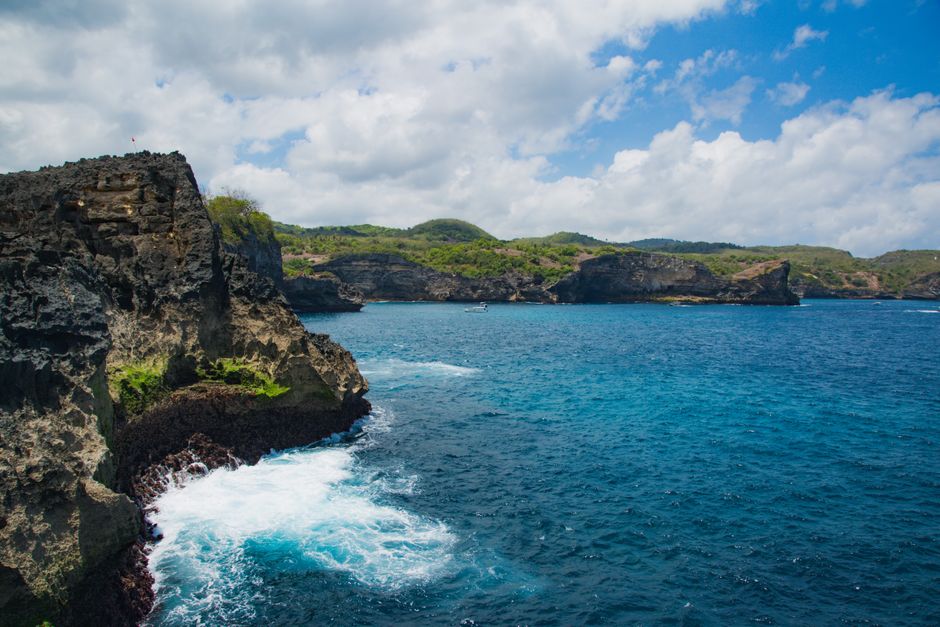
Nusa Penida, the largest of three islands off Bali’s southeast coast, is a rugged limestone plateau of about 200 km² (77 sq miles) rising straight out of the sea, part of Bali’s Klungkung regency. Its sheer white cliffs and turquoise coves have made it one of Indonesia’s most photographed places: the dinosaur-shaped headland above Kelingking Beach, the natural arch of Broken Beach, the tidal pool of Angel’s Billabong, and Diamond and Atuh beaches on the east coast. Below the surface, manta rays gather off the southwest coast, and from about July to October divers look for the giant oceanic sunfish (mola mola). Life on the island is still rural, with villages, temples and seaweed farms, and its smaller neighbors, Nusa Lembongan and Nusa Ceningan, are calmer, with beaches and easy snorkeling. Nusa Penida is 30–45 minutes by fast boat from Sanur; the dry season, from about April to October, brings the best weather, but the cliffs, currents and roads need care at any time of year.
Right now in Nusa Penida (Sampalan)
- Wed24–30°C75–86°FMostly clear
- Thu24–29°C75–85°F1 mm rain
- Fri25–30°C76–85°F1 mm rain
Top tours in Nusa Penida
See all tours for Nusa Penida →
From local operators, with prices and reviews; you check availability and book on Viator, our partner. We may earn a commission at no extra cost to you. How we earn money
Nusa Penida at a glance
- Best for: dramatic cliff viewpoints, manta-ray snorkeling and diving, wild beaches, temples and a slower pace than Bali.
- How long: a long day trip from Bali at a minimum; 2–3 nights to see both coasts without rushing.
- Best time: April to October, the dry season; mornings are calmer and less crowded at the viewpoints.
- Getting there: fast boats from Sanur in about 30–45 minutes, plus boats from Kusamba and Padang Bai and between the Nusa islands.
- Getting around: a car with driver or a scooter, but roads are narrow, steep and sometimes rough.
- Good to know: the regency charges visitors a tourism retribution, and Bali’s tourist levy applies to all foreign visitors to the province.
- Before you go: the Bali Tourism Levy and temple etiquette are in our Bali travel guide; visas, the arrival card, money and general safety are in our Indonesia travel guide.
Nusa Penida’s areas: where things are
The island measures about 20 km (12 miles) from east to west. Boats land on the north coast, where the main villages and most accommodation are; the famous viewpoints are on the west, south and east coasts, an hour or more apart by road.
Toyapakeh and the northwest
The northwest coast around Toyapakeh, opposite Nusa Lembongan, has the main fast-boat landing points, Crystal Bay’s beach and snorkeling, guesthouses and dive shops. It is the closest base to Kelingking and Broken Beach.
Sampalan and the north coast
Sampalan, the island’s main town, has the market, the harbor for boats from Kusamba and Padang Bai, and simple hotels; the coast road east leads to the cave temple of Goa Giri Putri.
The east coast
The east is the most dramatic and least developed part of the island, with Diamond Beach, Atuh Beach, the Thousand Islands viewpoint and Rumah Pohon tree houses; a few cliff-top resorts and bungalows let you stay close to the sunrise.
Nusa Lembongan and Nusa Ceningan
Lembongan, linked to Ceningan by the yellow suspension bridge, has white-sand beaches such as Dream Beach, mangrove tours, surf breaks and many hotels; it is smaller, calmer and more developed for tourism, and a short boat ride from Penida.
Top things to see on Nusa Penida
Kelingking Beach
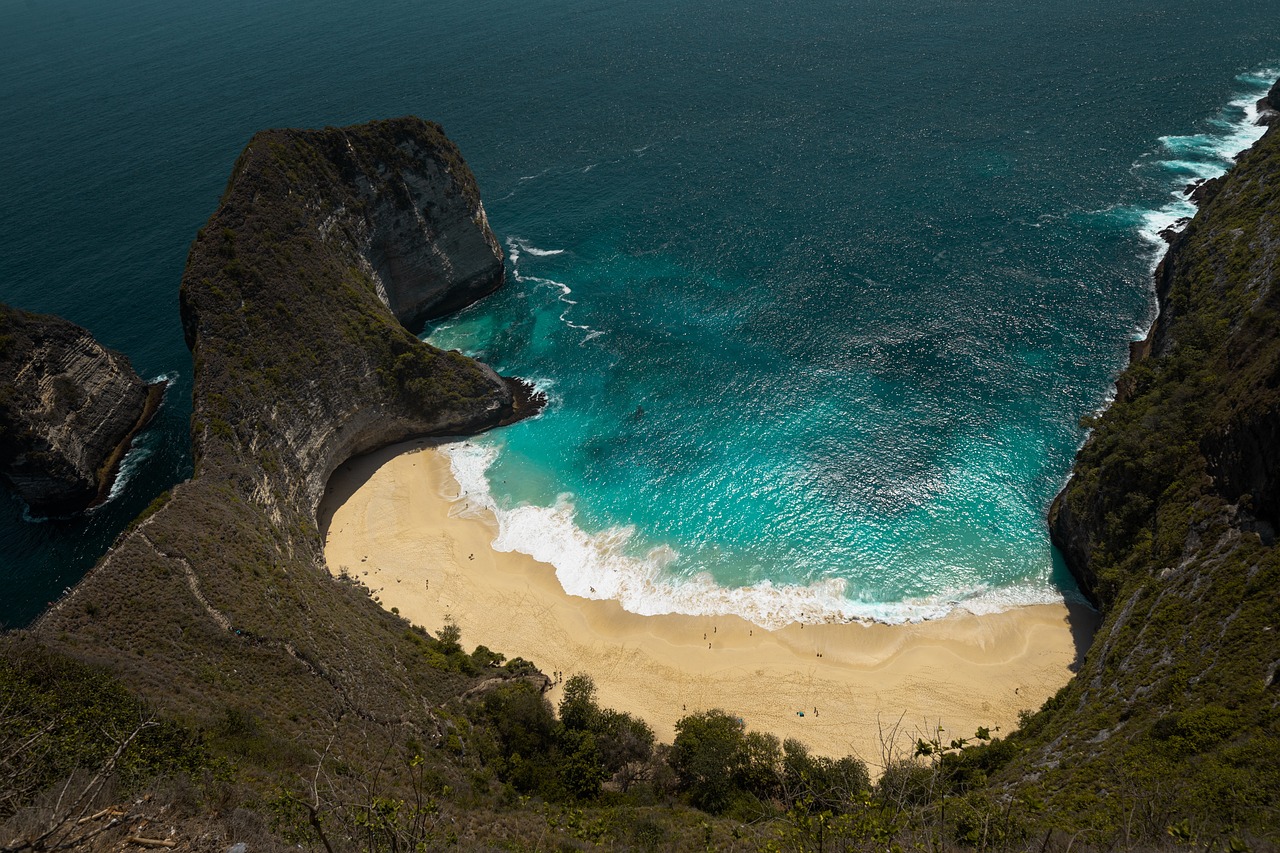
The viewpoint above Kelingking, where a headland shaped like a dinosaur’s back curves out into turquoise water, is Nusa Penida’s most famous sight. A steep, narrow path of bamboo railings and rough steps zigzags down the cliff to the beach, a hard 30–60 minutes each way; only fit visitors with good shoes should try it, and never in rain. The sea at the bottom has powerful waves and currents; swimming is dangerous. The viewpoint gets very crowded from mid-morning; go early or late. The regency’s tourism office has been working with the village of Bunga Mekar on managing the site.
Broken Beach and Angel’s Billabong
At Broken Beach (Pasih Uug), the sea rushes through a natural arch into a circular cove, with a path around the cliff top. Next door, Angel’s Billabong is a rock pool on the cliff edge that looks calm at low tide, but waves can surge over it without warning; people have been swept out to sea, so admire it from above.
Diamond Beach and Atuh Beach
On the east coast, steps cut into the cliff lead down to Diamond Beach, a white-sand cove framed by pinnacles of rock, and the next bay, Atuh, has a rock arch offshore and simple warungs. Currents can be strong; swim only in calm conditions.
Manta Point and Crystal Bay
Off the southwest coast, reef manta rays gather at Manta Point to be cleaned by small fish, and snorkeling and dive boats visit most days, sea conditions permitting. Crystal Bay, on the west coast, has coral gardens and, from about July to October, is a famous site for spotting oceanic sunfish, mainly for experienced divers in cold upwellings and strong currents. See our diving and snorkeling guides.
Goa Giri Putri
A Hindu temple inside a cave on the north coast, entered through a narrow opening that widens into a great chamber with shrines. Wear a sarong and sash, which are provided, and follow the priests’ instructions.
More classic sights
- Peguyangan Waterfall: a spring and temple at the bottom of a long blue staircase down the cliff.
- Thousand Islands viewpoint (Pulau Seribu): rocky islets off the east coast.
- Rumah Pohon (tree houses): stilt huts above the sea near Atuh.
- Pura Dalem Ped: an important temple near Toyapakeh associated with Bali’s protective spirits.
- Banah Cliff and Tembeling: a clifftop viewpoint and a forest spring with pools.
Beaches, snorkeling and diving
Nusa Penida’s beaches are spectacular but mostly unsafe for swimming because of waves and currents. The best snorkeling is on boat trips to Manta Point, Crystal Bay, Gamat Bay and Wall Lembongan, or from the beach at Crystal Bay when the sea is calm. The waters around the Nusa islands are part of a marine protected area, with cold upwellings that bring in mantas and sunfish but can make the water surprisingly chilly. Dive with experienced operators and listen to briefings about currents. See our beaches and boat trips guides.
Other things to do on Nusa Penida
Food and drink
Nusa Penida’s food is simple: warungs serve nasi campur, grilled fish, sate and seaweed dishes, and the island’s farmers grow seaweed in the shallows off Lembongan and Ceningan. Toyapakeh, Crystal Bay and the east coast have a growing number of cafés. Drink bottled water and only labeled alcohol.
Village life and temples
Most of the island’s people are Balinese Hindu farmers and fishermen. Temples hold ceremonies throughout the year, and traditional weaving is still practiced in some villages. Dress modestly away from the beach, and ask before taking photos of people.
Nusa Lembongan and Ceningan
Spend a day or a night on Lembongan: walk or cycle between Dream Beach, Devil’s Tear (a cliff where waves explode through the rocks; stay back from the edge), the mangroves and the yellow bridge to Ceningan’s Blue Lagoon, where cliff jumping is popular but dangerous.
Day trips from Bali to Nusa Penida
- West coast tour: Kelingking, Broken Beach, Angel’s Billabong and Crystal Bay in a long day from Bali.
- East coast tour: Diamond Beach, Atuh, Rumah Pohon and the Thousand Islands viewpoint; better from an overnight base.
- Snorkeling day trip: Manta Point, Crystal Bay, Gamat Bay and Wall Lembongan by boat.
- Lembongan and Ceningan: beaches, mangroves and the yellow bridge.
- From Sanur: combine a morning boat with the Sanur beach path on your return. See our Bali guide.
Nearby destinations
- Sanur30 km
- Ubud39 km
- Kuta40 km
- Canggu44 km
- Bali66 km
- Gili Islands72 km
- Lombok87 km
- Bromo Tengger Semeru National Park294 km
Getting there and getting around
By boat
Fast boats from Sanur, on Bali’s east coast, reach Nusa Penida’s northwest coast at Toyapakeh, Banjar Nyuh or Buyuk in about 30–45 minutes, with frequent departures in the morning and afternoon; boats also run from Kusamba and Padang Bai to Sampalan and Buyuk, and car ferries carry vehicles. Boats land on the beach or at small jetties, so expect to wade; wear shorts and carry bags you can lift. Between Penida and Lembongan, small boats cross in about 10–15 minutes. Seas can be rough, especially from June to September; choose established operators with life jackets, and allow for cancellations.
Tourism retribution and the Bali levy
As part of Bali Province, Nusa Penida is covered by the Bali Tourism Levy of 150,000 rupiah per foreign visitor, which you pay once per trip to Bali. Klungkung regency also collects its own retribution for recreation and tourism areas, sold at the harbors and at some sites, and in 2026 its tourism office was coordinating the supervision of these fees and the management of attractions such as Kelingking with local villages. Keep your receipts.
Around the island
Roads have improved but are still narrow, winding and steep, with potholes and rough sections near some viewpoints. Most day-trippers hire a car with a driver, which is the safest option; scooters are available at the harbors, but only experienced riders with a license and International Driving Permit should rent one, and you must wear a helmet. Travel times are long: allow at least an hour between the west-coast and east-coast sights.
When to go and how long to stay
Nusa Penida is drier than mainland Bali, lying in the rain shadow of Mount Agung, with a dry season from about April to October. BMKG has no published normals for the island, so the table uses the nearest official data for Bali’s south coast: average daily highs and lows are 1991–2020 averages of BMKG’s observations at Ngurah Rai Airport, from NOAA’s global daily records, and rainfall and rain days are BMKG’s long-term normals for Denpasar (1961–1990), as published by the World Meteorological Organization. Expect slightly less rain on Nusa Penida.
| Month | Average high / low (south Bali) | Rain (rain days), Denpasar | What to expect on Nusa Penida |
|---|---|---|---|
| January | 31 °C (88 °F) / 25 °C (77 °F) | 345 mm (13.6 in), 27 days | Wet; slippery paths; boats may be canceled |
| February | 31 °C (88 °F) / 25 °C (76 °F) | 274 mm (10.8 in), 22 days | Wet and humid; quiet |
| March | 31 °C (88 °F) / 25 °C (77 °F) | 234 mm (9.2 in), 20 days | Rain easing; Nyepi closes boats for a day |
| April | 31 °C (88 °F) / 25 °C (77 °F) | 88 mm (3.5 in), 9 days | Dry season begins; calm seas |
| May | 31 °C (87 °F) / 24 °C (76 °F) | 93 mm (3.7 in), 8 days | Sunny; great visibility for snorkeling |
| June | 30 °C (86 °F) / 24 °C (75 °F) | 53 mm (2.1 in), 6 days | Dry; bigger swells; cooler water |
| July | 29 °C (85 °F) / 24 °C (75 °F) | 55 mm (2.2 in), 4 days | Peak season; sunfish season begins |
| August | 29 °C (85 °F) / 24 °C (74 °F) | 25 mm (1.0 in), 4 days | Driest; busiest; cold upwellings |
| September | 30 °C (86 °F) / 24 °C (74 °F) | 47 mm (1.9 in), 8 days | Dry; sunfish season continues |
| October | 31 °C (88 °F) / 24 °C (76 °F) | 63 mm (2.5 in), 12 days | Warm; quieter |
| November | 32 °C (89 °F) / 25 °C (77 °F) | 179 mm (7.0 in), 16 days | Rains begin; low season |
| December | 31 °C (88 °F) / 25 °C (77 °F) | 276 mm (10.9 in), 22 days | Wet; holiday crowds |
According to BMKG’s outlook for the 2026–27 rainy season, a very strong El Niño was expected to delay the start of the rains across Bali to November or December 2026 and to shorten the season.
One long day from Bali
Take the first fast boat from Sanur, see Kelingking, Broken Beach and Angel’s Billabong with a driver, snorkel at Crystal Bay, and catch the afternoon boat back.
Three days on the Nusa islands
Day one, the west coast. Day two, a snorkeling trip to Manta Point in the morning and the east coast’s Diamond and Atuh beaches in the afternoon. Day three, cross to Lembongan and Ceningan before returning to Bali.
Where to stay on Nusa Penida
- Toyapakeh and Ped: guesthouses, dive resorts and restaurants near the boats.
- Crystal Bay: bungalows near the beach and the west-coast sights.
- The east coast: cliff-top bungalows and boutique resorts near Atuh and Diamond Beach.
- Nusa Lembongan: a wider choice of hotels, beach clubs and restaurants.
What a trip to Nusa Penida costs
Prices are approximate, for October 2026, converted at about 17,900 rupiah to the US dollar.
| Item | Typical cost |
|---|---|
| Bali Tourism Levy, per person, once per visit to Bali | 150,000 rupiah (about US$8.40) |
| Fast boat, Sanur to Nusa Penida, one way | 150,000–300,000 rupiah (about US$8.40–17) |
| Car with driver, full day on the island | 600,000–900,000 rupiah (about US$34–50) |
| Scooter rental, per day | 80,000–120,000 rupiah (about US$4.50–6.70) |
| Snorkeling trip with Manta Point, shared | 300,000–500,000 rupiah (about US$17–28) |
| Two fun dives | 1,300,000–1,800,000 rupiah (about US$73–100) |
| Site and parking fees at viewpoints | 10,000–25,000 rupiah (about US$0.60–1.40) each |
| Nasi campur at a warung | 25,000–45,000 rupiah (about US$1.40–2.50) |
| Guesthouse double, per night | 300,000–600,000 rupiah (about US$17–34) |
| Cliff-top resort, per night | 1,500,000 rupiah and up (about US$84 and up) |
Practical tips for Nusa Penida
- Start early: beat the day-trip crowds at Kelingking by arriving before 9 a.m.
- Cash: ATMs are few; carry cash for fees, parking and warungs.
- Shoes: wear proper shoes for cliff paths, not flip-flops.
- Pace yourself: don’t try to see both coasts in one day trip.
- Book the return: confirm your boat time and be at the beach early; boats fill up.
Safety
Nusa Penida’s beauty comes with real risks. Cliffs: viewpoints often have no railings; stay back from the edges, especially when taking photos. The paths down to Kelingking and Diamond beaches are steep and slippery. Sea: big waves, strong currents and rip currents make most beaches dangerous for swimming, and waves can sweep over Angel’s Billabong without warning; snorkel only with boat crews where conditions are calm. Boats: crossings can be rough; use established operators and wear a life jacket in bad weather. Roads: scooter accidents are common on the steep, narrow roads; hire a driver if you are not an experienced rider. Medical care on the island is basic, and serious cases go to Bali. Avoid unlabeled alcohol because of the risk of methanol, drink bottled water to avoid “Bali belly,” and keep away from stray dogs and monkeys because of rabies. In an emergency, call 112.
What to pack for Nusa Penida
Sturdy shoes with grip, swimwear and a rash guard, a light wetsuit or long-sleeved top for cool-water snorkeling, reef-safe sunscreen, a hat, a dry bag for the boat landing, a sarong for temples, cash, a power bank and a light rain jacket from November to March. Indonesia uses 230 V and round two-pin plugs.
Nusa Penida travel FAQ
How do I get from Bali to Nusa Penida?
By fast boat from Sanur in about 30–45 minutes, with frequent departures, or from Kusamba or Padang Bai.
Can I visit Nusa Penida as a day trip?
Yes. Most visitors see the west coast, Kelingking, Broken Beach, Angel’s Billabong and Crystal Bay, in a long day, but staying overnight lets you see the east coast too.
Is it safe to walk down to Kelingking Beach?
Only for fit visitors in good shoes and dry weather. The path is steep and rough, and swimming at the bottom is dangerous because of waves and currents.
Can you swim at Angel’s Billabong?
It is not recommended. Waves can surge over the pool without warning and have swept people out to sea.
Can I see manta rays at Nusa Penida?
Yes, at Manta Point off the southwest coast, on snorkeling and diving trips, sea conditions permitting.
When is mola mola season at Nusa Penida?
Divers most often see oceanic sunfish from about July to October, when cold water wells up around the Nusa islands.
When is the best time to visit Nusa Penida?
April to October, the dry season. Go early in the morning to avoid crowds at the viewpoints.
Do I need to pay a tourist tax on Nusa Penida?
The Bali Tourism Levy applies to all foreign visitors to Bali Province, and Klungkung regency charges its own retribution at harbors and sites.
Should I rent a scooter on Nusa Penida?
Only if you are an experienced, licensed rider. Roads are steep and narrow, and many visitors hire a car with a driver instead.
How many days do I need on Nusa Penida?
One long day for the west coast, or two to three nights to see both coasts, Manta Point and Nusa Lembongan.
Plan your trip
Partner links: TravelerCenter may earn a commission if you book, at no extra cost to you.
🇮🇩 Useful Indonesian phrases for Nusa Penida
All 38 Indonesian phrases: restaurant, hotel, emergencies, romance (printable) →
Sources · last reviewed 4 October 2026
Researched and last reviewed on 4 October 2026. The Bali Tourism Levy: the Bali provincial government’s Love Bali website; Klungkung regency’s tourism retribution and the 2026 coordination on Kelingking: Klungkung regency tourism office (Dinas Pariwisata); the 2026–27 rainy season outlook: BMKG; temperatures: BMKG observations at Ngurah Rai Airport via NOAA GHCN-Daily (1991–2020 averages); rainfall normals: BMKG for Denpasar via the WMO World Weather Information Service (1961–1990); exchange rate: Bank Indonesia. Island area, boat routes and times, the amount of the regency retribution, the marine protected area, dive sites, sunfish season, path lengths and typical prices are general references or estimates, flagged for checking. Prices and rules change, so check before you go. For entry rules, money and general safety, see our Indonesia travel guide.
Data: Weather: MET Norway (CC BY 4.0) · Sea temperature: NOAA CoastWatch · Rates: ECB · Costs: World Bank ICP and price levels · Wikidata (CC0)