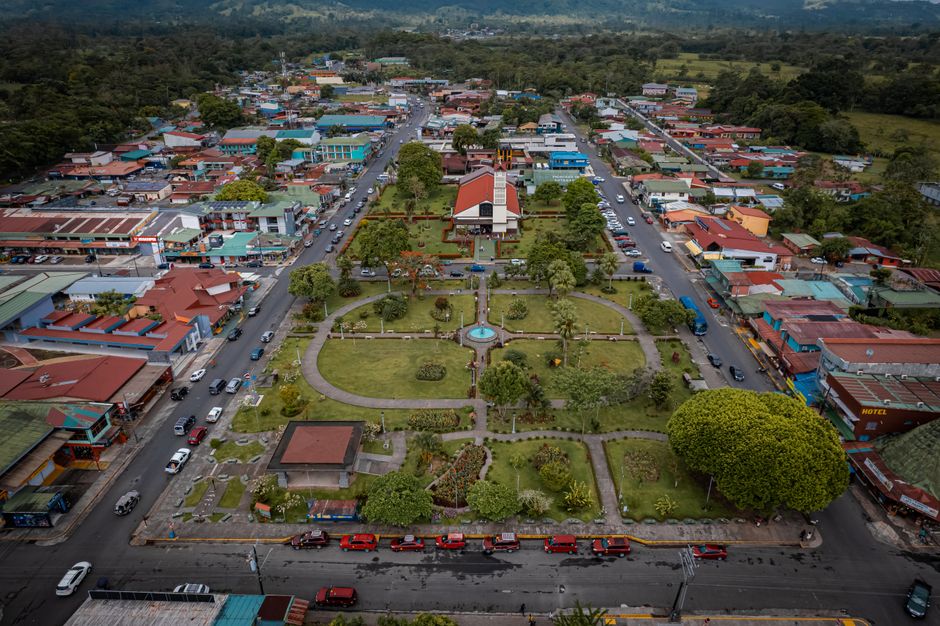
La Fortuna is the small town at the foot of Arenal Volcano, the near-perfect cone that rises to about 1,670 m (5,480 ft) above the rainforest of Costa Rica’s northern plains. Arenal was one of the world’s most active volcanoes for four decades after it erupted in 1968, and although it has been quiet for years, the lava flows, the steaming rivers and the hot springs it heats are the reason most visitors come. Around the town you can hike across old lava in the national park, soak in thermal pools, swim below a 70 m (230 ft) waterfall, walk hanging bridges through the canopy, raft or kayak, and take day trips to the sky-blue Río Celeste and the wetlands of Caño Negro. La Fortuna is a stop on almost every first trip to Costa Rica, about three hours from San José, and a natural partner for Monteverde across Lake Arenal. It rains a lot here, at any time of year, which is why it is so green.
Right now in La Fortuna
- Wed23–31°C74–88°F6 mm rain
- Thu23–31°C73–87°F10 mm rain
- Fri22–30°C72–87°F7 mm rain
Top tours in La Fortuna
See all tours for La Fortuna →
From local operators, with prices and reviews; you check availability and book on Viator, our partner. We may earn a commission at no extra cost to you. How we earn money
La Fortuna at a glance
- Best for: volcano views and lava-flow hikes, hot springs, waterfalls, hanging bridges, rafting, birdwatching and family adventure.
- How long: two nights for the park, the waterfall and a hot spring; three or four to add Río Celeste, Caño Negro or a rafting day.
- Best time: February to April is the least rainy, according to the National Meteorological Institute’s regional data, and the best chance of seeing the summit; the volcano is often in cloud, so stay at least two nights.
- Getting there: about three hours by road from San José or Liberia, by shuttle, bus or rental car, or a short SANSA flight to La Fortuna’s airstrip (FON).
- Before you go: entry rules, money and the national park ticket system are in our Costa Rica travel guide.
La Fortuna’s areas: where things are
The town of La Fortuna has a grid of streets around a central park and church, with tour agencies, restaurants, banks and budget hotels; from its streets you look straight up at the volcano. A road runs west from town toward the volcano and Lake Arenal, lined with the big hot spring resorts and lodges for about 5–10 km (3–6 miles); further on are the national park entrance, the village of El Castillo on the far side, and the dam at the end of the lake. The road to the La Fortuna waterfall climbs south from town.
Which area suits you depends on how you travel. Stay in town without a car: you can walk to restaurants, supermarkets and tour pick-ups, and buses and taxis leave from the center. The road west is for hot-spring resorts and volcano-view rooms, but you will need taxis or a car to eat out. El Castillo, on the far side of the national park, is a quiet hillside village above the lake with lodges, a butterfly garden and some of the best volcano views, reached by a partly unpaved road. East and south of town, toward Chachagua, rainforest lodges with their own trails and rivers suit birders and families who want space.
Top things to see around La Fortuna
Park prices and hours below were checked with SINAC in October 2026. Hot springs, the waterfall and hanging bridges are private or community-run and set their own prices, so check their own sites.
Arenal Volcano National Park
Created in 1991, the park protects the volcano and the forest around it. Its trails cross the lava flows of 1992, now covered in young forest, to viewpoints of the cone and Lake Arenal, and pass a ceiba tree more than 400 years old, according to SINAC. You can’t climb to the summit: the trails stay on the lower slopes. According to SINAC, the park opens daily from 8 a.m. to 4 p.m., and foreign visitors pay US$16.95 (US$5.65 for children); all entry money goes to the National Parks Fund, which supports every protected area. Arrive early for the best chance of a clear view, and look for coatis, toucans, oropendolas and, with a guide, snakes such as eyelash vipers.
Hot springs
Rivers heated by the volcano feed dozens of thermal pools along the road west of town, from big resorts with landscaped terraces, slides and swim-up bars to simpler pools and free spots in the river where locals go. Day passes are sold at the resorts, often with dinner; an evening soak after a hike is the classic La Fortuna end to the day. Check water temperatures if you are pregnant or have heart problems, and drink plenty of water.
The La Fortuna waterfall
South of town, a steep trail of about 500 steps leads down through the forest to a waterfall of about 70 m (230 ft) plunging into an emerald pool. It is run by a local development association, which charges an entrance fee that funds community projects. Swimming is allowed only in the marked area away from the base of the falls, where the current is strong; the climb back up is tiring, so go early.
Hanging bridges and Lake Arenal
Several private reserves have trails with long suspension bridges through the rainforest canopy, one of the best ways to see birds, monkeys and sloths at eye level; guided early-morning and night walks add more wildlife. Lake Arenal, a reservoir west of the volcano, is good for kayaking, fishing and sunset views, and its north shore road toward Nuevo Arenal and Tilarán is one of the country’s prettiest drives.
Other things to do in La Fortuna
- Rafting and kayaking: gentle floats on the Peñas Blancas river for wildlife, and class III–IV whitewater on the Toro and Balsa rivers.
- Hiking: besides the national park, private reserves have trails to the 1968 lava flows and viewpoints, and Cerro Chato, a steep, muddy climb to a crater lagoon, is for fit hikers with a guide. See our hiking guide.
- Zip lines, canyoning and horse riding: offered by many operators around town; choose established companies with good safety records.
- Chocolate and farm tours: learn how cacao, sugar cane and coffee are grown and processed on family farms.
- Night walks: frogs, including the red-eyed tree frog, tarantulas and sleeping birds with a guide and a flashlight.
Food and drink in La Fortuna
La Fortuna eats like the rest of rural Costa Rica, well and without fuss. In the streets around the central park, sodas serve the casado (rice, beans, salad, plantain and a choice of meat, fish or vegetarian), olla de carne beef and vegetable soup, and breakfast gallo pinto; they are the cheapest and often the tastiest meals in town. The northern plains are cattle and dairy country, so beef and fresh cheese are good, and you will see tilapia from local fish farms on many menus. Try fresh fruit drinks (batidos) made with water or milk, and the local chorreado, a sweet corn pancake.
For something different there are steakhouses, Italian and Mexican places, vegan cafés and a few upscale restaurants in the resorts along the road west, many with volcano views at sunset. Chocolate and cacao farms near town include tastings, and most hot-spring day passes can be combined with a buffet dinner. Bars around the central park stay open later at weekends, but La Fortuna is a place for early nights and early starts. Restaurant bills usually include the 10% service charge and 13% VAT.
Day trips from La Fortuna
- Río Celeste and Tenorio Volcano National Park: a river colored an unreal sky blue by minerals, with a waterfall and bubbling springs, about 1.5–2 hours north-west. Tenorio is one of the parks whose tickets SINAC sells online for a set time; swimming in the river is not allowed inside the park.
- Caño Negro Wildlife Refuge: a wetland near the Nicaraguan border with caimans, waterbirds, monkeys and iguanas, best seen on a boat tour. According to SINAC, it opens from 8 a.m. to 4 p.m. and foreign visitors pay US$5.65; tours usually include it.
- Monteverde: continue by the “jeep-boat-jeep” across Lake Arenal or by road around it; see our Monteverde travel guide.
- Venado caves: about an hour north, a guided tour through limestone caves with underground streams, bats and crawl spaces; wear clothes you don’t mind getting muddy.
- Bajos del Toro waterfalls: about two hours south-east over the mountains, the cloud forest around Bajos del Toro has several tall waterfalls, including one that drops into an extinct volcanic crater; trails are steep and run by private reserves.
- Nuevo Arenal and the lake road: a scenic drive along the north shore of Lake Arenal, with bakeries, viewpoints and windsurfing near Tilarán at the western end.
- Sarapiquí and the Caribbean side: rafting and rainforest research stations on the road east toward Tortuguero; see our Tortuguero National Park guide.
Nearby destinations
- Monteverde26 km
- San José86 km
- Tortuguero National Park126 km
- Tamarindo128 km
- Manuel Antonio National Park134 km
- San Juan del Sur160 km
- Granada216 km
- Puerto Viejo de Talamanca226 km
Getting there and getting around
By shuttle, bus or car
Shared tourist shuttles run daily from San José and both airports, from Monteverde, Manuel Antonio and the Guanacaste beaches, with hotel pick-up. Public buses from San José take longer, sometimes with a change in Ciudad Quesada (San Carlos). Driving takes about three hours from San José, through the mountains via Zarcero or Ciudad Quesada, and about three hours from Liberia airport; roads are paved but winding, and fog is common in the mountains, so drive by day.
By air
SANSA flies from San José to La Fortuna’s small airstrip (FON) in under an hour, a good option if you are short of time. The luggage allowance is small: SANSA allows a personal item of up to 4.5 kg (10 lb), and checked bags depend on your fare.
To Monteverde: the jeep-boat-jeep
Monteverde is only about 30 km (19 miles) away as the crow flies, but four hours by road around Lake Arenal. Most travelers take the combined transfer: a van to the lake, a boat across it, and another van up the mountain on a partly unpaved road, in about three hours. Book through your hotel or a licensed shuttle company.
Getting around
The town is walkable, but the park, hot springs and lodges are spread along the road west. Most tours include pick-up; taxis wait in town, and a rental car is handy for the waterfall, the park and the lake. Never leave valuables in a car at a trailhead.
When to go and how long to stay
La Fortuna is in the Northern Zone, which the National Meteorological Institute (IMN) describes as the third-rainiest region of Costa Rica, with more than 3,200 mm (126 in) of rain a year on average and about 199 days with rain. Unlike the Pacific coast, it follows the Caribbean pattern: there is a single long rainy season from May to December or January, and a relatively drier spell from February to April, when the volcano is most often clear. Cold fronts from the north can bring heavy rain from November to February. It is warm and humid year-round, with a gap of about 9 °C (16 °F) between day and night temperatures, according to the IMN.
| Season | What it’s like | Good for |
|---|---|---|
| February–April | The least rainy months; warm and often clear in the mornings | Volcano views, hiking, Río Celeste |
| May–August | Rainy season begins; sunny mornings and showers | Lower prices, waterfalls in full flow, rafting |
| September–October | Very wet, but often a little better than the Pacific coast | Hot springs, quieter trails |
| November–January | Rainy, with cold fronts bringing days of steady rain; busy at Christmas | Hot springs, wildlife, the holiday season |
These descriptions follow the IMN’s regional climate study for the Northern Zone (1961–1990 averages); there is no official station normal for La Fortuna itself. The volcano can disappear in cloud for days in any month.
La Fortuna month by month
| Month | Weather | Crowds and prices | Why go |
|---|---|---|---|
| January | Showery, with cold-front rain some days | Busy early in the month | Hot springs, wildlife |
| February | Drier spell begins; more clear mornings | High season | Volcano views, hiking |
| March | One of the least rainy months; warm | High season | Río Celeste, Cerro Chato |
| April | Warm and often clear in the mornings | Very busy in Holy Week | Volcano views, waterfall swims |
| May | Rainy season starts; afternoon showers | Quieter; lower rates | Rafting, green forest |
| June | Rain most afternoons | Moderate | Rivers in good flow |
| July | Wet, with some sunny breaks | Busier with family vacations | Rafting, hanging bridges |
| August | Wet and humid | Moderate | Night walks, chocolate tours |
| September | Very wet, but often better than the Pacific coast | Quiet | Hot springs, deals |
| October | Very wet | Quiet | Hot springs, quiet trails |
| November | Rainy; cold fronts begin | Quiet until the holidays | Waterfalls in full flow |
| December | Rainy, with days of steady rain | Busy and pricier at Christmas | Holiday trips; book ahead |
2 days in La Fortuna
Day one, the La Fortuna waterfall in the morning and the national park’s lava-flow trails in the afternoon, then a hot spring at night. Day two, hanging bridges at dawn, a chocolate tour or kayak on Lake Arenal, and a night walk.
3 to 4 days in La Fortuna
Add a full-day trip to Río Celeste or Caño Negro, a rafting day, or a hike up Cerro Chato with a guide, then continue to Monteverde by jeep-boat-jeep.
Where to stay in La Fortuna and the hotel taxes
- La Fortuna town: hostels, cabinas and mid-range hotels, close to restaurants, buses and tour pick-ups.
- The road west toward the volcano: hot spring resorts and lodges with volcano views, many with their own thermal pools.
- El Castillo and Lake Arenal: quieter lodges on the far side of the volcano, with lake views.
Hotel rooms carry Costa Rica’s 13% value-added tax, and restaurant bills include a 10% service charge, according to the tourism board (ICT). Resorts often quote prices in US dollars before tax, so compare totals.
What a day in La Fortuna costs
La Fortuna has something for every budget, but tours and resort day passes add up quickly. Hotels, resorts and tours quote in US dollars; sodas, buses and taxis charge in colones. These are our estimates for 2026, not official prices, converted at about ₡460 to US$1, close to the Central Bank’s reference rate in early October 2026. The national park fee is SINAC’s official price.
| Item | Colones (₡) | About (US$) |
|---|---|---|
| Arenal Volcano National Park entry (foreign adult, SINAC) | about ₡7,800 | US$16.95 |
| Casado lunch at a soda | ₡4,000–6,000 | US$9–13 |
| Fruit batido | ₡1,500–2,500 | US$3–5 |
| Taxi from town to the hot-spring resorts | ₡3,500–7,000 | US$8–15 |
| Hostel dorm bed | ₡7,000–12,000 | US$15–26 |
| Mid-range double room | ₡35,000–70,000 | US$75–150 |
| Hot-spring resort day pass | ₡23,000–55,000 | US$50–120 |
| Free river hot spring | ₡0 | free |
| Hanging bridges, self-guided | ₡12,000–18,000 | US$26–39 |
On a budget, with a hostel, sodas, the park and a free river soak, plan on about US$60 to US$80 (₡28,000–37,000) a day; a mid-range trip with a volcano-view hotel, a guided tour and a resort pass is more like US$200 to US$300 (₡92,000–138,000) per person.
Practical tips for La Fortuna
- Money: banks and ATMs are in town; dollars and cards are widely accepted, but carry colones for small sodas and taxis.
- Go early: mornings are clearer and wildlife is more active.
- Stay on trails: the volcano’s upper slopes are closed; going off-trail in protected areas can bring fines.
- Safety: swim only where it is allowed at waterfalls and rivers, as currents are strong and levels rise fast after rain; use reputable rafting and zip-line companies; and don’t leave anything in a parked car.
- Emergencies: call 911.
What to pack for La Fortuna
Bring a good rain jacket in any month, quick-dry clothes, swimwear for the hot springs and waterfall, sandals or water shoes, and hiking shoes with grip for muddy trails. Add insect repellent, a headlamp for night walks, binoculars, a dry bag for your phone, and a light sweater for evenings at the lake. Plugs are the US type.
La Fortuna travel FAQ
How much is Arenal Volcano National Park?
US$16.95 for foreign adults and US$5.65 for children, VAT included, according to SINAC as of October 2026. The park opens daily from 8 a.m. to 4 p.m.
Can you climb Arenal Volcano?
No. Trails in the national park and private reserves stay on the lower slopes and old lava flows; the upper cone is off limits.
Is Arenal Volcano still active?
It has been in a resting phase for years after four decades of activity that began in 1968, so you won’t see lava. Its heat still warms the rivers that feed the hot springs.
How do I get from San José to La Fortuna?
About three hours by shuttle or rental car, longer by public bus, or a short SANSA flight to La Fortuna’s airstrip.
How do I get from La Fortuna to Monteverde?
Most travelers take the jeep-boat-jeep, a van-boat-van transfer across Lake Arenal of about three hours. The drive around the lake takes about four hours.
When is the best time to visit La Fortuna?
February to April, the least rainy months, give the best chance of clear volcano views. It can rain at any time of year.
Can you swim at the La Fortuna waterfall?
Yes, in the marked area of the pool away from the base of the falls. Currents are strong, and the trail has about 500 steps.
Is Río Celeste worth the trip from La Fortuna?
Yes, for its blue river and waterfall, about 1.5 to 2 hours away. Book Tenorio park tickets online with SINAC; swimming is not allowed inside the park.
Are there free hot springs in La Fortuna?
Yes. Locals soak in a warm river along the road west of town, below one of the resorts; there are no facilities, the rocks are slippery, and you shouldn’t leave anything in your car. The resorts’ day passes cost much more but include pools, showers and lockers.
Do I need a car in La Fortuna?
No. The town is walkable, most tours include pick-up, and taxis are easy to find. A car helps if you stay along the road west or in El Castillo, or want to visit the waterfall, park and lake on your own schedule.
Plan your trip
Partner links: TravelerCenter may earn a commission if you book, at no extra cost to you.
🇪🇸 Useful Spanish phrases for La Fortuna
All 38 Spanish phrases: restaurant, hotel, emergencies, romance (printable) →
Sources · last reviewed 4 October 2026
Researched and last reviewed on 4 October 2026. Arenal Volcano National Park hours, fees, the 1992 lava flows, the old ceiba and the National Parks Fund: SINAC; Caño Negro hours and fees and Tenorio’s online tickets: SINAC; rainfall, rain days and seasons: the National Meteorological Institute’s (IMN) regional study of the Northern Zone; SANSA routes and baggage: SANSA; VAT and service charge: the Costa Rica Tourism Board (ICT). The volcano’s height and eruption history, the waterfall’s height, steps and operator, travel times, the jeep-boat-jeep, the Río Celeste swimming rule, hot springs and private reserves come from secondary sources or general knowledge and are flagged for checking, as do the food notes, the area descriptions, the extra day trips and the month-by-month table. The daily costs are our own estimates, with colón amounts converted at about ₡460 to US$1, close to the Central Bank’s reference rate in early October 2026. Prices change, so check the official sites before you go. For entry rules, money and park tickets, see our Costa Rica travel guide.
Data: Weather: MET Norway (CC BY 4.0) · Rates: ECB · Costs: World Bank ICP and price levels · Wikidata (CC0)