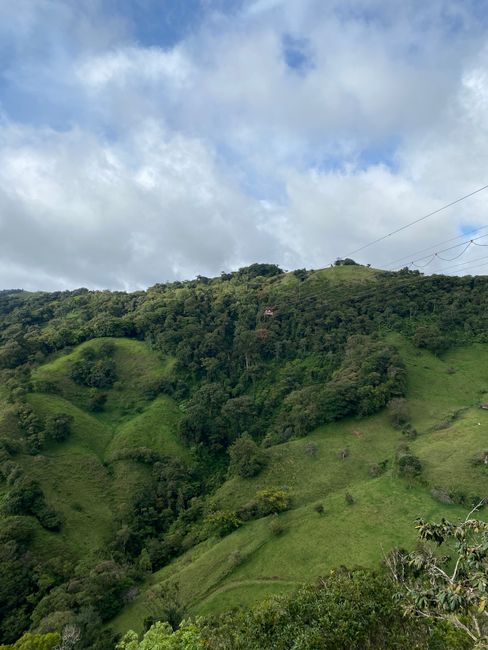
Monteverde is Costa Rica’s cloud forest: a cool, misty ridge on the continental divide, about 1,400 m (4,600 ft) up in the Tilarán mountains, where trade winds from the Caribbean push clouds through forests of moss-covered trees, orchids, bromeliads and tree ferns. It is one of the most studied cloud forests on Earth, home to the resplendent quetzal, the three-wattled bellbird and hundreds of other birds, and protected in a patchwork of private and community reserves that began in the 1970s with the help of a Quaker community from the United States, who also started a cheese and dairy tradition. Today the area, with the village of Santa Elena as its center, is known for guided forest walks by day and night, hanging bridges and some of the country’s longest zip lines, and coffee and chocolate farms. It is a natural partner for La Fortuna, across Lake Arenal.
Right now in Monteverde
- Tue 16–22°C 62–72°F 17 mm Heavy rain
- Wed 16–24°C 62–74°F 24 mm Heavy rain
- Thu 16–23°C 61–74°F 4 mm Rain
Weather: MET Norway (CC BY 4.0)
Top tours in Monteverde
See all tours for Monteverde →
From local operators, with prices and reviews; you check availability and book on Viator, our partner. We may earn a commission at no extra cost to you. How we earn money
Monteverde at a glance
- Best for: cloud forest walks, birdwatching, night tours, hanging bridges and zip lines, coffee and chocolate tours, and cooler weather.
- How long: two nights for a reserve, a night walk and the bridges; three to add a second reserve, a coffee tour and a zip line.
- Best time: the dry season, roughly December to April, though it is windy and misty from December to February; it can be cool and damp at any time.
- Getting there: about three and a half to four hours by road from San José, or three hours from La Fortuna by the jeep-boat-jeep transfer across Lake Arenal. There is no airport.
- Before you go: entry rules, money and transport tips are in our Costa Rica travel guide.
Monteverde’s areas: where things are
“Monteverde” is used for the whole area. The village of Santa Elena is the commercial center, with the bus stop, banks, supermarkets, restaurants, hostels and tour agencies. A road climbs about 6 km (4 miles) south-east from Santa Elena through the scattered community of Monteverde proper, with its cheese factory, lodges, coffee farms and galleries, to the Monteverde Cloud Forest Preserve. The Santa Elena reserve, the hanging bridges and most zip lines are in the forest north-east of the village.
Between the two sits Cerro Plano, a strip of hotels, cafés, the frog, butterfly and orchid exhibits and several night-walk reserves, handy if you want to walk to dinner and to tours. Below Santa Elena to the south-west, the farming valley of San Luis is lower, warmer and sunnier, with a few rural lodges, coffee farms and a waterfall hike; it suits travelers with a car who want views over the Gulf of Nicoya on clear days. The road from Santa Elena to the preserve is paved but narrow and steep, with few sidewalks, so many visitors use the local bus or taxis rather than walking it at night.
Top things to see in Monteverde
The reserves in Monteverde are private or community-run, not SINAC national parks, and each sets its own prices and booking system; check their own sites. Information below was checked in October 2026.
Monteverde Cloud Forest Preserve
The original and best-known reserve, run by the Tropical Science Center since 1972, protects more than 4,100 hectares (10,000 acres) of cloud forest, according to the preserve. It now limits visitor numbers in each time slot to protect the forest, so book online in advance. Visits start at the Monteverde Cloud Forest Visitor Center, about 1.5 km (1 mile) below the preserve entrance, where you park and check in 15 minutes before your slot; a free shuttle takes you up to the trailhead and back. According to the preserve, there are three ways to visit:
- The Cloud Forest Walk: self-guided, on marked circuits of about 1 to 2.5 hours, from easy to moderate, with signs in English and Spanish; open from 7:30 a.m. to 4 p.m.
- The Natural History Walk: the preserve’s guided walk with naturalists, starting between 7:30 a.m. and 1 p.m.
- The Night Walk: guided, starting between 6 p.m. and 6:30 p.m., to look for sleeping birds, frogs, insects and night mammals.
Late arrivals may not be accommodated, cancellations at least 48 hours ahead get a full refund, and if weather or safety forces a cancellation you can reschedule or get your money back. Pets and drones are not allowed, there are no toilets on the trails (use those at the visitor center or entrance), and the preserve asks you to eat after your walk, at its restaurant near the entrance, not before.
Santa Elena Cloud Forest Reserve
North-east of Santa Elena village, this community-run reserve, managed for the local high school, is a little higher, wetter and less crowded than the Monteverde preserve, with trails through primary forest and, on clear days, views toward Arenal Volcano. Its income supports local education.
Hanging bridges and zip lines
Several private parks have trails with long suspension bridges through the canopy, the easiest way to see the forest from above, and Monteverde’s zip lines are among the longest in Costa Rica, some with a “Superman” cable and a Tarzan swing. Choose well-known operators with good safety records, and check what’s included in the price.
Birds and the quetzal
Monteverde is one of the best places in Central America to see the resplendent quetzal, with its emerald plumage and long tail feathers, especially in its breeding season from about March to June, when it feeds on wild avocados. Look and listen too for the three-wattled bellbird, emerald toucanets and dozens of hummingbird species; a hummingbird garden near the Monteverde preserve is a sure bet. An early guided birdwatching walk greatly improves your chances.
Other things to do in Monteverde
- Night tours: besides the preserve’s own walk, many small reserves around Santa Elena run guided night walks for tarantulas, vipers, sloths, kinkajous and tree frogs.
- Coffee, chocolate and sugar cane: family farms on the slopes below Monteverde show how coffee is grown and roasted, with tastings.
- Children’s Eternal Rainforest: a large private reserve founded with donations from children around the world, with trails at its Bajo del Tigre station.
- Hiking: forest trails at every reserve, from flat loops to steep climbs to the divide; see our hiking guide.
- Small museums: butterfly gardens, frog and insect exhibits, and an orchid garden, good for a rainy afternoon.
Food and drink in Monteverde
Monteverde’s food is simple and hearty, made for cool evenings. In Santa Elena, sodas (small family diners) serve the casado, a plate of rice, black beans, salad, fried plantain and a choice of chicken, fish, beef or a vegetarian option, and breakfast gallo pinto with eggs and natilla (sour cream). The dairy started by the Quaker settlers still makes cheese, and its shop on the road to the preserve sells local cheeses and ice cream. Coffee is grown on the lower slopes, so you can drink it at a farm after a tour or buy beans roasted in the area to take home.
Along the road through Cerro Plano and Monteverde are bakeries, cafés with forest views and restaurants serving pizza, Costa Rican and international dishes, many with vegetarian choices. Dinner starts early, around 6 p.m. to 7 p.m., because tours start at dawn, and most kitchens close by 9 p.m. Nightlife is quiet: a few bars in Santa Elena, live music at weekends, and hot chocolate after a night walk. Check bills for the 10% service charge and 13% VAT, which are usually already included in menu prices; ask if you are unsure.
Day trips and next stops
- La Fortuna and Arenal: hot springs and the volcano, three hours by jeep-boat-jeep; see our La Fortuna travel guide.
- Guanacaste beaches: about three hours to Tamarindo; see our Tamarindo travel guide.
- Manuel Antonio: about four to five hours south by shuttle; see our Manuel Antonio guide.
- San Luis waterfall: a half-day hike in the San Luis valley below Santa Elena, on a private farm trail through forest and pasture to a tall waterfall; the track down is steep and slippery after rain, and the road there needs a 4×4 or a guided tour.
- Lake Arenal and Tilarán: the road north-east drops to the windy western shore of Lake Arenal, with lakeside cafés and views of the volcano on clear days; it is the route around the lake to La Fortuna.
- Curi-Cancha and the small reserves: if you have an extra half day, the private Curi-Cancha reserve near the main preserve is known for birdwatching on open trails and smaller groups; book a guide for dawn.
Nearby destinations
- La Fortuna26 km
- San José90 km
- Tamarindo108 km
- Manuel Antonio National Park127 km
- Tortuguero National Park144 km
- San Juan del Sur157 km
- Granada220 km
- Puerto Viejo de Talamanca236 km
Getting there and getting around
By road
From San José, take the Inter-American Highway (Route 1) north-west, then climb the mountain road from the lowlands; the trip takes about three and a half to four hours by car or shuttle, a little longer by public bus. From Liberia airport, allow about three hours. The final climb is steep and winding, with fog, so drive by day; a standard car is fine on the main paved road, but some lodges are on rough tracks where a 4×4 helps.
From La Fortuna: the jeep-boat-jeep
The two towns are about 30 km (19 miles) apart as the crow flies but separated by Lake Arenal. The usual transfer is a van to the lake, a boat across, and a van up to Santa Elena, in about three hours; the road around the lake takes about four hours. Book through your hotel or a licensed shuttle company.
Getting around
Santa Elena village is walkable, and most tours include hotel pick-up. Local buses run between Santa Elena and the Monteverde preserve’s visitor center a few times a day, and taxis are easy to find. Roads are hilly and dark at night, so take a taxi to night tours if you are not on a pick-up.
When to go and how long to stay
Monteverde sits on the continental divide, between the Pacific and the Caribbean slopes, so it gets weather from both: Pacific rainy-season storms from about May to November, and from about December to March, strong trade winds that blow mist and drizzle (“pelo de gato”) over the ridge even in the dry season. That moisture is what makes the cloud forest. Temperatures are much cooler than on the coasts, mild by day and cool at night, and it feels cold when it is wet and windy.
| Season | What it’s like | Good for |
|---|---|---|
| December–February | Drier, but windy and misty; cool nights; busy at the holidays | Hiking, hanging bridges, zip lines |
| March–April | The calmest and clearest weeks | Quetzals in breeding season, views |
| May–August | Rainy afternoons, misty forests, quieter | Birdwatching, lower prices; quetzals into June |
| September–November | The wettest months; trails are muddy | Night walks, coffee tours |
Monteverde month by month
| Month | Weather | Crowds and prices | Why go |
|---|---|---|---|
| January | Dry on the Pacific side but windy, with mist and drizzle on the ridge | Busy early in the month, then easing | Zip lines and bridges on clearer days |
| February | Windy and misty; cool nights | High season | Dry trails, birdwatching |
| March | Winds dropping, more sun | High season | Quetzals start nesting; clear views |
| April | Often the clearest month; warmer afternoons | Very busy in Holy Week (Semana Santa) | Quetzals, views toward the gulf |
| May | First rains, usually in the afternoon | Quieter; lower rates | Morning walks, quetzals |
| June | Mornings often fine, afternoon showers | Moderate | The end of quetzal breeding; lush forest |
| July | A drier spell some years (the veranillo) between rains | Busier with family vacations | Good all-round month |
| August | Rain most afternoons | Moderate | Birding, coffee tours |
| September | Wet and misty; muddy trails | Quiet; good deals | Night walks, frogs |
| October | Often the wettest month | Very quiet | Moody cloud forest, low prices |
| November | Rain easing, winds returning late in the month | Quiet until the holidays | Fewer people on the trails |
| December | Windy, misty, cooler | Busy and pricier at Christmas and New Year | Holiday trips; book well ahead |
There is no official station normal for Monteverde in the WMO or IMN datasets we use, so these descriptions are general; for the Pacific seasons, see the climate section of our Costa Rica travel guide.
2 days in Monteverde
Day one, an early Natural History Walk in the Monteverde Cloud Forest Preserve, the hummingbird garden, and a night walk. Day two, hanging bridges or a zip line in the morning and a coffee and chocolate tour in the afternoon.
3 days in Monteverde
Add the Santa Elena reserve or the Children’s Eternal Rainforest, and a dawn birdwatching walk for quetzals, before continuing to La Fortuna or the beach.
Where to stay in Monteverde and the hotel taxes
- Santa Elena village: hostels, budget and mid-range hotels close to restaurants and tour pick-ups.
- The road to the preserve: lodges and boutique hotels in the forest, quieter and closer to the reserves; some have their own trails.
- Around the reserves and hanging bridges: eco-lodges for birders who want to be out at dawn.
Hotel rooms carry Costa Rica’s 13% value-added tax, and restaurant bills include a 10% service charge, according to the tourism board (ICT). Few rooms have heating or air conditioning; ask for extra blankets in winter.
What a day in Monteverde costs
Monteverde is not cheap, because most of its experiences are paid tours. Hotels, reserves and tours quote in US dollars; sodas, buses and taxis charge in colones. The figures below are our estimates for 2026, not official prices, converted at about ₡460 to US$1, close to the Central Bank’s reference rate in early October 2026.
| Item | Colones (₡) | About (US$) |
|---|---|---|
| Casado lunch at a soda | ₡4,500–6,500 | US$10–14 |
| Coffee in a café | ₡1,500–2,500 | US$3–5 |
| Local bus, Santa Elena to the preserve’s visitor center | ₡1,000–1,500 | US$2–3 |
| Taxi within Santa Elena and Cerro Plano | ₡2,500–5,000 | US$5–11 |
| Hostel dorm bed | ₡7,000–12,000 | US$15–26 |
| Mid-range double room | ₡40,000–75,000 | US$90–160 |
| Coffee or chocolate farm tour | ₡16,000–23,000 | US$35–50 |
| Zip-line canopy tour | ₡25,000–37,000 | US$55–80 |
| Guided night walk at a private reserve | ₡14,000–23,000 | US$30–50 |
A budget traveler can get by on about US$60 to US$80 (₡28,000–37,000) a day with a hostel, sodas and one paid walk; a mid-range trip with a lodge, a guided walk and a zip line is more like US$200 to US$300 (₡92,000–138,000) per person. Check each reserve’s own site for its current entrance fee.
Practical tips for Monteverde
- Book ahead: the Monteverde preserve’s time slots and the best night walks sell out in high season.
- Hire a guide: wildlife in the cloud forest is hard to spot without one, especially quetzals and night animals.
- Money: ATMs and banks are in Santa Elena; dollars and cards are widely accepted.
- Safety: stay on marked trails, carry a light, and don’t hike alone at dusk. Use established zip-line and canopy operators, and drive the mountain roads only by day.
- Emergencies: call 911.
What to pack for Monteverde
Bring a warm fleece or light down jacket, a waterproof rain jacket, long pants and walking shoes or boots with grip for wet, muddy trails. A flashlight or headlamp for night walks, binoculars, a waterproof cover for your camera, and a hat and gloves for windy days in December to February are worth packing. Plugs are the US type.
Monteverde travel FAQ
Do I need to book the Monteverde Cloud Forest Preserve in advance?
Yes, it is strongly recommended. The preserve limits visitors per time slot, and you check in at its visitor center 15 minutes before your slot for a free shuttle to the trailhead.
What are the Monteverde preserve’s hours?
The self-guided Cloud Forest Walk runs from 7:30 a.m. to 4 p.m., guided Natural History Walks start between 7:30 a.m. and 1 p.m., and Night Walks start at 6 to 6:30 p.m., according to the preserve.
Is Monteverde or Santa Elena better?
Both are excellent. The Monteverde preserve is larger and better known, with the most guided options; the community-run Santa Elena reserve is a little wetter and usually quieter.
When can you see quetzals in Monteverde?
Year-round with luck, but most reliably in their breeding season from about March to June. Go early with a birding guide.
How do I get from La Fortuna to Monteverde?
The jeep-boat-jeep transfer across Lake Arenal takes about three hours; driving around the lake takes about four.
How cold does Monteverde get?
It is mild by day and cool at night, and feels cold in wind and drizzle, especially from December to February. Bring a fleece and rain jacket.
Can I drive to Monteverde in a regular car?
Yes, on the main road, which is steep and winding; drive by day. A 4×4 helps for some lodges on unpaved tracks.
How much does a day in Monteverde cost?
By our estimates, about US$60 to US$80 a day on a budget, with a hostel, sodas and one paid walk, and US$200 to US$300 per person mid-range, with a lodge, a guided walk and a zip line. Tours are priced in dollars.
Is Monteverde worth visiting in the rainy season?
Yes. Mornings are often clear, the forest is at its greenest, and hotels are cheaper. Plan walks early, keep afternoons for coffee tours and museums, and bring good rain gear; September and October are the wettest months.
Do I need a guide for a night walk?
Yes. Night walks are guided, both at the Monteverde preserve and at the private reserves around Santa Elena. Guides carry strong lights and know where sleeping birds, snakes, frogs and tarantulas are likely to be.
Sources and last review
Researched and last reviewed on 4 October 2026. The Monteverde Cloud Forest Preserve’s walks and hours, visitor center and shuttle, time slots, cancellation policy, size, rules and founding year: the preserve’s official site; VAT and service charge: the Costa Rica Tourism Board (ICT); the Pacific seasons: the National Meteorological Institute (IMN). The altitude, the Quaker history, the Santa Elena reserve, quetzal season, the Children’s Eternal Rainforest, travel times and road conditions, local buses and the description of Monteverde’s wind and mist come from secondary sources or general knowledge and are flagged for checking; there is no official climate normal for Monteverde in our data. The food notes, the month-by-month table, the extra day trips and the daily costs are general references or our own estimates and are flagged for checking; colón amounts are converted at about ₡460 to US$1, close to the Central Bank’s reference rate in early October 2026. Prices and hours change, so check each reserve’s site before you go. For entry rules and money, see our Costa Rica travel guide.
Plan your trip
Partner links: TravelerCenter may earn a commission if you book, at no extra cost to you.
🇪🇸 Useful Spanish phrases for Monteverde
All 38 Spanish phrases: restaurant, hotel, emergencies, romance (printable) →