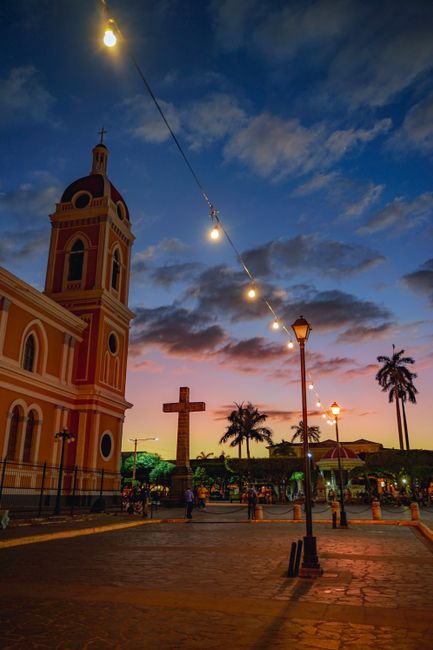
Granada, on the north-west shore of Lake Nicaragua, is one of the oldest colonial cities in mainland America and the most visited town in Nicaragua. Founded in 1524, it grew rich as a port linked to the Caribbean by the lake and the San Juan River, which also made it a target for pirates in the 17th century, and it was burned in 1856 during the wars of the period. Rebuilt in the following decades, its grid of streets is lined with single-story houses painted ochre, blue and red around cool inner courtyards, with the yellow cathedral on the central square and the pedestrian Calle La Calzada running down toward the lake. Above the city rises Mombacho, a dormant volcano wrapped in cloud forest, whose ancient eruption scattered hundreds of small islands, Las Isletas, along the lakeshore. Granada is also the best base for Masaya’s active volcano, the crater lake of Laguna de Apoyo and the craft villages of the Pueblos Blancos.
Right now in Granada
- Tue 25–31°C 77–87°F 10 mm Showers
- Wed 24–30°C 74–87°F 11 mm Showers
- Thu 24–30°C 76–87°F 2 mm Showers
- Mon 12 Oct Indigenous Resistance Day
Weather: MET Norway (CC BY 4.0) · Holidays: Nager.Date
Top tours in Granada
See all tours for Granada →
From local operators, with prices and reviews; you check availability and book on Viator, our partner. We may earn a commission at no extra cost to you. How we earn money
Granada at a glance
- Best for: colonial architecture, boat trips on Lake Nicaragua, volcanoes, food, Spanish lessons and day trips.
- How long: two or three days for the city, Las Isletas and Masaya; four or five to add Mombacho, Laguna de Apoyo and the Pueblos Blancos.
- Best time: November to April, the dry season; it is very hot in March and April.
- Getting there: about 45 minutes to an hour by road from Managua’s international airport, and about 1.5 hours from the Costa Rican border at Peñas Blancas.
- Before you go: entry rules, the arrival tax and money are in our Nicaragua travel guide.
Granada’s layout: where things are
The city center is a grid around the Parque Central (also called Parque Colón), with the cathedral on its east side. Calle La Calzada, a pedestrian street of restaurants and bars, runs east from the square toward the lake, about 1 km (0.6 miles) away, where a lakeside promenade and the Complejo Turístico park lead south to the docks for Las Isletas. The market is a few blocks south-west of the square, and the old fortress of La Pólvora on the west side. Most hotels are within a few blocks of the Parque Central.
The streets have distinct characters. Calle La Calzada and the blocks around it are the tourist hub, busy from late afternoon until late at night. Calle Atravesada, one block west of the square, has local eateries, bars and a few hostels. The quarter around the church of Xalteva, to the west, was once a separate Indigenous town, and its square and old walls are quieter and more residential. The streets south toward the market are noisy and crowded by day, with a real local feel; keep an eye on your bag there. The lakefront, about 15 minutes’ walk east, is open and breezy but quiet at night, so take a taxi back after dark.
Top things to see in Granada
The Parque Central and the cathedral
The shady main square, with horse-drawn carriages, food stalls selling vigorón and a bandstand, is the heart of the city. On its east side, the Cathedral of Granada, rebuilt in the early 20th century, is the city’s yellow-and-white landmark; some days you can climb its bell tower for views of the rooftops, the lake and Mombacho.
Iglesia La Merced
West of the square, the church of La Merced has a baroque facade and a bell tower that visitors can climb for a small fee, with one of the best views over Granada’s red-tile roofs toward the cathedral and the volcano, especially at sunset.
The San Francisco Convent
One of the oldest churches in Central America, its blue convent now holds a museum with a remarkable collection of pre-Columbian stone statues from the islands of Lake Nicaragua, as well as exhibits on the city’s history.
Calle La Calzada and the lakefront
Walk the pedestrian Calle La Calzada, lively in the evening with restaurants, bars and street performers, to the lakeside park and promenade. Lake Nicaragua, called Cocibolca, is the largest lake in Central America, big enough to have waves.
Las Isletas
A cluster of about 365 small volcanic islands just south of the city, formed by an ancient eruption of Mombacho. Boat tours of one to two hours leave from the docks south of the lakeside park and pass fishing families’ houses, holiday homes, the small Fortín San Pablo, an island of monkeys and many birds. See our boat trips guide.
Other things to do in Granada
- Horse-drawn carriage tours: a classic way to see the center, starting at the Parque Central.
- Chocolate and cigar workshops: make your own chocolate from Nicaraguan cacao, or watch cigars being rolled.
- Cooking classes: learn to make gallo pinto, nacatamales and other Nicaraguan dishes.
- Spanish schools: Granada has several schools offering one-to-one lessons and homestays.
- Kayaking: paddle among Las Isletas in the calm morning.
- Walking tours: see our city sightseeing guide.
Food and drink in Granada
Granada’s signature dish is vigorón: boiled yuca topped with crunchy pork rinds (chicharrón) and a tangy cabbage salad, served on a banana leaf at stalls in the Parque Central, where it is said to have been invented. Nicaraguan staples are everywhere: gallo pinto (rice and red beans fried together) at breakfast with eggs, cheese and sweet plantain; the nacatamal, a big tamal of corn dough with pork, rice, potato and herbs wrapped in banana leaf, traditionally eaten at weekends; indio viejo, a thick corn and beef stew; and grilled meats from street fritangas in the evening. Lake fish such as guapote and tilapia are served fried whole at lakeside restaurants and on Las Isletas.
Calle La Calzada has dozens of restaurants with tables in the street, serving Nicaraguan, Mexican, Italian, Mediterranean and vegetarian food at tourist prices; a block or two away, local comedores serve a set lunch for much less. Drink fresh refrescos such as cacao, chía and pitahaya (dragon fruit), a local Toña or Victoria beer, or rum from Nicaragua’s famous distillery, often mixed in a macuá, the national cocktail of rum with guava and orange juice. Check bills for the 15% VAT and any service charge; many restaurants add a voluntary 10% tip.
Day trips from Granada
Masaya Volcano National Park
About 30–40 minutes from Granada, one of the most accessible active volcanoes in the world: a road leads almost to the rim of the smoking Santiago crater, which INETER describes as currently active, with average sulfur dioxide emissions of about 1,087 tonnes a day measured in May 2026. The park is open every day from 8:30 a.m. to 7 p.m., according to the Ministry of the Environment and Natural Resources (MARENA). Evening visits, when glowing lava can sometimes be seen deep in the crater, are popular; stops at the rim are short because of the gases. Follow the rangers’ instructions.
Mombacho Volcano
The dormant volcano next to Granada has a nature reserve with cloud-forest trails around its craters, orchids, howler monkeys and views of the lake and Las Isletas; trucks take visitors up the steep road, and canopy zip lines operate on its slopes. See our hiking guide.
Laguna de Apoyo
A clear crater lake about 30 minutes away, warm and good for swimming, kayaking and relaxing at lakeside lodges and day clubs.
Masaya and the Pueblos Blancos
The city of Masaya has a big crafts market, and the “white villages” of the plateau, such as Catarina, with its viewpoint over Laguna de Apoyo, San Juan de Oriente, known for pottery, and Diriá, make a good half-day loop.
Ometepe
The twin-volcano island in Lake Nicaragua is best visited overnight: drive about 1.5 hours to San Jorge, near Rivas, and take the ferry to Moyogalpa, about an hour across the lake.
Next stops: León and San Juan del Sur
Most travelers combine Granada with one or both of Nicaragua’s other classic stops. León, about 2.5 hours north-west, is Granada’s old rival: a hotter, more student-filled colonial city with a huge white cathedral, art museums and the black slopes of Cerro Negro, where visitors slide down the volcanic gravel on boards. San Juan del Sur, about 1.5 to 2 hours south, is the country’s main Pacific beach town, with surf beaches, sunsets and boat trips; see our San Juan del Sur travel guide. A classic loop runs León, Granada, Ometepe and San Juan del Sur before crossing to Costa Rica.
Nearby destinations
- San Juan del Sur76 km
- Tamarindo183 km
- La Fortuna216 km
- Monteverde220 km
Getting there and getting around
From the airport and Managua
Augusto C. Sandino International Airport (MGA) in Managua is about 45 minutes to an hour from Granada by shuttle, taxi or private transfer, depending on traffic. Buses and minibuses run frequently between Managua and Granada.
From Costa Rica
The Peñas Blancas border is about 1.5 hours from Granada. International buses and tourist shuttles run between Granada and San José or the Guanacaste beaches in Costa Rica; when you enter Nicaragua you pay the US$10 arrival tax in cash, according to the UK government, and you need an onward ticket. Cross in daylight. For the Costa Rican side, see our Costa Rica travel guide.
To other destinations
Tourist shuttles link Granada with León, San Juan del Sur, the Ometepe ferry at San Jorge and the airport; minibuses are cheaper. Driving takes about 1.5 to 2 hours to San Juan del Sur and about 2.5 hours to León. Don’t drive at night, as highways are unlit, according to the UK government.
Getting around Granada
The center is flat and walkable. Taxis are cheap; use authorized taxis with red license plates and the driver’s ID displayed, agree on the fare first, and don’t share with strangers. Horse-drawn carriages and bicycles are other options.
When to go and how long to stay
Granada is hot all year, with daytime temperatures of about 30–33 °C (86–91 °F) and warm nights. The dry season from November to April brings sunny days; March and April are the hottest and dustiest months. The rainy season from May to October brings afternoon or evening storms and greener surroundings, with a drier spell in July or August; September and October are usually the wettest months. The eastern Pacific hurricane season runs from May 15 to November 30 and the Atlantic season from June 1 to November 30, according to NOAA’s National Hurricane Center; storms mainly bring heavy rain to Granada.
Granada month by month
| Month | Weather | Crowds and prices | Why go |
|---|---|---|---|
| January | Dry, sunny and breezy | Busy early in the month | Walking tours, Las Isletas |
| February | Dry and breezy | Moderate; the city has hosted an international poetry festival in February in many years | Culture, Mombacho views |
| March | Hot and dry | Busy around Holy Week (March 21–28, 2027) | Laguna de Apoyo, early sightseeing |
| April | The hottest, dustiest month | Moderate | Swimming, early-morning walks |
| May | Rains begin; green season | Quiet; lower prices | Fewer visitors |
| June | Afternoon storms | Quiet | Green landscapes |
| July | Storms, with a drier spell some years | Moderate | Las Isletas, Masaya |
| August | Afternoon storms | Moderate; Assumption festivities in mid-August | Local fiestas |
| September | Among the wettest months | Quiet; national holidays on September 14 and 15 | Museums, cooking classes |
| October | Among the wettest months | Very quiet | Spanish school, low prices |
| November | Dry season begins | Moderate | Walking tours, volcanoes |
| December | Dry, sunny and breezy | Busy; La Purísima and La Gritería on December 7–8 | Festivities, holidays |
| Season | What it’s like | Good for |
|---|---|---|
| November–February | Dry and sunny; breezy | Walking tours, Las Isletas, Mombacho views |
| March–April | Hottest and driest; Holy Week crowds | Laguna de Apoyo, early-morning sightseeing |
| May–August | Green season; afternoon storms | Lower prices, fewer visitors |
| September–October | Wettest months | Museums, cooking classes, Spanish school |
2 days in Granada
Day one, the Parque Central, the cathedral, La Merced’s bell tower at sunset, and dinner on Calle La Calzada. Day two, a morning boat tour of Las Isletas, the San Francisco Convent museum, and an evening trip to Masaya volcano.
4 to 5 days in Granada
Add Mombacho’s cloud forest, a lazy day at Laguna de Apoyo, the Masaya market and Pueblos Blancos, and a chocolate or cooking class, or continue to Ometepe for two nights.
Where to stay in Granada and the hotel taxes
- Around the Parque Central: colonial hotels with courtyards and pools, close to everything.
- Near Calle La Calzada: guesthouses and hostels on the lively pedestrian street and side streets.
- Toward the lake: quieter boutique hotels a few blocks from the lakeside park.
- Las Isletas and Laguna de Apoyo: island lodges and lakeside eco-lodges outside town.
Hotel bills carry Nicaragua’s 15% value-added tax and a 2% tourism tax; check whether quoted rates include them. Many hotels quote in US dollars.
What a day in Granada costs
Granada is one of the best-value colonial cities in the Americas. Hotels and tours usually quote in US dollars; street food, taxis, buses and markets charge in córdobas. These are our estimates for 2026, not official prices, converted at about C$36.6 to US$1, the official rate published by the Central American Monetary Council in early October 2026.
| Item | Córdobas (C$) | About (US$) |
|---|---|---|
| Vigorón in the Parque Central | C$100–150 | US$2.70–4 |
| Set lunch at a comedor | C$150–250 | US$4–7 |
| Dinner on Calle La Calzada | C$370–740 | US$10–20 |
| Local beer | C$50–90 | US$1.40–2.50 |
| Taxi within the center | C$40–80 | US$1–2.20 |
| Las Isletas boat tour (shared, per person) | C$370–740 | US$10–20 |
| Masaya volcano evening tour | C$900–1,500 | US$25–40 |
| Hostel dorm bed | C$370–550 | US$10–15 |
| Mid-range double room in a colonial hotel | C$1,800–3,700 | US$50–100 |
A budget traveler can manage on about US$30 to US$45 (C$1,100–1,650) a day with a dorm bed, street food and one tour; a mid-range day with a colonial hotel, a guided tour and restaurant dinners is closer to US$100 to US$160 (C$3,700–5,900).
Practical tips for Granada
- Money: there are ATMs near the Parque Central; US dollars are widely accepted, and the rate was about C$36.62 to US$1 in October 2026. Change money in banks.
- Heat: sightsee early and late, rest at midday, and drink plenty of water.
- Taxis: use authorized red-plate taxis and agree on the fare first.
- Safety: Granada’s center is generally relaxed, but petty theft happens; keep valuables out of sight, avoid quiet streets late at night, and take a taxi after dark. Stay away from any demonstrations: foreigners may not take part in political activity, according to the UK government.
- Emergencies: police 118, medical assistance 128, according to the Canadian government.
What to pack for Granada
Bring light, breathable clothes, a hat, sunglasses and strong sunscreen, comfortable walking shoes, a light rain jacket from May to October, swimwear for Laguna de Apoyo and hotel pools, a light layer for Mombacho’s cool cloud forest, insect repellent, and US dollars in small notes, including US$10 for the arrival tax. Leave drones and e-cigarettes at home, as both are banned. Plugs are the US type.
Granada travel FAQ
How do I get from Managua airport to Granada?
By shuttle, taxi or private transfer in about 45 minutes to an hour.
What are Las Isletas?
About 365 small volcanic islands in Lake Nicaragua just south of Granada, formed by an ancient eruption of Mombacho. Boat tours of one to two hours leave from the lakeshore docks.
Can I visit Masaya volcano from Granada?
Yes, it is 30–40 minutes away. The park is open daily from 8:30 a.m. to 7 p.m., according to MARENA, and evening visits are popular.
How many days do I need in Granada?
Two or three days for the city, Las Isletas and Masaya volcano; four or five with Mombacho and Laguna de Apoyo.
How do I get from Granada to Costa Rica?
By international bus or shuttle via the Peñas Blancas border, about 1.5 hours away.
When is the best time to visit Granada?
November to April, the dry season. March and April are very hot.
Is Granada, Nicaragua, safe?
It is one of the most visited and relaxed towns in Nicaragua. Take normal precautions, use authorized taxis at night, and avoid demonstrations.
What food is Granada known for?
Vigorón, boiled yuca with pork rinds and cabbage salad, sold in the Parque Central. Also try gallo pinto, nacatamales at weekends, indio viejo and fried lake fish, with a macuá rum cocktail or a fresh fruit refresco.
How much does a day in Granada cost?
By our estimates, about US$30 to US$45 (C$1,100–1,650) on a budget and US$100 to US$160 mid-range. US dollars are widely accepted, but carry córdobas for street food and taxis.
What is La Gritería?
Nicaragua’s celebration of the Immaculate Conception on the evening of December 7, when people visit altars to the Virgin Mary and call out “¿Quién causa tanta alegría?”, receiving sweets and small gifts in return. Granada’s streets are lively that night.
Sources and last review
Researched and last reviewed on 4 October 2026. Masaya’s active Santiago crater and its sulfur dioxide emissions: the Nicaraguan Institute of Territorial Studies (INETER); Masaya Volcano National Park’s opening hours: the Ministry of the Environment and Natural Resources (MARENA); the córdoba rate: the Executive Secretariat of the Central American Monetary Council (SECMCA); hurricane seasons: NOAA’s National Hurricane Center; the arrival tax, onward ticket, political activity rule, taxis, night driving and drones: the UK government; emergency numbers and the e-cigarette ban: the Canadian government. Granada’s history, the city layout, churches and museums, Las Isletas’ number and origin, Mombacho, Laguna de Apoyo, the Pueblos Blancos, travel times, the Ometepe ferry, temperatures, seasons and hotel taxes come from secondary sources or general knowledge and are flagged for checking. Prices and rules change, so check before you go. For entry rules and money, see our Nicaragua travel guide; for the coast, see our San Juan del Sur travel guide. The neighborhood notes, the food notes, the festival dates, the month-by-month table and the daily costs come from general knowledge or our own estimates and are flagged for checking; córdoba amounts are converted at about C$36.6 to US$1, the SECMCA rate in early October 2026.
Plan your trip
Partner links: TravelerCenter may earn a commission if you book, at no extra cost to you.
🇪🇸 Useful Spanish phrases for Granada
All 38 Spanish phrases: restaurant, hotel, emergencies, romance (printable) →