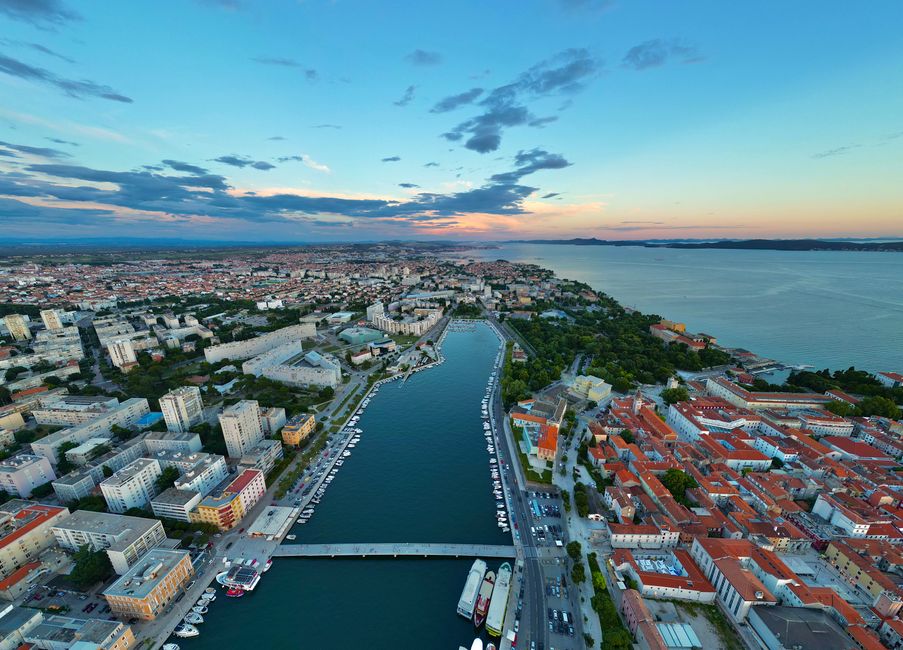
Zadar is a 3,000-year-old city on a narrow peninsula in northern Dalmatia, where Roman ruins, a round 9th-century church and Venetian walls meet some of the most original modern public art in Europe. At the tip of the old town, the Sea Organ plays chords as the waves push air through pipes under its marble steps, and next to it the Greeting to the Sun, a great circle of glass panels, stores the day’s sunlight and turns into a light show after dark, right where Zadar’s famous sunsets go down over the islands. It is relaxed, good value and easy to reach by cheap flights, and it makes a great base for the islands of the Zadar archipelago, the Kornati and Telašćica by boat, and Plitvice, Krka and Paklenica by road. Spend two or three days in town and a few more on day trips.
Right now in Zadar
- Wed 18–24°C 64–76°F 1 mm Partly cloudy
- Thu 19–24°C 66–76°F 10 mm Cloudy
- Fri 16–18°C 61–65°F 10 mm Partly cloudy
Weather: MET Norway (CC BY 4.0) · Sea temperature: NOAA CoastWatch · Rates: ECB
Top tours in Zadar
See all tours for Zadar →
From local operators, with prices and reviews; you check availability and book on Viator, our partner. We may earn a commission at no extra cost to you. How we earn money
Zadar at a glance
- Best months: May–June and September to early October. Mean temperatures run from about 18 °C in May to 24–25 °C in July and August (DHMZ, Zadar station).
- Days needed: 1–2 for the old town; 3–5 with the Kornati or Telašćica, Plitvice, Krka, Nin or Paklenica.
- Getting there: Zadar airport (ZAD) is about 10 km east of town, with many low-cost flights; buses from Zagreb (about 3.5 hours) and Split (about 3 hours); ferries from Ancona in Italy.
- Getting around: on foot in the old town; city buses; ferries from the harbour and Gaženica port to the islands.
- Budget level: cheaper than Split or Dubrovnik. See our Croatia guide for money, entry rules and costs.
Zadar’s areas and who each one suits
- The old town (Poluotok): the car-free peninsula with the Roman Forum, churches, the Sea Organ and most bars and restaurants. The best base without a car.
- Borik and Puntamika: resort hotels, pine trees and beaches about 4 km north-west, linked by bus. Good for families.
- Kolovare and Bili Brig: beach suburbs south-east of the old town, within walking distance, with Kolovare beach and apartments.
- Diklo, Petrčane and Nin: quieter villages and beaches along the coast north of the city.
- The islands of Ugljan and Pašman: across the channel by ferry, for village life and calm coves.
Top things to see in Zadar
The Sea Organ and the Greeting to the Sun
The Sea Organ (Morske orgulje), designed by the architect Nikola Bašić and opened in 2005, is a set of wide white stone steps on the western waterfront with 35 pipes hidden beneath them. As the waves and the wakes of passing boats push air through the pipes, the organ plays random, soothing chords; sit on the steps, dip your feet in the water and listen. It is free and never closes. A few steps away, Bašić’s Greeting to the Sun (Pozdrav Suncu, 2008) is a 22 m circle of glass solar panels set in the pavement. By day it collects sunlight; after sunset it lights up in patterns of colour, timed to the sound of the Sea Organ, and children love to dance on it. Come for the sunset, which drops into the sea between the islands, then stay for the lights.
The Roman Forum and St Donatus
The Roman Forum, founded under the Emperor Augustus, is the largest on the eastern Adriatic coast; columns and stone fragments lie around a broad square where children climb freely. On one side stands the round Church of St Donatus, built in the 9th century partly from Roman stones, Zadar’s symbol and a concert hall with superb acoustics. Next to it, the “Pillar of Shame”, a Roman column where offenders were once chained, still stands. The Romanesque Cathedral of St Anastasia (Stošija), the largest in Dalmatia, has a bell tower you can climb for a view over the old town and the islands.
The walls, gates and Five Wells Square
Zadar’s Venetian fortifications, built in the 16th and 17th centuries, are part of the UNESCO World Heritage Site “Venetian Works of Defence” listed in 2017. Enter the old town through the Land Gate (1543), with the winged lion of St Mark above the arch. Nearby, Five Wells Square covers a Venetian cistern built to supply the city during Ottoman sieges, with the Queen Jelena Madijevka Park on the bastion above. Walk the harbour side along the walls, and cross the harbour like a local in a barkajol, a little rowing boat that has ferried people between the old town and the Brodarica side for centuries.
Museums and the Kalelarga
The Kalelarga (Široka ulica), the old town’s polished main street, follows the line of the Roman decumanus and is lined with shops and cafés. The Museum of Ancient Glass has a superb collection of Roman glassware found in Dalmatia. The Archaeological Museum covers the region from prehistory to the Middle Ages, and the treasury of the Benedictine nuns of St Mary, “The Gold and Silver of Zadar”, holds medieval reliquaries and church silver. Taste maraschino, the cherry liqueur that Zadar has made for centuries from local marasca cherries.
Museums
- Archaeological Museum Zadar
- Gold and Silver of Zadar
Archaeological sites
- Roman Forum (Zadar)
Churches and cathedrals
- Cathedral of St Anastasia
- Church of St Donatus
Other sights
- Greeting to the Sun
- Sea Organ
Beaches near Zadar
Zadar is not a beach town in itself, but you can swim off the stone promenade below the Sea Organ, at Kolovare beach, a short walk south-east of the old town, and at the pebble and pine beaches of Borik and Puntamika to the north-west. Further afield, Nin, 15 km north, has shallow, sandy beaches, including the Queen’s Beach, and healing mud baths. On the island of Dugi Otok, Sakarun is one of the few long sandy beaches on the Croatian coast, with shallow turquoise water. Ugljan and Pašman, a short ferry ride away, have quiet coves.
Day trips by boat: the Kornati and Telašćica
Kornati National Park
The Kornati are a maze of about 140 bare limestone islands and islets south of Zadar, 89 of which are protected as a national park. Their white cliffs, dry-stone walls and grazing land, the work of centuries of farmers, look almost lunar from the sea. There are no roads or regular ferries: you visit by boat. Full-day excursions leave from Zadar, Biograd na Moru, Murter and Sali, usually combining a cruise through the park, a swim and a walk to a viewpoint; from Zadar the boat journey is long, so Murter or Biograd are better starting points. The park ticket is usually included in the excursion price; if you go on your own boat, all visitors need a valid ticket for each day, and tickets bought before entering the park cost less than those sold inside it, according to the park’s official site.
Telašćica Nature Park
Telašćica is a deep, sheltered bay at the southern end of Dugi Otok, next to the Kornati. Its sights are the salt lake Mir, whose warm, slightly muddy water is popular for swimming, and the cliffs on the open-sea side, which drop up to about 160 m into the water. Donkeys and wild flowers line the paths. As of October 2026, according to the park’s official price list, the visitor ticket is €8 per person per day from June to September and €6 the rest of the year, whether you arrive on an excursion boat or by road through the Dolac entrance; cars pay a separate ticket. Most visitors come on a combined Kornati and Telašćica boat trip.
Activities and best months
- Boat tripsKornati National Park lies about 15 nautical miles from Zadar; registered boat operators run day tours through the archipelago, most leaving around 9:00 and returning about 18:00, with lunch and swimming stops. · source
- City sightseeingOn the tip of the old-town peninsula, the Sea Organ plays with the waves and tides, next to the Greeting to the Sun light installation facing the islands and Zadar's famous sunset; the old town has been a city since Roman times. · source
Day trips by road
- Plitvice Lakes: about 1.5–2 hours; book an early entry time. See our Plitvice guide.
- Krka National Park: about 1 hour to Lozovac or Skradin. See our Krka guide.
- Paklenica National Park: about 45 minutes north, two dramatic limestone canyons in the Velebit mountains, famous for rock climbing and hiking.
- Nin: the tiny island town where Croatia’s early kings were crowned, with the “smallest cathedral in the world”, the Church of the Holy Cross, salt pans and sandy beaches.
- Pag: a bare, moon-like island reached by bridge, known for its sheep’s cheese, lace and, at Zrće beach near Novalja, summer party clubs.
- Šibenik: about 1 hour south, with its UNESCO-listed cathedral and fortress.
Paklenica National Park
About 45 minutes north of Zadar, Paklenica National Park protects two deep canyons, Velika and Mala Paklenica, cut into the southern slopes of the Velebit mountains. Velika Paklenica, with limestone walls up to about 400 m high, is Croatia’s best-known rock-climbing area, with hundreds of routes, and an easy path leads up the canyon floor past the climbers to a mountain hut and, for fit walkers, to the high Velebit peaks. Mala Paklenica is wilder and steeper. Starigrad-Paklenica, on the coast at the park entrance, has rooms and campsites. Go early in summer, as the canyon heats up quickly, and carry plenty of water; spring and autumn are the best seasons.
Islands of the Zadar archipelago
Zadar faces a chain of islands that is still little known to most visitors. Ugljan, 25 minutes by car ferry from Gaženica to Preko, has olive groves, fishing villages and a short walk to the Fortress of St Michael for views over Zadar. Its neighbour Pašman, joined by a bridge, is even quieter. Dugi Otok, the “long island”, has the sandy beach of Sakarun, the lighthouse of Veli Rat and, at its southern tip, Telašćica Nature Park; ferries and catamarans run to Brbinj and Sali. Silba and Olib are car-free islands with sandy coves, reached by catamaran. Island ferries are fewer outside summer, so check the timetable before you go.
Food, drink and events in Zadar
Zadar’s food is classic Dalmatian: grilled fish and shellfish, black cuttlefish risotto, Pag cheese, Dalmatian ham and pašticada. Look for Ninski šokol, a cured pork neck from Nin, and lamb from Pag. Finish with a glass of maraschino, Zadar’s cherry liqueur, made here since the 16th century; the Maraska factory shop sells it near the harbour. In summer, the old town hosts outdoor concerts, the Musical Evenings in St Donatus (classical music in the round church), and the Kalelarga fills late into the night. For a cool-off, cross the harbour in a barkajol rowing boat for a euro or two.
Nearby destinations
- Krka National Park69 km
- Plitvice Lakes91 km
- Krk118 km
- Split118 km
- Istria160 km
- Hvar163 km
- Makarska Riviera182 km
- Zagreb198 km
Zadar’s dress code
Like other Dalmatian cities, Zadar does not allow walking around the old town in swimwear or without a shirt. In July 2026 the city put up new warning signs at the entrances to the old town; municipal officers first warn visitors, and those who ignore them are fined €132, according to Croatian press reports. Wear a top and shorts or a dress when you leave the beach or the waterfront.
Getting there and getting around
Flights, buses and ferries
Zadar airport (ZAD), about 10 km east, is a busy base for low-cost airlines in summer; airport buses run to the bus station and the harbour by the old town. Buses connect Zadar with Zagreb (about 3.5 hours), Plitvice, Šibenik and Split (about 3 hours). Jadrolinija’s car ferries leave from Gaženica port, 4 km south-east, for Preko on Ugljan, Dugi Otok and other islands, while passenger catamarans and some local lines use the city harbour next to the old town. In summer, Krilo runs a fast catamaran line between Pula and Zadar, and international ferries sail to Ancona in Italy.
Driving
The A1 motorway passes just east of Zadar, linking it with Zagreb, Split and Dubrovnik. The old town is closed to traffic; parking is around its edges and in the Ravnice and Jazine car parks. A car is useful for Paklenica, Nin and the national parks.
When to go and how long to stay
Zadar is warm and sunny from May to October, with dry summers and mild, rainy winters. September brings its heaviest rains, often in short thunderstorms, after a dry summer. July and August are hot and busy, with outdoor concerts and festivals; June and September are ideal for sightseeing and boat trips; from November to March the town is quiet but pleasant, and many island boats run on reduced timetables.
| Season | Mean temperature | Days with rain a month | What it’s like |
|---|---|---|---|
| Spring (Mar–May) | 10–18 °C | 9–10 | Mild and green; boat excursions start in April; the sea is still cool. |
| Summer (Jun–Aug) | 22–25 °C | 5–8 | Hot and sunny; peak season for boats and beaches; sunsets at their best. |
| Autumn (Sep–Nov) | 20 °C falling to 12 °C | 9–12 | Warm sea in September, with storms; quieter October; wet November. |
| Winter (Dec–Feb) | 7–9 °C | 9–12 | Mild with rain and cold bura winds; quiet; local life. |
Figures are DHMZ long-term monthly averages for the Zadar station (1961–2024). They are means over day and night: summer afternoons reach about 28–30 °C. Zadar gets about 2,600 hours of sunshine and about 910 mm of rain a year.
Weather month by month
Averages from DHMZ normals 1991–2020, Split-Marjan (temperature); DHMZ Zadar 1961–2024 averages (rain, sun) · Last reviewed 4 Oct 2026
2 days in Zadar
Day 1: the Land Gate, Five Wells Square, the Forum, St Donatus and the cathedral bell tower, the Museum of Ancient Glass, and sunset at the Sea Organ and the Greeting to the Sun. Day 2: a boat trip to the Kornati and Telašćica, or a morning in Nin and an afternoon at the beach.
4–5 days around Zadar
Add a day at Plitvice, a day at Krka and Šibenik, and a day hiking in Paklenica or exploring Pag. Then continue south to Split.
Where to stay in Zadar
- First visit, no car: the old town peninsula.
- Families and beaches: Borik or Puntamika, with pools and pine trees.
- Value and walking distance: Kolovare and Bili Brig.
- Quiet: Petrčane, Nin or the island of Ugljan.
A tourist tax per person per night is added to most bills; children under 12 are exempt, and 12- to 18-year-olds pay half.
Practical tips for Zadar
- Sunset: arrive at the Sea Organ 30 minutes before sunset to find a seat on the steps.
- Dress code: no swimwear or bare chests in the old town.
- Boat trips: compare excursions to the Kornati carefully: check the departure point, the time on board and what is included.
- National park days: book Plitvice online with an entry time.
- Wind: the bura can stop small boats and make winter days cold.
- Emergencies: call 112.
What to pack for Zadar
Pack light summer clothes, a sun hat, sunglasses and sunscreen, swimwear and water shoes for the stone promenade and pebble beaches, and a snorkel mask for island trips. Bring comfortable shoes for the old town’s polished streets, walking or hiking shoes for Paklenica and the national parks, and a light windproof layer for boat days. In spring, autumn and winter, add a rain jacket and a warm layer for the bura.
What to pack
- City walking shoesLisbon and Porto are steep, with polished limestone cobbles that get slippery, so grippy soles matter.
- Day packs and anti-theft bagsA small zipped or anti-theft bag makes crowded trams and viewpoints less stressful.
- Dry bags and phone pouchesSpray soaks phones and cameras on open boats to the Algarve caves and on whale-watching trips.
- Fleeces and warm layersIt is cooler at sea than on land, especially on morning whale-watching trips.
- Rain jacketsA windproof, waterproof shell keeps you warm on open boats, where wind and spray cool you quickly.
- Reef-friendly sunscreenSun reflects off the water on cruises and cave tours.
- Travel adapters and convertersPortugal uses Type C and F sockets at 230 V, so most visitors from outside Europe need an adapter.
- Water shoesKayak and small-boat trips to the Algarve grottoes land on rock and wet sand.
Zadar travel FAQ
What is the Sea Organ in Zadar?
A set of marble steps on the waterfront with 35 pipes beneath them, designed by Nikola Bašić and opened in 2005. The waves push air through the pipes to make music. It is free and open at all hours.
What is the Greeting to the Sun?
A 22 m circle of glass solar panels next to the Sea Organ, also by Nikola Bašić, that collects sunlight by day and puts on a light show after sunset.
Is Zadar worth visiting?
Yes. It has a lively, compact old town, unique modern art on the waterfront, great sunsets, good prices and easy access to Plitvice, Krka, the Kornati and the islands.
How do I visit the Kornati from Zadar?
On a full-day boat excursion from Zadar, or better from Biograd, Murter or Sali, which are closer to the park. The park ticket is usually included. Visitors on private boats need a ticket for each day.
How much is the Telašćica ticket?
As of October 2026, €8 per person per day from June to September and €6 the rest of the year, according to the park’s official price list.
Can you swim in Zadar?
Yes, off the stone promenade near the Sea Organ, at Kolovare beach near the old town and at Borik. For sand, go to Nin or to Sakarun on Dugi Otok.
Is Zadar a good base for Plitvice?
Yes. Plitvice is about 1.5–2 hours’ drive away, closer than from Split. Book an early entry time and leave early.
Can you wear swimwear in Zadar’s old town?
No. Walking around the old town in swimwear or without a shirt can be fined €132 after a warning, as reported in July 2026.
What are the best islands near Zadar?
Ugljan and Pašman for easy day trips by car ferry, Dugi Otok for Sakarun beach and Telašćica, and car-free Silba for sandy coves and peace.
How many days do you need in Zadar?
One or two days for the old town, and three to five with boat trips and national parks.
Sources
- © OpenStreetMap contributors · ODbL · fetched 4 Oct 2026
- Wikidata · CC0 · fetched 4 Oct 2026
Sources and last review
Researched and last reviewed on 4 October 2026. Telašćica prices come from the nature park’s official price list; Kornati ticket rules from Kornati National Park’s official site; ferry routes from Jadrolinija and Krilo; UNESCO listings from UNESCO; climate from the Croatian Meteorological and Hydrological Service (DHMZ). The €132 dress-code fine comes from Croatian press reports, and the Sea Organ and Greeting to the Sun details from the Zadar Tourist Board and secondary sources; they are flagged for checking. Prices, timetables and rules change, so check the official sites before you travel.
Plan your trip
Partner links: TravelerCenter may earn a commission if you book, at no extra cost to you.
🇭🇷 Useful Croatian phrases for Zadar
All 38 Croatian phrases: restaurant, hotel, emergencies, romance (printable) →