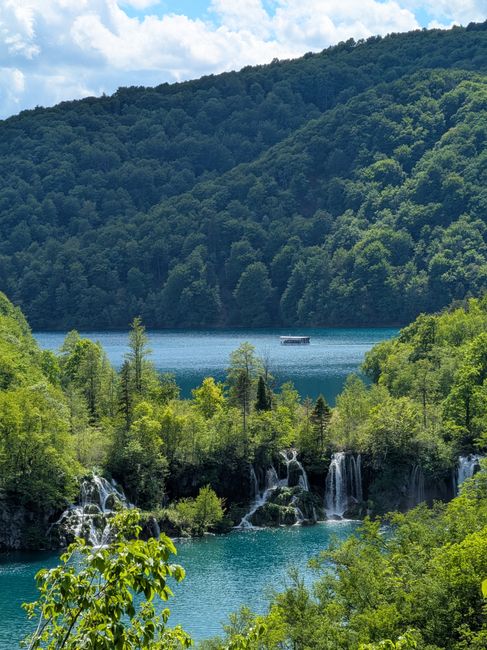
Plitvice Lakes is Croatia’s oldest and most famous national park: sixteen terraced lakes in shades of turquoise, emerald and blue, joined by dozens of waterfalls and crossed by wooden boardwalks that run just above the water. The lakes sit in a forested karst valley in the Lika highlands, halfway between Zagreb and the Dalmatian coast, and they keep growing as the mineral tufa (travertine) builds new natural dams. The park was founded in 1949 and became one of the first UNESCO World Heritage Sites in 1979. It is breathtaking in every season, and very busy in summer, so the key to a good visit is buying your ticket online for an early entry time. You cannot swim in the lakes.
Right now in Plitvice Lakes (Rastovača (Plitvice Entrance 1))
- Wed 11–21°C 52–69°F Clear
- Thu 15–20°C 59–69°F 10 mm Rain
- Fri 8–14°C 46–57°F 18 mm Rain
Weather: MET Norway (CC BY 4.0) · Rates: ECB
Top tours in Plitvice Lakes
See all tours for Plitvice Lakes →
From local operators, with prices and reviews; you check availability and book on Viator, our partner. We may earn a commission at no extra cost to you. How we earn money
Plitvice Lakes at a glance
- Best months: May–June and September–October, for full waterfalls, green or golden forest and fewer people. Winter is magical but cold, and the Upper Lakes usually close.
- Time needed: 4–6 hours for the main routes; a full day or two days to see everything and walk the hiking trails.
- Getting there: about 2 hours by road from Zagreb, 1.5–2 hours from Zadar and about 3 hours from Split. Buses between Zagreb and the coast stop at both entrances.
- Tickets (as of October 2026): €40 for adults from June to September, €23 in April, May and October, €10 from November to March; buy online with an entry time.
- Rules: no swimming, no drones, no dogs off the leash, and stay on the boardwalks and paths.
How the lakes work: Upper and Lower Lakes
The park has two parts. The Upper Lakes (Gornja jezera), twelve lakes on dolomite rock in the south, are wide and wooded, with countless small cascades between them. Lake Prošćansko is the highest, at about 636 m. They flow down into Lake Kozjak, the largest and deepest lake, which you cross by electric boat. Below Kozjak, the four Lower Lakes (Donja jezera) lie in a narrow limestone canyon with high cliffs, ending at the Veliki slap (Great Waterfall), at 78 m the highest waterfall in Croatia, where the Plitvica stream falls into the canyon. Just beyond, the waters meet at Sastavci to form the Korana river.
The colours change with the minerals, the depth, the light and the season, from milky turquoise to deep blue and green. The tufa barriers that hold the lakes in place are living formations of moss, algae and calcium carbonate, which is why you must never step off the boardwalks or touch them.
Tickets and booking (as of October 2026)
Prices below are from the park’s official 2026 price list. A ticket includes the electric boat on Lake Kozjak, the panoramic “train” (road vehicle) and visitor insurance.
| Season | Adults | Students | Children 7–18 |
|---|---|---|---|
| 1 June – 30 September | €40 (€25 late afternoon) | €25 (€15 late afternoon) | €15 (€9 late afternoon) |
| April, May and October | €23 | €14 | €6 |
| January – March and November – December | €10 | €6 | €4 |
Children under 7 go free. The cheaper late-afternoon price applies after 16:00 from 1 June to 31 August and after 15:00 in September. Two-day tickets cost €60 for adults in summer, €39 in spring and October and €15 in winter. Students need a valid student card.
Book online, with an entry time. The park strongly recommends buying tickets on its official webshop (np-plitvicka-jezera.hr), where you choose a date, an entrance and an entry time. You must validate the ticket at the entrance you chose, within that time: according to the park, you cannot enter before the time on the ticket, and you can be at most one hour late. Tickets are also sold at the entrances if they are not sold out, but in July and August popular morning slots go days ahead, and queues at the ticket desks can be long. Guests at the park’s own Hotel Jezero and the Korana and Borje campsites pay for the first day only and can extend their ticket for free for each extra night.
Opening hours: the park is open every day of the year, with seasonal hours. As of early October 2026 both entrances are open 07:00–18:00, with ticket sales until 15:00; the electric boats run every 30 minutes from 08:00 and the panoramic vehicles from 07:30. Hours are longer in summer and shorter in winter, so check the official site for your date.
Entrance 1 or Entrance 2?
The two main entrances are about 3 km apart on the D429 road, each with a car park, ticket desks, toilets, cafés and a bus stop.
- Entrance 1 (Rastovača, north) is next to the Lower Lakes and the Great Waterfall, with the famous viewpoint over the canyon a few minutes from the gate. It is the busier entrance and the start of routes A, B and C. Choose it for a short visit or if you want the classic view first.
- Entrance 2 (Hladovina, south) is by the Upper Lakes and the park hotels, at the middle of the system. It is the start of routes E, F and H, and the auxiliary Flora entrance nearby also sells tickets. Choose it if you are staying at the hotels or want to see the whole system with fewer people early on.
Which route to take
The park’s official routes are marked at the entrances: green from Entrance 1, orange from Entrance 2.
- Route A (Entrance 1, 2–3 hours, 3.5 km): the Lower Lakes and the Great Waterfall. Short but crowded.
- Route B (Entrance 1, 3–4 hours, 4 km): the Lower Lakes, a boat ride across Kozjak and the panoramic vehicle back.
- Route C (Entrance 1, 4–5 hours, 8 km): the Lower and Upper Lakes, with boat and panoramic vehicle. The best choice for most first-time visitors.
- Route E (Entrance 2, 2–3 hours, 5.1 km): the Upper Lakes only.
- Route F (Entrance 2, 3–4 hours, 4.6 km): boat across Kozjak, then the Lower Lakes and the Great Waterfall.
- Route H (Entrance 2, 4–6 hours, 8.9 km): the whole lake system, starting with the panoramic vehicle to the top of the Upper Lakes and walking down. Great for a full day and fewer crowds.
- Route K (6–8 hours, about 16.5 km): the full loop on foot, for keen walkers.
In summer, start early: the first hour after opening is the quietest and the light is best. Boardwalks can be one-person wide, so expect to walk in a slow line at busy times on the Lower Lakes.
Nature
- Lake Galovac
- Lake Kaluđerovac
- Lake Kozjak
- Lake Milanovac
- Lake Prošće (Prošćansko jezero)
- Veliki slap (Great Waterfall)
Caves
- Golubnjača Cave
Hiking, rowing and winter visits
Besides the 22 km of lake paths, the park has about 36 km of hiking trails in the surrounding forest, including routes to the viewpoints over Kozjak and the Čorkova uvala old-growth beech and fir forest. Rowing boats can be hired on Lake Kozjak in season. In winter, the lakes may partly freeze and the waterfalls turn to icicles: it is beautiful and almost empty, but usually only the Lower Lakes are open, the boats and panoramic vehicles may not run, and paths can be icy. The Upper Lakes normally reopen in early April, depending on the weather.
Activities and best months
- HikingThe lake tour programmes are signed walks from Entrance 1 or 2: programme B (about 4 km, 3-4 hours) walks the Lower Lakes canyon below the Great Waterfall, crosses Lake Kozjak by electric boat and returns by the panoramic vehicle, both included in the ticket. Longer marked trails climb the Medveđak peaks (about 2.5 h from Entrance 2) or follow the Plitvica stream (9 km) and Čorkova uvala (21 km). Swimming in the lakes is forbidden.
Why you cannot swim at Plitvice
Swimming in the lakes is strictly prohibited, as the park’s rules and its official FAQ state. The tufa barriers are fragile and the water ecosystem is protected; rangers fine people who swim or leave the paths. Other rules: do not feed the animals, pick plants or throw anything in the water; keep dogs on a leash (including on the boats); no fishing, fires, camping or cycling inside the lake area; and no drones. If you want to swim nearby, the Korana river has bathing spots downstream in the village of Korana and further north at Slunj’s Rastoke, a pretty village of mills and small waterfalls about 30 km away.
Getting there and getting around
By car
From Zagreb, take the A1 motorway towards Karlovac and then the D1 state road south through Slunj, about 2 hours in all. From Zadar or Split, leave the A1 at Otočac or Gornja Ploča and follow the D52 or D1, about 1.5–2 hours from Zadar and 3 hours from Split. Parking at the entrances costs €2 an hour in summer and €1.50 an hour in spring and autumn (motorbikes and campers pay a daily rate). Car parks open 07:00–19:00.
By bus
Buses between Zagreb and Zadar or Split stop on the main road by both entrances; check times at Zagreb bus station (akz.hr) and book a seat back in summer. Lika’s local bus service, Likaline, runs within Lika-Senj County. Many day tours run from Zagreb, Zadar and Split, but they arrive mid-morning, when the park is busiest.
Inside the park
Electric boats cross Lake Kozjak, and panoramic road vehicles link three stations along the east side of the lakes; both are included in your ticket. Luggage can be left free at Entrance 1, Entrance 2 and the Flora entrance.
Around Plitvice: Rastoke, caves and Lika food
Plitvice sits in Lika, a thinly populated region of forests, meadows and karst plateaus between the coast and inland Croatia. It is worth an extra day.
- Rastoke: in the town of Slunj, about 30 km north, the Slunjčica river tumbles over tufa ledges into the Korana among old wooden watermills and houses, like a miniature Plitvice you can walk through. Some mills are open to visit, and you can swim in places in summer.
- Barać Caves: near Rakovica, about 15 km north, a show cave with stalactites and bats, visited on guided tours in season.
- The Velebit and Northern Velebit National Park: the mountain range between Lika and the sea has wild hiking and the Premužić Trail, a historic high path with sea views.
- Lika food: try lamb or veal from the peka, pura s ličkim krumpirom (turkey with Lika potatoes), trout, local cheese such as škripavac, and basa, a fresh soft cheese. Roadside restaurants near the park roast lamb and pig on spits.
Accessibility and visiting with children
Children love the boardwalks, the boats and the panoramic vehicles, and under-7s go free; keep small children close, as many boardwalks have no railings. For pushchairs, the Upper Lakes from Entrance 2 are easier than the steep paths around the Lower Lakes canyon. The park says that, because of the terrain, wheelchair access is not possible throughout, but staff at the entrances can suggest the most accessible route. People with a disability over 50%, and one companion, enter free.
Photography tips
Plitvice is one of the most photographed places in Croatia, and a little planning helps. The classic view of the Lower Lakes and the Great Waterfall is from the viewpoint a few minutes from Entrance 1, best in the morning light. On the Upper Lakes, the boardwalks around Galovac and Gradinsko lakes give the best close-ups of the cascades. Arrive at opening time for empty boardwalks and still water; by mid-morning in summer the paths are crowded. Overcast days are ideal for waterfalls, softening the light and deepening the colours. Tripods are allowed for personal use if they do not block the boardwalks, but drones are banned, and commercial photography needs a permit from the park.
Nearby destinations
When to go and how long to stay
Weather for your datesSunrise and sunset
Plitvice is in the mountains, so it is much cooler and wetter than the coast, with cold, snowy winters. Spring brings the fullest waterfalls with snowmelt and rain; summer is green and warm, with the biggest crowds; autumn turns the beech forests gold and red in October; winter is quiet and frosty. For most people, late April to June and September to October are the best months. Allow a full day; stay overnight nearby to be at the gate at opening time.
| Season | Mean temperature | Days with rain a month | What it’s like |
|---|---|---|---|
| Spring (Mar–May) | 4–13 °C | 9–12 | Waterfalls at their fullest; cool and changeable; Upper Lakes reopen in early April. |
| Summer (Jun–Aug) | 17–19 °C | 8–11 | Warm, green and very busy; book an early entry time. |
| Autumn (Sep–Nov) | 14 °C falling to 5 °C | 10–12 | Gold and red forests in October; fewer people; wet November. |
| Winter (Dec–Feb) | −2 to 0 °C | 7–10 | Snow and frozen falls; usually only the Lower Lakes open. |
Figures are DHMZ long-term monthly averages for Gospić (1872–2024), the nearest station with published normals, about 40 km south at a similar height; the lakes themselves are at about 500–640 m. They are means over day and night: summer afternoons reach about 24–26 °C. The area gets about 1,500 mm of rain and snow a year, so pack a waterproof in any season.
Weather month by month
Plitvice in one day
Arrive the evening before and stay nearby. Be at Entrance 1 at opening time for Route C, or at Entrance 2 for Route H; have lunch at the Kozjak restaurants, and spend the late afternoon at Rastoke on your way north or at the viewpoints.
Two days
On day one, do Route C or H; on day two, walk the hiking trails above the lakes or return for the Upper Lakes in the early morning light with a two-day ticket. Combine with Zadar or Zagreb.
Where to stay near Plitvice
- Inside the park: Hotel Jezero, by Entrance 2, plus the park’s other hotels; staying there gives you free extra days in the park.
- Village guesthouses: Mukinje, Jezerce, Rastovača and Grabovac have family-run rooms within a few kilometres of the entrances.
- Camping: the park’s Korana and Borje campsites have buses to the entrances.
- With more character: Rastoke near Slunj, about 30 km north.
Practical tips for Plitvice
- Book online for an early entry time, especially from June to September.
- Start early and do your route in the direction the signs show to avoid jams on the boardwalks.
- Bring food and water: there are cafés at the entrances and by Kozjak, but few in between.
- Wear grippy shoes: boardwalks are wet and slippery, and there are no railings on many of them.
- No swimming and no leaving the paths.
- Cash: the exchange offices at the entrances are closed; pay by card or bring euros.
- Emergencies: call 112.
What to pack for Plitvice
Packing list for Plitvice Lakes
Bring walking shoes or light hiking shoes with good grip, a rain jacket (the weather changes quickly), a warm layer for the early morning and the boat, a hat and sunscreen in summer, water and snacks, and a bag for your rubbish. A small backpack is easier than a large bag on the narrow boardwalks. In winter, add warm boots, gloves and a hat, and microspikes if the paths are icy. Leave the drone at home.
What to pack
- Day packs and anti-theft bagsA 20–30 litre pack carries layers, water, a head torch and snacks on full-day levada walks.
- Fleeces and warm layersSummits like Pico do Areeiro averaged about 11 °C over 2024, so a fleece is needed even in summer.
- HeadlampsLevada routes such as PR1 and PR9 pass through long, dark, wet tunnels.
- Hiking shoes and bootsMadeira's levadas and the Azores' crater rims are wet, rocky and slippery, so grippy shoes matter more than anywhere else in Portugal.
- Rain jacketsMountain and island weather changes fast; a real shell beats an umbrella in the wind.
- Trekking polesLong stone staircases and steep descents on Madeira's peaks and the Azores' crater rims are easier on the knees with poles.
- Water bottles and hydration packsAlgarve and Alentejo trails are hot and exposed with few refill points.
Plitvice Lakes travel FAQ
How much is the Plitvice Lakes ticket in 2026?
For adults, €40 from June to September (€25 late in the afternoon), €23 in April, May and October and €10 from November to March. Students pay €25, €14 or €6, and children 7–18 pay €15, €6 or €4. Under-7s go free.
Do I need to book Plitvice in advance?
It is strongly recommended, especially in summer. Online tickets are for a chosen entrance and entry time; you cannot enter early and may be at most an hour late. Tickets are sold at the gates only if not sold out.
Can you swim in Plitvice Lakes?
No. Swimming is strictly prohibited throughout the park to protect the tufa barriers and the lakes. Swim in the Korana river downstream instead.
Which entrance is better, 1 or 2?
Entrance 1 is closest to the Great Waterfall and the classic viewpoint, and is busier. Entrance 2 is next to the hotels and the Upper Lakes and is often quieter early in the day. Both lead to routes that cover the whole system.
Which route is best at Plitvice?
Route C from Entrance 1 or Route H from Entrance 2 for most visitors: 4–6 hours covering the Lower and Upper Lakes with the boat and panoramic vehicle.
How long do you need at Plitvice?
At least 4–6 hours. A full day, or two with an overnight stay, lets you go early and see everything without rushing.
Can you visit Plitvice in winter?
Yes. It is quiet and beautiful, and tickets cost €10. Usually only the Lower Lakes are open, and the boats and panoramic vehicles may not run.
Is Plitvice a good day trip from Split?
It is possible but long: about 3 hours each way. It is easier from Zadar (1.5–2 hours) or Zagreb (about 2 hours), or as a stop on the drive between them.
Are dogs allowed at Plitvice?
Yes, on a leash at all times, including on the boats and the panoramic vehicles.
What should I see near Plitvice?
Rastoke, a village of watermills and small waterfalls in Slunj about 30 km north, the Barać Caves near Rakovica and the Velebit mountains towards the coast.
Is the boat included in the Plitvice ticket?
Yes. The electric boat across Lake Kozjak and the panoramic vehicles are included in the entrance ticket.
Plan your trip
Partner links: TravelerCenter may earn a commission if you book, at no extra cost to you.
🇭🇷 Useful Croatian phrases for Plitvice Lakes
All 38 Croatian phrases: restaurant, hotel, emergencies, romance (printable) →
Sources · last reviewed 4 October 2026
Researched and last reviewed on 4 October 2026. Ticket prices, entry-time rules, opening hours, routes, rules of conduct, parking and directions come from the official website of Plitvice Lakes National Park; climate from the Croatian Meteorological and Hydrological Service (DHMZ). Prices, hours and rules change, so check the park’s official site before you travel.
Also: np-plitvicka-jezera.hr · DHMZ normals 1991–2020, Zagreb-Maksimir (temperature); DHMZ Gospić 1872–2024 averages (rain, sun) (climate)
Place data: © OpenStreetMap contributors (ODBL) · Wikidata (CC0)