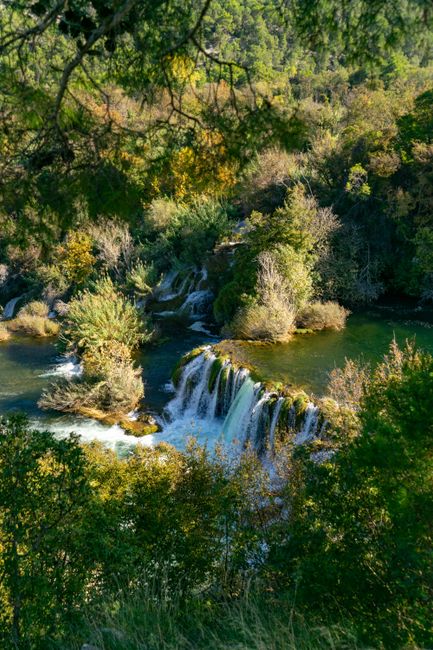
Krka National Park protects the lower course of the Krka river in Dalmatia, where the water tumbles over a chain of seven tufa waterfalls on its way to the sea at Šibenik. The star is Skradinski buk, a broad cascade of pools and falls crossed by a loop of wooden boardwalks, with old watermills turned into small museums. Upriver, a Franciscan monastery sits on the tiny island of Visovac in the middle of a lake, and the falls of Roški slap spill through a village of mills. Krka is easier to reach than Plitvice, only an hour from Split and a short drive from Šibenik, and the classic way in is by boat from the little town of Skradin. One thing has changed: you can no longer swim below Skradinski buk, which has been banned since 2021.
Right now in Krka National Park (Skradin)
- Wed14–25°C57–76°FPartly cloudy
- Thu18–24°C65–76°FPartly cloudy
- Fri18–24°C64–75°F12 mm rain
Top tours in Krka National Park
See all tours for Krka National Park →
From local operators, with prices and reviews; you check availability and book on Viator, our partner. We may earn a commission at no extra cost to you. How we earn money
Krka National Park at a glance
- Best months: April–June and September–October, when the falls are full and the paths are calmer. July and August are hot and crowded.
- Time needed: 3–4 hours for Skradinski buk; a full day with the boat to Visovac and Roški slap.
- Getting there: about 1 hour by road from Split, 1–1.5 hours from Zadar and 20 minutes from Šibenik. The main entrances are Skradin (boat) and Lozovac (bus).
- Tickets (as of October 2026): €40 for adults from June to September (€30 after 15:00), €20 in April, May and October, €7 in winter. The boat from Skradin is included from April to October.
- Rules: no swimming at Skradinski buk, stay on the paths, no drones, dogs on a leash and not on Visovac.
The park and its waterfalls
The park covers about 109 km² along the Krka, a karst river that rises near Knin and runs about 73 km to the sea. Like the lakes at Plitvice, its waterfalls are built from tufa (travertine): mosses and algae trap calcium carbonate from the water, slowly forming natural dams that grow and change over the centuries. That is why the park asks you to stay on the boardwalks and not to touch or step on the barriers. The park counts seven waterfalls, 47 km of walking paths and a long cycling network in the wider area, as well as monasteries, Roman remains and medieval forts.
Skradinski buk
Skradinski buk is the lowest and largest set of falls, near the point where the fresh river meets the brackish water of the estuary, and the reason most people come. A circular trail of about 2 km of boardwalks and paths, taking an hour or two, leads over and around the cascades, past green pools and through shady woods. Along the way, restored watermills, washing stamps and a small ethnographic collection show how villagers once used the river. Near the falls stand the remains of Jaruga, one of the world’s first alternating-current hydroelectric power plants, which began supplying Šibenik with electricity in 1895.
Visovac and the Roški slap
Upriver, the river widens into Visovac Lake. On a little island in the middle stands the Visovac Franciscan monastery, founded in the 15th century, with a church, a garden of cypresses and a museum. Further north, Roški slap is a 650 m-wide stretch of small cascades known locally as the “necklaces”, ending in a 27 m fall, with old mills that sell local produce. Nearby are the Oziđana pećina cave, with traces of people from the Stone Age onwards, and a viewpoint over the canyon.
Further upriver: Krka Monastery, Burnum and Manojlovac
In the quieter north of the park, the Serbian Orthodox Krka Monastery stands in a green bay with ancient catacombs beneath it. The Burnum archaeological site has the arches of a Roman legionary camp and a small military amphitheatre. The Manojlovac falls, the highest in the park at about 60 m in all, are seen from a viewpoint above the canyon. These sites are reached by car and see few visitors.
Nature
- Roški slap
- Skradinski buk
Churches and cathedrals
- Visovac Monastery
Castles and forts
- Kamičak Fortress
Other sights
- Krka Monastery
Archaeological sites
- Burnum
Tickets and boats (as of October 2026)
Prices below come from the park’s official 2026 price list. There are two kinds of ticket: one for all the land sites, including Skradinski buk, and a cheaper one for the northern sites only (Roški slap, Manojlovac, Burnum, Kistanje and the Eco Campus).
| Period | Adults, all sites | Children 7–18 and students, all sites | Adults, northern sites only |
|---|---|---|---|
| June – September | €40 (€30 after 15:00) | €15 (€11.25 after 15:00) | €20 |
| April, May and October | €20 | €12 | €12 |
| January – March and November – December | €7 | €4 | €7 |
Children under 7 go free. From 1 April to 31 October the ticket includes the park boat from Skradin to Skradinski buk and back and the shuttle bus from Lozovac to Skradinski buk and back; from 1 June to 30 September it also includes the bus between Laškovica and Roški slap. Buy online on the park’s official site to avoid the queues in summer.
Boat excursions leave from Skradinski buk at extra cost, from April to October: to Visovac (about 2 hours, €15 for adults), a 45-minute trip into the Čikola canyon (€10) and a 4-hour trip to Visovac and Roški slap (€20).
Opening hours: Skradinski buk and Roški slap are open every day with seasonal hours. At Skradinski buk, 2026 hours are 08:00–20:00 from June to August, 08:00–19:00 in May and September, 08:00–18:00 in April and from 1 to 15 October, 09:00–17:00 from 16 to 31 October and in March, and 09:00–16:00 from November to February. The park is closed on 25 and 26 December. The Skradin ticket office opens half an hour before Skradinski buk.
Skradin or Lozovac: which entrance?
- Skradin is a pretty little harbour town at the mouth of the gorge. Park in town, buy your ticket at the park office on the waterfront and take the park boat upriver, about 25 minutes through the gorge to the falls. From November to March, when the boat does not run, you can walk the 3.5 km path along the river or drive to Lozovac. Skradin is also a good place for lunch, and has a marina full of yachts.
- Lozovac is on the plateau above the falls, with a large car park. From April to October, a shuttle bus takes you down to Skradinski buk in a few minutes; out of season, you walk down a short path. It is the quicker option by car from the motorway.
For Roški slap, use the Laškovica or Roški slap entrances by car, or take the excursion boat from Skradinski buk.
Swimming at Krka: what has changed
For decades, swimming in the pool below Skradinski buk was one of the classic Croatian summer pictures. It was banned from 1 January 2021, as reported by Croatian public broadcaster HRT, to protect the growth of the tufa barriers and for visitors’ safety. The park’s official rules now say swimming is not allowed except at specially marked places. Those places are a few traditional bathing spots on Visovac Lake and below Roški slap, used by local people; ask at the entrance which are open. For a proper swim, head to the sea at Šibenik, Primošten or the beaches near Vodice.
Activities and best months
- Boat tripsAprMayJunJulAugSepOctPark boats carry visitors from Skradin to Skradinski buk from April to October (included in the ticket), and an excursion boat goes up the river from Skradinski buk to Roški slap.
- HikingA 1,900 m circular educational trail leads around the Skradinski buk waterfalls, and a 3,400 m walking and cycling trail runs from the Skradin bridge up the river to Skradinski buk. Swimming at Skradinski buk is not allowed.
Walking, cycling and kayaking
Besides the Skradinski buk loop, marked trails lead to viewpoints over the canyon and between the northern sites; the park’s “Krka Hike” and “Krka Bike” pages list routes. The cycling network runs on quiet roads and gravel tracks across the plateau. Guided kayaking trips run on the river outside the strictly protected zones. Walking from Skradin to Skradinski buk along the river path is a good alternative to the boat, about an hour each way.
History along the river
The Krka has been a crossroads for thousands of years, and the park protects much more than waterfalls. The Romans built the legionary camp of Burnum to guard a river crossing; its arches and amphitheatre still stand on the plateau. In the Middle Ages, rival Croatian noble families built forts on both sides of the canyon: the ruins of Trošenj and Nečven face each other across the gorge, and Ključica looms over the Čikola canyon. The Franciscans settled on Visovac in the 15th century, and the Orthodox monks of the Krka Monastery a few decades later; both communities are still active. In the 19th century the river’s power was harnessed for mills and stamps, and in 1895 for one of the earliest alternating-current power systems in the world at Jaruga, which supplied Šibenik with street lighting.
Food and drink near Krka
Skradin is known for Skradin risotto (skradinski rižot), a slow-cooked veal and rice dish traditionally stirred for hours and served at weddings and feasts; some restaurants make it to order. Inland, the town of Drniš is famous for its pršut, air-dried ham, and the area around Šibenik grows the red Babić grape on stony terraces, most famously at Primošten. At Roški slap, the old mills sell flour, honey and dried figs. Šibenik itself has excellent restaurants in its old town.
Krka with children and accessibility
Krka works well with children: the Skradinski buk loop is short, mostly flat and shaded, with plenty to look at, and the boat ride from Skradin is part of the fun. Keep small children close on the boardwalks, which have no railings in places. Parts of the Skradinski buk trail are accessible for wheelchairs and pushchairs from the Lozovac side, but some sections have steps; ask at the entrance for the best route. People with a disability over 50%, with one companion, enter free, as do children under 7.
Krka or Plitvice: how they compare
Both parks are built from tufa waterfalls and both are UNESCO-quality landscapes, but they feel different. Plitvice is a chain of sixteen lakes in a mountain forest, with more waterfalls, bigger crowds and a full day of walking; it is cooler, and its colours are famous. Krka is a single great river in a dry Dalmatian canyon, with one spectacular set of falls at Skradinski buk, a boat ride in, monasteries and Roman remains upriver, and a much easier location near the coast. Prices in summer are the same for adults (€40). If you have time for only one and are based on the coast, Krka fits into half a day; if you are driving between Zagreb and the coast, stop at Plitvice. See our Plitvice guide to compare.
Nearby destinations
- Split50 km
- Zadar69 km
- Hvar96 km
- Makarska Riviera113 km
- Plitvice Lakes123 km
- Međugorje153 km
- Mostar156 km
- Krk179 km
Getting there
By car
Leave the A1 motorway at the Šibenik exit for Lozovac and Skradin, or at Skradin itself. From Split it takes about an hour, from Zadar about 1–1.5 hours, and from Šibenik about 20 minutes. Parking in Skradin and Lozovac fills up by mid-morning in July and August.
By bus and tour
Local buses run from Šibenik to Skradin and Lozovac several times a day in summer. Many tours from Split, Trogir, Šibenik and Zadar include Krka, often combined with Šibenik or Primošten; they are convenient but arrive at the busiest time. Short boat excursions also run from Šibenik and Vodice up the estuary to Skradin.
Šibenik
Šibenik, 15 km away at the mouth of the Krka, is a lovely base with two UNESCO sites: the Cathedral of St James, built entirely of stone, and the Venetian sea fortress of St Nicholas at the entrance to the channel. Its upper-town fortresses of St Michael and Barone have wide views.
When to go and how long to stay
Spring brings the fullest falls, after the winter rain and snowmelt upstream; summer is hot, with the most visitors and a full boat service; autumn is pleasant and quieter. In winter the boats and shuttle buses stop and hours are short, but tickets cost just €7. Half a day is enough for Skradinski buk; spend a full day for the boat to Visovac and Roški slap, or a night in Skradin.
| Season | Mean temperature | Days with rain a month | What it’s like |
|---|---|---|---|
| Spring (Mar–May) | 10–18 °C | 9–10 | Fullest waterfalls; mild; boats and buses from 1 April. |
| Summer (Jun–Aug) | 23–25 °C | 5–8 | Hot and busy; go at opening time or after 15:00 for the cheaper ticket. |
| Autumn (Sep–Nov) | 21 °C falling to 12 °C | 7–12 | Pleasant and calmer in September and October; boats until 31 October. |
| Winter (Dec–Feb) | 7–8 °C | 9–12 | Quiet and cheap; no park boats or shuttles; short hours. |
Figures are DHMZ long-term monthly averages for Šibenik (1949–2024), the nearest coastal station, about 15 km from Skradinski buk. They are means over day and night: summer afternoons reach about 30 °C and feel hotter in the sheltered canyon. Šibenik gets about 800 mm of rain a year.
Weather month by month
Half a day at Krka
Arrive in Skradin at opening time, take the first boat to Skradinski buk, walk the loop, and be back in Skradin for lunch.
A full day
Do Skradinski buk early, then take the 4-hour boat trip to Visovac and Roški slap, or drive to Roški slap and the Krka Monastery. End with dinner in Šibenik.
Where to stay
- Skradin: small hotels and apartments by the water, perfect for being first on the boat.
- Šibenik: the best base for culture and restaurants, 20 minutes away.
- Vodice and Primošten: beach resorts on the coast.
- Split or Zadar: if you prefer a day trip from a big base.
Practical tips for Krka
- Buy online and arrive early in summer, or after 15:00 for the cheaper ticket.
- No swimming at Skradinski buk; bring swimwear only for the sea.
- Stay on the boardwalks and do not touch the tufa.
- Bring water and a hat: there are cafés at the falls, but the paths are hot in summer.
- Dogs must be on a leash and are not allowed on Visovac.
- Emergencies: call 112.
What to pack for Krka
Bring comfortable walking shoes with grip for wet boardwalks, a sun hat, sunscreen, sunglasses and a refillable water bottle, plus a light rain jacket in spring and autumn. A small backpack is easier than a large bag on the narrow paths. Insect repellent helps on summer evenings by the river. Pack a swimsuit only if you are heading to the sea afterwards, not for the falls.
What to pack
- Day packs and anti-theft bagsA 20–30 litre pack carries layers, water, a head torch and snacks on full-day levada walks.
- Dry bags and phone pouchesSpray soaks phones and cameras on open boats to the Algarve caves and on whale-watching trips.
- Fleeces and warm layersIt is cooler at sea than on land, especially on morning whale-watching trips.
- HeadlampsLevada routes such as PR1 and PR9 pass through long, dark, wet tunnels.
- Hiking shoes and bootsMadeira's levadas and the Azores' crater rims are wet, rocky and slippery, so grippy shoes matter more than anywhere else in Portugal.
- Rain jacketsA windproof, waterproof shell keeps you warm on open boats, where wind and spray cool you quickly.
- Reef-friendly sunscreenSun reflects off the water on cruises and cave tours.
- Trekking polesLong stone staircases and steep descents on Madeira's peaks and the Azores' crater rims are easier on the knees with poles.
- Water bottles and hydration packsAlgarve and Alentejo trails are hot and exposed with few refill points.
- Water shoesKayak and small-boat trips to the Algarve grottoes land on rock and wet sand.
Krka National Park travel FAQ
Can you still swim at Krka National Park?
Not at Skradinski buk: swimming there has been banned since 1 January 2021. The park’s rules allow swimming only at specially marked spots, a few traditional bathing places on Visovac Lake and below Roški slap.
How much is the Krka National Park ticket in 2026?
For adults, €40 from June to September (€30 after 15:00), €20 in April, May and October and €7 from November to March. Children 7–18 and students pay €15, €12 or €4; under-7s go free.
Is the boat from Skradin included in the ticket?
Yes, from 1 April to 31 October the ticket includes the park boat from Skradin to Skradinski buk and back, and the shuttle bus from Lozovac. Excursions to Visovac and Roški slap cost extra.
Should I enter Krka at Skradin or Lozovac?
Skradin, for the boat ride up the gorge and a pretty town for lunch. Lozovac, for a quicker visit by car, with a shuttle bus down to the falls.
What are Krka’s opening hours?
Skradinski buk opens at 08:00 from April to mid-October and 09:00 the rest of the year, closing between 16:00 and 20:00 depending on the month. It is closed on 25 and 26 December.
Krka or Plitvice: which is better?
Plitvice is bigger, with more lakes and waterfalls, and is a full day. Krka is closer to Split and the coast, smaller and easier to combine with Šibenik. If you can, see both.
How long do you need at Krka?
Three or four hours for Skradinski buk; a full day if you add the boat to Visovac and Roški slap.
Can you visit Krka from Split?
Yes. It is about an hour’s drive, and many tours run from Split. Arrive early in summer to beat the crowds.
Can you visit Krka in winter?
Yes. The park is open all year except 25 and 26 December, and tickets cost only €7 from November to March. The boats and shuttle buses do not run, so walk from Skradin or drive to Lozovac.
Is Krka good for children?
Yes. The Skradinski buk loop is short and shaded, and the boat from Skradin adds to the fun. Children under 7 go free; keep them close on boardwalks without railings.
What is Visovac?
A tiny island in the middle of a lake on the Krka with a Franciscan monastery, reached by an excursion boat from Skradinski buk.
Plan your trip
Partner links: TravelerCenter may earn a commission if you book, at no extra cost to you.
🇭🇷 Useful Croatian phrases for Krka National Park
All 38 Croatian phrases: restaurant, hotel, emergencies, romance (printable) →
Sources · last reviewed 4 October 2026
Researched and last reviewed on 4 October 2026. Ticket prices, what the ticket includes, boat excursion prices, opening hours, entrances and park rules come from the official website of Krka National Park and its 2026 price list; climate from the Croatian Meteorological and Hydrological Service (DHMZ). The date of the swimming ban at Skradinski buk comes from Croatian public broadcaster HRT and is flagged for checking. Prices, hours and rules change, so check the park’s official site before you travel.
Also: npkrka.hr · DHMZ normals 1991–2020, Split-Marjan (temperature); DHMZ Šibenik 1949–2024 averages (rain, sun) (climate)
Data: Weather: MET Norway (CC BY 4.0) · Rates: ECB · Costs: World Bank ICP and price levels · © OpenStreetMap contributors (ODBL) · Wikidata (CC0)