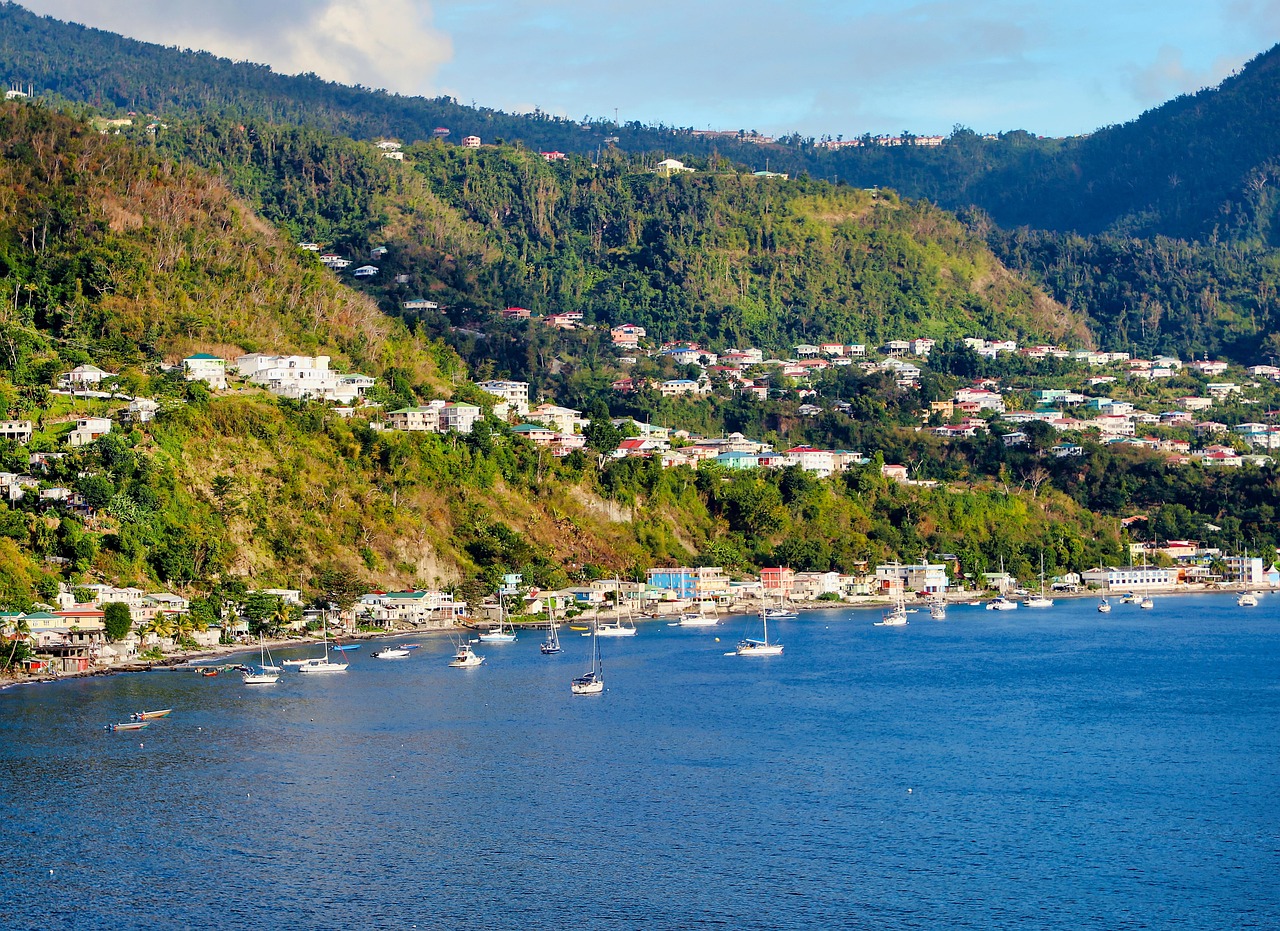
Dominica (pronounced dom-in-EE-ka) is the “Nature Island” of the Caribbean: a steep, volcanic island between Guadeloupe and Martinique, about 29 miles long, covered in rainforest and cut by rivers and waterfalls, with about 75,000 people. It is not a beach-resort island but an adventure one. The Morne Trois Pitons National Park, a UNESCO World Heritage Site, holds the Boiling Lake, a flooded volcanic vent that the Discover Dominica Authority calls the world’s second largest boiling lake, reached by a famous day hike through the steaming Valley of Desolation, as well as Trafalgar Falls, Emerald Pool, Middleham Falls and Titou Gorge. The Waitukubuli National Trail runs the length of the island; offshore, divers explore volcanic reefs such as Champagne Reef, where bubbles rise from the seabed, and boats go out to watch the sperm whales that live in Dominica’s deep waters. The capital, Roseau, is a lively small town of wooden Creole houses. Dominica is also the home of the Kalinago, the island’s Indigenous people, and of a strong Creole culture celebrated at Carnival and the World Creole Music Festival. English is the official language, the currency is the Eastern Caribbean dollar, and all travelers complete an electronic immigration form before arrival. February to May is the driest time.
Right now in Dominica
- Sat26–29°C78–85°F2 mm rain
- Sun25–30°C77–85°F2 mm rain
- Mon25–30°C78–86°F2 mm rain
Weather, sun and air quality here are for one point near the centre of Dominica, not the whole country; conditions elsewhere can differ. Readings refresh through the day.
Dominica: quick answers
- Best time to visit Dominica
- Dominica is warm all year and green because it is wet: the Discover Dominica Authority gives an average temperature of 27 °C and average coastal rainfall of about 1,780 mm, with three times that in the mountainous interior. More
- Things to do in Dominica
- Hikes, waterfalls, whales and Creole culture. More
- Entry rules for Dominica
- According to the Discover Dominica Authority, immigration officers require a valid passport, a return ticket, enough money for your stay and a local address. Visitors from Commonwealth countries do not need a visa; nationals of Haiti and the Dominican Republic do. More
Dominica at a glance
Dominica covers about 751 km² (290 square miles), making it one of the larger islands of the Lesser Antilles, but its mountains are so steep that most of its people live along the coast. The Discover Dominica Authority describes it as two-thirds rainforest, with nine volcanoes, 365 rivers and 29 waterfalls; the highest peak, Morne Diablotin, rises to about 1,447 m (4,747 feet). Rainfall is heavy in the interior and on the windward coast, which keeps the island green and its rivers running. Dominica’s national bird, the Sisserou parrot, appears on the flag. Do not confuse Dominica with the Dominican Republic, a much larger country on the island of Hispaniola; see our Dominican Republic guide if that is where you are headed.
English is the official language, but, according to the Discover Dominica Authority, much of the population speaks Kwéyòl, a French-based Creole, and a few northern villages use an English dialect called Kokoy. The currency is the Eastern Caribbean dollar (XCD, written EC$). Dominica keeps Atlantic Standard Time, UTC−4, all year, with no daylight saving time. Cars drive on the left. Electricity is 220/240 V, and the international dialing code is +1 767.
Dominica’s regions
- Roseau and the Roseau Valley: the capital on the southwest coast, with its cruise berth and ferry terminal, and, just inland, the villages of Trafalgar, Wotten Waven and Laudat, gateways to Trafalgar Falls, the hot springs, Titou Gorge, Freshwater Lake and the Boiling Lake trail.
- The south: Soufrière, with its sulphur springs, and the Scotts Head peninsula, at the edge of the Soufrière–Scotts Head Marine Reserve, Dominica’s best-known area for diving and snorkeling, including Champagne Reef.
- The west coast: a road north from Roseau past fishing villages, dive resorts and black-sand beaches to Portsmouth, Dominica’s second town.
- Portsmouth and the north: Prince Rupert Bay, the Indian River, Cabrits National Park with Fort Shirley, Morne Diablotin National Park and the Syndicate Nature Trail, and the beaches of the northeast around Calibishie.
- The east coast: the wild Atlantic side, with Douglas-Charles Airport, the Kalinago Territory, Emerald Pool inland, and rugged bays and rivers to the south.
Videos of Dominica
Hand-picked travel videos from YouTube creators to help you picture the trip. They play from YouTube; the facts in this guide come from our own research.
Where to go: rainforest, waterfalls and volcanic reefs
Most visitors base themselves in or near Roseau, which puts Morne Trois Pitons National Park, the Roseau Valley and the southern reefs within easy reach; our Roseau guide covers the town and its day trips. A second base in the north, around Portsmouth or Calibishie, makes it easy to explore the Indian River, Cabrits, Morne Diablotin and the northern beaches. Distances are short, but roads are steep and winding, so journeys take longer than the map suggests.
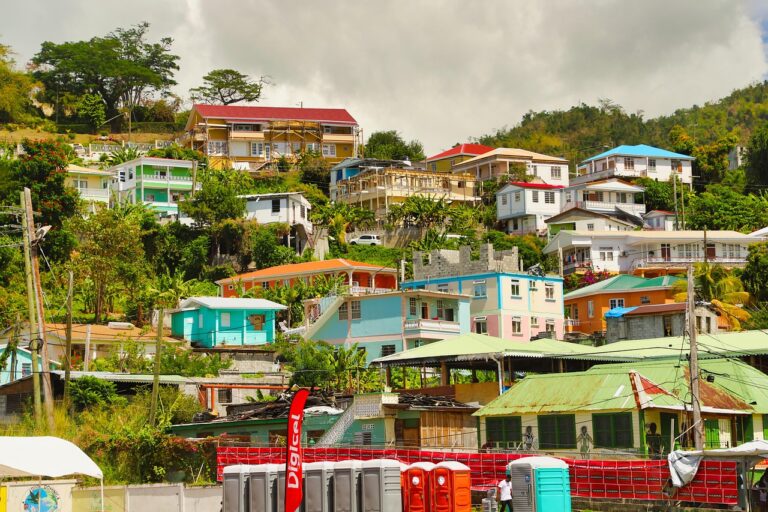
Roseau Travel Guide
Plan a visit to Roseau, Dominica's capital: the Old Market and Dominica Museum, the Bayfront, Fort Young, the cathedral and Creole architecture, the Botanic…
Beyond Roseau
Morne Trois Pitons National Park and the Boiling Lake
Dominica’s volcanic heart was inscribed by UNESCO as a World Heritage Site in 1997, for its rainforest, volcanoes, fumaroles, hot springs, lakes and waterfalls. The great hike is to the Boiling Lake: according to the Discover Dominica Authority, a flooded fumarole whose water reaches 82–92 °C at its edges, reached on a round trip of about 8 miles, 3 to 4 hours each way, through river valleys and the Valley of Desolation, a landscape of sulphur vents and steaming mud pools. It is a strenuous trek for fit hikers, and all hikers must be accompanied by a certified local guide; tours start from Laudat, about 40 minutes from Roseau. Many hikers cool off afterward in Titou Gorge, a narrow canyon where you swim upstream to a hidden waterfall. Also in the park are Freshwater Lake, at about 2,500 feet, and Boeri Lake.
Trafalgar Falls, Middleham Falls and Emerald Pool
Trafalgar Falls, about 20 minutes from Roseau, is the most accessible of Dominica’s big waterfalls: twin cascades, Papa Falls (85 m) and Mama Falls (40 m), with hot spring vents near the base, a 10-minute walk from the parking area to a viewing platform. Middleham Falls, the island’s tallest at about 60 m, is a 1½- to 2-hour hike each way through dense rainforest. Emerald Pool, in the center of the island on the road to the east coast, is a jade-green pool below a mossy waterfall, reached by a short, easy trail, and swimming is allowed. Hot springs in Wotten Waven, in the Roseau Valley, are a relaxing way to end the day.
Scotts Head, Soufrière and Champagne Reef
South of Roseau, the coast road ends at Scotts Head, a narrow isthmus and headland separating the Caribbean from the Atlantic, with views back along Soufrière Bay, the rim of a submerged volcanic crater. The bay lies within the Soufrière–Scotts Head Marine Reserve, with reefs, walls and pinnacles close to shore. At Champagne Reef, volcanic gases bubble up through the sand, so snorkelers swim through streams of warm bubbles. In the village of Soufrière, the Soufrière Sulphur Springs have warm pools for bathing. The village hosts an annual Dive Fest in late summer.
Portsmouth, the Indian River and Cabrits
On the northwest coast, Portsmouth sits on wide Prince Rupert Bay. Licensed guides row visitors up the Indian River through mangroves and swamp bloodwood trees, past a hut used in Pirates of the Caribbean, to a bush bar upstream. On a headland north of town, Cabrits National Park protects dry forest and the restored 18th-century garrison of Fort Shirley, with views over the bay. Inland, the Syndicate Nature Trail in Morne Diablotin National Park is the best place to look for Dominica’s two endemic parrots, the Sisserou and the Jaco, and Syndicate Falls lies at the foot of the mountain. Beaches in the north, such as Purple Turtle Beach near Portsmouth and the golden-sand bays around Calibishie, are among the island’s best.
The Kalinago Territory
Dominica is home to the Kalinago, the Indigenous people of the island, who live mainly in the Kalinago Territory on the east coast. Visitors can learn about Kalinago crafts, basket weaving, cassava bread-making, dance and history at the cultural village of Kalinago Barana Autê, and buy baskets from roadside stalls. The Kalinago name for Dominica, Waitukubuli, means “tall is her body,” according to the Discover Dominica Authority.
Best time to visit Dominica
Dominica is warm all year and green because it is wet: the Discover Dominica Authority gives an average temperature of 27 °C and average coastal rainfall of about 1,780 mm, with three times that in the mountainous interior. The drier months are February to May, the best time for hiking and the Boiling Lake. Rain increases from June, and the Atlantic hurricane season runs from June to November, peaking from August to October. Even in the wettest months, mornings are often sunny, and the waterfalls are at their most powerful. The table shows the World Meteorological Organization’s 1991–2020 climate normals for Canefield Airport, on the coast just north of Roseau, rounded.
| Month | Average high / low | Rain (days with 1 mm or more) | What to expect |
|---|---|---|---|
| January | 30 °C (85 °F) / 22 °C (71 °F) | 110 mm (4.3 in), 16 days | Fresh trade winds; Carnival season begins |
| February | 30 °C (85 °F) / 22 °C (71 °F) | 67 mm (2.6 in), 13 days | Drier; Carnival (February 8–9, 2027) |
| March | 30 °C (87 °F) / 22 °C (72 °F) | 43 mm (1.7 in), 10 days | Driest month; ideal for hiking |
| April | 31 °C (88 °F) / 23 °C (73 °F) | 67 mm (2.6 in), 10 days | Dry and sunny; Easter |
| May | 32 °C (89 °F) / 24 °C (75 °F) | 89 mm (3.5 in), 11 days | Warm, still fairly dry |
| June | 32 °C (90 °F) / 25 °C (76 °F) | 160 mm (6.3 in), 16 days | Rains begin; hurricane season starts |
| July | 32 °C (89 °F) / 25 °C (76 °F) | 232 mm (9.1 in), 20 days | Wet and humid; Gouté Domnik food week |
| August | 32 °C (90 °F) / 24 °C (76 °F) | 250 mm (9.8 in), 20 days | Wettest month at Canefield; Dive Fest |
| September | 32 °C (90 °F) / 24 °C (75 °F) | 246 mm (9.7 in), 16 days | Peak storm risk; quiet and green |
| October | 32 °C (89 °F) / 24 °C (75 °F) | 179 mm (7.1 in), 17 days | Creole Heritage month; World Creole Music Festival |
| November | 31 °C (88 °F) / 23 °C (74 °F) | 177 mm (7.0 in), 15 days | Independence celebrations (November 3) |
| December | 30 °C (87 °F) / 22 °C (72 °F) | 125 mm (4.9 in), 16 days | Showers easing; Christmas |
Canefield, on the sheltered west coast, gets about 1,730 mm (68 in) of rain a year. The east coast is much wetter: the WMO normals for Douglas-Charles Airport, in the northeast, show about 2,570 mm (101 in) a year, with October and November the wettest months, and the high interior gets more still. Pack for showers at any time of year, especially on hikes.
Carnival 2027 and other festivals
Dominica’s Carnival, Mas Domnik, known as “the Real Mas,” runs from January 9 to February 10, 2027, according to the Discover Dominica Authority, with calypso, bouyon music, costume competitions and street parades, building to the two Carnival days, Monday and Tuesday, February 8 and 9, 2027, before Ash Wednesday. The other big event of the year is the World Creole Music Festival, three nights of bouyon, zouk, soca and other Creole music at Windsor Park stadium in Roseau in late October; the 2026 edition, its 26th, ran from October 23 to 25.
- Gouté Domnik: a week-long taste of Dominica in late July, with a restaurant week, a one-pot cooking competition and a farmers’ market (July 19–26 in 2026).
- Bike Fest: four days of motorcycle events in late July and early August.
- Dive Fest: in Soufrière in late August (August 29–30 in 2026), with kayaking races, water sports and seafood, set against the marine reserve.
- Flavours of the World: a food and culture festival in early October.
- WATO: a riverside food and culture festival where Caribbean chefs cook over open fire; WATO means “fire” in the Kalinago language (October 31 in 2026).
- Creole Heritage and Independence: October is a month of Creole culture, with schools and businesses celebrating Creole Day in national dress, leading up to Independence Day on November 3 and Community Day of Service on November 4.
How long to stay: sample itineraries
- A cruise day in Roseau: a walk through the old town, the Botanic Gardens and the Dominica Museum, then Trafalgar Falls and Titou Gorge, or a snorkel at Champagne Reef.
- 5 days: base in Roseau or the Roseau Valley; walk the town, then Trafalgar Falls and the hot springs, the Boiling Lake hike with a guide, a dive or snorkel at Champagne Reef and Scotts Head, and a whale-watching trip.
- 8–10 days: four nights in the south as above, then four nights in the north for Emerald Pool and the Kalinago Territory on the way, the Indian River, Cabrits and Fort Shirley, the Syndicate Nature Trail and the beaches around Calibishie.
- 2 weeks or more: hike several segments of the Waitukubuli National Trail, or paddle the Waitukubuli Sea Trail, and add a ferry hop to Guadeloupe or Martinique. See our Guadeloupe and Martinique guides.
Entry, money and costs
The electronic immigration form (as of November 2026)
According to the Discover Dominica Authority, all travelers must complete Dominica’s electronic immigration form online, at edcard.dominica.gov.dm, in advance of their trip, whether they arrive by air or by sea. Complete it shortly before you travel and keep the confirmation on your phone or printed.
Passports and visas
According to the Discover Dominica Authority, immigration officers require a valid passport, a return ticket, enough money for your stay and a local address. Visitors from Commonwealth countries do not need a visa; nationals of Haiti and the Dominican Republic do. Visitors staying less than 24 hours, including cruise passengers, do not need a visa, and neither does any bona fide tourist with a return ticket who satisfies the immigration officer that they will not stay longer than 21 days. The UK government’s entry information says British visitors are granted a stay of six months on arrival and that passports should be valid for at least six months after the date you arrive. A yellow fever vaccination certificate is required if you arrive from a country with a risk of yellow fever transmission. Stays can be extended through the Immigration Division. Regulations change, so contact Dominica’s Immigration Department (+1 767 448 2222) or the nearest Dominica mission to confirm the rules for your nationality.
There is a departure tax of EC$86 (US$33), usually included in the price of an air ticket and also payable when leaving by ferry, according to the UK government. Cash or traveler’s checks worth EC$10,000 or more must be declared on arrival. Pets need an import permit from the Ministry of Agriculture’s veterinary unit.
Money and cards
The Eastern Caribbean dollar (EC$) has been fixed by the Eastern Caribbean Central Bank at EC$2.70 to US$1 since July 7, 1976; the Discover Dominica Authority notes that businesses typically exchange US dollars at about EC$2.67. According to the authority, businesses across the island accept US dollars, British pounds and euros, and most hotels, restaurants, tour operators and car rental agencies take Mastercard, Visa and American Express. Carry EC dollars for minibuses, markets, small shops and site passes. Banks open from 8 a.m. to 2 p.m. Monday to Thursday and 8 a.m. to 5 p.m. on Friday, and are closed on Saturdays, when many shops open from 8 a.m. to 1 p.m. According to the Inland Revenue Division, the standard value-added tax (VAT) is 15%, with a reduced 10% rate on hotel accommodation; many hotels and restaurants also add a service charge, so check the bill before you tip.
Site passes for national parks
Non-residents need a site pass to visit the main eco-tourism sites, including Morne Trois Pitons National Park (with the Boiling Lake, Emerald Pool, Freshwater and Boeri lakes and Middleham Falls), Trafalgar Falls, Cabrits National Park and Fort Shirley, Morne Diablotin National Park and the Syndicate trail, the Indian River and the Soufrière Sulphur Springs. The Discover Dominica Authority lists US$5 for a single-site pass and US$12 for a week pass covering repeat visits to all sites, but the Forestry, Wildlife and Parks Division has published higher prices (US$8 for a single site visit and US$20 for a day pass), so confirm the current price when you buy. Passes are sold at the site visitor centers, at the Forestry Division in Roseau and by selected vendors near the sites, and tour operators often include them in their prices. See our hiking guide.
What a trip costs
Prices are approximate, for November 2026, in Eastern Caribbean or US dollars (EC$2.70 to US$1).
| Item | Typical cost |
|---|---|
| Site pass, single site / week (Discover Dominica Authority) | US$5 / US$12 |
| Departure tax (usually in the ticket) | EC$86 (US$33) |
| Minibus ride | EC$3–10 |
| Taxi, Douglas-Charles Airport to Roseau | US$65–85 per vehicle |
| Guided Boiling Lake hike, per person | US$60–120 |
| Whale-watching trip | US$70–100 |
| Two-tank dive | US$100–150 |
| Creole lunch in a local restaurant | EC$25–45 |
| Rental car, per day | US$50–80 |
| Guesthouse or eco-lodge double, per night | US$70–150 |
| Upscale resort double, per night | US$300–900 |
A comfortable trip with a guesthouse or mid-range hotel, a rental car or taxis, a few guided tours and meals out costs roughly US$130–220 per person per day for two people sharing. Figures other than the site pass and departure tax are our estimates, not official statistics.
Getting there and getting around
Flights
Dominica has two airports. Most visitors arrive at Douglas-Charles Airport (DOM), formerly Melville Hall, on the northeast coast, about an hour’s drive from Roseau, which has the longer runway. Canefield Airport (DCF), 15 minutes from Roseau, has a short runway of 3,100 feet for small aircraft. According to the Discover Dominica Authority, American Airlines flies directly from Miami to Douglas-Charles, and other travelers from North America and Europe connect through hubs such as Antigua, Barbados, Martinique, Guadeloupe, St. Maarten, San Juan and Trinidad, on regional airlines including interCaribbean, Winair, Sunrise Airways and LIAT2020. Schedules change, so check with the airlines, and book an airport transfer in advance, as minibuses may not meet your flight.
Ferries and cruise ships
The FRS Express des Îles ferry links Dominica with Guadeloupe to the north and Martinique and Saint Lucia to the south, docking at the Roseau Ferry Terminal in the center of the capital, with some sailings at Portsmouth. Schedules vary with the season and demand, so check the operator’s timetable before booking. Cruise ships berth at the Roseau cruise ship berth, at Woodbridge Bay just north of the capital, and at the Cabrits berth near Portsmouth; according to the Discover Dominica Authority, hundreds of thousands of cruise visitors arrive each year. Yachts can anchor at the official ports and must clear customs and immigration on arrival. See our Saint Lucia guide.
Getting around
Driving is on the left. According to the Discover Dominica Authority, visitors may need a local temporary driving permit in addition to their home license; ask your rental company, which can usually arrange it. Roads are steep, narrow, winding and slippery after rain, so avoid unnecessary night driving and allow extra time. Taxis are available at Douglas-Charles Airport, through the dispatch desk, and in Roseau; licensed taxis have registration plates starting with H, HA or HB. Taxis are generally not metered, so agree on the total fare, currency and luggage before you go. Privately run minibuses link Roseau with towns and villages, most dependably by day from Monday to Saturday, with limited service on Sundays and holidays and often no fixed departure times. For hikes and remote sights, a guided tour or a driver for the day is often easiest; the Discover Dominica Authority publishes a directory of tour and taxi operators.
Hiking, diving and whale watching
The Waitukubuli National Trail, which the Discover Dominica Authority describes as the longest hiking trail in the Caribbean, runs about 115 miles (185 km) in 14 segments from Scotts Head in the south to Cabrits National Park in the north, through rainforest, volcanic highlands, river valleys and villages. Each segment can be walked on its own, from half-day walks to multi-day treks, and a trail passport can be stamped at checkpoints; a site pass covers the trail fee. Since 2023, the Waitukubuli Sea Trail has offered a 40-mile, 14-segment kayak route along the sheltered west coast, with guided expeditions and rentals from the Soufrière Outdoor Centre. Canyoning, river tubing and birdwatching are also popular. See our hiking guide.
Under water, Dominica’s volcanic slopes drop steeply close to shore, with walls, pinnacles, sponges and reef fish; the Soufrière–Scotts Head Marine Reserve and Champagne Reef are the best-known sites, and diving is good year-round. Dominica’s deep, calm leeward waters are also home to a resident population of sperm whales, and boat trips from the Roseau area go out to look for them, with dolphins and pilot whales also often seen. See our diving, snorkeling and boat trips guides.
Culture, food and everyday etiquette
A short history
The Kalinago, who called the island Waitukubuli, held Dominica long after Europeans settled the neighboring islands, helped by its mountains and forests. Columbus sighted it on a Sunday in 1493 and named it after the day. French settlers and their enslaved Africans arrived in the 18th century, and Dominica passed between France and Britain before British rule was confirmed in the late 18th century; French influence lives on in the Kwéyòl language, place names and Catholic faith. Dominica became independent on November 3, 1978, and is a member of the Commonwealth. Roseau’s name comes from the French for the reeds that grew at the mouth of its river.
Food and drink
Dominican cooking is Creole, based on fresh fish, local farm produce and spices: try callaloo soup, bakes (fried dough) with salt fish, accra (fish fritters), stewed chicken with provisions such as dasheen and green bananas, fresh tuna and mahi-mahi, and, from the Kalinago, cassava bread. The island grows abundant fruit, from mangoes and passion fruit to soursop, and fresh juices are everywhere. Drink local rum and bush rum infusions, Kubuli beer, and sea moss drinks. The Gouté Domnik week in July and WATO in October are good times to taste the island.
Etiquette
Greet people with “good morning” or “good afternoon” before asking a question; in Kwéyòl, bonjou. Dress modestly away from the beach and in churches, and ask before photographing people, especially in villages and the Kalinago Territory. On trails and at sites, stay on the paths, take your rubbish with you, and follow your guide’s instructions near hot springs and fumaroles.
Health, practical tips and connectivity
- Everyday precautions: use common sense with your belongings; keep valuables out of sight in cars and use your hotel safe.
- Hiking: hire a certified guide for the Boiling Lake, which is required, and for other long or remote trails; start early, carry water and rain gear, and avoid river crossings after heavy rain, when water rises quickly.
- Driving: drive slowly on mountain roads, give way on narrow bends, and avoid driving at night where you can.
- Sun and insects: use sunscreen and a hat, and insect repellent against mosquitoes, particularly in the rainy season.
- Medical care: according to the Discover Dominica Authority, there are public hospitals at Marigot, Portsmouth and Roseau, where the Dominica China Friendship Hospital is the main one, plus private clinics; have travel insurance that covers medical evacuation.
- Storms: from June to November, follow forecasts and the instructions of your hotel and the local authorities.
- Emergencies: call 999 for the police, ambulance and fire service.
The two mobile providers are FLOW and Digicel; check your plan’s roaming rates or buy a local SIM. Wi-Fi is common in hotels and guesthouses. The supply is 220/240 V, and, according to the Discover Dominica Authority, American appliances need a transformer, though many accommodations offer both types of outlet; bring a travel adapter and confirm with your hotel.
Things to do: hikes, waterfalls, whales and Creole culture
Hike to the Boiling Lake through the Valley of Desolation; swim through Titou Gorge; stand below the twin cascades of Trafalgar Falls; soak in the hot springs of Wotten Waven or the Soufrière Sulphur Springs; snorkel through the bubbles of Champagne Reef; dive the Soufrière–Scotts Head Marine Reserve; watch sperm whales off the west coast; row up the Indian River and explore Fort Shirley in Cabrits; look for Sisserou parrots on the Syndicate Nature Trail; meet Kalinago craftspeople on the east coast; walk a segment of the Waitukubuli National Trail; and dance to bouyon at Carnival or the World Creole Music Festival. See our hiking, diving, snorkeling, boat trips and city sightseeing guides.
What to pack
Sturdy hiking shoes with good grip for muddy trails, water shoes for rivers, gorges and rocky beaches, a light rain jacket at any time of year, quick-drying clothes and a change of clothes for after hikes, swimwear, a dry bag, insect repellent, sunscreen and a hat, a refillable water bottle, and a warm layer for early starts in the mountains. Bring your home driving license if you plan to drive.
Dominica travel FAQ
Is Dominica the same as the Dominican Republic?
No. Dominica is a small, English-speaking island nation in the Eastern Caribbean, between Guadeloupe and Martinique. The Dominican Republic is a much larger Spanish-speaking country on the island of Hispaniola.
Do I need to fill in a form before traveling to Dominica?
Yes. According to the Discover Dominica Authority, all travelers must complete the electronic immigration form at edcard.dominica.gov.dm before their trip.
Do I need a visa for Dominica?
Commonwealth citizens do not, and neither do bona fide tourists with a return ticket staying up to 21 days or cruise passengers staying less than 24 hours; nationals of Haiti and the Dominican Republic need a visa. British visitors are granted six months on arrival. Check with Dominica’s Immigration Department for your nationality.
Can I hike to the Boiling Lake without a guide?
No. All Boiling Lake hikers must go with a certified local guide. The round trip of about 8 miles takes 3 to 4 hours each way from Laudat and is strenuous.
What is the best time to visit Dominica?
February to May, the driest months, for hiking and the Boiling Lake; Carnival falls in February in 2027, and the World Creole Music Festival in late October. June to November is wetter and is the hurricane season.
How much is a site pass in Dominica?
The Discover Dominica Authority lists US$5 for one site and US$12 for a week pass covering all the main sites, but the Forestry Division has published higher prices, so check when you buy. Tours often include the pass.
How do I get to Dominica?
Fly to Douglas-Charles Airport, directly from Miami or via Caribbean hubs such as Antigua, Barbados, Guadeloupe, Martinique, St. Maarten or San Juan, or take the ferry from Guadeloupe, Martinique or Saint Lucia to Roseau.
Are there beaches in Dominica?
Yes, though Dominica is known more for its rainforest and reefs. Many beaches are black volcanic sand; the north has golden-sand bays around Calibishie and Purple Turtle Beach near Portsmouth. See our beaches guide.
What currency is used in Dominica?
The Eastern Caribbean dollar, fixed at EC$2.70 to US$1. US dollars, British pounds and euros are widely accepted, and most tourism businesses take Visa, Mastercard and American Express.
What is the emergency number in Dominica?
999 for the police, ambulance and fire service.
Can I combine Dominica with other islands?
Yes, easily by ferry to Guadeloupe, Martinique and Saint Lucia, or by air via Antigua or Barbados. See our Guadeloupe, Martinique, Antigua and Barbuda and Barbados guides.
Plugs and power in Dominica
Dominica uses 230 V, 50 Hz and these plugs (left) and wall sockets (right):
Supply is 220/240 V; American appliances need a transformer, though many accommodations also offer US-style outlets.
All plug types and voltages by country → · Check what you need to pack →
Plan your trip
Partner links: TravelerCenter may earn a commission if you book, at no extra cost to you.
Before you go: guidebooks and travel gear
Affiliate links: we may earn a commission at no extra cost to you. As an Amazon Associate we earn from qualifying purchases. We pick items for the place, not for the commission. How we earn money
Sources · last reviewed 10 November 2026
Researched and last reviewed on 10 November 2026. The electronic immigration form, entry requirements, languages, money, banking hours, telecommunications, electricity, hospitals, emergency number, time, climate summary, airports and airlines, ferries, cruise berths, taxis, minibuses, driving, site passes, the Boiling Lake, waterfalls, the Waitukubuli National and Sea Trails, festivals and dates including Carnival 2027 and the World Creole Music Festival: the Discover Dominica Authority (discoverdominica.com); British visitors’ stay, passport validity, yellow fever, departure tax and cash declarations: the UK government’s entry information for Dominica; VAT rates: the Inland Revenue Division; the exchange rate: the Eastern Caribbean Central Bank; climate averages: the WMO 1991–2020 normals for Canefield and Douglas-Charles airports (NOAA archive); the World Heritage Site: UNESCO; area and population: Wikidata. The newer Forestry Division site-pass prices, history, Morne Diablotin’s height, the parrots, the Kalinago Territory and Barana Autê, Creole Day, Independence dates, food, Indian River and Cabrits details, whale and dive details beyond the authority’s descriptions, plug types, and taxi, tour, car, food and hotel prices are general references or estimates, flagged for checking. Rules and prices change, so check the official sites before you go.
Data: Weather: MET Norway (CC BY 4.0) · Rates: ECB · Wikidata (CC0)