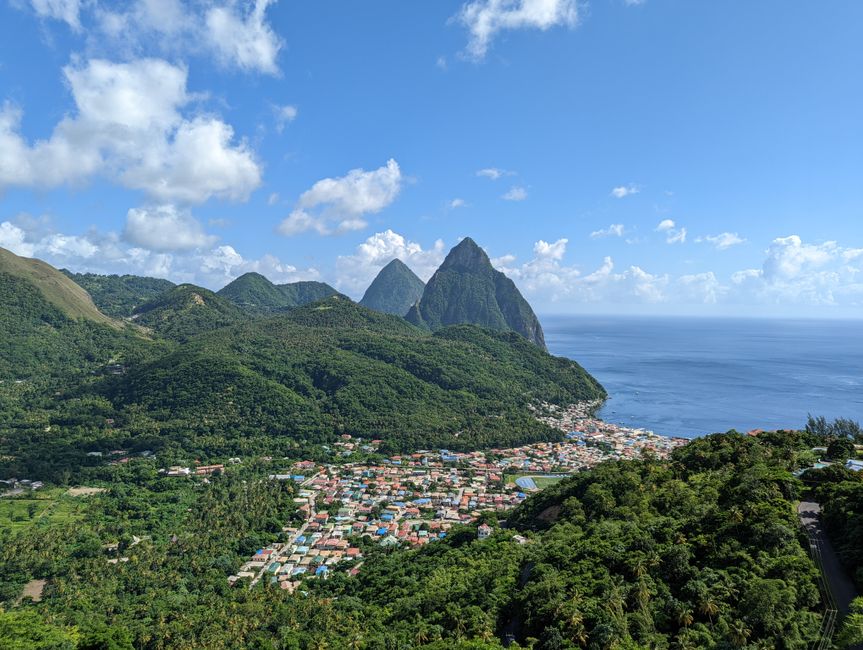
Saint Lucia is a mountainous, green island in the Windward Islands of the Eastern Caribbean, about 43 km (27 miles) long, between Martinique to the north and St Vincent to the south. Its emblem is the Pitons, two steep volcanic spires rising straight out of the sea near Soufrière and protected as a UNESCO World Heritage Site. Around them you will find rainforest trails, waterfalls, a steaming volcanic caldera with mud baths, cocoa estates, coral reefs in a well-run marine reserve, and golden and black-sand beaches. In the north, Rodney Bay and Gros Islet have the easiest beaches, restaurants and the famous Friday-night street party. English is the official language, but you will hear Kwéyòl, a French-based Creole, everywhere. December to April is the dry season; May, June and November are good-value shoulder months. Give it a week, ideally split between the north and Soufrière.
Right now in Saint Lucia
- Tue 24–27°C 74–81°F 15 mm Rain
- Wed 25–29°C 77–84°F 9 mm Showers
- Thu 24–28°C 75–83°F 5 mm Light showers
- Today Thanksgiving
Weather: MET Norway (CC BY 4.0) · Holidays: Nager.Date
Multi-day tours of Saint Lucia
Multi-day tours from local operators. You check dates and book on Viator, our partner; we may earn a commission at no extra cost to you. How we earn money
Saint Lucia at a glance: overview and geography
Saint Lucia covers about 617 km² (238 square miles) and is about 23 km (14 miles) wide. It is a volcanic island with a spine of forested mountains rising to Mount Gimie, about 950 m (3,120 feet), and steep valleys running down to the coast. The sheltered west (Caribbean) coast has the calm bays, the capital Castries and most of the resorts; the east (Atlantic) coast is windier, wilder and much less developed. The south is flatter and drier, with the main international airport at Vieux Fort. About 180,000 people live on the island, around a third of them in and around Castries.
Saint Lucia’s history is one of rivalry between Britain and France, which fought over it so often, and so fiercely, that it changed hands 14 times and earned the nickname “the Helen of the West Indies”. Britain finally kept it in 1814, but the French legacy survives in place names such as Soufrière, Vieux Fort and Gros Islet, in the Catholic faith of most islanders and in Kwéyòl. Saint Lucia became independent on 22 February 1979 and remains a Commonwealth realm. For its size it has produced a remarkable two Nobel laureates, the economist Sir Arthur Lewis and the poet Derek Walcott, who share a birthday on 23 January. The Pitons Management Area, covering the two peaks, the land between them and the sea around them, was inscribed by UNESCO in 2004.
Time zone: Saint Lucia runs on Atlantic Standard Time (UTC−4) all year, with no daylight saving time, the same as New York in summer and one hour ahead of it in winter.
The regions
- The north: Rodney Bay, Gros Islet and Cap Estate: the main resort area, with Reduit Beach, the marina, Pigeon Island and most restaurants and nightlife.
- Castries: the busy capital and cruise port, with its central market, cathedral and the hill of Morne Fortune.
- Marigot Bay and the west coast: a deep, palm-fringed bay that is one of the Caribbean’s most sheltered anchorages, then the fishing villages of Anse La Raye and Canaries.
- Soufrière and the Pitons: the old French capital beneath the Pitons, with the volcano, waterfalls, cocoa estates, the marine reserve and the island’s most spectacular hotels.
- The south: Vieux Fort: the international airport, the windswept Sandy Beach for kitesurfing and the Maria Islands nature reserve.
- The east coast and the interior: farming villages, banana plantations, the Edmund and Des Cartiers rainforest reserves and Atlantic beaches such as Grande Anse, where turtles nest.
Where to go: the Pitons, Soufrière, Rodney Bay and Marigot Bay
Roads are steep and winding, so distances take longer than they look: Rodney Bay to Soufrière is about an hour and a half by road, or 45 minutes by water taxi. Many visitors split a week between the north, for beaches and restaurants, and Soufrière, for the Pitons and nature.
Soufrière and the Pitons
Gros Piton (about 798 m / 2,618 feet) and Petit Piton (about 743 m / 2,438 feet) are the eroded plugs of ancient volcanoes, and the views of them from the sea, from the road above Soufrière and from the hotels on the hillsides are unforgettable. Gros Piton can be climbed with a local guide from the village of Fond Gens Libre: it is a steep, rocky trail of about two hours up and one and a half down. The easier Tet Paul Nature Trail gives close-up views of both peaks in under an hour. Between the Pitons lies Sugar Beach (Anse des Pitons), and just north of Soufrière, Anse Chastanet and Anse Mamin have excellent snorkeling right off the sand.
Sulphur Springs, waterfalls and cocoa
Just outside Soufrière, the Sulphur Springs sit in the collapsed caldera of the Qualibou volcano, marketed as the world’s only “drive-in volcano”. Steam vents and bubbling gray pools smell strongly of sulfur, and downstream you can wallow in warm mud baths. Nearby are the Diamond Falls Botanical Gardens, with mineral-stained falls and old French baths; the Toraille waterfall, where you can stand under the cascade; and cocoa and coffee estates such as Morne Coubaril and Fond Doux, where you can see how chocolate is made.
Rodney Bay, Gros Islet and Pigeon Island
Rodney Bay is the island’s tourist hub: a long sweep of calm water at Reduit Beach, a large marina, shopping malls, restaurants and bars. Next door, the fishing village of Gros Islet hosts a lively Friday-night street party with grilled fish, rum and loud soca. At the end of the causeway, Pigeon Island National Landmark, run by the Saint Lucia National Trust, has the ruins of an 18th-century British fort, small beaches and a short climb to Fort Rodney for views across to Martinique on a clear day.
Castries and Marigot Bay
Castries is a working port town rebuilt after several fires, best seen on a weekday morning at the central market, where stalls sell spices, cocoa sticks, hot sauce and crafts. Derek Walcott Square and the colorful Cathedral Basilica of the Immaculate Conception are just a few blocks away, and Morne Fortune above town has old fortifications and wide views. South of Castries, Marigot Bay is a small, deep inlet ringed by palms and hills, with a marina, restaurants and a tiny beach reached by a short ferry ride.
The east coast and the rainforest
The Atlantic side has few hotels, rough seas and a strong sense of rural Saint Lucia. Dennery’s Saturday-night fish fry is popular with locals, the Mamiku Gardens and Fond d’Or nature park are pleasant stops, and Grande Anse is a nesting beach for leatherback turtles. Inland, the Edmund Forest Reserve and the Des Cartiers trail lead through rainforest where, with luck, you may hear or see the endemic Saint Lucia parrot, the national bird.
A few more worth your time
Anse Cochon, a sheltered snorkeling beach reached mainly by boat; the Friday seafood night in Anse La Raye; the fishing village of Canaries and its river pools; Sandy Beach at Vieux Fort for kitesurfing from December to June; the Maria Islands nature reserve, home to a rare ground lizard; and a sunset sail along the west coast to see the Pitons from the water.
Best time to visit Saint Lucia
Saint Lucia is hot and humid all year, with afternoon highs of 29–31 °C (84–89 °F) and warm nights. The dry season runs from about December to May; the wet season, from June to November, brings heavy tropical downpours, especially in the mountains, and the risk of tropical storms. The table uses the Saint Lucia Meteorological Services’ 1991–2020 averages for George F. L. Charles Airport in Castries, on the north-west coast. The south around Hewanorra is drier (about 1,498 mm / 59 inches of rain a year against 1,829 mm / 72 inches in Castries), and the rainforest gets far more.
| Season (Castries, 1991–2020) | Average afternoon high | Average night low | Rainfall a month | What it’s like |
|---|---|---|---|---|
| Winter (Dec–Feb) | 29–30 °C (84–85 °F) | 23–24 °C (73–75 °F) | 72–129 mm (2.8–5.1 in) | Dry season, sunny with short showers; the busiest and most expensive time. |
| Spring (Mar–May) | 30–31 °C (85–88 °F) | 23–25 °C (74–77 °F) | 66–105 mm (2.6–4.1 in) | The driest, sunniest months; the Jazz and Arts Festival in May. |
| Summer (Jun–Aug) | 31 °C (87–88 °F) | 25 °C (77 °F) | 157–218 mm (6.2–8.6 in) | Hot, humid and showery; Carnival in July; hurricane season begins. |
| Autumn (Sep–Nov) | 31–32 °C (87–89 °F) | 24–25 °C (76–77 °F) | 206–251 mm (8.1–9.9 in) | The wettest months and the storm peak; quiet and cheap, with Creole Heritage Month in October. |
The sea is warm all year, at about 26–29 °C (79–84 °F). Before the 2026 hurricane season, the Meteorological Services reported below-normal rainfall and brush fires in the dry season, and warned that heavy rain on burned slopes raises the risk of landslides.
Hurricanes and recent storms
The Atlantic hurricane season runs from 1 June to 30 November, peaking from August to October. Saint Lucia is not hit every year, but the mountains make heavy rain dangerous: Hurricane Tomas in 2010 caused deadly landslides and floods around Soufrière. In July 2024, Hurricane Beryl passed to the south, devastating the Grenadines; Saint Lucia had strong winds and rough seas but escaped serious damage. The 2026 season has been unusually quiet: through early October 2026 the US National Hurricane Center had recorded no Atlantic hurricanes and issued no storm watches or warnings for Saint Lucia. If you travel between June and November, take insurance that covers storms and follow the Saint Lucia Meteorological Services.
Sargassum seaweed
Rafts of sargassum seaweed drift in from the Atlantic, mostly between spring and late summer. They pile up on the east and south-east coasts, around Vieux Fort, Micoud and Dennery, where they can smell of sulfur and make swimming unpleasant. The west coast, where nearly all the resorts are, is usually clear.
Crowds and prices through the year
Mid-December to mid-April is high season, with peak prices over Christmas, New Year and Easter. The Jazz and Arts Festival in May and Carnival in July also fill hotels. September and October are the quietest and cheapest months, and a few small hotels close for a break.
Festivals and public holidays
The biggest events are the Saint Lucia Jazz and Arts Festival in May; Carnival, which climaxes with two days of costumed parades in Castries in July; the flower festivals of La Rose (30 August) and La Marguerite (17 October); Creole Heritage Month in October, ending with Jounen Kwéyòl on the last Sunday, when villages celebrate Creole food, dress and music; and Nobel Laureate Week in January. Public holidays include New Year’s Day and 2 January, Independence Day (22 February), Good Friday, Easter Monday, 1 May, Whit Monday, Corpus Christi, Emancipation Day (1 August), Thanksgiving Day (the first Monday in October), National Day (13 December), Christmas Day and Boxing Day.
How long to stay: sample itineraries
Because the roads are slow, two bases work best for a week: Rodney Bay or Marigot Bay in the north, and Soufrière in the south-west.
5 days: Pitons and beaches
Days 1–2 in Rodney Bay: Reduit Beach, Pigeon Island and, on a Friday, the Gros Islet street party. Day 3: a boat trip down the west coast via Marigot Bay to Soufrière, with snorkeling at Anse Cochon. Days 4–5 in Soufrière: the Sulphur Springs and mud baths, Diamond Falls, a cocoa estate, Tet Paul Nature Trail and snorkeling at Anse Chastanet.
7 days: the island’s highlights
Add a climb of Gros Piton with a guide, a rainforest hike in the Edmund Forest Reserve, Castries market and Morne Fortune, and a day on the east coast or at Sandy Beach in Vieux Fort before flying home from Hewanorra.
10 days: Saint Lucia and Martinique
Spend a week on Saint Lucia, then take the fast ferry from Castries to Fort-de-France, a crossing of about an hour and a half, for three nights in French Martinique: its beaches, rum distilleries and the Mount Pelée volcano. Our Martinique guide has the details.
Entry, money, fees and costs
Entry and visas (last reviewed October 2026)
Visitors need a valid passport. Citizens of the United States, Canada, the United Kingdom and most EU countries do not need a visa for a short holiday; other nationalities should check with a Saint Lucian embassy or consulate, as the Saint Lucia Tourism Authority advises. Carry a return or onward ticket and the address of your accommodation. French citizens arriving on the ferry from Martinique can use a national ID card for stays of up to 42 days, according to the ferry operator; everyone else needs a passport.
The online immigration form
Since late 2022, Saint Lucia has used a free online Embarkation/Disembarkation (ED) form instead of the paper card for air arrivals. You reach it through the tourism authority’s page at stlucia.org/entry. One form covers a family; once you submit it, you receive a QR code by email, which you show with your passport at immigration and customs. The government says there is no time limit on early submission, and the tourism authority suggests completing it within three days of travel. You can also fill it in in the departure lounge, on board flights with internet, or on arrival using the airport’s free Wi-Fi, but doing it beforehand saves time in the line.
Departure tax
For air travel, the departure tax for passengers over 12 is included in the price of your ticket, as is the airport development charge. If you leave by sea, for example on the ferry to Martinique, the departure tax is EC$33 (about US$13), paid in cash at the ferry counter before boarding, according to the tourism authority and the ferry operator. Children under 12 are generally exempt.
The Eastern Caribbean dollar, cards and tipping
The currency is the Eastern Caribbean dollar (EC$ or XCD), shared with seven other islands and fixed at EC$2.70 to US$1. US dollars are widely accepted, though change usually comes in EC dollars and some shops use a slightly lower rate. Cards are accepted in hotels, larger restaurants and supermarkets; carry cash for minibuses, markets, street food and small beach bars. Most hotels and many restaurants add a 10% service charge; where they don’t, 10–15% is a normal tip, and guides and drivers appreciate a tip too.
Hotel taxes: the Tourism Levy and VAT
Since 1 December 2020, guests at registered accommodation pay the Tourism Levy, which funds the tourism authority: US$3 per person per night where the room rate is below US$120, and US$6 per person per night where it is US$120 or more. Guests aged 12 to 17 pay half, and children under 12 pay nothing. At the same time, the government cut VAT on tourist accommodation from 10% to 7%. Many hotels quote rates before the levy, VAT and service charge, so check the final price.
Marine reserve fees
The coast around Soufrière is the Soufrière Marine Management Area (SMMA), and a second reserve covers Canaries and Anse La Raye. The Soufrière Marine Management Association charges a daily entrance fee of EC$3 (US$1) per person for snorkelers and other users, a daily dive fee of EC$13.50 (US$5) or an annual dive fee of EC$40.50 (US$15). Dive shops and boat operators usually collect it for you. Yachts must use the SMMA’s moorings in the yacht zones, since anchoring is restricted to protect the reefs.
Typical travel costs
Saint Lucia is famous for its luxury resorts, but guesthouses, local restaurants and minibuses keep costs reasonable. These estimates per person per day, sharing a room, are a planning guide as of October 2026:
| Style | Estimated cost per day | What that looks like |
|---|---|---|
| Budget | about US$80–140 | Guesthouse or small apartment near Rodney Bay or Soufrière, minibuses, local lunches and the Friday fish fries, free beaches and trails |
| Mid-range | about US$200–350 | 3- or 4-star hotel, a boat trip down the coast, Sulphur Springs and Diamond Falls, a guided hike, restaurant dinners |
| High-end | about US$600+ | Pitons-view resort in Soufrière or an all-inclusive in the north, helicopter transfer, private boat and spa treatments |
Add the Tourism Levy, VAT and service charge to room rates. The figures are our estimates, not official statistics.
Getting there and getting around
Two airports: Hewanorra (UVF) and George F. L. Charles (SLU)
Check which airport your flight uses, because it makes a big difference. Hewanorra International Airport (UVF), at Vieux Fort in the far south, handles long-haul jets. It is about 64 km (40 miles) from Castries, a drive of around an hour and a half to Rodney Bay, or about an hour to Soufrière; helicopter transfers cut that to 15 minutes. George F. L. Charles Airport (SLU), at Vigie just outside Castries, handles regional flights from other Caribbean islands and is only 15 minutes from Rodney Bay.
According to the Saint Lucia Tourism Authority, nonstop flights reach Hewanorra from Miami, Charlotte and Philadelphia on American Airlines, from New York and Boston on JetBlue, from Atlanta on Delta, and from Newark and Chicago on United. Air Canada and WestJet fly from Toronto all year, and British Airways and Virgin Atlantic from London. Regional airlines including InterCaribbean, LIAT20, Sunrise Airways and Caribbean Airlines connect George F. L. Charles with neighboring islands.
Ferries to Martinique, Dominica and Guadeloupe
FRS Express des Îles (L’Express des Îles) runs fast passenger catamarans from Castries to Fort-de-France in Martinique (about 1 hour 30 minutes nonstop), Roseau in Dominica (about 2 hours 15 minutes, via Martinique) and Pointe-à-Pitre in Guadeloupe (about 6 hours 45 minutes, via Martinique and Dominica). There are 3 to 7 round trips a week depending on the season: three in the maintenance months of January, June and September, five normally and seven in school holidays. On the current timetable, boats leave Castries at 07:30 on several mornings a week and reach Fort-de-France at 09:00. Fares changed on 31 March 2026; the operator advertises international return fares from €119 (about US$134). Check in at least two hours before departure in Castries, and pay the EC$33 sea departure tax at the counter. Vehicles are not carried on the Saint Lucia route.
Minibuses, taxis and water taxis
Privately run minibuses, with route numbers on the windshield and “M” plates, are cheap and run frequently along the main roads, especially Castries–Gros Islet and Castries–Vieux Fort, until early evening; they stop anywhere when you call out. Taxis have “TX” plates and are not metered: fares are set by the government for common routes, so agree the price, and the currency, before you set off. Water taxis link Soufrière with the beaches between the Pitons and run between the west coast villages; they are often the fastest way to travel along that coast.
Driving
Saint Lucia drives on the left. You need a temporary local driving permit, which car rental companies issue with the rental. Roads are narrow, steep and full of hairpin bends, potholes and fast minibuses, and the west coast road south of Castries is particularly slow. Many visitors hire a car for a day or two of exploring and use taxis or tours otherwise; a four-wheel drive helps for some estate and trail roads.
Beaches, the sea and the marine reserve
All beaches in Saint Lucia are public. The calmest and most popular are on the west coast: Reduit Beach and Pigeon Island in the north, Marigot Bay’s small beach, Anse Cochon, and Anse Chastanet, Anse Mamin and Sugar Beach near Soufrière, several of them with volcanic gray or golden sand. The Atlantic beaches are wild and better for walking than swimming. See our beaches guide, plus snorkeling, diving and boat trips.
- Soufrière Marine Management Area: zoned into marine reserves, fishing priority areas, recreational areas and yacht moorings, with daily fees that fund rangers and reef monitoring. The reserves off Anse Chastanet and around the Pitons have some of the best reef life in the Eastern Caribbean.
- Don’t touch the reef: Department of Fisheries rules forbid touching or standing on coral; licensed operators follow them closely.
- Currents: currents can be strong away from the beaches; snorkel close to shore unless you have boat support.
- Turtles: leatherbacks nest on Grande Anse and other east coast beaches from about March to August; join a guided turtle watch rather than going alone.
- Footwear: wear water shoes on stony beaches and river crossings.
Safety, health and connectivity
Safety
Most visits are trouble-free. Crime that affects visitors is mostly theft: bags left on beaches, valuables in parked cars and unlocked rooms, and pickpocketing in crowds such as the Gros Islet street party. Violent crime has risen in recent years, but it mostly involves local disputes in parts of Castries and Vieux Fort away from tourist areas. Avoid walking alone on quiet beaches or roads at night, use licensed taxis, and book tours and boat trips with registered operators rather than beach touts. Hikes in the rainforest and up Gros Piton should be done with official guides. Emergency number: 911 (999 also works) for police, fire and ambulance.
Health, sun and mosquitoes
Use high-factor sunscreen and drink plenty of water, especially on hikes. Dengue fever is spread by mosquitoes, mainly in the wet season, so use repellent. Tap water is treated and generally safe in towns and hotels, but many visitors drink bottled or filtered water, especially after heavy rain. The main hospital is the Owen King EU Hospital in Castries, and St Jude Hospital serves the south. Medical care is costly for visitors, so carry travel insurance that includes evacuation.
Connectivity and power
Mobile coverage is good on the coasts and patchy in the mountains; local SIM cards and eSIMs are easy to buy. Wi-Fi is standard in hotels and free at the airports. The power supply is 240 volts with British three-pin plugs (type G), so visitors from North America and continental Europe need an adapter, and North American devices that are not dual-voltage need a converter. See travel adapters.
Food, cocoa, rum and Creole culture
Saint Lucian food is Creole cooking with African, French, British and Indian influences. The national dish is green fig (green banana) and saltfish; also try accra (saltfish fritters), bouyon (a thick stew), callaloo soup, fried bakes, breadfruit, curried goat and fresh fish at the Friday-night fish fries in Gros Islet and Anse La Raye. Saint Lucia grows fine cocoa, and estates around Soufrière make chocolate and serve “cocoa tea”, hot chocolate spiced with cinnamon and nutmeg. St Lucia Distillers makes the Chairman’s Reserve and Bounty rums, and Piton is the local beer. Kwéyòl is spoken alongside English: bonjou (good morning), mèsi (thank you) and sa ka fèt? (how are you?) are good to know. Saint Lucia is a mainly Catholic, fairly conservative society: cover up away from the beach.
Things to do: hiking, diving, boats and volcanoes
- Hiking: Gros Piton with a guide, Tet Paul Nature Trail, the Edmund Forest Reserve and Des Cartiers rainforest trails, and Pigeon Island. See our hiking guide.
- Diving and snorkeling: the walls and reefs of the Soufrière Marine Management Area, Anse Chastanet, Anse Cochon and the Lesleen M freighter wreck.
- Boat trips: catamaran day trips from Rodney Bay to Soufrière, sunset cruises, whale and dolphin watching, and sailing from Rodney Bay and Marigot Bay.
- Volcano and wellness: the Sulphur Springs mud baths, Diamond Falls’ mineral baths and the Toraille waterfall.
- Adventure: zip lines in the rainforest, mountain biking near Anse Mamin, and kitesurfing at Vieux Fort. See our cycling guide.
- Food and culture: cocoa estates, Castries market, rum tastings and the Friday-night street parties.
What to pack
Bring light, quick-drying clothes, swimwear and a cover-up, a sun hat, reef-safe sunscreen and insect repellent. For hikes, pack proper hiking shoes with good grip (Gros Piton is steep, rocky and slippery after rain), a light rain jacket for the rainforest, and a small dry bag for boat trips. Add water shoes, a snorkel mask, old swimwear for the mud baths (sulfur stains), and a type G plug adapter.
Saint Lucia travel FAQ
When is the best time to visit Saint Lucia?
December to May, the dry season, is the most popular time. May, June and November are good-value shoulder months. August to October is the wettest period and the peak of hurricane season.
Do I need a visa for Saint Lucia?
Not for short holidays if you are a citizen of the United States, Canada, the UK or most EU countries. You need a valid passport and should carry a return or onward ticket.
Do I need to fill in an immigration form before arriving in Saint Lucia?
Air travelers are asked to complete the free online ED form, reached through stlucia.org/entry, before arrival. One form covers a family, and you show the emailed QR code with your passport at the airport.
Which airport should I fly into, UVF or SLU?
Long-haul flights from the US, Canada and the UK land at Hewanorra (UVF) in the south, about 90 minutes from Rodney Bay. Regional flights use George F. L. Charles (SLU) near Castries, 15 minutes from Rodney Bay.
What is the Saint Lucia Tourism Levy?
A nightly charge at registered accommodation: US$3 per person if the room costs under US$120 a night, or US$6 per person if it costs more. Ages 12–17 pay half, under-12s are exempt. VAT on accommodation is 7%.
Is there a departure tax in Saint Lucia?
For flights it is included in the ticket. If you leave by ferry, you pay EC$33 (about US$13) in cash at the port; children under 12 are generally exempt.
Can I take a ferry from Saint Lucia to Martinique?
Yes. FRS Express des Îles sails from Castries to Fort-de-France in about 90 minutes, with 3 to 7 round trips a week depending on the season, and continues to Dominica and Guadeloupe.
How much are the Soufrière marine park fees?
EC$3 (US$1) per person per day to enter, EC$13.50 (US$5) per dive day or EC$40.50 (US$15) for an annual dive pass. Your boat or dive operator usually collects them.
Can you climb the Pitons?
Gros Piton, yes, with a local guide from Fond Gens Libre; allow three to four hours round trip and start early. Petit Piton is much more dangerous and is not recommended. The Tet Paul Nature Trail is an easy alternative with great views.
Can I use US dollars in Saint Lucia?
Yes, widely, but the local currency is the Eastern Caribbean dollar, fixed at EC$2.70 to US$1, and change usually comes in EC dollars.
Which side of the road do they drive on in Saint Lucia?
The left. You need a temporary local permit from your car rental company, and the mountain roads are slow and winding.
Is Saint Lucia safe for tourists?
Most visits are trouble-free. Guard valuables on beaches and at street parties, avoid isolated places at night, use licensed taxis and guides, and call 911 in an emergency.
Does Saint Lucia have sargassum?
Mostly on the Atlantic-facing east and south-east coasts, between spring and late summer. The west coast, where most hotels are, is usually clear.
Sources and last review
Researched and last reviewed on 4 October 2026. The online ED form comes from the Government of Saint Lucia and the Saint Lucia Tourism Authority; flights, airports and the sea departure tax from the tourism authority; the Tourism Levy and accommodation VAT from the Government of Saint Lucia; marine park fees and zones from the Soufrière Marine Management Association; ferry routes, timetables and fares from FRS Express des Îles; the climate averages (George F. L. Charles Airport, 1991–2020) and the 2026 season outlook from the Saint Lucia Meteorological Services, with rainfall at Hewanorra from the World Meteorological Organization normals; and the 2026 storm record from the US National Hurricane Center. Beryl’s effects on the island, the airport development charge, transport details, emergency numbers, hospitals and some festival dates come from secondary sources and are flagged for checking. Daily costs are estimates. Prices, timetables and rules change, so check the official sites before you travel.
Plan your trip
Partner links: TravelerCenter may earn a commission if you book, at no extra cost to you.