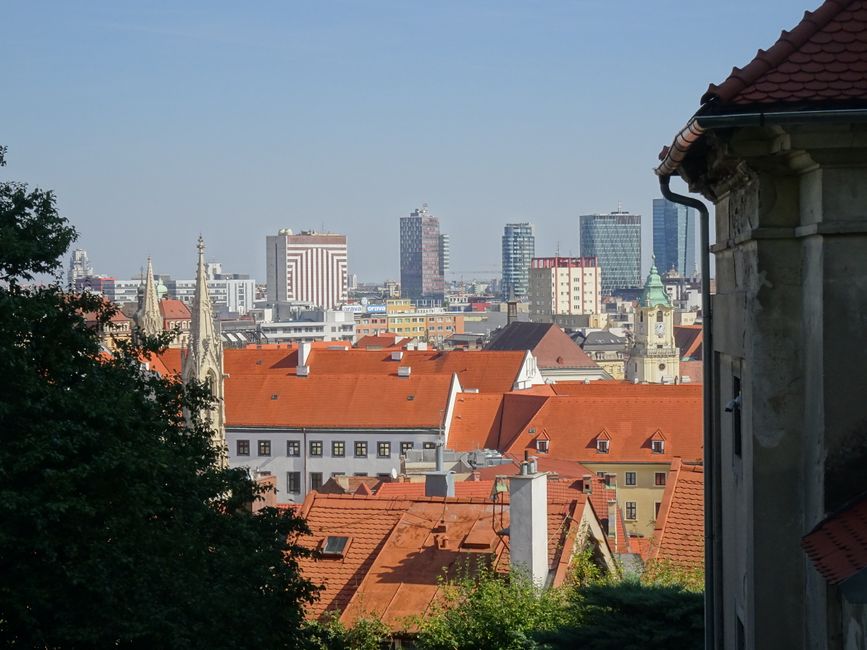
Bratislava is the capital of Slovakia, a compact city on the Danube where Slovakia, Austria and Hungary meet, and the only capital in the world that borders two other countries. You come to wander the car-free lanes of the Old Town, see the coronation church of the Hungarian kings, climb to the white castle above the river, ride the lift to the flying saucer on top of the UFO bridge and take a boat or bus out to the ruins of Devín Castle. It is about an hour from Vienna by train or by boat, so many visitors come for a day; stay a night and you will see it quiet, with cafés and wine bars in old courtyards. Give it one full day for the Old Town and the castle, two or three to add Devín, the galleries, the wine villages of the Small Carpathians and a slow lunch by the river.
Right now in Bratislava
- Wed 10–23°C 50–74°F Clear
- Thu 14–24°C 57–76°F 1 mm Partly cloudy
- Fri 11–16°C 53–60°F Clear
Weather: MET Norway (CC BY 4.0) · Air quality: OpenAQ
Top tours in Bratislava
See all tours for Bratislava →
From local operators, with prices and reviews; you check availability and book on Viator, our partner. We may earn a commission at no extra cost to you. How we earn money
Bratislava at a glance
- Best for: a relaxed old town, castles and river views, coffee and wine, an easy add-on to Vienna or Budapest, and Christmas markets.
- How long: 1 day for the Old Town, St Martin’s Cathedral, the castle and the UFO; 2–3 days to add Devín Castle, the Slovak National Gallery and the Small Carpathian wine villages.
- Best time: May, June and September for walking and river terraces; late November to early January for the Christmas markets.
- Getting in: trains from Vienna take about an hour; the Twin City Liner boat from Vienna about 75 minutes. Vienna Airport is about 40 km away, with direct buses; Bratislava Airport has city bus 61.
- Getting around: on foot in the Old Town, by tram and bus for the rest. As of October 2026, the castle museum cost €14 for adults, and the castle grounds are free.
- Before you go: entry rules, money and general safety are in our Slovakia travel guide.
Bratislava, area by area
The historic centre is small: Michael’s Gate to the Blue Church is a 15-minute walk. The castle hill rises to the west, the Danube runs along the south side, and the modern city spreads north and across the river.
The Old Town (Staré Mesto)
A pedestrian maze of baroque palaces, churches and courtyards around the Main Square (Hlavné námestie), the Old Town Hall, the Primate’s Palace and Michael’s Gate. Best for: first visits, cafés and evening strolls.
The castle hill and Podhradie
Above the cathedral, the four-towered castle and its gardens look down on the river; the slopes below, called Podhradie, were cleared for the bridge approach around 1970 and are being rebuilt. Best for: views and sunset walks.
The Danube embankment
Hviezdoslav Square leads past the historic Slovak National Theatre to the embankment, the Slovak National Gallery and the landing stages for boats to Devín and Vienna; newer riverside districts to the east have shops and restaurants. Best for: river views, galleries and boat trips.
Petržalka and the south bank
Across the UFO bridge (Most SNP) lie Sad Janka Kráľa, one of the oldest public parks in Central Europe, and the tower blocks of Petržalka. The view back to the castle and the Old Town is the classic photo. Best for: the skyline view and cycling along the Danube.
Top things to see in Bratislava
Prices and hours below were checked on the official sites in October 2026. They change, so check before you go.
Bratislava Castle
A castle has stood on this rock above the Danube for more than a thousand years. Its present shape, a white rectangle with a tower at each corner, dates from rebuilding for Empress Maria Theresa in the 18th century; it burned in 1811 and was restored from the 1950s. Today it houses the Museum of History of the Slovak National Museum, with a treasury of archaeological finds including the tiny prehistoric Venus of Moravany, and changing exhibitions in the Northern Walls.
Visiting. The grounds and courtyard are free and open daily 08:00–22:00, with views over the Old Town and the Danube into Austria and Hungary. As of October 2026, the museum is open daily except Tuesday, 10:00–18:00 (last entry 17:00), and a ticket for the castle interior, the Treasury and the Northern Walls cost €14 for adults, €7 for children and students and €8 for seniors aged 62 to 69; children under 6 and over-70s go free, and a family ticket cost €33. A 2026 exhibition on Marie Antoinette costs €10 extra, or €22 combined. The baroque garden opens 09:00–17:00 in October and 09:00–16:00 from November to February. Buy tickets at the box office behind the statue of Svätopluk or online; it is a steep 10-minute climb from the cathedral.
St Martin’s Cathedral
Between 1563 and 1830, when Bratislava (then Pressburg or Pozsony) was the coronation city of the Kingdom of Hungary, ten kings, one queen and seven royal consorts were crowned in this Gothic church, including Maria Theresa. A 300-kg gilded copy of the Hungarian crown tops its 85-metre tower. According to the tourist board, it is open to visitors Monday to Saturday 09:00–11:30 and 13:00–18:00 and on Sunday 13:30–16:00, except during services and concerts. At the start of September each year, the city re-enacts a coronation with costumed processions.
The Main Square, Old Town Hall and Michael’s Gate
The Main Square has the Roland Fountain, café terraces and the Old Town Hall, home of the City Museum, whose courtyard leads to the Primate’s Palace and its Hall of Mirrors. A few minutes north, Michael’s Gate and its green copper tower mark the old entrance to the walled town. In the lanes around, look for the bronze statues, above all Čumil, the worker peering out of a manhole.
The Blue Church
The Church of St Elizabeth, a short walk east of the Old Town, is pale blue inside and out, with Art Nouveau curves designed by Ödön Lechner and completed in 1913. It is a working parish church, often open only around Mass times, but the outside alone is worth the walk.
The UFO bridge and observation deck
The Most SNP, opened in 1972, hangs from a single leaning pylon topped by a saucer-shaped restaurant, the UFO. A lift takes you to the observation deck, 95 m above the river, for a 360° view. As of October 2026, it is open daily 10:00–23:00 with no booking; tickets are sold only at the reception at the foot of the pylon. Adults paid €11.50 on weekdays before 13:00 and €12.50 at other times, €15 from 25 December to 4 January; children over 111 cm up to 15 paid €7.90–9.30, and smaller children go free. Go at sunset.
The Slovak National Gallery
The country’s main art collection fills the baroque Water Barracks and Esterházy Palace on the embankment (Rázusovo nábrežie), linked by a bold 1970s extension, with Slovak and European art from Gothic altarpieces to modern design. As of October 2026 it opens Tuesday to Sunday 10:00–18:00 (Thursday 12:00–20:00) and is closed on Mondays; exhibition tickets cost up to €7, and some displays are free.
Devín Castle
About 10 km west of the centre, the ruins of Devín Castle stand on a cliff where the Morava flows into the Danube, on the border with Austria. It was a fortress of Great Moravia in the 9th century and was blown up by Napoleon’s troops in 1809; the slender Maiden Tower on its own rock is the classic view. A memorial and an exhibition recall the people shot trying to cross the Iron Curtain here between 1948 and 1989.
Visiting. Devín Castle is run by the Bratislava City Museum and closed on Mondays; in October 2026 it opens 10:00–17:00 (last entry 16:15). As of October 2026, entry from April to October cost €8 for adults and €4 reduced (children 6–15, students, over-65s), and from November to March €6 and €3; family tickets cost €10–18, and under-6s go free. City bus 29 runs from the Most SNP stop under the UFO bridge, and from April to October sightseeing boats sail up the Danube in about 1 hour 30 minutes. Wear good shoes for the steep paths.
Danube boats to Vienna: the Twin City Liner
The Twin City Liner is a fast catamaran that links Bratislava’s Old Town landing stage with Schwedenplatz in central Vienna, passing the Danube floodplain forests of the Donau-Auen National Park. As of October 2026, the main 2026 season runs daily until 2 November 2026, with three sailings each way:
- From Vienna: 08:30, 12:30 and 16:30, arriving in Bratislava about 75 minutes later.
- From Bratislava: 10:30, 14:30 and 18:30, arriving in Vienna 90 minutes later, as the boat sails upstream.
- Fares: economy seats cost €34 Monday to Friday and €39 at weekends and on Austrian public holidays, plus a fuel surcharge of €3 per ticket. Children aged 2 to 11 pay half, and a limited number of “Red Tickets” sell for €25.
- Advent cruises: from 27 November to 20 December 2026, on Fridays, Saturdays, Sundays and holidays, one boat a day leaves Vienna at 10:30 and returns from Bratislava at 16:30.
Board 30 minutes before departure and carry a passport or ID card: Austria runs checks on its river and land borders with Slovakia until at least March 2027. Low water can cancel sailings at short notice, as it did on the afternoon of 4 October 2026, so check the operator’s website on the day. See our boat trips guide.
Things to do in Bratislava
The Small Carpathian wine villages
Vineyards start at the edge of the city in Rača and run north along the hills to Pezinok and Modra, known also for its blue-and-white majolica pottery. Family cellars open for tastings, especially at the September harvest festivals. See our wine tasting guide.
Kamzík and the forest park
North of the centre, the Bratislava Forest Park covers the wooded Little Carpathian hills, with trails, forest pubs at Železná studnička and a TV tower on Kamzík hill with a revolving restaurant. See our hiking guide.
Cycling along the Danube
The Danube cycle route runs along the dykes on both banks: west from Petržalka into Austria, or east to the Danubiana art museum at Čunovo, about 20 km away. See our cycling guide.
Eat and drink like a local
Try bryndzové halušky (potato dumplings with sheep’s cheese and bacon), poppy-seed or walnut bratislavské rožky pastries, goose with potato pancakes around St Martin’s Day, and a Small Carpathian Grüner Veltliner or Frankovka. Weekday lunch menus (denné menu) are good value.
Christmas in Bratislava
Bratislava’s Christmas markets fill the Main Square and Hviezdoslav Square from 26 November 2026 to 3 January 2027, open daily 10:00–22:00 except on 24 and 25 December; the lights go on at the official opening on 26 November at 18:00. Stalls sell kapustnica (sauerkraut soup), potato pancakes, langoš, mead, mulled wine and crafts, with returnable cups you can hand back at any stall. A Christmas tram runs during Advent, and the Twin City Liner runs Advent cruises from Vienna at weekends. Pickpockets work the crowds, so keep valuables close.
Getting to Bratislava
From Vienna by train. Regional trains run from Wien Hauptbahnhof to Bratislava’s main station (hlavná stanica) in about an hour, and some to Bratislava-Petržalka, south of the river. From the main station, walk to the Old Town in 15 minutes or take bus 93 or tram 1; from Petržalka, buses 80, 91 and 93 run to the centre.
By bus. Slovak Lines, RegioJet and FlixBus run coaches from Vienna to Bratislava’s Nivy bus station about every hour, and from Vienna Airport every 30 to 60 minutes.
By air. Bratislava Airport (BTS), 15–20 minutes from the centre, has mainly low-cost flights; city bus 61 runs to the main station, and a shuttle runs hourly to Nivy bus station. Vienna Airport has far more long-haul connections.
From elsewhere. Direct trains link Bratislava with Brno (about 1 hour 30 minutes), Prague (about 4 hours) and Budapest (about 2 hours 30 minutes), and with Žilina, Poprad and Košice inside Slovakia. Drivers need a Slovak e-vignette for the motorways; see our Slovakia guide.
Getting around Bratislava
Walk in the Old Town; DPB trams, trolleybuses and buses cover the rest, as part of the IDS BK network. The easiest ticket is a contactless bank card: tap it on the reader when you board for a 30-minute ticket (as of October 2026, €1.09), with a daily cap of €4.85. Or use the IDS BK app, or buy paper tickets at machines and kiosks and validate them on board: 30 minutes €1.20, 60 minutes €1.80, 24 hours €5.40 and 72 hours €10.70. SMS tickets only work with Slovak phone numbers.
Temporary half-price fares. The government has approved halving full fares on city transport in Bratislava and the other regional capitals from 12 October 2026, because of high fuel prices; the measure is reviewed monthly, so check DPB’s website. The Bratislava CARD, sold by the tourist information centre for one to three days, includes public transport and free or discounted entry to many sights, including the castle museum and Devín. Bolt, Uber and Hopin taxi apps work in the city.
When to go and how long to stay
Bratislava is one of the warmest and sunniest places in Slovakia, with hot summers, short cold winters and most rain in early summer. The table uses the Slovak Hydrometeorological Institute (SHMÚ) 1991–2020 averages for the Bratislava airport station: average temperature over day and night, rainfall and sunshine per month.
| Season | Average temperature | Rain per month | Sunshine per month | What it’s like |
|---|---|---|---|---|
| Winter (Dec–Feb) | 0.3–1.9 °C | 33–43 mm | 52–99 hours | Cold and often grey, frosty nights; Christmas markets until early January |
| Spring (Mar–May) | 6.1 °C rising to 16.2 °C | 36–59 mm | 154–258 hours | Blossom in the vineyards, café terraces reopen, boats start sailing in April |
| Summer (Jun–Aug) | 20.2–22.0 °C | 59–62 mm | 269–287 hours | Hot, with afternoons often above 30 °C and occasional thunderstorms; river bars and open-air events |
| Autumn (Sep–Nov) | 16.2 °C falling to 5.7 °C | 44–59 mm | 195 falling to 70 hours | Wine harvest festivals, jazz and young wine; foggy November |
Bratislava averages about 575 mm of rain and 2,075 hours of sunshine a year; July and August highs average about 28 °C, and January nights about −3 °C.
Bratislava in 1 day
Morning: Michael’s Gate, the Main Square and St Martin’s Cathedral. Afternoon: the castle museum and view, then the Blue Church and the embankment. Evening: the UFO at sunset.
Bratislava in 2–3 days
Add Devín Castle by bus or boat, the Slovak National Gallery and Sad Janka Kráľa park; on a third day, visit the Pezinok and Modra wine cellars, cycle to Danubiana or continue to Vienna.
Where to stay in Bratislava
- Old Town: the most atmospheric base, within walking distance of everything; streets can be noisy on weekend nights, so ask for a quiet room.
- Below the castle and along the embankment: hotels with river or castle views, close to the boat landing stages.
- Around the Nivy and Eurovea riverside districts: big modern hotels, good value, handy for the bus station and riverside walks.
- Near the main station: practical for early trains and day trips, a 15-minute walk from the Old Town.
Bratislava charges an accommodation tax per person per night, added to the bill: €3, or €3.50 in the Old Town. Book early for Christmas market weekends and big concerts.
Practical tips for Bratislava
- Know the closing days: the castle museum closes on Tuesdays, Devín Castle and the Slovak National Gallery on Mondays.
- Carry ID: you need your passport or ID card on the boat and trains to Austria, and Slovak police can ask to see it.
- Check the river: low water can cancel the Twin City Liner at short notice in dry spells.
- Keep the peace: quiet hours run from 22:00 to 06:00, and drinking in the streets of the centre is fined; stag groups attract police attention.
What to pack for Bratislava
Shoes with a good grip for cobbles, the castle steps and Devín; a light waterproof and layers in spring and autumn; sun cream, a hat and water in summer; and a warm coat, hat and gloves for the Christmas markets. Bring a contactless bank card for transport and a type E/F plug adapter if you need one.
Bratislava travel FAQ
Is Bratislava worth visiting?
Yes, especially combined with Vienna or Budapest. The Old Town, the castle, the cathedral, the UFO and Devín fill a busy day, and an overnight stay lets you see the city once the day-trippers have gone.
How much does it cost to visit Bratislava Castle?
The grounds are free and open 08:00–22:00. As of October 2026, the museum inside cost €14 for adults and €7 for students and children, and is open 10:00–18:00, closed on Tuesdays.
How much is the UFO observation deck?
As of October 2026, €11.50 for adults on weekdays before 13:00 and €12.50 at other times, €15 over Christmas and New Year. It is open daily 10:00–23:00, with tickets sold only at the reception; no booking is needed.
How do I get from Vienna to Bratislava?
By train in about an hour, by bus from Vienna or its airport, or by the Twin City Liner boat in about 75 minutes (as of October 2026, from €34 plus a €3 fuel surcharge, sailing until 2 November 2026). Carry your passport or ID card.
How do I get to Devín Castle?
Take city bus 29 from the Most SNP stop under the UFO bridge, or from April to October a sightseeing boat from the passenger port (about 1 hour 30 minutes). The castle is closed on Mondays; as of October 2026, entry cost €8 for adults until the end of October and €6 from November to March.
How do I pay for trams and buses in Bratislava?
Tap a contactless bank card on the reader when you board for a 30-minute ticket, use the IDS BK app, or buy a paper ticket at a machine or kiosk and validate it on board. A temporary 50% fare cut was due to start on 12 October 2026, so check current prices.
When are the Bratislava Christmas markets in 2026?
From 26 November 2026 to 3 January 2027 on the Main Square and Hviezdoslav Square, open daily 10:00–22:00, except on 24 and 25 December. The official opening is on 26 November at 18:00.
How many days do you need in Bratislava?
One full day covers the Old Town, the cathedral, the castle and the UFO. Two or three days let you add Devín Castle, the Slovak National Gallery, the wine villages of the Small Carpathians or a bike ride along the Danube.
Can you drink in the street in Bratislava?
No. Drinking alcohol in the streets of the city centre is banned, except on bar and restaurant terraces and at events, and police fine offenders on the spot. Quiet hours run from 22:00 to 06:00.
Nearby destinations
- Vienna55 km
- Brno122 km
- Wachau126 km
- Banská Štiavnica136 km
- Hévíz151 km
- Lake Balaton152 km
- Budapest161 km
- Graz174 km
Sources and last review
Researched and last reviewed on 4 October 2026. Bratislava Castle hours and prices: the Slovak National Museum (SNM – Museum of History); Devín Castle hours and prices: the Bratislava City Museum; UFO observation deck: the UFO operator; Slovak National Gallery hours and prices: the gallery; Twin City Liner timetable, fares and the low-water cancellation: the operator’s 2026 timetable and website; cathedral hours, Christmas market dates, airport links and boats: the Bratislava Tourist Board; street-drinking rules and safety: the Bratislava Tourist Board and the UK Foreign Office; border checks: the European Commission; climate: SHMÚ 1991–2020 normals for Bratislava airport, as archived by NOAA NCEI. Paper ticket and contactless fares, the October 2026 half-price fares, the accommodation tax, bus 29 to Devín and some train times come partly from secondary sources and are flagged for checking. Prices, timetables and rules change, so check the official links before you go. For entry rules, money and general safety, see our Slovakia travel guide; for the next stop, our Vienna, Budapest and Brno guides.
Plan your trip
Partner links: TravelerCenter may earn a commission if you book, at no extra cost to you.
🇸🇰 Useful Slovak phrases for Bratislava
All 38 Slovak phrases: restaurant, hotel, emergencies, romance (printable) →