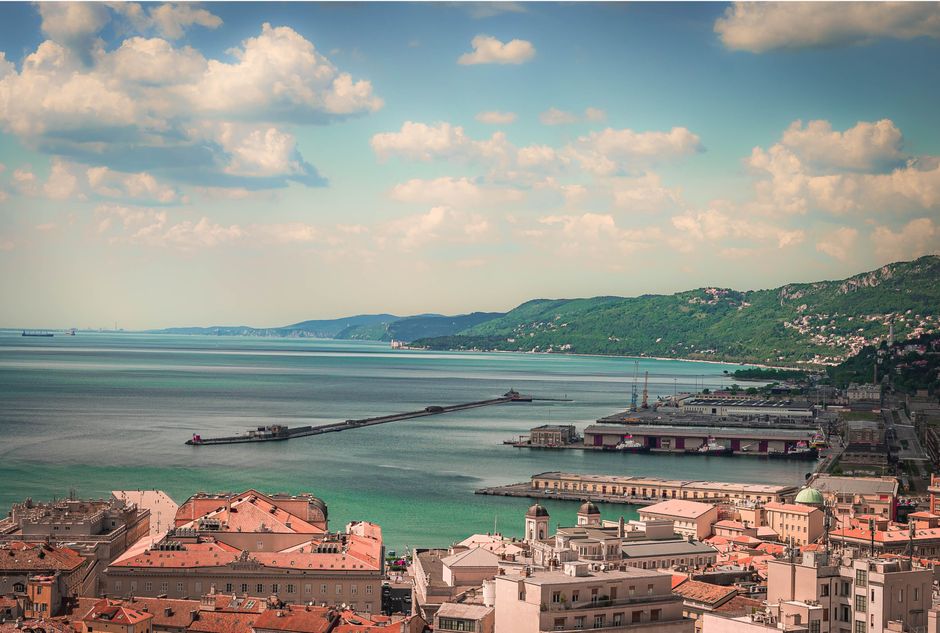
Trieste is Italy’s most unexpected city: a grand Habsburg seaport at the top of the Adriatic, squeezed between the limestone plateau of the Karst and the sea, a few kilometres from Slovenia. For almost 200 years it was Austria’s great port, and it still feels like Vienna by the sea, with neoclassical palaces, old literary cafés, a canal lined with boats and a vast square open to the water. It has Roman ruins, a white fairy-tale castle at Miramare, a famous wind called the bora, a mix of Italian, Slovene, Austrian, Greek and Jewish history, and some of the best coffee in Italy. Two or three days is ideal, and it is an easy add-on to Venice or the start of a trip into Slovenia and Istria.
Right now in Trieste
- Wed 14–21°C 57–70°F 9 mm Rain
- Thu 17–21°C 62–69°F 66 mm Heavy rain
- Fri 15–19°C 58–66°F 7 mm Cloudy
Weather: MET Norway (CC BY 4.0) · Sea temperature: NOAA CoastWatch · Rates: ECB
Top tours in Trieste
See all tours for Trieste →
From local operators, with prices and reviews; you check availability and book on Viator, our partner. We may earn a commission at no extra cost to you. How we earn money
Trieste at a glance
- Best for: Habsburg architecture and cafés, the seafront and Miramare Castle, Roman and literary history, Karst walks and wines, and a base for Slovenia and Istria.
- How long: 2 days for the city and Miramare, 3–4 days with the Karst, Muggia or a trip across the border.
- Best time: May to June and September to mid-October. In summer locals swim off the Barcola promenade; in winter the bora can blow hard and cold.
- Book ahead: rooms for the Barcolana regatta week in October; Grotta Gigante tours at weekends.
- Getting in: trains from Venice take about 2 hours; Trieste Airport has its own railway station, about 30 minutes from the city by train.
- Before you go: entry rules, money, trains and general safety are on our Italy travel guide.
Trieste’s neighbourhoods and who each one suits
Trieste, the capital of the Friuli Venezia Giulia region, is a compact city that climbs steeply from the sea. The flat Habsburg grid by the water is easy to walk; the old town and the castle sit on the hill behind; and the Karst plateau rises 300 metres above it all.
Borgo Teresiano and the Canal Grande
The 18th-century grid laid out under Empress Maria Theresa, around the Canal Grande, with the station at its northern end. Elegant streets, cafés, bars and plenty of hotels. A good, flat base for first-timers and anyone arriving by train.
Piazza Unità and the seafront
The heart of the city: Piazza Unità d’Italia, the Rive seafront and the Molo Audace pier. Grand hotels with sea views, the most atmospheric evenings and the busiest crowds during the Barcolana.
Cittavecchia and San Giusto
The medieval old town behind Piazza Unità, with the Roman theatre, narrow lanes, antique shops, and the hill of San Giusto with its cathedral and castle. Characterful and central, with some steep streets.
Barcola and the coast road
The suburb along the coast north of the centre, with the long promenade where Triestines sunbathe and swim, and the road to Miramare. Good in summer and for regatta week, with buses into town.
Top things to see in Trieste
Prices and hours were checked on the official sites in October 2026; check again before you go. Many civic museums close on Mondays from mid-October, and state and civic museums are free on the first Sunday of the month.
Piazza Unità d’Italia and the Molo Audace
One of the largest squares in Europe that opens directly onto the sea, framed by the Town Hall, the Palace of the Government and the old Lloyd Triestino headquarters, all lit up at night. Walk out along the Molo Audace, the stone pier opposite, at sunset: it is the city’s favourite ritual. Both are free and open all day.
Miramare Castle and park
About 8 km north of the centre, the white castle of Miramare stands on a rocky point above the sea, built in the 1850s and 1860s for Archduke Maximilian of Habsburg, who later became the ill-fated Emperor of Mexico. Its rooms keep their original furnishings, and the 22-hectare park of exotic trees, ponds and sea views is free all year. As of October 2026 the castle is open daily from 9:00 to 19:00 (last tickets at 18:30). Until 12 October 2026 the ticket costs €17 including a temporary exhibition (€7 for ages 18–25; free for EU under-18s); check the standard price after that date. The park is open from 8:00 to 17:00 from 15 October and to 16:00 in November. Bus 6 runs from the centre towards Miramare, or walk along the seafront from Barcola.
San Giusto: the cathedral and the castle
On the hill above the old town, the Cathedral of San Giusto joins two older churches into one, with glittering Byzantine-style mosaics in its apses. Next door, the 15th-century Castle of San Giusto has walkways on its bastions with views over the city and the gulf, an armoury and the Lapidario Tergestino, a fine collection of Roman stones. As of October 2026 the castle costs €7 (€5 reduced) and is open daily from 10:00 to 19:00 until 11 October, then Tuesday to Sunday from 10:00 to 17:00. Walk up from the Roman theatre or by the steps from Via della Cattedrale.
Roman Trieste
The Roman city of Tergeste left a Roman theatre from the first century AD, set right in the modern streets below San Giusto, and the Arco di Riccardo, a Roman gate in the old town. You can see both from the street at any time.
The Canal Grande and the churches of many faiths
The short Canal Grande, dug in the 18th century to bring ships into the city, is lined with cafés and ends at the blue-domed Serbian Orthodox Church of San Spiridione. Nearby are the Greek Orthodox church on the seafront and the Synagogue, one of the largest in Europe, signs of the merchant communities that made Trieste rich. On the Ponte Rosso bridge, a bronze James Joyce strolls across the canal: the Irish writer lived here for more than ten years.
More classic sights
- Museo Revoltella: a merchant’s palace and modern art gallery, with a rooftop terrace.
- Risiera di San Sabba: a former rice mill used as a Nazi camp, the only one in Italy with a crematorium, now a national monument and museum; free.
- The Grotta Gigante: a huge show cave on the Karst above the city, with a single chamber so tall it could hold St Peter’s in Rome; visits are guided tours of about an hour (book on grottagigante.it).
- The literary trail: statues and plaques for Joyce, Italo Svevo and Umberto Saba, and the Joyce and Svevo museums.
Other things to do in Trieste
Coffee and the historic cafés
Trieste is Italy’s coffee port, and its cafés are institutions: the Caffè San Marco, with its Art Nouveau interior and bookshop, the Tommaseo by the sea, and the Caffè degli Specchi on Piazza Unità. Ordering has its own language: a nero is an espresso, a capo is a small macchiato, and a capo in b comes in a glass.
Food and wine
Trieste’s cooking shows its Central European past: buffets serving boiled pork, sausages and ham with mustard and horseradish, jota (bean and sauerkraut soup), goulash and strudel, next to fresh Adriatic seafood. Up on the Karst, look for an osmiza, a farm that opens for a few days a year to sell its own wine, ham and cheese, signposted with a leafy branch. Try the local Vitovska and Terrano wines; see our wine tasting guide.
Swimming and walks
In summer the city swims off the concrete terraces of the Barcola promenade and at small beaches below the coast road; see our beaches guide. For a walk with a view, the Strada Napoleonica runs along the edge of the Karst from Opicina to Prosecco, high above the gulf, and the Val Rosandra is a limestone gorge just south-east of the city. See our hiking guide.
The Opicina tram
The historic tram from Trieste up to Villa Opicina on the Karst, part-hauled by a funicular on its steepest section, has had long stoppages: it ran again in 2026 after a closure of nine months, with more short breaks for maintenance, and for now it leaves from Piazza Dalmazia rather than its old terminus at Piazza Oberdan. Check with Trieste Trasporti before you plan around it; bus line 64 covers the route when it is stopped.
Day trips from Trieste
Trieste sits on the borders of three countries, so day trips cross easily into Slovenia and Croatia. Bring your ID or passport.
Muggia
A small Venetian-style fishing town across the bay, reached by the year-round Trieste–Muggia boat from the Molo Bersaglieri in about 30 minutes, with a pretty harbour square and seafood restaurants.
Duino and the Rilke path
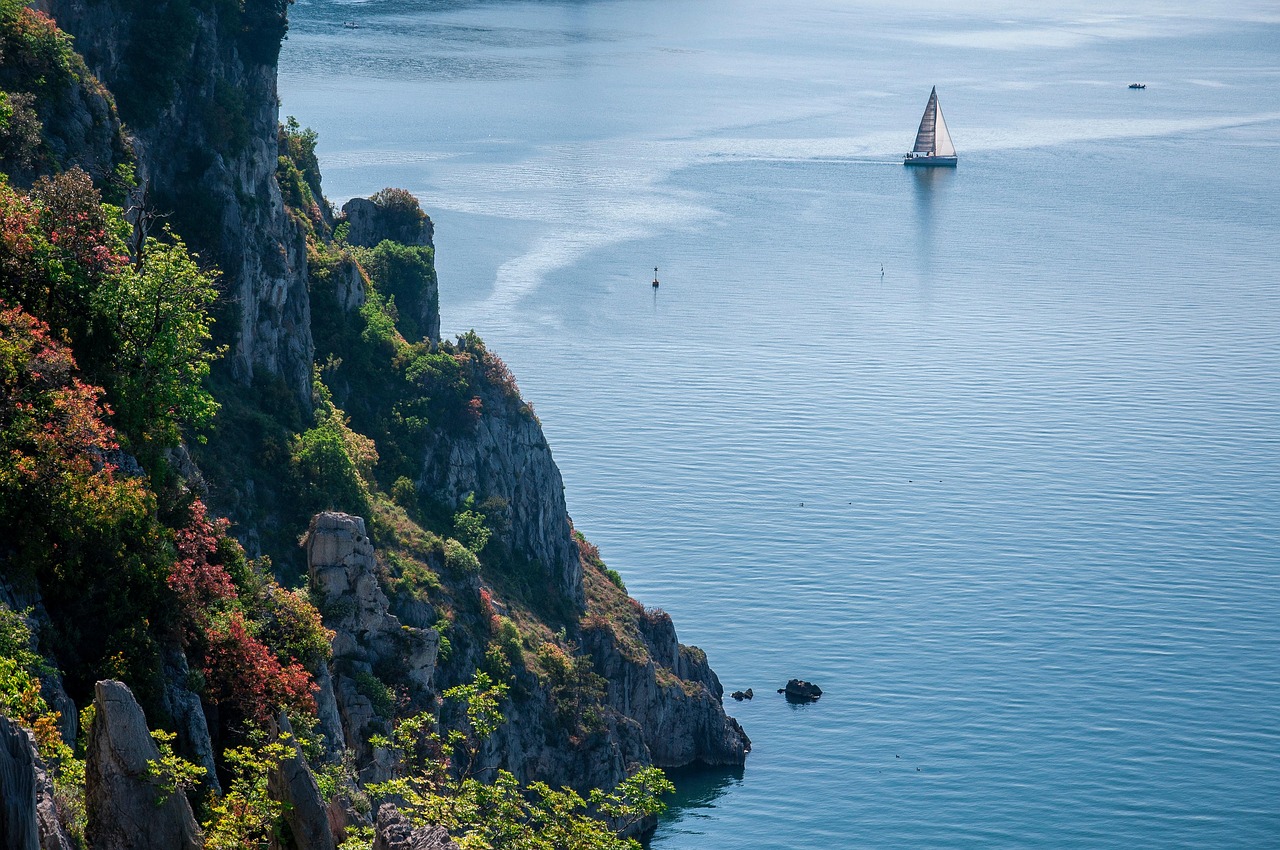
About 25 km north-west, the clifftop castle of Duino overlooks the sea, and the Rilke path, named after the poet who wrote his Duino Elegies here, follows the white cliffs to Sistiana bay.
Slovenia: Piran, the Karst caves and Ljubljana
Piran, a lovely Venetian town on the Slovenian coast, is about 40 minutes by car: see our Piran guide. Inland, the Škocjan Caves and the Lipica stud farm, home of the Lipizzaner horses, are under an hour away. Ljubljana is about 1½ hours by road, with two direct trains a day from Trieste: see our Ljubljana guide and the Slovenia travel guide.
Croatia: Istria
The Croatian border is about 30 minutes south. Istria’s hill towns, Rovinj and the Roman arena of Pula make a great road trip: see our Istria guide.
Nearby destinations
Getting there and getting around
By train
Trieste Centrale station is at the northern edge of the city centre, a 10–15 minute walk from Piazza Unità. Trains from Venice take about 2 hours, with high-speed services continuing to Milan and Rome. Two direct trains a day link Trieste with Ljubljana, run by Trenitalia and Slovenian Railways, and the MICOTRA cross-border train runs to Udine and Villach in Austria.
By air
Trieste Airport (TRS) is at Ronchi dei Legionari, about 35 km north-west of the city. A covered walkway links the terminal to its own railway station, served every day by 6 high-speed and 48 regional trains as of October 2026; the ride to Trieste Centrale takes about 30 minutes. Venice Marco Polo and Ljubljana airports are about 1½–2 hours away.
By car and parking
The A4 motorway from Venice ends at Trieste, and the coast road (Strada Costiera) is one of the most beautiful drives in Italy. Parking in the centre is limited and paid; use the large car parks near the station and the seafront, and avoid driving in the narrow old-town streets, where some areas are limited-traffic zones. You don’t need a car in the city.
Getting around
The centre is easy on foot, though the old town and San Giusto are uphill. Trieste Trasporti buses cover the city, Barcola, Miramare and the Karst; buy tickets before you board or with the app. In summer, Delfino Verde boats also link the city with Barcola, Grignano and Sistiana.
When to go and how long to stay
Trieste has a mild, sunny climate for its latitude, but it is famous for the bora, a cold north-easterly wind that blasts down from the Karst, mostly in winter, with gusts that can top 100 km/h; ropes and railings line some steep streets for this reason. The table uses the WMO 1991–2020 climate normals for Trieste (Italian Air Force station, 3 m): long-term average daily highs and lows, and days with at least 1 mm of rain.
| Season | Average high / low | Rainy days per month | What it’s like | Good for |
|---|---|---|---|---|
| Winter (Dec–Feb) | 9–10 °C / 4–5 °C | 6–8 | Mild but grey, with cold bora days | Cafés and museums, low prices, Christmas lights |
| Spring (Mar–May) | 13–22 °C / 7–15 °C | 6–9 | Fresh and bright, warmer by May | Walking the city and the Karst, Miramare’s gardens |
| Summer (Jun–Aug) | 27–29 °C / 19–21 °C | 6–8 | Hot and humid, with summer storms | Swimming at Barcola, evenings by the sea, festivals |
| Autumn (Sep–Nov) | 24 °C falling to 14 °C / 17 °C falling to 9 °C | 8–10 | Warm September, the Barcolana in October, wetter November | The regatta, wine and osmize, walks |
These are long-term averages; recent summers have been hotter. October and November are the wettest months, with about 110–120 mm of rain each.
Events worth planning around
- The Barcolana (2–11 October 2026): the city’s great sailing festival, with the main race on Sunday 11 October 2026 at 10:30, when well over a thousand boats usually fill the gulf between Barcola and Miramare. Ten days of events line the seafront. Book rooms early.
- San Giusto (3 November): the city’s patron saint’s day, with a fair and the castle open free.
- Summer: open-air concerts and theatre, including evenings at the Castle of San Giusto and the Roman theatre.
How long to stay: 1-, 2- and 3-day plans
1 day: coffee at a historic café, Piazza Unità and the Molo Audace, the Canal Grande and the Roman theatre, then up to San Giusto; Miramare in the late afternoon.
2 days: add the Museo Revoltella, the synagogue, a buffet lunch and a walk at Barcola, with the Strada Napoleonica or the Grotta Gigante. 3 days: add Muggia by boat, Duino and the Rilke path, or a trip to Piran or the Škocjan Caves.
Where to stay in Trieste and the tourist tax
- Borgo Teresiano: flat, central and close to the station; the best all-round base.
- Piazza Unità and the Rive: sea views and grand hotels; pricier.
- Cittavecchia: characterful apartments in the old town, with some hills.
- Barcola: by the sea for summer swims, a short bus ride from the centre.
- The Karst: country inns and farm stays with views, best with a car.
Trieste tourist tax (imposta di soggiorno): charged per person per night, for up to 5 consecutive nights in the same property, and paid at your accommodation. The city raised it by about 50% from January 2026; as of October 2026 the published rates run from about €1.50 (campsites) to €3.80 (five-star hotels), with most three- and four-star hotels at €3.00–€3.30. Check comune.trieste.it or ask your host for the exact amount.
Practical tips for Trieste
- Watch for the bora: on windy days, hold on to hats and railings, and avoid the end of the Molo Audace.
- Plan around Mondays: many civic museums close on Mondays outside the summer.
- Use the first Sunday: state and civic museums, including Miramare and San Giusto, are free on the first Sunday of the month.
- Learn the coffee words before you order at the bar.
- Carry ID for day trips: Slovenia and Croatia are in the Schengen area, but spot checks happen.
- Wear good shoes: the old town and San Giusto are steep.
- Emergencies: call 112.
What to pack for Trieste
Comfortable walking shoes for the hills and stone streets. In summer, pack light clothes, a swimsuit, a towel and water shoes for the rocky shore at Barcola, plus sunscreen and a hat. In spring and autumn bring layers and a compact umbrella; October and November are the wettest months. In winter, a windproof jacket matters more than a heavy coat, because of the bora, along with a scarf and hat. Bring a passport or ID card if you plan to cross into Slovenia or Croatia.
Trieste travel FAQ
Is Trieste worth visiting?
Yes. It is unlike any other Italian city, with Habsburg grandeur, a superb seafront, Roman ruins, Miramare Castle, great cafés and an easy reach into Slovenia and Croatia, and it is far less crowded than Venice.
How many days do you need in Trieste?
Two days cover the city and Miramare. Three or four let you add the Karst, Muggia, Duino or a trip to Piran or Ljubljana.
How do I get from Venice to Trieste?
By train in about 2 hours, with regional and high-speed services, or by car on the A4 motorway in a similar time.
How much is Miramare Castle?
As of October 2026, €17 until 12 October including a temporary exhibition, €7 for ages 18–25 and free for EU under-18s; the park is free all year. Check the price after the exhibition closes. It is free for everyone on the first Sunday of the month.
When is the Barcolana in 2026?
The festival runs from 2 to 11 October 2026, and the main regatta starts at 10:30 on Sunday 11 October in the gulf between Barcola and Miramare.
What is the bora?
A cold, dry north-easterly wind that pours down from the Karst onto Trieste, mostly in winter, with gusts that can top 100 km/h. Days of bora are usually clear and sunny but bitterly cold.
Can you swim in Trieste?
Yes. In summer locals swim from the Barcola promenade and the small beaches and rocks along the coast road towards Miramare. The water is clean, but most spots are rocky or concrete, so bring water shoes.
Is the Opicina tram running?
It ran again in 2026 after a long closure, but with occasional stoppages for maintenance, and it currently starts from Piazza Dalmazia. Check with Trieste Trasporti; bus 64 replaces it when it is stopped.
Can you visit Slovenia from Trieste?
Easily. Piran is about 40 minutes by car, the Škocjan Caves and Lipica under an hour, and Ljubljana about 1½ hours, with two direct trains a day.
How much is the tourist tax in Trieste?
As of October 2026 it ranges from about €1.50 to €3.80 per person per night depending on the type of accommodation, for up to 5 nights in a row. It rose by about 50% in 2026.
Sources and last review
Researched and last reviewed on 4 October 2026. Miramare prices, hours and park times come from the Miramare museum (miramare.cultura.gov.it); San Giusto Castle prices and hours from the Comune di Trieste’s castle site; the Barcolana dates from barcolana.it; trains at Trieste Airport from the airport (triesteairport.it); the Muggia boat from Trieste Trasporti; climate from the WMO 1991–2020 normals for Trieste (Italian Air Force station, archived by NOAA). The 2026 tourist tax rates, the Grotta Gigante tours, the Opicina tram status and train journey times come from secondary sources and should be checked before you travel. Prices, timetables and opening hours change, so check the official sites before you go. For entry rules, money and safety, see our Italy travel guide.
Plan your trip
Partner links: TravelerCenter may earn a commission if you book, at no extra cost to you.
🇮🇹 Useful Italian phrases for Trieste
All 38 Italian phrases: restaurant, hotel, emergencies, romance (printable) →