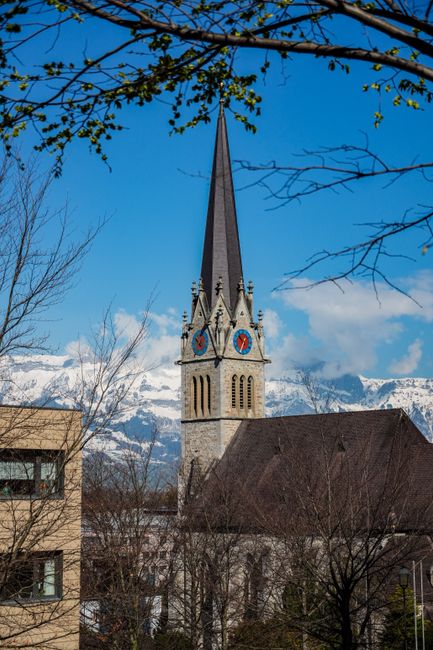
Liechtenstein is a tiny Alpine principality wedged between Switzerland and Austria: 25 km of Rhine valley and mountains, about 40,000 people, a prince in a castle above the capital and no airport, no army and no border controls with its neighbours. It is easy to treat it as a quick photo stop on the way between Zurich and Innsbruck, but it rewards a slower look. Walk the cliff-edge Fürstensteig and the 75 km Liechtenstein Trail through all eleven municipalities, see world-class art and the princely treasures in Vaduz, ski or hike from the family resort of Malbun, cycle along the Rhine and drink the Prince’s own wine. Liechtenstein uses the Swiss franc, is part of the Schengen area and is reached by train to the Swiss or Austrian border and a short bus ride. A day covers Vaduz; give it two to four days to hike or ski.
Right now in Liechtenstein
- Wed 8–23°C 47–74°F Partly cloudy
- Thu 11–17°C 52–63°F 33 mm Heavy rain
- Fri 8–14°C 47–56°F 2 mm Partly cloudy
Weather: MET Norway (CC BY 4.0)
Multi-day tours of Liechtenstein
Multi-day tours from local operators. You check dates and book on Viator, our partner; we may earn a commission at no extra cost to you. How we earn money
Liechtenstein at a glance: overview and geography
Liechtenstein covers just 160 km², making it the fourth-smallest country in Europe and the sixth-smallest in the world, according to the official country portal liechtenstein.li. It is about 25 km long from north to south and only a few kilometres wide. The western third is the flat, fertile valley of the Rhine, which forms the border with Switzerland; the rest rises steeply into the mountains of the Rätikon range, with peaks of more than 2,500 m along the Swiss and Austrian borders. Liechtenstein describes itself as the only country lying entirely within the Alpine region. Its eleven municipalities are divided between the Oberland (the “upper country”, with Vaduz, Schaan, Triesen, Balzers, Triesenberg and Planken) and the Unterland (the “lower country”, with Eschen, Mauren, Gamprin, Ruggell and Schellenberg).
The country takes its name from the princely House of Liechtenstein, one of the oldest noble families in Europe, which bought the lordships of Schellenberg and Vaduz and had them raised to an imperial principality in 1719; Liechtenstein celebrated 300 years in 2019. It became fully sovereign in 1806, abolished its army in 1868 and stayed neutral in both world wars. In the 20th century it turned from a poor farming country into one of the world’s richest, with a strong industrial base (around 40% of gross value added, says liechtenstein.li) and financial services; there are more jobs than inhabitants, and thousands of people commute in from Switzerland and Austria every day. Liechtenstein is a constitutional hereditary monarchy: Prince Hans-Adam II is head of state, and his son, Hereditary Prince Alois, has exercised the sovereign’s duties as regent since 2004. The princely family lives in Vaduz Castle above the capital.
The official language is German, and people speak a local Alemannic dialect close to Swiss German; English is widely understood in hotels, museums and shops. Liechtenstein has been in a customs and currency union with Switzerland since the 1920s, is a member of the European Economic Area (but not the EU) and joined the Schengen area on 19 December 2011. Time zone: Central European Time (UTC+1, UTC+2 in summer), the same as Switzerland and Austria.
The areas
- Vaduz: the small capital, with the castle, the parliament and government buildings, the pedestrian Städtle with the Kunstmuseum, the national museum and the Postal Museum, and the Prince’s winery. Our separate Vaduz guide has full details.
- Schaan: the largest municipality and the transport hub, with the railway station, the LIEmobil bus centre and the TAK theatre.
- Triesenberg and Malbun: the mountain municipality above Vaduz, settled by Walser migrants in the 13th century, with the Walser Museum and the high resort of Malbun (1,600 m) for skiing and hiking.
- Balzers and Triesen: the south, with Gutenberg Castle on its hill, vineyards and access to the Rhine dam path.
- The Unterland: quiet farming villages on and around the Eschnerberg hill, prehistoric sites and the Ruggeller Riet wetland reserve near the Austrian border.
Where to go: Vaduz, the mountains and the Rhine
Vaduz
Most visitors start, and many finish, in Vaduz. The pedestrian Städtle packs in the black cube of the Kunstmuseum Liechtenstein and the Hilti Art Foundation, the Liechtenstein National Museum with the Treasure Chamber and the Postal Museum, the neo-Gothic Cathedral of St Florin and the parliament building. Above town, Vaduz Castle, home of the princely family, is not open to the public, but a footpath leads up to it for views over the Rhine valley. Below the castle, the vineyards of the Prince’s winery, the Hofkellerei, surround the Red House, a landmark with a stepped gable.
Malbun and Triesenberg
A winding road and LIEmobil bus climb from Vaduz to Triesenberg, a village of scattered wooden houses with views over the Rhine valley and the Walser Museum, which tells the story of the Valais settlers who arrived here around 1300. Through a tunnel beyond Steg lies Malbun, a car-light mountain village at about 1,600 m. In winter it is a small, family-friendly ski area; in summer, a chairlift climbs to Sareis at about 2,000 m and hiking trails lead into the high valleys and up to the Pfälzerhütte mountain hut on the border with Austria.
The Fürstensteig and the Three Sisters
The Fürstensteig (Prince’s Path), built in 1898, is Liechtenstein’s most famous mountain walk: a narrow path, secured with cables in places, cut into the cliffs above the Rhine valley from Gaflei (above Triesenberg) towards the Kuegrat and Garsellikopf ridges. It needs a head for heights, sturdy shoes and dry weather. The Drei Schwestern (Three Sisters) ridge on the Austrian border is another classic, with fixed ropes and ladders. Both are for experienced hikers in summer and early autumn only.
Balzers and Gutenberg Castle
In the far south, Gutenberg Castle stands on a rocky hill above Balzers, a striking sight from the road and the Rhine dam. It was rebuilt in the early 20th century and is now owned by the state and used for events and summer opening; check the municipality’s programme before you go. Balzers and Triesen also have old village centres, vineyards and walks along the Rhine.
The Rhine and the Unterland
The Rhine dam (Rheindamm) runs the whole length of the country and carries a flat, traffic-free path for walking and cycling, part of the long-distance Rhine cycle route between Lake Constance and the Alps; old wooden and new bridges cross to Switzerland. In the north, the Unterland is rural and little visited: walk the Eschnerberg history trail past prehistoric settlements, or look for birds and orchids in the Ruggeller Riet nature reserve.
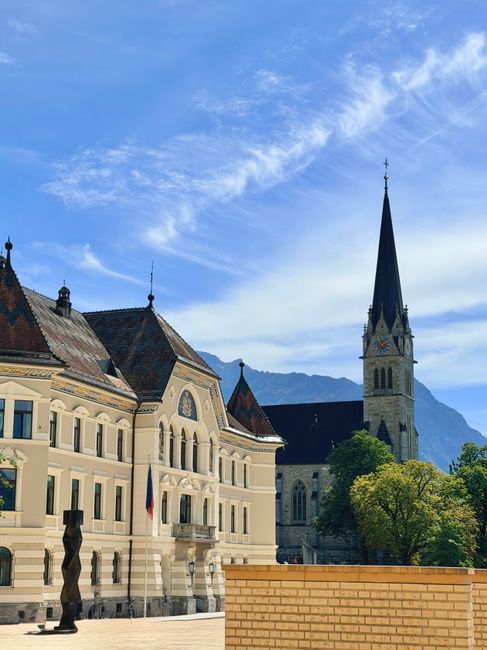
Vaduz Travel Guide
Plan a trip to Vaduz: the Kunstmuseum and Hilti Art Foundation (free on Wednesdays), the Liechtenstein National Museum, Treasure Chamber and Postal Museum with…
Best time to visit Liechtenstein
Liechtenstein has a central European climate shaped by the mountains: warm summers with frequent afternoon thunderstorms, cold winters with snow in the mountains, and the warm, dry Föhn wind that can sweep down the Rhine valley in spring and autumn. The table shows 1991–2020 averages for the MeteoSwiss weather station in Vaduz (457 m), calculated by TravelerCenter from MeteoSwiss’s daily open data; Malbun and the mountains are much colder and snowier, roughly 6–7 °C cooler at 1,600 m.
| Season (Vaduz, 1991–2020) | Mean temperature | Average afternoon high | Rain a month | Sunshine a month | What it’s like |
|---|---|---|---|---|---|
| Spring (Mar–May) | 7–15 °C | 12–20 °C | 55–90 mm | 130–170 hours | Blossom in the valley in April; snow lingers on the mountains into May; changeable. |
| Summer (Jun–Aug) | 18–19 °C | 23–25 °C | 120–150 mm | 180–200 hours | Warm, the wettest season, with afternoon thunderstorms; the best time for mountain hikes. |
| Autumn (Sep–Nov) | 15 °C falling to 6 °C | 20 °C falling to 10 °C | 60–100 mm | 145 hours falling to 65 | Clear, settled spells in September and October; grape harvest and autumn colours. |
| Winter (Dec–Feb) | 1–3 °C | 5–7 °C | 35–55 mm | 55–90 hours | Cold, often grey in the valley; snow and ski season in Malbun from mid-December. |
At Vaduz, July averages 19.4 °C with afternoon highs near 25 °C and January 1.4 °C with nights just below freezing. Rain totals about 960 mm a year, with the most in June, July and August.
When to go
- June to mid-October is best for hiking. The Fürstensteig and high trails are usually free of snow from about mid-June; September and early October often bring the clearest views.
- Mid-December to early April is ski season in Malbun; the 2026/27 season is scheduled from 19 December 2026 to 4 April 2027.
- 15 August, Liechtenstein’s National Day: the Prince speaks at a ceremony on the meadow below the castle, the castle garden opens to the public, and the day ends with fireworks over Vaduz. Museums open late and the National Museum and the Kunstmuseum are free that day.
- Spring and late autumn are quiet in the valley, but the mountain lifts and huts close between seasons.
How long to stay: sample itineraries
1 day: Vaduz
Arrive by bus from Sargans, Buchs or Feldkirch. Visit the Liechtenstein Center for maps (and a souvenir passport stamp), the Kunstmuseum and the National Museum with the Treasure Chamber, walk up to Vaduz Castle for the view, and finish with a glass of the Prince’s wine at the Hofkellerei or a stroll along the Rhine.
2–3 days: Vaduz and the mountains
Spend a day in Vaduz, then take the bus up to Triesenberg and Malbun. Walk the Fürstensteig from Gaflei if you are confident on exposed paths, or take the chairlift to Sareis and hike towards the Pfälzerhütte. On another day, walk or cycle a section of the Liechtenstein Trail or the Rhine dam, and see Gutenberg Castle in Balzers.
4–5 days: the whole Liechtenstein Trail
Walk the 75 km Liechtenstein Trail in three to five days, staying in different villages, or combine a few stages with a ski day in Malbun in winter. Liechtenstein also fits easily into a wider trip: Zurich is about 1¼ hours away, St. Moritz and the Engadine lie to the south, Innsbruck and St. Anton am Arlberg are to the east, and Lake Constance is less than an hour to the north.
Entry, money, fees and costs
Entry and visas (last reviewed October 2026)
Liechtenstein has been part of the Schengen area since 19 December 2011. Its borders with Switzerland and Austria are internal Schengen borders, so there are no routine passport checks, and the usual Schengen rules apply: citizens of the EU, the EEA and Switzerland need only an ID card or passport, and visitors from many other countries, including the United States, Canada, the UK and Australia, can stay up to 90 days in any 180-day period across all Schengen countries without a visa.
- Entry/Exit System (EES): the EU’s digital border system has been fully running at Schengen external borders since 10 April 2026. Liechtenstein has no airport, so non-EU visitors are registered where they first enter the Schengen area, usually at Zurich airport or another European airport: passport details, a photo and fingerprints (not for under-12s) instead of a stamp. Registration is free and lasts three years.
- ETIAS: the planned online travel authorisation (fee €20) is not in operation as of October 2026; no start date has been published and press reports point to 2027. You don’t need one until the EU announces a date.
- Passports: for non-EU visitors, your passport should have been issued less than 10 years before you arrive and be valid for at least 3 months after you plan to leave the Schengen area.
- Customs: Liechtenstein is in the Swiss customs area, and Austria is in the EU’s. There are no passport controls on the Austrian border at Schaanwald, but customs officers can stop vehicles and check goods, so keep within the allowances and carry your passport.
The Swiss franc, cards and tipping
Liechtenstein uses the Swiss franc (CHF). Cards and phone payments are accepted almost everywhere, including on LIEmobil buses, where you don’t need cash. Many shops and hotels also take euros, but usually at a poor exchange rate and with change in francs. Service is included in prices; rounding up or leaving 5–10% for good service is a nice gesture but not expected.
The souvenir passport stamp
There is no border stamp, but the Liechtenstein Center, the tourist information office in Vaduz’s Städtle, will put a souvenir Liechtenstein stamp in your passport for a small fee (reported at CHF 3). It is not an official entry stamp. If you are worried about how border officials elsewhere might view unofficial stamps, ask for it on a separate card instead.
Typical travel costs
Liechtenstein’s prices are Swiss prices: hotels and restaurants are expensive, but buses are cheap and distances tiny. These estimates, per person per day, are a planning guide as of October 2026:
| Style | Estimated cost per day | What that looks like |
|---|---|---|
| Budget | about CHF 90–140 | Youth hostel in Schaan or a campsite, supermarket picnics, bus day tickets, free hikes and one museum |
| Mid-range | about CHF 180–300 | 3- or 4-star hotel shared by two, restaurant meals, museum tickets, a chairlift or a ski day |
| High-end | about CHF 400+ | Top hotel in Vaduz or Malbun, gourmet dinners, wine tastings and private guides |
As a rough guide to sights (as of October 2026): the Kunstmuseum costs CHF 15, the National Museum CHF 10 (CHF 13 with the Treasure Chamber), and a Malbun adult day ski pass CHF 55; children and teenagers up to 16 get into the museums free. These daily cost figures are our estimates, not official statistics.
Getting there and getting around
Arriving by air and rail
Liechtenstein has no airport. The nearest is Zurich, from where trains run to Sargans or Buchs SG on the Swiss side of the Rhine in about an hour; from Austria and Germany, take the train to Feldkirch. From these stations LIEmobil buses do the last stretch: line 11 from Sargans or Feldkirch to Vaduz Post, line 12E from Sargans, and line 12 from Buchs to Schaan, where you change to line 11 for Vaduz. The Kunstmuseum puts the total journey at about 1¼ hours from Zurich, 2 hours from Basel and 2½ hours from Munich or Innsbruck. A few Austrian regional trains on the Feldkirch–Buchs line stop at Schaan-Vaduz, Forst Hilti and Nendeln, but the buses are much more frequent. St. Gallen-Altenrhein and Friedrichshafen are smaller airports nearby.
LIEmobil buses and fares
The LIEmobil bus network covers every village and runs up to Malbun. As of October 2026, a single ticket costs CHF 3 for one zone (valid 30 minutes), CHF 4 for two zones (1 hour) and CHF 5 for three or more zones (2 hours); a day ticket costs CHF 5, CHF 7 or CHF 9; and a short-distance ticket for up to five stops costs CHF 2. Children up to 16 and holders of a Swiss half-fare travelcard pay reduced fares, children under 6 travel free with an adult, and holders of a Swiss GA travelcard travel free. Buy tickets from the driver (contactless cards accepted), in the SBB Mobile app or with the FAIRTIQ app, which charges the cheapest fare automatically. The network reaches across the border to Sargans, Buchs and Feldkirch.
Driving and cycling
By car, take the Swiss A13 motorway to the Sevelen/Vaduz exit, or the Austrian A14 to Feldkirch and continue via Schaanwald. Remember that Swiss and Austrian motorways need a vignette (toll sticker or e-vignette); Liechtenstein’s own roads don’t. Traffic drives on the right, and rules, signs and speed limits are similar to Switzerland’s. Parking is easy in Vaduz car parks but traffic can be slow at rush hour, when commuters cross the Rhine bridges. Liechtenstein is ideal for cycling: the Rhine dam path is flat and traffic-free, and LIEmobil’s LIEbike scheme rents bikes; e-bikes help on the climb to Triesenberg.
Hiking, skiing and the outdoors
Half of Liechtenstein is mountain, and there are about 400 km of marked hiking trails for such a small country. See our hiking guide for gear and planning.
- The Liechtenstein Trail (Liechtenstein-Weg): opened in 2019 for the principality’s 300th anniversary, it runs about 75 km through all eleven municipalities, past vineyards, castles, nature reserves and old village centres. Its highest point is only about 1,100 m, so much of it can be walked even in winter. The free LIstory app tells the stories of 147 points of interest along the way, and luggage transport is available.
- The Fürstensteig and Drei Schwestern: exposed ridge paths with cables and ladders, for sure-footed hikers only.
- Malbun and the high valleys: family walks around Malbun, the chairlift to Sareis and longer hikes to the Pfälzerhütte, the Augstenberg and the Naafkopf, where Liechtenstein, Switzerland and Austria meet.
- Skiing in Malbun: a small area of mainly easy and intermediate runs, a beginners’ area and a fun park, popular with families. For the 2026/27 season (19 December 2026–4 April 2027) a day pass costs CHF 55 for adults, CHF 42 for teenagers, students and seniors and CHF 30 for children, and children born in 2020 or later ski free with proof of age. Cross-country skiing is at Steg, and there is sledging and winter walking too.
- The Rhine: flat walking and cycling on the dam, with views across to the Swiss Alps.
Safety, health and connectivity
Safety
Liechtenstein has very little crime. The main risks are in the mountains: start hikes early to avoid afternoon thunderstorms, check the weather and snow conditions, carry water and layers, and turn back on exposed paths if the rock is wet. Emergency numbers: 112 (general), 117 for police, 118 for fire and 144 for ambulance; in the mountains, Swiss mountain rescue can also be called via 1414.
Health
Healthcare is of a high standard but expensive, so have travel insurance; EU and EEA visitors should bring their European Health Insurance Card. Pharmacies are found in Vaduz, Schaan and the larger villages. Tap water is excellent. Protect yourself against ticks in woods and meadows from spring to autumn.
Accessibility
Vaduz’s Städtle is flat and pedestrianised, and the National Museum and the Kunstmuseum are fully accessible; the National Museum lends wheelchairs free of charge. Mountain paths and the castle path are steep.
Connectivity and power
Mobile coverage is good. Liechtenstein is in the European Economic Area, so EU “roam like at home” rules apply on EU and EEA SIM cards, but watch for your phone switching to a Swiss network near the Rhine, where they don’t; visitors from elsewhere should check their roaming deal. Sockets are Swiss type J (which also takes type C two-pin plugs), at 230 V and 50 Hz; see our plug adapter guide.
Food, wine and culture
Liechtenstein’s food is Alpine and close to that of eastern Switzerland and Vorarlberg. The national dish is Käsknöpfle, small cheese dumplings with mountain cheese and fried onions, often served with apple sauce or potato salad; also try Ribel, a cornmeal dish of the Rhine valley, eaten with coffee, compote or cheese, and Hafaläb, a dumpling with smoked meat. Wine has been made here for centuries: the Prince’s own winery, the Hofkellerei des Fürsten von Liechtenstein in Vaduz, and small producers in Vaduz, Balzers and Triesen grow mainly Pinot Noir and Chardonnay and offer tastings; see our wine tasting guide. Liechtenstein beer comes from the Liechtensteiner Brauhaus in Schaan.
Culture punches above its weight: the Kunstmuseum and the Hilti Art Foundation, the TAK theatre in Schaan, classical concerts and the princely collections, much of which is shown in Vienna. Stamps are a national passion, and the Postal Museum in Vaduz displays the country’s famous issues.
Things to do: art, castles, mountains and wine
- Art and museums in Vaduz: the Kunstmuseum, the Hilti Art Foundation, the National Museum, the Treasure Chamber and the Postal Museum.
- Castles: the view of Vaduz Castle (exterior only) and Gutenberg Castle in Balzers.
- Hiking: the Fürstensteig, the Liechtenstein Trail and the Malbun valleys.
- Skiing and winter walks: Malbun and Steg from mid-December.
- Wine: the Hofkellerei and local wineries, especially around the harvest in September and October.
- Cycling: the Rhine dam path and the climb to Triesenberg.
- Combine: pair Liechtenstein with Switzerland, Austria or the Lake Constance region; Lucerne and the Bavarian Alps are within a few hours.
What to pack
For summer, pack layers, a rain jacket for afternoon storms, sun protection for the mountains and hiking shoes with good grip for rocky paths such as the Fürstensteig. In winter, bring warm, waterproof clothing for Malbun; skis and boots can be hired there. Smart-casual clothes are fine for restaurants in Vaduz.
Liechtenstein travel FAQ
How do I get to Liechtenstein?
Take the train to Sargans or Buchs in Switzerland, or Feldkirch in Austria, then a LIEmobil bus to Vaduz. From Zurich the whole journey takes about 1¼ hours. There is no airport.
Do I need a passport for Liechtenstein?
There are no passport checks, because Liechtenstein is in the Schengen area, but carry your passport or ID card anyway. Non-EU visitors are registered in the EES where they first enter Schengen, usually at Zurich.
What currency does Liechtenstein use?
The Swiss franc. Cards are accepted almost everywhere, and euros are often taken at a poor rate.
Can I get a Liechtenstein passport stamp?
Yes, a souvenir stamp at the Liechtenstein Center tourist office in Vaduz, for a small fee (reported at CHF 3). It is not an official border stamp.
Can you visit Vaduz Castle?
No. It is the home of the princely family and is not open to the public, but you can walk up to it for the view, and the castle garden opens on National Day, 15 August.
Is one day enough for Liechtenstein?
One day is enough for Vaduz and its museums. Stay two to four days to hike, ski in Malbun or walk the Liechtenstein Trail.
How much is the bus in Liechtenstein?
As of October 2026, a LIEmobil single costs CHF 3–5 depending on zones, and a day ticket CHF 5–9. Pay the driver by card or use the SBB Mobile or FAIRTIQ apps.
Is Liechtenstein expensive?
Yes, at Swiss price levels for hotels and food. Buses are cheap, many hikes are free and under-16s get into the main museums free.
What is the Liechtenstein Trail?
A 75 km walking route through all eleven municipalities, opened in 2019 for the principality’s 300th anniversary, with the LIstory app describing 147 points of interest.
Can you ski in Liechtenstein?
Yes, in Malbun, a small family resort above Triesenberg. The 2026/27 season runs from 19 December 2026 to 4 April 2027, and an adult day pass costs CHF 55.
When is Liechtenstein’s National Day?
15 August, with a ceremony below Vaduz Castle, the castle garden open to all, free museums and fireworks in the evening.
What language is spoken in Liechtenstein?
German, with a local Alemannic dialect. English is widely understood in tourist places.
Can I combine Liechtenstein with Switzerland and Austria?
Easily. Buses link Vaduz with Swiss and Austrian railway stations in minutes. See our Switzerland guide, our Austria guide and our Lake Constance guide.
Sources and last review
Researched and last reviewed on 4 October 2026. Entry rules come from the European Commission; area, population, the economy and country facts from the official portal liechtenstein.li; bus fares and routes from LIEmobil; museum prices and hours from the Liechtenstein National Museum and the Kunstmuseum Liechtenstein; Malbun season dates and prices from Bergbahnen Malbun; climate averages were calculated by TravelerCenter from MeteoSwiss open data for Vaduz (1991–2020). The official tourism site (tourismus.li) could not be read during our check, so the passport stamp fee, the Liechtenstein Trail details, the National Day programme, some emergency numbers and hiking details come from secondary sources and are flagged for checking. Daily costs are estimates. Prices, timetables and rules change, so check the official sites before you travel.
Plan your trip
Partner links: TravelerCenter may earn a commission if you book, at no extra cost to you.
🇩🇪 Useful German phrases for Liechtenstein
All 38 German phrases: restaurant, hotel, emergencies, romance (printable) →