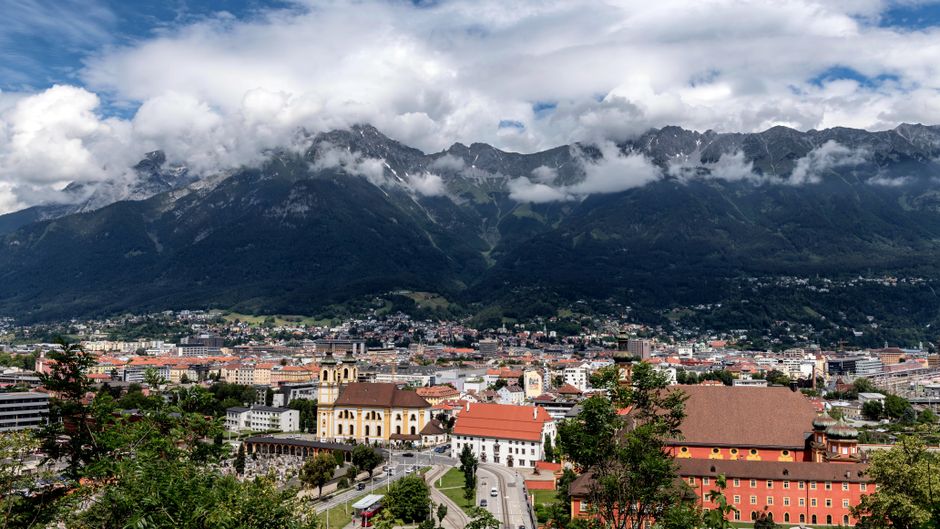
Innsbruck, the capital of Tyrol, is a small historic city with very big mountains. The Nordkette range rises almost straight out of the old town, and a chain of funicular and cable cars takes you from the colourful houses on the Inn river to a 2,256 m summit in about half an hour. Down below are the Golden Roof, the imperial Hofburg, Ambras Castle with its curiosity cabinets and the Bergisel ski jump; just outside the city are Swarovski Crystal Worlds, a dozen ski areas and hundreds of kilometres of hiking trails. Twice host of the Winter Olympics, it is a lively student city, too. Give it two days for the city and the Nordkette, three or four to hike, ski or explore the valleys.
Right now in Innsbruck
- Wed 10–21°C 50–70°F Mostly clear
- Thu 13–19°C 55–66°F 28 mm Heavy rain
- Fri 7–14°C 45–56°F 1 mm Partly cloudy
Weather: MET Norway (CC BY 4.0) · Rates: ECB
Top tours in Innsbruck
See all tours for Innsbruck →
From local operators, with prices and reviews; you check availability and book on Viator, our partner. We may earn a commission at no extra cost to you. How we earn money
Innsbruck at a glance
- Best for: city and mountains in one trip, Habsburg history, cable-car views, hiking, skiing within reach of the centre and Christmas markets.
- How long: 2 days for the old town, the Hofburg, Ambras and the Nordkette; 3–4 days to add Swarovski, a hike or ski days and a valley trip.
- Best time: June to September for hiking; December to March for skiing and the Christmas markets; May and October are quieter shoulder months.
- Getting in: trains from Munich take about 1 hour 50 minutes, from Salzburg about 2 hours and from Vienna about 4 hours 30 minutes; the airport is 20 minutes away by bus.
- Getting around: on foot in the centre; trams and buses for the rest. As of October 2026, a return to the Hafelekar summit on the Nordkette costs €56.
- Before you go: entry rules, money, mountain safety and driving are in our Austria travel guide.
Innsbruck, area by area
Innsbruck lies in the wide Inn valley at about 575 m, hemmed in by the Nordkette to the north and the Patscherkofel and the Stubai Alps to the south. The compact centre sits on the south bank of the Inn; the main station is a 10-minute walk east.
The Altstadt
The medieval old town is a tight grid of arcaded lanes and pastel houses around the Golden Roof, with the Hofburg, the Court Church and the cathedral at its edge. Walk to the Inn bridge for the classic view of the coloured houses of Mariahilf against the Nordkette. Best for: first visits and short stays.
Maria-Theresien-Strasse and Wilten
The broad main street runs south from the old town past St Anne’s Column and the Triumphal Arch, lined with shops and cafés. Beyond it, Wilten has a baroque abbey and basilica and leads up to the Bergisel. Best for: shopping, central hotels and good restaurants.
Mariahilf, St Nikolaus and the Hungerburg
Across the river, the old suburbs of Mariahilf and St Nikolaus have bars and small restaurants, and the Hungerburg plateau above, reached by funicular, has the Alpenzoo, walking paths and wide views. Best for: quiet stays and early starts on the Nordkette.
Top things to see in Innsbruck
Prices and hours below were checked on the official sites in October 2026. They change, so check before you go.
The Golden Roof
Innsbruck’s emblem is a late Gothic balcony covered with 2,657 fire-gilded copper tiles, built around 1500 for Emperor Maximilian I so that he could watch tournaments and festivities in the square below. The reliefs show the emperor with his two wives, dancers and jesters. Behind it, a small museum tells the story of Maximilian, who made Innsbruck the centre of his empire. As of October 2026 the museum opens 10:00–17:00, daily from May to September and Tuesday to Sunday from October to April. Climb the City Tower nearby for a view over the roofs.
The Nordkette cable cars
The Nordkettenbahnen are Innsbruck’s great adventure. From Congress station in the centre, the Hungerburgbahn, a futuristic funicular with stations designed by Zaha Hadid, climbs through a tunnel and over the Inn to the Hungerburg (860 m); from there, cable cars continue to Seegrube (1,905 m), with a restaurant terrace and a mountain bike trail, and to Hafelekar (2,256 m), a short walk from the summit and the edge of the Karwendel, Austria’s largest nature park. The whole trip takes about 20 to 30 minutes.
Tickets. As of October 2026, adult returns from Innsbruck cost €14 to the Hungerburg, €50.40 to Seegrube and €56 to Hafelekar; children pay much less. The summer season runs until 1 November 2026, and the lifts also run in winter for skiers, sledgers and sightseers. Go on a clear morning, and take a warm layer: it can be 15 °C colder at the top than in town. Experienced hikers can follow the Goetheweg ridge path from Hafelekar, or the Innsbruck via ferrata along the crest.
The Hofburg and the Court Church
The Imperial Palace, rebuilt in the 18th century by Empress Maria Theresa, has state rooms, a giant ceremonial hall with portraits of her 16 children and an exhibition on Maximilian I. From 1 January 2026, the Imperial Apartments cost €10.50 for adults, combination tickets €16 to €21, and under-19s go free; it opens daily 9:00–17:00. Next door, the Court Church (Hofkirche) holds Maximilian’s empty tomb, surrounded by 28 larger-than-life bronze statues of his real and imagined ancestors, known as the “Black Men”, including King Arthur.
Ambras Castle
On a hill on the edge of the city, Archduke Ferdinand II turned a medieval castle into a Renaissance palace in the 16th century to house his collections: armour, a Chamber of Art and Curiosities full of strange objects, a Habsburg portrait gallery and the magnificent Spanish Hall. As of October 2026, entry costs €16 online or €18 at the door (free for under-19s); it opens daily 10:00–17:00 and closes every November.
The Bergisel ski jump
Zaha Hadid’s sleek ski jump tower, opened in 2002, hosts the Four Hills Tournament every New Year. A funicular and lift take you to the café and viewing platform at the top, looking down the in-run to the city and across to the Nordkette. As of October 2026, a ticket costs €12 for adults (€16 combined with the Tirol Panorama museum next door, with its huge circular painting of the 1809 Tyrolean uprising). It opens daily 9:00–18:00 from June to October and is closed on Tuesdays from November to May.
Swarovski Crystal Worlds
In Wattens, about 20 km east of Innsbruck, the crystal company has built a fantasy world behind the face of a grassy giant with glittering eyes: art installations in “chambers of wonder”, a crystal cloud of 800,000 crystals over a pool in the garden, a playtower and a huge shop. As of October 2026, it opens daily 9:00–19:00 (last entry 18:00) and costs €25 online or €27 on site for adults and €9 for children aged 6 to 17. A shuttle bus runs from Innsbruck’s main station and the Congress centre several times a day (€13 return, or €38 including entry).
The Alpenzoo
Europe’s highest zoo, on the slopes of the Hungerburg, keeps only animals of the Alps: ibex, chamois, bears, wolves, lynx and bearded vultures. As of October 2026 it costs €16 for adults, or €23 with the Hungerburg funicular return, and opens every day.
Other sights
- Golden Roof
Monuments
- Hofburg, Innsbruck
Churches and cathedrals
- Hofkirche
- Innsbruck Cathedral
Peaks and mountains
- Bergisel
Palaces
- Ambras Castle
Viewpoints
- Nordkette (Hafelekarspitze)
Things to do in Innsbruck
Hike from the city
Few cities have such easy access to real mountains. Ride the Patscherkofel cable car from Igls (as of October 2026, €33 return, summer season until 1 November) for the gentle Zirbenweg, a high trail through stone pines with views of the Inn valley; take the Nordkette to Seegrube for easy panorama paths; or walk the Alpine Park Karwendel’s valleys. In summer, many hotels’ guest cards include free guided hikes. See our hiking guide.
Ski with the SKI plus CITY Pass
Innsbruck is a rare ski city: the SKI plus CITY Pass Stubai Innsbruck covers 12 ski areas, from the Nordkette’s steep freeride slopes to the Stubai Glacier, the Axamer Lizum (an Olympic venue) and Kühtai, plus city attractions and ski buses. As of the 2026/27 season, a 2-day pass costs €162 and a 3-day pass €223 for adults. Stay in town and ski a different area every day.
Christmas in Innsbruck
From 13 November 2026 to 6 January 2027, Innsbruck’s “Bergweihnacht” brings seven Christmas markets: the old town market under the Golden Roof with its giant Christmas tree, the Marktplatz by the river, Maria-Theresien-Strasse, the Hungerburg with views over the lights, Wilten, St Nikolaus and the Kaiserweihnacht at the Bergisel, plus a light trail in the Hofgarten. The old town market usually closes on 23 December, while several others continue to 6 January.
Eat Tyrolean
Try Tiroler Gröstl (pan-fried potatoes, beef and onions with a fried egg), Kaspressknödel in soup, Schlutzkrapfen (Tyrolean ravioli) and Kaiserschmarrn, ideally on a mountain hut terrace. The Markthalle by the river sells local cheese, bacon and schnapps.
Activities and best months
- City sightseeingInnsbruck's old town still shows its medieval layout; above Herzog-Friedrich-Strasse the Golden Roof built for Emperor Maximilian I gleams with 2,657 gilded copper tiles. IVB buses and trams link the old town, museums and mountain railways, and the Hungerburgbahn starts right in the centre.
- CyclingInnsbruck has about 90 km of cycle paths and the Stadtrad bike-share scheme with stations across the city, good for the Inn riverside route and short hops between sights and cafés.
- HikingThree cable cars take you from the Congress station, five minutes from the Golden Roof, to the Top of Innsbruck in under 30 minutes: the Hungerburgbahn (8 min), the Seegrubenbahn to 1,905 m and the Hafelekarbahn to 2,256 m. From there a walk of just under 15 minutes reaches the 2,334 m Hafelekarspitze, with views into the Karwendel and down over the Inn valley; austria.info notes hiking trails waiting at the top.
Day trips from Innsbruck
Hall in Tirol, 10 minutes by train, has the largest old town in Tyrol and the mint where the “thaler”, ancestor of the dollar, was first struck. The Stubai valley leads to the Stubai Glacier, with skiing for much of the year; the Ötztal has Sölden and the Aqua Dome thermal spa. The Zillertal is about 40 minutes away by train to Jenbach and the Zillertalbahn, and Kitzbühel about an hour. Lake Achensee, Tyrol’s largest lake, has boats and a cog railway. Over the Brenner Pass, the Dolomites are about two hours by car, and the Bavarian Alps around Garmisch-Partenkirchen about an hour; see our Bavarian Alps guide.
Nearby destinations
- Zillertal36 km
- Bavarian Alps50 km
- Kitzbühel78 km
- St. Anton am Arlberg87 km
- Dolomites93 km
- Munich98 km
- Cortina d'Ampezzo99 km
- Zell am See-Kaprun106 km
Getting to Innsbruck
By train. Innsbruck Hauptbahnhof has direct Railjets from Vienna (about 4 hours 30 minutes) and Salzburg (about 2 hours), direct trains from Munich (about 1 hour 50 minutes, around ten a day), and trains over the Brenner to Bolzano, Verona and Venice, as well as west to the Arlberg and Zürich.
By air. Innsbruck Airport, 4 km west of the centre, has European and winter charter flights; bus F runs to the main station in about 20 minutes. Munich Airport is the main long-haul gateway, about 2 hours 30 minutes away by train or transfer bus.
By car. The A12 Inn valley motorway and the A13 Brenner motorway meet at Innsbruck. You need a vignette, plus a separate toll for the Brenner motorway (€12.50 per trip for a car in 2026); a lower air-quality speed limit applies on parts of both motorways.
Getting around Innsbruck and the Innsbruck Card
The centre is walkable; trams and buses run by IVB cover the city and the Stubai valley. As of October 2026, a single ticket costs €3.30 and a 24-hour ticket €7.30. Many hotels give guests a Welcome Card with free local public transport and discounts; ask at check-in.
The Innsbruck Card covers 22 museums and sights (including the Golden Roof museum, the Hofburg, Ambras, the Bergisel, the Alpenzoo and Swarovski Crystal Worlds), one return trip on each of several cable cars including the Nordkette, public transport and the Sightseer hop-on hop-off bus. In 2026 it costs about €69 for 24 hours, €79 for 48 hours and €89 for 72 hours, with children half price; check innsbruck.info before buying. With the Nordkette alone at €56, it pays off quickly.
When to go and how long to stay
Weather for your datesSunrise and sunset
Innsbruck has warm summers with afternoon thunderstorms and cold, sunny winters; the valley is sheltered and drier than most of the northern Alps. The warm, dry föhn wind from the south can suddenly lift temperatures in any season. The table uses GeoSphere Austria’s 1991–2020 climate normals for the Innsbruck University station.
| Season | Average temperature | Rain per month | Sunshine per month | What it’s like |
|---|---|---|---|---|
| Winter (Dec–Feb) | 0.6–2.7 °C | 36–53 mm | 91–126 hours | Cold and often sunny; snow on the mountains, skiing and Christmas markets |
| Spring (Mar–May) | 7.2 °C rising to 15.6 °C | 54–82 mm | 179–209 hours | Spring in the valley while the peaks keep their snow; spring skiing |
| Summer (Jun–Aug) | 18.9–20.5 °C | 115–139 mm | 213–230 hours | Warm, with thunderstorms; prime hiking season |
| Autumn (Sep–Nov) | 15.8 °C falling to 5.7 °C | 81 falling to 59 mm | 187 falling to 102 hours | Clear, settled days and golden larches in September and October |
Innsbruck gets about 915 mm of precipitation and about 2,000 hours of sunshine a year, with an average temperature of 10.9 °C. On the Nordkette, 1,700 m higher, it is far colder and snow can fall in summer.
Innsbruck in 2 days
Day 1: the Golden Roof, the old town, the Hofburg and the Court Church, then the Nordkette to Hafelekar in the afternoon light. Day 2: Ambras Castle in the morning, the Bergisel after lunch and Swarovski Crystal Worlds or a riverside evening in Mariahilf.
Innsbruck in 4 days
Add a hiking day on the Patscherkofel or in the Karwendel (or two ski days with the SKI plus CITY Pass), and a trip to Hall in Tirol and Swarovski, or to the Zillertal or Lake Achensee.
Weather month by month
Where to stay in Innsbruck
- Altstadt: historic inns steps from the Golden Roof; atmospheric but limited parking.
- Maria-Theresien-Strasse and the station: modern hotels, central and handy for trains and ski buses.
- Mariahilf and the Hungerburg: quieter, with views and quick access to the Nordkette.
- Igls and the villages: mountain-village hotels on the sunny plateau south of the city, at the foot of the Patscherkofel.
Practical tips for Innsbruck
- Watch the weather: ride the Nordkette on a clear morning; clouds and storms often build in the afternoon.
- Dress for altitude: bring a warm layer and sturdy shoes even for a short trip to Hafelekar.
- Ask for the guest card: it gives free buses and discounts in the region.
- Check seasonal closures: Ambras closes every November, and some lifts close between the summer and winter seasons.
- Mountain emergencies: call 140 for mountain rescue or 112.
What to pack for Innsbruck
Layers and a windproof jacket for the cable cars, hiking shoes or boots with good grip, sunglasses and high-factor sun cream for the strong mountain sun, and a water bottle. In winter, a warm coat, hat, gloves and boots with grip for icy streets; ski gear can be hired in every ski area.
What to pack
- City walking shoesLisbon and Porto are steep, with polished limestone cobbles that get slippery, so grippy soles matter.
- Day packs and anti-theft bagsA small zipped or anti-theft bag makes crowded trams and viewpoints less stressful.
- Fleeces and warm layersSummits like Pico do Areeiro averaged about 11 °C over 2024, so a fleece is needed even in summer.
- HeadlampsLevada routes such as PR1 and PR9 pass through long, dark, wet tunnels.
- Hiking shoes and bootsMadeira's levadas and the Azores' crater rims are wet, rocky and slippery, so grippy shoes matter more than anywhere else in Portugal.
- Rain jacketsFrom October to April Porto and Lisbon see rain on roughly a third of days.
- Travel adapters and convertersPortugal uses Type C and F sockets at 230 V, so most visitors from outside Europe need an adapter.
- Trekking polesLong stone staircases and steep descents on Madeira's peaks and the Azores' crater rims are easier on the knees with poles.
- Water bottles and hydration packsRiding in the Algarve and Alentejo heat needs more water than you expect.
Innsbruck travel FAQ
How much is the Nordkette cable car?
As of October 2026, an adult return from the city costs €14 to the Hungerburg, €50.40 to Seegrube and €56 to Hafelekar. It is included once in the Innsbruck Card.
Is the Innsbruck Card worth it?
Usually yes if you ride the Nordkette and visit two or three sights. In 2026 it costs about €69 for 24 hours and includes the cable cars, museums, Swarovski Crystal Worlds and public transport.
How much does Swarovski Crystal Worlds cost?
As of October 2026, €25 online or €27 on site for adults and €9 for children aged 6 to 17. It opens daily 9:00–19:00, and a shuttle bus runs from Innsbruck.
Can you visit the Golden Roof?
You can see the balcony from the street for free at any time. The museum behind it, about Emperor Maximilian I, opens 10:00–17:00 and is closed on Mondays from October to April.
Can you ski from Innsbruck?
Yes. The Nordkette starts in the city, and the SKI plus CITY Pass covers 12 ski areas nearby, including the Stubai Glacier, with ski buses from the centre.
When are the Innsbruck Christmas markets in 2026?
From 13 November 2026 to 6 January 2027, at seven markets across the city. The old town market under the Golden Roof usually closes on 23 December.
How do I get from Munich to Innsbruck?
Direct trains take about 1 hour 50 minutes; by car it is about 2 hours via Garmisch or the Inn valley motorway, with a vignette needed in Austria.
How many days do you need in Innsbruck?
Two days for the old town, the palaces and the Nordkette; three or four to add hiking or skiing and day trips.
When is the best time to visit Innsbruck?
June to September for hiking and cable-car views, December to March for skiing and Christmas markets, and September for settled weather and fewer crowds.
Plan your trip
Partner links: TravelerCenter may earn a commission if you book, at no extra cost to you.
🇩🇪 Useful German phrases for Innsbruck
All 38 German phrases: restaurant, hotel, emergencies, romance (printable) →
Sources · last reviewed 4 October 2026
Researched and last reviewed on 4 October 2026. Nordkette fares and season: Innsbrucker Nordkettenbahnen; Hofburg prices: Burghauptmannschaft Österreich; Ambras: Schloss Ambras Innsbruck; the Bergisel: Bergisel Betriebsges.m.b.H.; Swarovski Crystal Worlds and the shuttle: kristallwelten.swarovski.com; the Alpenzoo; Patscherkofel fares; IVB fares; the SKI plus CITY Pass: Tourismusverband Stubai Tirol; Christmas markets: christkindlmarkt.cc and Tirol Werbung; climate: GeoSphere Austria 1991–2020 normals. The Golden Roof museum hours, the Innsbruck Card prices, train times and individual market dates come partly from secondary sources and are flagged for checking. Prices, timetables and rules change, so check the official links before you go. For Austria-wide entry rules, money and mountain safety, see our Austria travel guide.
Also: austria.info · nordkette.com · GeoSphere Austria normals 1991–2020, Innsbruck Airport (climate)
Place data: © OpenStreetMap contributors (ODBL) · Wikidata (CC0)