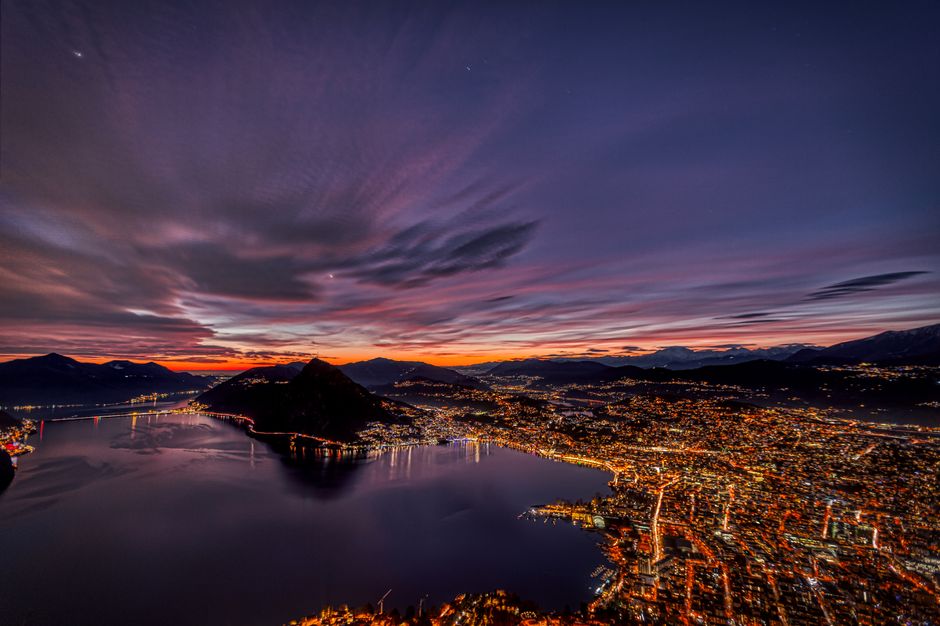
Lugano is Switzerland with an Italian accent. The largest town in Ticino, the Italian-speaking canton south of the Alps, it curves around a deep, fjord-like lake between two sugarloaf mountains, Monte San Salvatore and Monte Brè, with palm trees on the promenade, arcaded streets, piazzas full of café tables and a climate that lets camellias bloom in March. You come to ride the funiculars for the views, walk the lakeside olive trail to the old fishing village of Gandria, take the boat to Morcote, eat risotto and polenta in a grotto, and use the town as a base for Bellinzona’s castles, Locarno and the Lake Como side of Italy. Give it two or three days; a week if you want to explore Ticino.
Right now in Lugano
- Wed 13–18°C 55–65°F 12 mm Cloudy
- Thu 15–19°C 60–67°F 37 mm Showers
- Fri 11–19°C 52–66°F Clear
Weather: MET Norway (CC BY 4.0) · Air quality: OpenAQ · Rates: ECB
Top tours in Lugano
See all tours for Lugano →
From local operators, with prices and reviews; you check availability and book on Viator, our partner. We may earn a commission at no extra cost to you. How we earn money
Lugano at a glance
- Best for: lake views and boat trips, easy mountain viewpoints, walks through villages and olive groves, Italian-style food and a mild climate, with Swiss efficiency.
- How long: 2 days for the town, one funicular and Gandria; 3–4 days to add Morcote, Monte Generoso and Bellinzona.
- Best time: April to June and September to October for warm, clear days; July and August for swimming and festivals, but it can be hot and stormy.
- Getting in: about 2 hours by train from Zurich through the Gotthard Base Tunnel; about 1 hour from Milan by train.
- Getting around: on foot in the centre, then buses, boats and funiculars. Hotel guests get the free Ticino Ticket for regional trains and buses.
- Before you go: rail passes, money, entry rules and mountain safety are in our Switzerland travel guide.
Lugano, area by area
The town spreads along the Gulf of Lugano, with the railway station on the hillside above the centre, linked to it by a short funicular. From the lakefront, the city stretches south to Paradiso, at the foot of Monte San Salvatore, and east to Cassarate and Castagnola, at the foot of Monte Brè.
Centro: Piazza della Riforma and Via Nassa
The heart of Lugano is the Piazza della Riforma, a big café-lined square in front of the town hall, close to the lake. Via Nassa, with arcades full of boutiques, runs south to the church of Santa Maria degli Angioli, whose Renaissance fresco of the Passion by Bernardino Luini is one of the finest in Switzerland. Steep lanes lead up to the Cathedral of San Lorenzo, with a view over the rooftops. Best for: first visits and car-free strolling.
The lakefront and Parco Ciani
The promenade runs along the water from Paradiso to Parco Ciani, a lakeside park of old trees, flowerbeds and a villa, and on to the Lido di Lugano at the mouth of the Cassarate river. Best for: evening walks, swimming and lake views.
Paradiso
South of the centre, Paradiso has many of the larger hotels on the lake shore, the lower station of the Monte San Salvatore funicular and a boat landing. Best for: lake-view hotels.
Castagnola and Gandria
East of the centre, the villa suburb of Castagnola climbs the slopes of Monte Brè, and beyond it the village of Gandria clings to the cliffs above the water, reachable by boat, bus or the lakeside path. Best for: peaceful stays and walks.
Top things to see in Lugano
Prices and seasons below were checked on the official sites in October 2026. They change, so check before you go.
Monte San Salvatore
The steep, wooded cone of San Salvatore rises 912 m above the lake from Paradiso. A funicular built in 1890 climbs it in about 10 minutes, with a change of car halfway, to a summit with a church, a restaurant and a panoramic terrace on the roof of the church: you see the whole lake, the city, Monte Rosa and the Bernese and Valais Alps on a clear day. A path leads down through the woods to the village of Carona and on to Morcote, about 2 to 3 hours on foot.
Season and fares. As of October 2026, the 2026 summer season ran from 14 March to 8 November 2026, with departures every 30 minutes. A return ticket cost CHF 32 for adults (single CHF 25) and CHF 14 for children aged 6–16; with the Swiss Travel Pass or the Half Fare Card the return cost CHF 16, and with the Ticino Ticket CHF 25.50. Important: the funicular and the summit restaurant are closed from 9 November 2026 to 12 March 2027 for renovation work, so in winter visit Monte Brè instead.
Monte Brè
On the other side of the bay, Monte Brè (925 m) is often called the sunniest mountain in Switzerland. A funicular in two sections climbs from Cassarate, with new cars, to a summit with restaurants, trails and a view straight down the lake towards Italy. Walk down to the hilltop village of Brè, with its outdoor art and stone houses, then on to Gandria. As of October 2026, a return ticket cost CHF 26 for adults (single CHF 17), half price with the Half Fare Card or the Swiss Travel Pass, and CHF 18.20 with the Ticino Ticket; on Friday and Saturday evenings in July and August the upper section ran until 23:00 at a special evening fare. The funicular runs most of the year but closes from 11 January to 12 February 2027 and on 25 December.
LAC Lugano Arte e Cultura
The town’s cultural centre, opened in 2015 on the lakefront, houses a concert hall and the Museo d’arte della Svizzera italiana (MASI), which shows art from Ticino and changing international exhibitions; MASI has a second venue in the Palazzo Reali on Via Canova. The big glass foyer frames a view of the lake. The Lugano Region tourist office sells a three-day Culture Pass for the main museums (CHF 35 for adults as of October 2026).
Gandria and the Olive Trail
The Sentiero dell’olivo, the Olive Trail, follows the slopes from Castagnola to Gandria, about an hour of easy walking through restored olive groves, with information boards and lake views. Gandria is a car-free tangle of stairways, arches and terraces right on the water, with a few grotto restaurants. Return by boat, or continue along the shore path to the Swiss Customs Museum on the far side of the lake, reached by boat.
Morcote
At the tip of the peninsula south of Lugano, Morcote is one of the most beautiful villages in Switzerland: arcaded houses along the shore and a monumental staircase of about 400 steps up to the church of Santa Maria del Sasso. The Parco Scherrer has terraced gardens with exotic plants and small copies of famous buildings. Get there by boat (about 45 minutes), by bus, or on foot from San Salvatore; the funicular sells a combined ticket.
Churches and cathedrals
- Cathedral of Saint Lawrence
Museums
- MASI Lugano
- Museum of Cultures (MUSEC)
- Swiss Customs Museum
Peaks and mountains
- Monte Boglia
- Monte Brè
- Monte San Salvatore
Things to do in Lugano
Take a boat on Lake Lugano
The Società Navigazione del Lago di Lugano runs boats from the landings in the centre and Paradiso to Gandria, Morcote, Campione d’Italia (an Italian enclave), Melide and other villages, with more sailings from spring to autumn. The Swiss Travel Pass covers boats in Swiss waters, and hotel guests get a discount with the Ticino Ticket. See our boat trips guide.
Ride the rack railway up Monte Generoso
From Capolago, at the southern end of the lake, a rack railway dating from 1890 climbs 9 km to Monte Generoso (1,704 m), on the Italian border, with a view over the lakes to the Po plain and the whole chain of the Alps. At the top stands the Fiore di Pietra, a stone-flower building by the Ticino architect Mario Botta with a restaurant. In 2026 the high season ran daily from 2 May to 25 October 2026; check montegeneroso.ch for winter services and fares.
Swim and relax
The Lido di Lugano has pools, a sandy beach and lake swimming in summer, and smaller lidos dot the shore. The lake reaches the low to mid-20s °C in July and August. Lake Lugano is deep and has boat traffic, so swim at the lidos and marked areas.
Eat in a grotto
Ticino’s grotti are rustic restaurants with granite tables under chestnut trees, once used as cool cellars. Try risotto, polenta with braised meat, local cheeses and salumi, and a glass of Ticino Merlot, served in a ceramic boccalino. In autumn, look for roast chestnuts. For vineyard visits, see our wine tasting guide.
Swissminiatur
At Melide, a short train or boat ride south, Swissminiatur shows more than 100 models of Swiss landmarks, trains and boats on a 1:25 scale in a lakeside park. It is a hit with children and opens from spring to autumn.
Festivals
In summer, the LongLake festival brings concerts, theatre and events to the lakefront and parks, and Estival Jazz has free open-air concerts on Piazza della Riforma in July. In December, the Natale in Piazza Christmas market fills the centre. Check the Lugano Region events calendar for the dates.
Activities and best months
- Beaches and swimmingIn summer everyone heads for the water: lidos and lakeside swimming pools around Lake Lugano offer games for children, sport and relaxation. · source
- Boat tripsAprMayJunJulAugSepOctThe Lake Lugano Navigation Company (since 1848) runs the tourist line on Lake Lugano; its 2026 timetable runs from 29 March to 18 October, with tickets at the Lugano Giardino, Lugano Centrale and Paradiso offices, and lakeside grottos and restaurants with their own moorings make good stops. · source
- City sightseeingLugano Region describes a small city between the lake and steep mountains where Swiss and Mediterranean cultures meet: arcades, piazzas with cafés and aperitif bars, palace courtyards and shopping streets, and the lakeside Parco Ciani with its Italian- and English-style gardens; museums, galleries and guided tours fill out a visit. · source
- CyclingLugano Region has over 415 km of road-bike, mountain-bike and e-MTB routes through villages, valleys and panoramic roads, plus a 330 km gravel/touring route across the whole of Ticino. · source
- HikingOver 900 km of trails cross the Lugano Region, for all levels; the Monte Brè area above the city offers countless routes for hikers and mountain bikers, with grottos and panoramic terraces over the lake, and Lugano Region features the 360-degree view from Monte San Salvatore to Morcote. · source
Day trips from Lugano
Bellinzona, about 30 minutes north by train, has three medieval castles, Castelgrande, Montebello and Sasso Corbaro, together a UNESCO World Heritage Site; hotel guests with the Ticino Ticket get a discount. Locarno and Ascona, on Lake Maggiore, are about an hour away, with the Madonna del Sasso sanctuary, Cardada and the Brissago Islands; the Locarno Film Festival fills the Piazza Grande with open-air screenings, and its 80th edition runs from 4 to 14 August 2027. The Verzasca valley, with its clear green river and the Ponte dei Salti, is a short bus ride from Locarno. Across the border in Italy, Lake Como is about 30 minutes away by car to Menaggio, and Como town about 30 minutes by train; Milan is about an hour away. The Bernina Express bus links Lugano with Tirano in season, so you can combine it with the Bernina Express train to St. Moritz.
Nearby destinations
- Lake Maggiore21 km
- Lake Como24 km
- Milan63 km
- Bergamo65 km
- St. Moritz86 km
- Zermatt94 km
- Interlaken113 km
- Lucerne126 km
Getting to Lugano
By train. Since the Gotthard and Ceneri base tunnels opened, fast trains reach Lugano from Zurich in about 2 hours and from Lucerne in a little under 2 hours, with direct EuroCity trains to Milan in about an hour. For scenery, take the Gotthard Panorama Express (boat from Lucerne plus train over the old Gotthard line) in season.
By air. Lugano’s own airport has very few flights. Most visitors fly to Milan Malpensa (about 1 hour by train or shuttle bus) or Zurich (about 2 hours 30 minutes by train).
By car. The A2 motorway runs from Basel and Lucerne through the Gotthard road tunnel, which can have long queues on summer and holiday weekends, to Lugano and Chiasso. A Swiss vignette is required.
Getting around: the Ticino Ticket and passes
The centre is compact and mostly pedestrian; the funicular from the station to the old town saves the steep walk. City buses run to Paradiso, Cassarate and the funiculars. If you stay in a hotel, youth hostel or campsite in Ticino, you receive the free Ticino Ticket, valid from check-in to check-out: it covers second-class public transport throughout the canton and gives discounts on boats, funiculars and attractions, including 20% off San Salvatore and 30% off Monte Brè, Monte Generoso and the Bellinzona castles.
A note on the Lugano Regional Pass: this multi-day pass for transport, boats and funiculars around Lugano was sold in past years, but in October 2026 we could not find it on sale on the official Lugano Region or transport sites. The Ticino Ticket and the Swiss Travel Pass now cover most of what it did; ask the tourist office if you plan to buy a pass on arrival.
When to go and how long to stay
Lugano has the mildest climate of any Swiss city: hot summers, sunny and fairly dry winters and early springs. It is also wetter than the north overall, because rain comes in heavy downpours and summer thunderstorms rather than drizzle. The table uses MeteoSwiss climate normals for 1991–2020 at Lugano.
| Month | Average daily high | Average nightly low | What it’s like |
|---|---|---|---|
| January | 7.1 °C | 1.2 °C | Mild and often sunny; some attractions closed |
| April | 16.7 °C | 8.5 °C | Camellias and magnolias, pleasant for walking |
| July | 27.3 °C | 18.0 °C | Hot, lake swimming, festivals, evening thunderstorms |
| October | 16.9 °C | 10.2 °C | Warm days, chestnut season; heavy rain possible |
Lugano gets about 1,570 mm of rain a year, more than Zurich, but also about 2,120 hours of sunshine, among the most of any Swiss city. Rain tends to fall in heavy bursts, especially from May to October.
Lugano in 1 day
Morning on Piazza della Riforma, Via Nassa and Santa Maria degli Angioli; ride up Monte San Salvatore (or Monte Brè in winter) before lunch; walk the Olive Trail to Gandria in the afternoon and return by boat for an evening on the promenade.
Lugano in 3 days
Add Morcote by boat and Monte Generoso on day two, and Bellinzona’s castles or Locarno and the Verzasca valley on day three.
Weather month by month
Averages from MeteoSwiss normals 1991–2020, Lugano · Last reviewed 4 Oct 2026
Where to stay in Lugano
- Centro: walkable to everything, with historic hotels near the lake.
- Paradiso: lake-view hotels, the San Salvatore funicular and boat landings.
- Castagnola: quieter villas and resort hotels on the slopes of Monte Brè.
- Near the station: good value and convenient for day trips.
- Lakeside villages: Morcote, Melide or Gandria for a slow, romantic stay.
Every hotel stay comes with the Ticino Ticket, which can save a lot on transport. Summer weekends and festival weeks fill up early.
Practical tips for Lugano
- Speak Italian: Italian is the local language; most people in tourism also speak English and German.
- Check the funicular dates: San Salvatore is closed from 9 November 2026 to 12 March 2027.
- Carry your passport: boats stop in Italian villages and the border is minutes away.
- Watch for storms: summer thunderstorms build quickly over the mountains in the afternoon.
- Keep francs and euros: Lugano uses francs, but you may need euros in Campione d’Italia and Italy.
What to pack for Lugano
Light clothes, sun cream, a hat and swimwear from May to September; walking shoes with grip for the Olive Trail and the stairways of Gandria and Morcote; a light waterproof for thunderstorms; and a jacket for summits, which are cooler than the lakefront. Bring a Type J plug adapter.
What to pack
- City walking shoesLisbon and Porto are steep, with polished limestone cobbles that get slippery, so grippy soles matter.
- Day packs and anti-theft bagsCarries water, towel and sunscreen down the long stairways to Algarve coves.
- Dry bags and phone pouchesProtects phones and cameras from sand and spray on beaches reached by ferry or steep paths.
- Fleeces and warm layersIt is cooler at sea than on land, especially on morning whale-watching trips.
- HeadlampsLevada routes such as PR1 and PR9 pass through long, dark, wet tunnels.
- Hiking shoes and bootsMadeira's levadas and the Azores' crater rims are wet, rocky and slippery, so grippy shoes matter more than anywhere else in Portugal.
- Quick-dry beach towelsA sand-shedding quick-dry towel packs small for beach days and lido visits.
- Rain jacketsA windproof, waterproof shell keeps you warm on open boats, where wind and spray cool you quickly.
- Reef-friendly sunscreenSummer UV is strong on Portuguese beaches and there is little shade below the cliffs.
- Travel adapters and convertersPortugal uses Type C and F sockets at 230 V, so most visitors from outside Europe need an adapter.
- Trekking polesLong stone staircases and steep descents on Madeira's peaks and the Azores' crater rims are easier on the knees with poles.
- Water bottles and hydration packsRiding in the Algarve and Alentejo heat needs more water than you expect.
- Water shoesRocky coves, lava pools and weever fish in shallow sand make water shoes useful.
- WetsuitsOn the west and north coasts the sea stays around 16–18 °C even in summer, so a thin suit helps for long swims.
Lugano travel FAQ
How much is the Monte San Salvatore funicular?
As of October 2026, a return ticket cost CHF 32 for adults and CHF 16 with the Swiss Travel Pass or Half Fare Card. The funicular runs from mid-March to 8 November 2026 and is closed for renovation from 9 November 2026 to 12 March 2027.
Which is better, Monte San Salvatore or Monte Brè?
San Salvatore has the classic view over the city and the lake; Monte Brè has a longer view down the lake, the village of Brè and walks to Gandria. Brè also runs in winter, except from 11 January to 12 February 2027.
Is the Lugano Regional Pass still sold?
We could not find it on sale in October 2026. Hotel guests get the free Ticino Ticket for regional transport and discounts, and the Swiss Travel Pass covers trains, buses and boats in Swiss waters.
What is the Ticino Ticket?
A free pass for guests of hotels, hostels and campsites in Ticino, valid from arrival to departure. It covers second-class public transport in the canton and gives discounts on boats, funiculars and attractions.
Do people speak Italian in Lugano?
Yes. Lugano is in Ticino, the Italian-speaking canton, though it uses Swiss francs and Swiss rules. English and German are widely spoken in hotels and shops.
Can you swim in Lake Lugano?
Yes, in summer, at the Lido di Lugano and other lidos around the shore. Swim in marked areas and keep away from the boat lanes.
How do I get from Zurich to Lugano?
By direct train through the Gotthard Base Tunnel, in about 2 hours. In season, the Gotthard Panorama Express is a slower, scenic alternative from Lucerne.
Can I visit Lake Como from Lugano?
Yes. Menaggio, on Lake Como, is about 30 minutes by car or bus, and Como town about 30 minutes by train. Bring your passport.
How many days do you need in Lugano?
Two days for the town, a funicular, Gandria and a boat trip; three or four to add Morcote, Monte Generoso, Bellinzona or Locarno.
When is the best time to visit Lugano?
April to June and September to October for warm, clear weather; July and August for swimming and festivals. Winter is mild and sunny but some attractions close.
Sources
- © OpenStreetMap contributors · ODbL · fetched 4 Oct 2026
- Wikidata · CC0 · fetched 4 Oct 2026
Sources and last review
Researched and last reviewed on 4 October 2026. Monte San Salvatore fares, season and winter closure: Funicolare Monte San Salvatore (montesansalvatore.ch); Monte Brè fares and closure: Funicolare Monte Brè; the Ticino Ticket: Ticino Tourism and Lugano Region; the Culture Pass: Lugano Region; Monte Generoso season: Ferrovia Monte Generoso; Locarno Film Festival 2027 dates: Ascona-Locarno Tourism; climate: MeteoSwiss 1991–2020 normals for Lugano. The status of the Lugano Regional Pass, train times and festival details come partly from secondary sources and are flagged for checking. Prices, timetables and rules change, so check the official links before you go. For rail passes, money and entry rules, see our Switzerland travel guide.
Plan your trip
Partner links: TravelerCenter may earn a commission if you book, at no extra cost to you.
🇩🇪 Useful German phrases for Lugano
All 38 German phrases: restaurant, hotel, emergencies, romance (printable) →