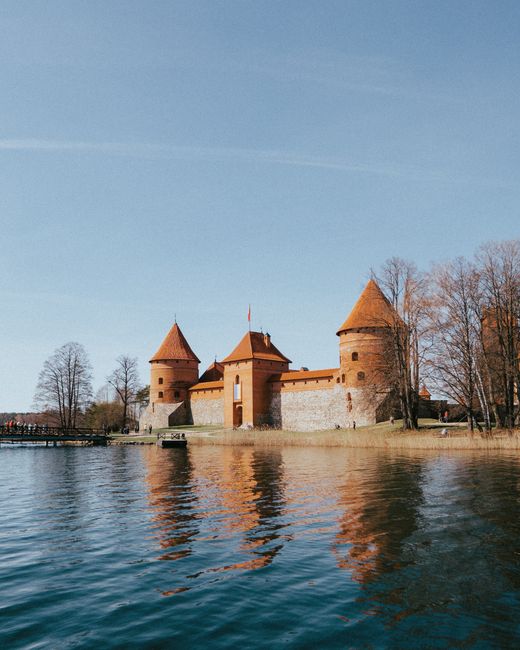
Lithuania is the largest and southernmost of the three Baltic states: a gentle country of forests, lakes and rivers, with a short but beautiful coast on the Baltic Sea. Its capital, Vilnius, has one of the largest baroque old towns in Europe; Kaunas, the interwar capital, is a showcase of 1930s modernist architecture; and on the coast, the white dunes of the Curonian Spit rise above the sea and the lagoon. In between are the island castle of Trakai, the Hill of Crosses, wooden villages, spa towns and thousands of lakes. Lithuania is in the EU, the euro area and Schengen, it is easy and safe to travel, and it is still good value by European standards. May to September is the best time for the coast and the countryside, and December brings Christmas markets to the cities. Give it five days for Vilnius, Trakai and Kaunas, and a week or more to add the coast.
Right now in Lithuania
- Wed 8–16°C 47–60°F Mostly clear
- Thu 8–18°C 47–65°F Clear
- Fri 10–15°C 49–58°F 5 mm Rain
Weather: MET Norway (CC BY 4.0) · Rates: ECB
Key facts
| Currency | Euro (EUR, €); cards almost everywhere, some cash for markets and the countrysideSource: lithuania.travel · Last reviewed 4 Oct 2026 |
|---|---|
| Languages | Lithuanian; English widely understood, Russian and Polish among older peopleSource: wikidata.org · Last reviewed 4 Oct 2026 |
| Plugs and voltage | Type C and F · 230 V, 50 HzSource: wikidata.org · Last reviewed 4 Oct 2026 |
| Emergency number | 112 (police, fire, ambulance), answered in EnglishSource: govilnius.lt · Last reviewed 4 Oct 2026 |
| Driving side | On the right; 50 in towns, 90 outside, 130 on motorways in summer; headlights on; alcohol limit 0.4 per mille; winter tyres 10 Nov-31 MarSource: europe-consommateurs.eu · Last reviewed 4 Oct 2026 |
| Tap water | Safe to drinkSource: vv.lt · Last reviewed 4 Oct 2026 |
| Tipping | Not mandatory; about 10% in restaurants for good serviceSource: lrt.lt · Last reviewed 4 Oct 2026 |
| Calling code | +370 (dial 00 for international calls)Source: wikidata.org · Last reviewed 4 Oct 2026 |
| Time zones | EET (UTC+2), summer time EEST (UTC+3) from the last Sunday in March to the last Sunday in OctoberSource: data.iana.org · Last reviewed 4 Oct 2026 |
| Entry summary | Schengen and EU. Most visitors from outside the EU stay visa-free for up to 90 days in 180 and register in the EU Entry/Exit System at the border; ETIAS is not yet in operation. Poland checks its border with Lithuania until at least 30 March 2027; crossings to Belarus and Kaliningrad are few and can close at short notice.Source: home-affairs.ec.europa.eu · Last reviewed 4 Oct 2026 |
Multi-day tours of Lithuania
Multi-day tours from local operators. You check dates and book on Viator, our partner; we may earn a commission at no extra cost to you. How we earn money
Lithuania at a glance: forests, lakes and Baltic dunes
Lithuania covers about 65,300 km², a little smaller than Ireland, and is mostly low and green, with rolling hills in the east and the north-west and nowhere higher than about 300 m. It borders Latvia to the north, Belarus to the east and south, Poland to the south and the Russian region of Kaliningrad to the south-west, and has about 90 km of Baltic coast. According to Eurostat, 2,887,592 people lived in Lithuania on 1 January 2026, about 600,000 of them in Vilnius. Lithuania regained its independence from the Soviet Union in 1990 and joined both the European Union and NATO in 2004; it has used the euro since 2015 and is part of the Schengen area.
Lithuanian, one of the oldest living Indo-European languages and a close cousin of Latvian, is the official language. Many older people also speak Russian or Polish, and English is widely spoken by younger people and in tourism. Lithuania is a mainly Catholic country, and its many churches, roadside crosses and shrines are part of the landscape.
Time zone: Lithuania runs on Eastern European Time (UTC+2) in winter and Eastern European Summer Time (UTC+3) from the last Sunday in March to the last Sunday in October, the same as Latvia, Estonia and Finland and one hour ahead of Poland and Germany.
Lithuania’s regions
- Vilnius and Aukštaitija (the east): the capital and its UNESCO Old Town, Trakai’s island castle and lakes, the hill forts of Kernavė, and the lake district of Aukštaitija National Park around Ignalina and Molėtai.
- Kaunas and central Lithuania: the modernist second city at the meeting of the Neris and Nemunas, the open-air museum at Rumšiškės, the spa town of Birštonas and the castles along the Nemunas.
- Dzūkija (the south): pine forests, mushroom-picking villages and Dzūkija National Park, with the spa resort of Druskininkai on the Nemunas.
- Samogitia (Žemaitija, the north-west): a hilly region of lakes and farms with Žemaitija National Park and Lake Plateliai, and further east, near Šiauliai, the Hill of Crosses.
- The coast (Lithuania Minor): the port city of Klaipėda, the seaside resort of Palanga, the Nemunas delta and the dunes and fishing villages of the Curonian Spit, a UNESCO World Heritage Site.
Regions
- Alytus County
- Kaunas County
- Klaipėda County
- Marijampolė County
- Panevėžys County
- Tauragė County
- Telšiai County
- Utena County
- Vilnius County
- Šiauliai County
Where to go: cities, castles and the coast
Distances are short: Vilnius to Kaunas is about an hour by train, and Kaunas to the coast about three hours. Most first trips combine Vilnius, Trakai and Kaunas, then head west to Klaipėda and the Curonian Spit, or north to Riga in Latvia.
Vilnius
The capital’s Old Town, a UNESCO World Heritage Site, is a maze of baroque churches, courtyards and cobbled lanes from Cathedral Square to the Gates of Dawn. Climb Gediminas Castle Tower for the view, visit the rebuilt Palace of the Grand Dukes, wander the artists’ quarter of Užupis and learn about the Soviet years at the Museum of Occupations and Freedom Fights in the former KGB headquarters. Vilnius is also a city of good cafés, modern art at the MO Museum and a lively food scene.
Trakai and Kernavė
The red-brick island castle of Trakai, in Lake Galvė about 28 km west of Vilnius, is Lithuania’s postcard image. The town is also home to the Karaim, a small Turkic-speaking community whose wooden houses and pastries (kibinai) are part of the visit. North-west of Vilnius, the grassy hill forts of Kernavė, Lithuania’s medieval capital, are a UNESCO World Heritage Site above the Neris valley.
Kaunas
Lithuania’s second city has a compact Gothic Old Town and castle at the confluence of the Neris and Nemunas, and a New Town of 1920s and 1930s buildings from its years as the temporary capital, listed by UNESCO in 2023 as Modernist Kaunas. Add the Ninth Fort memorial, the paintings of M. K. Čiurlionis, two historic funiculars, Pažaislis Monastery and Žalgiris basketball.
The Curonian Spit and Nida
A 98 km ribbon of sand and pine forest between the Baltic and the Curonian Lagoon, shared with Russia’s Kaliningrad region. The Lithuanian half is a national park with empty white beaches, the 52-metre Parnidis Dune, the Hill of Witches at Juodkrantė and the fishing village and resort of Nida. It is reached by a short ferry from Klaipėda, and cars pay an entry fee that rises sharply in high summer.
Klaipėda and Palanga
Klaipėda, the country’s only seaport, has a small Old Town with German half-timbered warehouses and a riverside promenade, and is the gateway to the Curonian Spit. Palanga, 25 km north, is the busiest seaside resort, with a long sandy beach, a wooden pier made for sunsets, a botanical park and the Amber Museum in the Tyszkiewicz Palace. It is lively, and loud, in July and August.
The Hill of Crosses and Samogitia
About 12 km north of Šiauliai, the Hill of Crosses is a small hill covered with tens of thousands of crosses, rosaries and statues, left by pilgrims and visitors. Soviet authorities bulldozed it several times, and people kept bringing crosses back, so it became a symbol of quiet resistance. It is free and always open, and an easy stop on the drive between Vilnius and Riga. Further west, Žemaitija National Park has lakes, wooden churches and a Cold War nuclear missile base turned museum at Plokštinė.
Druskininkai, Dzūkija and the eastern lakes
Druskininkai, in the south, is a spa town of mineral springs, wellness hotels and an indoor ski slope, with Grūtas Park and its collection of Soviet statues nearby. Dzūkija National Park around it has pine forests, sand dunes and log-built villages such as Zervynos. In the north-east, Aukštaitija National Park is a lake district of canoe routes, wooden churches and the old beekeeping museum at Stripeikiai.
Curonian Spit Travel Guide
Plan a trip to the Curonian Spit: Nida and the Parnidis Dune, the Valley of Silence, the Thomas Mann Memorial Museum, Juodkrantė's Hill of…
Kaunas Travel Guide
Plan a trip to Kaunas: the Old Town and Town Hall Square, Kaunas Castle and the confluence, Modernist Kaunas on the UNESCO list since…
Vilnius Travel Guide
Plan a trip to Vilnius: the UNESCO Old Town from Cathedral Square to the Gates of Dawn, Gediminas Castle Tower and funicular prices for…
Best time to visit Lithuania, region by region
Lithuania has a cool temperate climate that becomes more continental as you move inland. The coast has milder winters, cooler springs and a wet, windy autumn; the east around Vilnius has warmer summer days and colder, snowier winters. The table shows rounded average daily highs at four stations, from the Lithuanian Hydrometeorological Service’s (LHMT) official 1991–2020 records, with the average rainfall a year and the number of days with at least 1 mm of rain.
| Region (LHMT station) | Spring highs (Mar–May) | Summer highs (Jun–Aug) | Autumn highs (Sep–Nov) | Winter highs (Dec–Feb) | Rain a year (rainy days) |
|---|---|---|---|---|---|
| Vilnius and the east (Vilnius) | 5–19 °C | 22–24 °C | 18 °C falling to 4 °C | −1 to 0 °C | about 680 mm (121) |
| Kaunas and central Lithuania (Kaunas) | 5–19 °C | 22–24 °C | 18 °C falling to 5 °C | −1 to 1 °C | about 650 mm (115) |
| The coast (Klaipėda) | 5–16 °C | 19–22 °C | 18 °C falling to 6 °C | 1–3 °C | about 760 mm (127) |
| The Curonian Spit (Nida) | 5–16 °C | 20–22 °C | 18 °C falling to 6 °C | 1–3 °C | about 770 mm (126) |
Winter nights are colder than the highs suggest: average January lows are about −6 °C in Vilnius and −3 °C on the coast, and most winters have spells below −15 °C inland. July is the warmest month nearly everywhere, and also the wettest inland because of summer thunderstorms, while on the coast October is the wettest month. The coast is the sunniest part of the country, with about 2,000 hours of sunshine a year at Klaipėda against about 1,770 in Vilnius. Summers have grown warmer, with more hot spells above 30 °C, so check the forecast from LHMT (meteo.lt) before long outdoor days.
Daylight and the seasons
- Long summer days: Lithuania is too far south for the midnight sun, but around Midsummer the sun is up for about 17½ hours, and the nights stay light with long twilight. Midsummer itself, Joninės or Rasos on 23–24 June, is celebrated with bonfires, wreaths and the search for the mythical fern flower.
- Short winter days: in late December the sun is up for only about 7 hours, rising after 08:30 and setting before 16:00 in Vilnius.
- Snow: snow can fall from November to March. Inland, there are often a few weeks of snow cover each winter, but it varies a lot from year to year, and the coast often stays green.
- Northern Lights: the aurora is seen in Lithuania only during strong geomagnetic storms, low on the northern horizon, on a few nights a year. For reliable displays, go further north to Finnish or Norwegian Lapland.
Crowds and prices through the year
- June to August: high season on the coast. Palanga and Nida are full of Lithuanian holidaymakers, rooms must be booked ahead and the car fee for the Curonian Spit jumps to €50 from 20 June to 20 August. The cities are pleasant and not overcrowded.
- May and September: the best balance for many people: long days, lower prices and quiet beaches; the sea is cool for swimming in May, warmer in early September.
- October to April: low season. The cities stay lively, with concerts, museums and Christmas markets, while many coastal guesthouses and restaurants close or open only at weekends.
Festivals and public holidays
- February and March: Statehood Restoration Day on 16 February; Užgavėnės, the carnival before Lent, with masks and the burning of a straw figure (Shrove Tuesday is 9 February 2027); Independence Restoration Day on 11 March; and the Kaziukas crafts fair in Vilnius around St Casimir’s Day (4 March).
- Spring: Easter, with painted eggs (Easter Sunday and Monday fall on 28–29 March 2027), the Kaunas Jazz festival and city days in Vilnius and Kaunas.
- Summer: Midsummer (Joninės) on 24 June; Statehood Day on 6 July, when Lithuanians everywhere sing the national anthem together at 21:00; the Klaipėda Sea Festival in late July; and open-air concerts and music festivals across the country. The great Song Celebration, part of the UNESCO-listed Baltic song and dance tradition, is held every few years in Vilnius; its centenary edition was in 2024.
- Autumn and winter: All Saints’ Day and All Souls’ Day (1–2 November), when cemeteries glow with candles; the lighting of Christmas trees in late November; and Christmas Eve (Kūčios) on 24 December, with a 12-dish meatless supper.
Weather month by month
Averages from LHMT daily station data 1991–2020 (monthly means computed), Vilnius · Last reviewed 4 Oct 2026
How long to stay: sample itineraries
Lithuania is compact and its main road and rail line run east to west, from Vilnius through Kaunas to Klaipėda. Trains and buses cover the cities; a car helps for national parks, the Hill of Crosses and the countryside.
3 days: Vilnius and Trakai
Two days in Vilnius for the Old Town, Gediminas Castle Tower, the Palace of the Grand Dukes, Užupis and the Museum of Occupations and Freedom Fights. On day 3, take the train or bus to Trakai for the island castle and lunch by the lake.
5 days: Vilnius, Trakai and Kaunas
Follow the 3-day plan, then take the train to Kaunas for two days: the Old Town and castle, the modernist New Town, the Ninth Fort and the Čiurlionis museum. Kaunas Airport has many low-cost flights, so you can fly home from there.
7–8 days: from Vilnius to the coast
Vilnius (two or three days with Trakai), Kaunas (one or two days), then continue by train to Klaipėda and cross to the Curonian Spit for two or three nights in Nida. Finish with a day in Palanga, and fly from Palanga or return to Vilnius. In summer, this is the classic Lithuanian holiday.
10–14 days: a Baltic road trip
Combine Lithuania with Latvia and Estonia on a north-south trip. Start in Vilnius and Trakai, go west via Kaunas to the Curonian Spit, then drive north along the coast via Palanga and the Hill of Crosses to Riga (about 3½–4 hours from Vilnius by direct train or coach) and on to Tallinn, where ferries cross to Helsinki. From the south, you can arrive from Poland: Warsaw is about 8–9 hours by train via Mockava, and the drive from Gdańsk follows the coast of the Vistula Lagoon. See our Warsaw and Gdańsk guides, or our Masuria guide for the lake district on the Polish side of the border.
Entry, money and costs
Entry: Schengen, EES and ETIAS (last reviewed October 2026)
Lithuania is part of the Schengen area, so the usual Schengen rules apply. EU, EEA and Swiss citizens only need a valid passport or national ID card. Many other nationalities, including UK, US, Canadian and Australian citizens, can visit without a visa for up to 90 days in any 180-day period, counted across all Schengen countries together.
- Entry/Exit System (EES): the EU’s digital border system has been fully running at all Schengen external borders since 10 April 2026. The first time you enter, non-EU visitors register fingerprints and a facial photo instead of getting a passport stamp; children under 12 are not fingerprinted. Registration is free. Allow extra time at passport control when you arrive on a flight from outside Schengen, such as from the UK.
- ETIAS: the EU’s planned online travel authorisation (fee €20) is not in operation as of October 2026, and no start date has been officially announced. You don’t need one yet. Ignore websites selling “ETIAS applications”.
- Passport validity: non-EU passports must have been issued within the last 10 years and be valid for at least three months after the day you plan to leave the Schengen area.
- Belarus and Russia: Lithuania’s borders with Belarus and the Kaliningrad region are the external border of the EU, and crossings have been closed at short notice in recent years. Overland travel to Belarus and Russia is not a practical tourist route, and crossings can close at short notice. Internal Schengen borders with Latvia and Poland normally have no checks, but carry your passport or ID card.
Money: the euro, cards and cash
Lithuania has used the euro (€) since 2015. On 2 October 2026, according to the European Central Bank, €1 was worth about US$1.12, £0.85 and PLN 4.38. Contactless cards and Apple Pay or Google Pay are accepted almost everywhere, including on city buses and in most taxis and market stalls, and ATMs are easy to find. A little cash is still useful in small villages, at smokehouses and for church donations. Always choose to pay in euros when a card terminal offers your home currency.
Tipping
Tipping is common but modest. In restaurants with table service, leave about 10% for good service, or round up; you can add it on the card terminal or leave cash. There is no need to tip at counters, in cafés where you order at the bar, or in taxis, though rounding up is appreciated.
Alcohol rules
Lithuania has some of the strictest alcohol laws in the EU. You must be 20 to buy or be served alcohol, and staff check ID. Shops may sell alcohol only from 10:00 to 20:00 Monday to Saturday and from 10:00 to 15:00 on Sundays, so buy wine for a picnic or cabin before the shops stop selling. Bars and restaurants serve later. Drinking in public places such as streets and parks is not allowed, and the drink-drive limit is low (see the driving section).
Tax-free shopping and city taxes
The standard VAT rate is 21%. Visitors living outside the EU can claim part of it back on goods bought in shops displaying the Tax Free sign, above a minimum amount per receipt, if they take the goods out of the EU within three months; ask for a tax-free form in the shop and get it stamped by customs when you leave. Vilnius charges a city tax of €2 per person per night on all accommodation (under-18s are exempt), and Kaunas a smaller nightly fee; hotels add it to your bill.
Typical travel costs
Lithuania is cheaper than Western Europe and Scandinavia, though prices have risen quickly in recent years and Vilnius and the coast in summer are the most expensive. These estimates per person per day are a planning guide as of October 2026:
| Style | Estimated cost per day | What that looks like |
|---|---|---|
| Budget | about €50–70 | Hostel bed or simple guesthouse, bakery breakfast, a lunch deal (dienos pietūs) and one sit-down meal, buses and trains |
| Mid-range | about €100–160 | Double room in a 3- or 4-star hotel shared by two, café lunch and restaurant dinner, a museum or castle, a city tax |
| High-end | about €250+ | Boutique or spa hotel, tasting menus, a hot-air balloon flight or guided tours, car hire, a summer stay in Nida or Palanga |
Sample prices as of October 2026: a 30-minute bus ticket in Vilnius costs €1.00, Gediminas Castle Tower €8, Trakai Island Castle €12–14 depending on the season, and the Ninth Fort in Kaunas €8. Many national museums are free on the last Sunday of the month.
Getting there and getting around
Airports, ferries and trains
- Vilnius Airport (VNO): the main airport, only about 6 km from the centre, with flights from across Europe and connections via Riga, Warsaw, Frankfurt, Helsinki and others. City buses 3G and 88 reach the centre in about 20 minutes for €1.00, and a short train runs to the railway station.
- Kaunas Airport (KUN): a Ryanair base with many low-cost routes, about 40 minutes from Kaunas by city bus 29 and about 1¼ hours from Vilnius by road.
- Palanga Airport (PLQ): a small airport on the coast, about 30 km from Klaipėda, with a handful of routes.
- By ferry: Klaipėda has car ferries from Germany and Sweden: DFDS from Kiel and Karlshamn, and TT-Line from Karlshamn, Trelleborg, Travemünde and Rostock.
- By train and coach: a direct LTG Link train runs once a day between Vilnius and Riga, taking about 4 hours. For Poland, LTG Link trains run to Mockava on the border, where you change to a Polish train for Warsaw and Kraków. Lux Express, FlixBus and others run coaches from Vilnius and Kaunas to Riga, Tallinn, Warsaw and Berlin. Rail Baltica, a new fast line from Poland through the three Baltic states, is under construction and not yet running.
Trains and buses in Lithuania
LTG Link, the national railway, runs comfortable modern trains on the main line from Vilnius to Kaunas (about 1–1¼ hours, frequent) and on to Klaipėda (about 4 hours from Vilnius), plus lines to Trakai, Šiauliai and the eastern towns. Buy tickets in the LTG Link app or online, at stations or from the conductor; fares are low by Western standards. Buses fill the gaps: intercity buses run often between all the main towns, and they are often the best option for places like Druskininkai, Palanga and the Curonian Spit. In the cities, tap a contactless bank card or use an app such as m.Ticket for city buses and trolleybuses.
Driving: winter tyres, tolls and the Curonian Spit fee
Lithuania’s roads are generally good, with the A1 motorway from Vilnius via Kaunas to Klaipėda and the Via Baltica (A5/E67) north from Poland via Kaunas to Riga. Drive on the right, use dipped headlights at all times, and expect speed limits of 50 km/h in towns, 70–90 km/h on country roads and up to 130 km/h on motorways in summer (110 km/h in winter). The drink-drive limit is 0.4 g/l, and lower for new drivers, and speed cameras are common, including average-speed checks.
- Winter tyres: compulsory from 10 November to 31 March, with at least 3 mm of tread; studded tyres are allowed only within a slightly longer winter period. Hire cars come equipped in season.
- Tolls: as of October 2026, ordinary passenger cars don’t need a vignette on Lithuanian roads; vans, lorries and buses pay road charges.
- The Curonian Spit: cars pay a local fee at the Alksnynė post to enter the national park: as of October 2026, €10 from 21 August to 19 June and €50 from 20 June to 20 August.
- Wildlife: elk, deer and wild boar cross roads at dawn and dusk, especially in forests; slow down where signs warn of animals.
Outdoors: national parks, lakes and the rules
About a third of Lithuania is forest, and there are thousands of lakes, most of them in the east. The five national parks are Aukštaitija (lakes and canoeing), Dzūkija (pine forests and old villages), Žemaitija (lakes and the Plokštinė missile base), Trakai Historical National Park and the Curonian Spit, plus many regional parks such as Pavilniai on the edge of Vilnius.
- Walking in forests: most forests are open to walkers, and picking berries and mushrooms is a national pastime in late summer and autumn. Only pick mushrooms you know are safe.
- Camping: camp at campsites or at the many free, equipped forest rest areas run by the state forest service, not just anywhere. In national parks, tents and campervans are allowed only at marked sites, and fires only at marked fireplaces.
- Protected dunes and reserves: on the Curonian Spit and in strict reserves, keep to the marked paths and boardwalks.
- Ticks: ticks are common in forests and long grass from spring to autumn, and Lithuania has one of the highest rates of tick-borne encephalitis in Europe. Use repellent, check your skin after walks, and consider vaccination if you will spend a lot of time in the countryside.
- Swimming: lakes and the Baltic are warm enough from late June to August. Swim at beaches with lifeguards where you can, and never swim after drinking; drowning is a real risk in Lithuania’s lakes.
Culture, food and everyday etiquette
Lithuanians can seem reserved at first, but they are warm and hospitable once you get talking. Greet people with laba diena (good day), shake hands when you meet, and take your shoes off when you enter someone’s home. Dress modestly in churches, and keep your voice down at memorials such as the Ninth Fort and Paneriai. Basketball is close to a national religion: if Lithuania or Žalgiris is playing, you will see it on every screen.
Lithuanian food is hearty and built on potatoes, rye, pork, dairy, mushrooms and berries. Try cepelinai (big potato dumplings filled with meat or curd and served with a rich sauce), šaltibarščiai (a bright pink cold beetroot soup served with hot potatoes in summer), kibinai (Karaim pastries from Trakai), dark rye bread with garlic croutons and beer, smoked fish on the coast, and šakotis, a spiky cake baked on a spit. Lunch deals in cafés are excellent value, and the craft beer and coffee scenes are strong.
Shops in the cities are usually open every day, with shorter hours on Sundays, and big supermarkets often open from 08:00 to 22:00. The main public holidays coming up are Christmas Eve and Christmas (24–26 December), New Year’s Day, 16 February, 11 March, Easter Sunday and Monday (28–29 March 2027), 1 May, Mother’s Day (2 May 2027) and Father’s Day (6 June 2027), 24 June, 6 July, 15 August, and 1–2 November.
Safety, health and connectivity
Safety
Lithuania is a safe country to travel in. Violent crime against visitors is rare; watch for pickpockets in crowds, check bar bills in tourist areas, and use licensed taxis or ride-hailing apps at night. The bigger risks are icy pavements in winter, fast drivers on country roads, and swimming in lakes and rough seas. Lithuania is a NATO member with allied troops stationed in the country, and you may see military exercises; follow any signs near military areas and the eastern borders. The emergency number for police, ambulance and fire is 112.
Health
Healthcare in the cities is good. EU and EEA citizens should carry their European Health Insurance Card (EHIC), and UK visitors their GHIC, for necessary treatment in public healthcare; everyone should have travel insurance. Pharmacies (vaistinė) are easy to find. Tap water is safe to drink in Vilnius and most towns. Protect yourself against ticks in summer, as described above.
Connectivity and power
Mobile coverage and data speeds are excellent, and free Wi-Fi is standard in hotels, cafés and many public places. EU phone plans roam at home prices; others can buy a cheap local SIM or eSIM. Sockets are type C and F at 230 V and 50 Hz, so bring a travel adapter from the UK, North America or Australia. Useful apps: LTG Link (trains), m.Ticket and JUDU (city transport), Bolt (taxis and scooters) and the LHMT weather service.
Things to do: city sightseeing, beaches, cycling and canoeing
- City sightseeing: the baroque Old Town of Vilnius, modernist and Old Town Kaunas, Klaipėda’s half-timbered warehouses and Trakai Island Castle.
- Beaches: the long sandy beaches of Palanga, Nida, Juodkrantė and Smiltynė, plus hundreds of lakeside beaches inland. The sea is warm enough for swimming from late June to August.
- Cycling: the flat forest path the length of the Curonian Spit, the coastal route north to Palanga, and quiet country roads in the lake districts. Lithuania is on the EuroVelo 10 and 11 routes.
- Hiking: gentle walking rather than mountains: dune trails on the Curonian Spit, lakeside paths in Aukštaitija and Žemaitija, and forest walks in Dzūkija.
- Boat trips and canoeing: lagoon boat trips from Nida, a summer hydrofoil down the Nemunas from Kaunas, boats on the lakes at Trakai, and multi-day canoe routes through the lakes of Aukštaitija.
- Hot-air balloons, spas and saunas: balloon flights over Vilnius and Trakai on calm summer evenings, mineral spas in Druskininkai and Birštonas, and traditional bathhouses (pirtis) in the countryside.
What to pack
Pack layers for changeable weather in every season. In summer, bring light clothes, a warm layer for evenings and the coast, a light rain jacket for thunderstorms, swimwear, sun cream and insect and tick repellent. Comfortable shoes with a good grip are essential for cobbled old towns, and sturdy hiking shoes help on forest and dune trails. From November to March, add a warm winter coat, hat, scarf and gloves, waterproof boots and slip-on ice grips for icy pavements. Also bring a type C/F plug adapter, a refillable water bottle and a contactless card.
Lithuania travel FAQ
When is the best time to visit Lithuania?
May to September for warm, long days, with June to August best for the coast and the Curonian Spit. May and September are quieter and cheaper. December is lovely in Vilnius and Kaunas for the Christmas trees and markets, if you don’t mind cold, short days.
How many days do you need in Lithuania?
Three days covers Vilnius and Trakai, five adds Kaunas, and a week or more lets you include the Curonian Spit and the coast. Allow 10–14 days to combine Lithuania with Latvia and Estonia.
Do I need a visa or ETIAS to visit Lithuania?
Lithuania is in the Schengen area. Many nationalities, including UK, US, Canadian and Australian citizens, can stay up to 90 days in any 180 days without a visa. Since April 2026, non-EU visitors register fingerprints and a photo in the EES border system on first entry. ETIAS is not yet running as of October 2026, so you don’t need it yet.
What currency does Lithuania use?
The euro, since 2015. Cards and phone payments are accepted almost everywhere, including on city buses; keep a little cash for small villages, markets and church donations.
Is Lithuania expensive?
It is cheaper than Western Europe and Scandinavia. As a rough guide for October 2026, budget travellers spend about €50–70 a day and mid-range travellers about €100–160. Vilnius and the coast in July and August are the most expensive, and Vilnius adds a city tax of €2 per person per night.
Is it safe to travel to Lithuania?
Yes. Lithuania is an EU and NATO member with low crime against visitors. Avoid the borders with Belarus and Russia’s Kaliningrad region, which are not tourist crossings. The emergency number is 112.
How do I get from Vilnius to Riga or Warsaw?
To Riga, take the daily direct LTG Link train (about 4 hours) or one of many coaches (about 4 hours). To Warsaw, take LTG Link to Mockava on the Polish border and change to a Polish train, about 8–9 hours in total, or a direct coach. Flights are quicker but rarely cheaper.
How old do you have to be to drink in Lithuania?
Twenty, the highest legal age in the EU. Shops sell alcohol only from 10:00 to 20:00 Monday to Saturday and 10:00 to 15:00 on Sundays; bars and restaurants serve later. Drinking in public streets and parks is not allowed.
Can I see the Northern Lights in Lithuania?
Only occasionally, during strong geomagnetic storms, low on the northern horizon away from city lights. Lithuania is too far south for regular displays; for the best chances, head north to Lapland in Finland, Sweden or Norway between September and March.
Do I need a car in Lithuania?
Not for the cities: trains and buses link Vilnius, Trakai, Kaunas and Klaipėda, and local buses run along the Curonian Spit. A car helps for national parks, the Hill of Crosses, Kernavė and the countryside. Winter tyres are compulsory from 10 November to 31 March.
Sources
- Natural Earth · Public domain · fetched 4 Oct 2026
- © OpenStreetMap contributors · ODbL · fetched 4 Oct 2026
- Wikidata · CC0 · fetched 4 Oct 2026
Sources and last review
Researched and last reviewed on 4 October 2026. Population from Eurostat (1 January 2026); exchange rates from the European Central Bank; climate from the Lithuanian Hydrometeorological Service’s (LHMT) official 1991–2020 station data and standard climate normals; EES and ETIAS from the European Commission; Vilnius city tax, airport transfers and public transport from Go Vilnius and JUDU; sight prices from the National Museum of Lithuania, the Trakai History Museum and the Kaunas Ninth Fort Museum; the Curonian Spit entry fee from Neringa municipality; ferries from Visit Neringa; public holidays from the official closing-day lists of Lithuanian national museums. LTG Link routes and journey times, alcohol sale hours, winter tyre and toll rules, speed and drink-drive limits, the Kaunas city tax, tax-free details and daily costs come partly from secondary sources or general knowledge and are flagged for checking. Check the official links before you travel.
Plan your trip
Partner links: TravelerCenter may earn a commission if you book, at no extra cost to you.
🇱🇹 Useful Lithuanian phrases for Lithuania
All 38 Lithuanian phrases: restaurant, hotel, emergencies, romance (printable) →