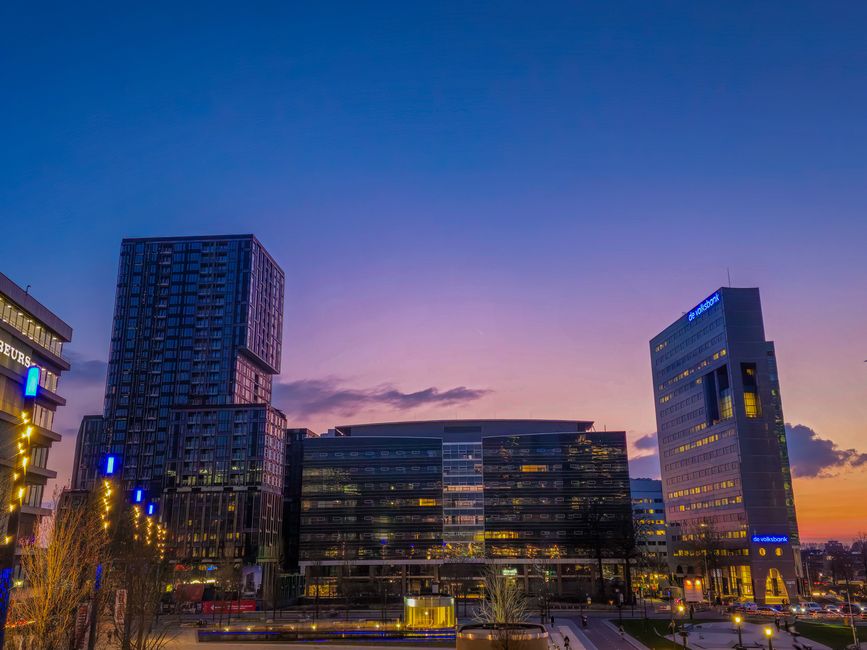
Utrecht is a lively university city at the heart of the Netherlands, with a medieval centre that many visitors find more relaxed and more authentic than Amsterdam’s. Its symbol is the Dom Tower, the tallest church tower in the country, now freshly restored and climbable on guided tours. Below it runs the Oudegracht, a canal unlike any other: its banks are two-level, with old wharves and cellars at water level that now hold cafés and restaurant terraces right beside the boats. You come for the tower, the canals, the Rietveld Schröder House, Miffy, music boxes and the national railway museum, and for a young, cycling city full of students. It is under 30 minutes from Amsterdam by train. One day covers the highlights; two lets you add the museums and a castle.
Right now in Utrecht
- Wed 13–20°C 55–68°F 6 mm Cloudy
- Thu 12–15°C 53–58°F 3 mm Light showers
- Fri 11–15°C 51–59°F 12 mm Rain
Weather: MET Norway (CC BY 4.0) · Rates: ECB
Top tours in Utrecht
See all tours for Utrecht →
From local operators, with prices and reviews; you check availability and book on Viator, our partner. We may earn a commission at no extra cost to you. How we earn money
Utrecht at a glance
- Best for: canal-side cafés, church towers and medieval streets, design and architecture, families with small children, cycling and a relaxed city break.
- How long: 1 day for the Dom Tower, the canals and a museum; 2 days to add the Rietveld Schröder House, the Railway Museum or Castle De Haar.
- Best time: May to September for wharf terraces and canal boats; any time for museums.
- Getting in: Utrecht Centraal is the busiest station in the country, under 30 minutes by train from Amsterdam and direct from Schiphol.
- Getting around: on foot or by bike; the old centre is compact. As of October 2026, an adult Dom Tower tour cost €13.50.
- Before you go: entry rules, money and general safety are in our Netherlands travel guide.
Utrecht, area by area
The old city sits inside a ring of canals (the Singel) a 10-minute walk east of Utrecht Centraal. Two canals cut through it from north to south: the busy Oudegracht and, to the east, the quieter, tree-lined Nieuwegracht.
Domplein and the Oudegracht
The heart of the city: the Dom Tower and Dom Church on the Domplein, the cloister garden (Pandhof) behind them, and the Oudegracht with its wharves, shops and cafés. Best for: first-time visitors and staying in the middle of everything.
The Museum Quarter and the Nieuwegracht
South of the Dom, the Museumkwartier holds the Centraal Museum, the Miffy Museum, the Museum Catharijneconvent and grand canal houses along the Nieuwegracht and Maliebaan. Best for: museum days, families and quieter stays.
Wittevrouwen and Lombok
Wittevrouwen, north-east of the centre, is a charming area of small streets and independent shops; Lombok, west of the station, is a multicultural neighbourhood with Turkish and Moroccan grocers and food. Best for: local life and food.
Utrecht in brief: from Roman fort to bishops’ city
Utrecht began around AD 47 as a small Roman fort guarding a crossing of the Rhine, on the spot that is now the Domplein. In the 7th and 8th centuries, missionaries made it the religious centre of the northern Netherlands, and for centuries the bishops of Utrecht were powerful princes. The city grew rich on trade along its canals, which explains the merchants’ wharves and cellars, and it was here, in 1579, that the northern provinces signed the Union of Utrecht, the founding alliance of the Dutch Republic. In 1713 the Treaty of Utrecht ended the War of the Spanish Succession.
Today Utrecht has one of the largest universities in the country, and around a fifth of its residents are students, which keeps the cafés, bars and music venues busy. The city has grown fast, and a new district has risen around Utrecht Centraal, but the medieval centre within the Singel remains compact, car-free in places and remarkably intact. Look for the signposted Roman and medieval traces, from the outlines of the Roman fort in the paving of the Domplein to the stumps of old city towers along the Singel.
Top things to see in Utrecht
Prices and hours below were checked on the official sites in October 2026. They change, so check before you go.
The Dom Tower
At about 112 metres, the Dom Tower (Domtoren) is the tallest church tower in the Netherlands, built between 1321 and 1382. It stands apart from its church because a storm in 1674 brought down the nave between them, leaving the open square of the Domplein. Climbing its 465 steps, you pass the chapels and the great bells, and on clear days the view from the top reaches Amsterdam.
Restoration. The tower spent five years under scaffolding for its third complete restoration, which began in 2019 and was completed on 9 November 2024. The work focused on the outside stonework, and as of October 2026 the tower is open all year round with no restoration closures.
Tickets and rules. You can only climb with a guide. As of October 2026, an adult staircase tour cost €13.50, and students, over-65s and children aged 4–12 paid €8.50, with lower prices for holders of Utrecht’s U-pas. Buy online in advance or at the Utrecht Tourist Information Centre at Domplein 9, where tours start; tickets are for a set time, and latecomers lose their place. No bags or handbags are allowed in the tower, nor tripods or selfie sticks; free lockers are provided, and you may take a camera. Children under 18 must be with an adult, and food, drink and smoking are not allowed. The tower can only be reached by stairs, so it is not accessible for visitors with reduced mobility. Combination tickets add the DOMunder excavations below the square (tour in Dutch) or Museum Speelklok.
The Oudegracht and its wharves
Utrecht’s main canal is special because its banks have two levels. In the Middle Ages, merchants dug cellars under the street that opened onto wharves (werven) at water level, where goods were unloaded from boats. Today many of the wharf cellars are cafés, restaurants and studios, and the wharves are lined with terraces just above the water: the best place in the city for a drink on a summer evening. Walk the wharf level from the Weerdsluis in the north to the Tolsteegbrug in the south, then climb back up to the street for the shops.
Canal boat tours of about an hour leave from the Oudegracht, and you can rent pedal boats, canoes or small electric boats to explore the canals and the Singel yourself. See our boat trips guide.
Dom Church, the Pandhof and DOMunder
The surviving choir and transept of the Gothic Dom Church are free to enter (a donation is welcome) and hold regular concerts. Behind it, the cloister garden of the Pandhof is a peaceful green courtyard. Under the Domplein, DOMunder takes you by torchlight into the excavations of the Roman fort and the earlier cathedrals; outlines in the paving show where the lost nave once stood.
Rietveld Schröder House
Designed in 1924 by Gerrit Rietveld for Truus Schröder, this small house of coloured planes and sliding walls is a manifesto of the De Stijl movement and a UNESCO World Heritage Site. It is managed by the Centraal Museum, and visits are by reservation only, in small groups at set times from Tuesday to Sunday, even with a museum pass. A ticket includes entry to the Centraal Museum on the same day; book well ahead.
Museums for every age
- Centraal Museum: Utrecht’s art and history museum, with old masters, De Stijl furniture by Rietveld and a fashion collection.
- Miffy Museum (Nijntje Museum): a play museum for children up to about six, celebrating Dick Bruna’s rabbit, who was born in Utrecht.
- Museum Speelklok: self-playing instruments, from tiny music boxes to giant dance organs, demonstrated on the tour, in a medieval church.
- Museum Catharijneconvent: religious art and history in a former convent.
- Spoorwegmuseum: the national railway museum in an old station, with rides and steam trains, a short ride from Utrecht Centraal.
Other sights
- Dom Tower
Monuments
- Castle de Haar
- Dom Church (St. Martin's Cathedral)
Museums
- Centraal Museum
- Museum Catharijneconvent
- Railway Museum (Spoorwegmuseum)
- Rietveld Schröder House
Things to do in Utrecht
Cycle like a local
Utrecht is one of the world’s great cycling cities, and next to Utrecht Centraal lies the world’s largest bicycle parking garage, with space for more than 12,000 bikes. Rent a bike at the station and ride the Singel canal ring, out along the River Vecht to its riverside country houses, or to Castle De Haar. The same traffic rules as in Amsterdam apply: ride in the bike lanes, use lights at night and never hold your phone. See our cycling guide.
Markets and food
The big market on the Vredenburg sells cheese, fish and stroopwafels on Wednesdays, Fridays and Saturdays, and a flower market fills the Janskerkhof on Saturdays. Eat on a wharf terrace by the Oudegracht, try a craft beer in a former church, or explore the restaurants of Twijnstraat and Lombok.
Shopping
Utrecht is known for independent shops. Browse the boutiques, vintage stores and design shops of the Oudegracht, Twijnstraat, Voorstraat and Schoutenstraat, and the old streets around the Nieuwegracht. For big brands, the Hoog Catharijne shopping centre links straight to the station. Many shops in the centre open on Sundays from noon.
Music and festivals
TivoliVredenburg, a stack of concert halls by the station, has music almost every night. On 11 November, children carry lanterns through the streets for St Martin’s Day, Utrecht’s patron saint, and in December Christmas markets and lights fill the old centre.
Activities and best months
- Boat tripsRederij Schuttevaer runs canal boat tours from Oudegracht 85 past Utrecht's wharves; canoes, kayaks, stand-up paddleboards and pedal boats can also be hired on the canals. · source
- City sightseeingUtrecht's top sights: the 112 m Dom Tower, the tallest church tower in the Netherlands (465 steps), the Oudegracht and its wharf cellars, Dom Square with the remains of the Roman fort (UNESCO), the Railway Museum, the Rietveld Schröder House (UNESCO), the Singel ring canal and, 30 minutes away, De Haar, the largest castle in the Netherlands. · source
- CyclingThe Stationsplein bicycle parking at Utrecht Centraal holds 12,500 bikes, the largest in the world, open 24/7 and free for the first 24 hours; OV-fiets public-transport bikes can be rented at the station. · source
Day trips from Utrecht
Castle De Haar, near Haarzuilens, is the largest castle in the Netherlands, a neo-Gothic fantasy rebuilt around 1900 by the Rothschild-backed Van Zuylen family, with grand gardens; it is about 30 minutes away by bus or a pleasant bike ride. The Vecht river, lined with 17th-century country estates, is lovely by bike or boat. Because Utrecht is the hub of the Dutch railway network, Amsterdam (under 30 minutes), Rotterdam and The Hague (around 40 minutes) and even Maastricht (about two hours) are easy by train. The Hoge Veluwe National Park and the Kröller-Müller Museum, with its Van Goghs, are about an hour east.
Nearby destinations
Getting to Utrecht
By train. Utrecht Centraal is the hub of the Dutch railway network. Trains from Amsterdam Centraal run several times an hour and take about 27 minutes; as of October 2026 a second-class single cost about €10. There are direct trains from Schiphol (about 30 minutes), Rotterdam, The Hague, Eindhoven and Arnhem, and ICE trains from Germany. Tap in and out with a contactless bank card, or buy a ticket in the NS app.
By air. Fly into Schiphol and take the direct train.
By car. Utrecht lies at the junction of several motorways. The old centre is hard to drive in and expensive to park; use a Park + Ride on the edge of the city and take the tram or bus in.
Getting around Utrecht
Walk: from Utrecht Centraal, through the Hoog Catharijne shopping centre, to the Dom takes about 10 minutes, and the whole old centre is compact. Buses and trams run from the station’s two sides, and all accept contactless cards. Bikes are the local way of getting around; the station has rental bikes, including the national OV-fiets scheme for residents.
When to go and how long to stay
Utrecht lies inland, so summers are slightly warmer and winters slightly colder than on the coast. The table uses the WMO 1991–2020 normals for De Bilt, home of the Dutch weather service, about 6 km east of the city centre.
| Season | Average high / low | Rainy days per month | What it’s like |
|---|---|---|---|
| Spring (Mar–May) | 11–18 °C / 2–8 °C | 8–10 | Wharf terraces reopen, blossom along the canals, King’s Day on 27 April |
| Summer (Jun–Aug) | 21–23 °C / 11–13 °C | 10–11 | Warmest inland weather, evening drinks by the water, boat rentals; can be busy at weekends |
| Autumn (Sep–Nov) | 20 °C falling to 10 °C / 10 °C falling to 4 °C | 10–13 | Film festival and music events, St Martin’s Day in November, wetter weather |
| Winter (Dec–Feb) | 6–7 °C / about 1 °C | 11–14 | Christmas markets and lights, occasional frost; cosy wharf cellars |
De Bilt records about 855 mm of rain a year on about 132 days; April is the driest month. May to August each average more than 200 hours of sunshine, against about 55 to 70 hours in December and January.
Utrecht in 1 day
Climb the Dom Tower in the morning, then visit the Dom Church, the Pandhof and DOMunder. Lunch on a wharf terrace by the Oudegracht, then Museum Speelklok or the Centraal Museum. End with a canal boat tour or a drink by the water as the lights come on.
Utrecht in 2 days
Add a booked visit to the Rietveld Schröder House, the Miffy Museum or the Railway Museum with children, and a bike ride along the Vecht or to Castle De Haar.
Weather month by month
Averages from KNMI normals 1991–2020, De Bilt · Last reviewed 4 Oct 2026
Where to stay in Utrecht
- Old centre: boutique hotels and canal-house B&Bs near the Dom and the Oudegracht.
- Near Utrecht Centraal: modern chain hotels, ideal if you use Utrecht as a base for day trips around the country.
- Museum Quarter: quieter streets and guesthouses a few minutes from the centre.
Utrecht is usually cheaper than Amsterdam and only half an hour away by train, so it makes a good base for exploring the country.
Practical tips for Utrecht
- Book the Dom Tower: tours run at set times and can sell out at weekends and in holidays.
- Leave your bag behind: no bags are allowed in the Dom Tower, and lockers are limited, so travel light.
- Watch the wharf edges: the wharves have no railings; take care with children and after a drink.
- Mind the bikes: Utrecht’s cycle lanes are among the busiest in the world.
- Pay by card: cards and phones are accepted almost everywhere, including all transport.
What to pack for Utrecht
Comfortable shoes for the 465 steps and the cobbled wharves, a waterproof jacket, layers for evenings by the water, a small wallet or phone you can carry without a bag in the tower, and a contactless card for transport.
What to pack
- City walking shoesLisbon and Porto are steep, with polished limestone cobbles that get slippery, so grippy soles matter.
- Day packs and anti-theft bagsA small zipped or anti-theft bag makes crowded trams and viewpoints less stressful.
- Dry bags and phone pouchesSpray soaks phones and cameras on open boats to the Algarve caves and on whale-watching trips.
- Fleeces and warm layersIt is cooler at sea than on land, especially on morning whale-watching trips.
- Rain jacketsA windproof, waterproof shell keeps you warm on open boats, where wind and spray cool you quickly.
- Reef-friendly sunscreenSun reflects off the water on cruises and cave tours.
- Travel adapters and convertersPortugal uses Type C and F sockets at 230 V, so most visitors from outside Europe need an adapter.
- Water bottles and hydration packsRiding in the Algarve and Alentejo heat needs more water than you expect.
- Water shoesKayak and small-boat trips to the Algarve grottoes land on rock and wet sand.
Utrecht travel FAQ
Is the Dom Tower open after the restoration?
Yes. The restoration that began in 2019 was completed on 9 November 2024, and the tower is open all year round for guided climbs.
How much does it cost to climb the Dom Tower?
As of October 2026, €13.50 for adults and €8.50 for students, over-65s and children aged 4–12. Every climb is a guided tour at a set time, starting from Domplein 9.
How many steps does the Dom Tower have?
465 steps to the top, at about 112 metres the tallest church tower in the Netherlands. There is no access for visitors with reduced mobility, and bags are not allowed inside.
What are Utrecht’s wharves?
Medieval quays at water level along the Oudegracht, below the street, with old cellars that once stored goods. Many are now cafés and restaurants with terraces beside the canal.
How far is Utrecht from Amsterdam?
About 27 minutes by direct train, with several trains an hour. A second-class single cost about €10 in October 2026.
Do I need to book the Rietveld Schröder House?
Yes. Visits are in small groups at set times from Tuesday to Sunday, and everyone needs a reservation, including museum-pass holders.
Is Utrecht good for children?
Very. The Miffy Museum is made for under-sixes, the Railway Museum and Museum Speelklok delight older children, and pedal boats on the canals are fun for everyone.
Is Utrecht worth visiting instead of Amsterdam?
It is a great complement or a calmer alternative: canals, a medieval centre and good food with fewer tourists and lower hotel prices, and Amsterdam is under half an hour away.
Can I take a bag up the Dom Tower?
No. Bags and handbags, tripods and selfie sticks are not allowed in the tower. Free lockers are available at the start of the tour; you may bring a camera and a baby carrier.
How many days do you need in Utrecht?
One full day covers the Dom Tower, the Oudegracht and a museum. Two days let you add the Rietveld Schröder House, the Railway Museum or a bike ride to Castle De Haar.
Can you take a boat on Utrecht’s canals?
Yes. Hour-long canal tours leave from the Oudegracht, and you can rent pedal boats, canoes or small electric boats to explore the Oudegracht and the Singel yourself.
Sources
- © OpenStreetMap contributors · ODbL · fetched 4 Oct 2026
- Wikidata · CC0 · fetched 4 Oct 2026
Sources and last review
Researched and last reviewed on 4 October 2026. Dom Tower prices, rules, accessibility and restoration: Domtoren (Stichting Domtoren / Utrecht Marketing); Rietveld Schröder House: the house’s official site run by the Centraal Museum; trains: NS; climate: WMO 1991–2020 climate normals for De Bilt. Prices, timetables and rules change, so check the official links before you go. For entry rules and money, see our Netherlands travel guide; for the capital, our Amsterdam guide.
Plan your trip
Partner links: TravelerCenter may earn a commission if you book, at no extra cost to you.
🇳🇱 Useful Dutch phrases for Utrecht
All 38 Dutch phrases: restaurant, hotel, emergencies, romance (printable) →