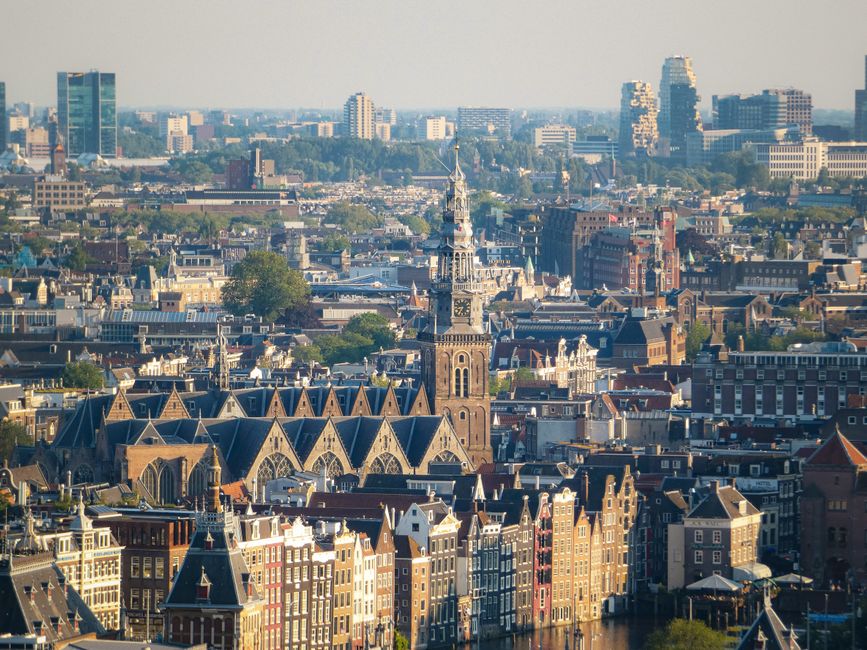
Amsterdam is a city built on water: a ring of 17th-century canals lined with tall, leaning merchants’ houses, crossed by more than 1,500 bridges and ridden by more bikes than people. You come for the Rijksmuseum’s Rembrandts and Vermeers, the Van Gogh Museum, the hiding place of Anne Frank, a boat ride along the Golden Age canals, the narrow lanes of the Jordaan, brown cafés, markets and parks, and an evening in a city that is lively, liberal and surprisingly small. It is 15 minutes by train from Schiphol airport, and almost everything is within a 30-minute walk or a short tram ride. Give it three days for the highlights, or four to five to add day trips to windmills, tulips and other Dutch cities. The big museums now sell tickets by time slot, and Anne Frank House tickets go fast, so book before you travel.
Right now in Amsterdam
- Wed 14–20°C 57–68°F 3 mm Cloudy
- Thu 12–14°C 53–58°F 3 mm Showers
- Fri 10–16°C 51–61°F 14 mm Rain
Weather: MET Norway (CC BY 4.0) · Air quality: OpenAQ · Rates: ECB
Top tours in Amsterdam
See all tours for Amsterdam →
From local operators, with prices and reviews; you check availability and book on Viator, our partner. We may earn a commission at no extra cost to you. How we earn money
Amsterdam at a glance
- Best for: world-class art museums, canal walks and boat trips, cycling, history, cafés and markets, nightlife, city breaks and a first taste of the Netherlands.
- How long: 2–3 days for the museums, the canals and the Jordaan; 4–5 days to add Zaanse Schans, Haarlem, the tulip fields or Rotterdam.
- Best time: April and May for tulips and King’s Day; June to September for long evenings by the canals; December for lights and fewer crowds.
- Getting in: NS trains from Schiphol to Amsterdam Centraal take about 15 minutes; as of October 2026 a second-class single cost about €5.50, paid by tapping a contactless card at the gates.
- Getting around: on foot, by tram or by bike. A GVB one-hour ticket cost €3.40 and a 24-hour ticket €10 in 2026.
- Book ahead: the Anne Frank House (online only, released six weeks ahead), the Van Gogh Museum (online only) and the Rijksmuseum (time slot required).
- Before you go: entry rules, money and general safety are in our Netherlands travel guide.
Amsterdam’s neighbourhoods and who each one suits
The historic centre fans out in half-rings from Amsterdam Centraal station on the IJ waterfront. The medieval core is closest to the station; around it run the three great canals of the Canal Ring (Herengracht, Keizersgracht and Prinsengracht), a UNESCO World Heritage Site since 2010; beyond them lie the 19th-century districts, the museums and the parks.
The Canal Ring (Grachtengordel)
The postcard Amsterdam: gabled canal houses, houseboats and bridges strung with lights, with the “Nine Streets” (De 9 Straatjes) of small shops and cafés crossing the canals between them. The Anne Frank House sits on the Prinsengracht at the western edge. Best for: first visits, romantic stays and walking everywhere.
The old centre, Dam Square and De Wallen
Between Centraal station and the Canal Ring are Dam Square with the Royal Palace and the Nieuwe Kerk, the shopping streets Kalverstraat and Nieuwendijk, the peaceful courtyard of the Begijnhof, and De Wallen, the oldest part of the city around the Oude Kerk, which includes the red-light district, and Nieuwmarkt with its medieval weigh house and Chinatown. Best for: sights on your doorstep, but it is the busiest and noisiest part of town at night.
The Jordaan
West of the Prinsengracht, this former working-class district of narrow streets, small canals, hidden courtyard almshouses (hofjes), galleries and brown cafés is one of the most charming places to wander. The Noordermarkt holds a farmers’ market on Saturdays. Best for: local atmosphere, cafés and a quieter base close to the centre.
Museumplein and the Vondelpark
The Museum Quarter (Museumkwartier) groups the Rijksmuseum, the Van Gogh Museum, the Stedelijk modern art museum and the Concertgebouw around one big lawn, with the Vondelpark, the city’s favourite park, next door. Best for: art lovers, families and elegant, slightly calmer hotels.
De Pijp
South of the canals, De Pijp is a lively, multicultural neighbourhood of cafés, restaurants and terraces around the Albert Cuyp Market, the city’s biggest street market (Monday to Saturday). Best for: food lovers, younger travellers and good-value stays.
Plantage, Oost and the Eastern Docklands
The leafy Plantage quarter has the Artis zoo, the botanical garden (Hortus Botanicus) and the National Holocaust Museum in the old Jewish Quarter; further east, the old docks have been rebuilt with bold modern housing, and NEMO science museum stands like a ship’s bow over the water. Best for: families, design fans and quieter stays.
Amsterdam-Noord
A free ferry ride across the IJ from behind Centraal station takes you to the city’s creative side: the EYE film museum, the A’DAM Lookout tower with its rooftop swing, and the former shipyard of NDSM, now full of street art, studios and waterside bars. Best for: repeat visitors, nightlife and modern hotels.
Top things to see in Amsterdam
Prices and hours below were checked on the official sites in October 2026. They change, so check before you go. Anyone under 18 enters the Rijksmuseum and the Van Gogh Museum free, but still needs a timed ticket.
Rijksmuseum
The national museum of the Netherlands tells 800 years of Dutch art and history, and its Gallery of Honour leads to Rembrandt’s The Night Watch, with Vermeer’s The Milkmaid, Frans Hals and Jan Steen close by. Do not miss the dolls’ houses, the ship models and the library. As of October 2026, an adult ticket cost €25, and under-18s went free. The museum opens daily 9:00–17:00, and everyone must book a start time, including Museumkaart holders; tickets at the door are sold only if slots remain, so book online. Go at opening time or late afternoon for the calmest rooms. You can walk or cycle through the tunnel under the building even without a ticket.
Van Gogh Museum
The world’s largest collection of Vincent van Gogh’s work follows his short career from dark Dutch peasant scenes to the sunflowers, almond blossom and wheat fields of his last years in France, with letters and works by his friends. As of October 2026, adults paid €25 and students €16, and under-18s went free. Tickets are sold online only, with a start time; there is no ticket desk at the museum. In October 2026 it opened from 9:00 to 18:00 most days, with Friday openings until 21:00; from November hours were 9:00 to 17:00, still with late Fridays. Book a week or more ahead in spring, summer and school holidays.
Anne Frank House
In the rear annexe of this canal house on the Prinsengracht, Anne Frank, her family and four others hid from the Nazis for more than two years, until they were betrayed in 1944. You climb behind the moveable bookcase into the bare rooms where Anne wrote her diary; the original diary is on display. It is a moving, quiet visit of about an hour.
Tickets. As of October 2026, tickets cost €16.50 for adults, €7 for ages 10–17 and €1 for children under 10, including a €1 booking fee. They are sold only online on the museum’s own site, never at the door, and every Tuesday at 10:00 (Amsterdam time) all tickets are released for the week six weeks later. They are tied to a date and time and cannot be changed or refunded. You can add a 30-minute introductory programme in English. The museum opens daily 9:00–22:00, with exceptions on some holidays (it closed for Yom Kippur in 2026). It recommends a minimum age of 10. Avoid resellers offering “Anne Frank” tours: these do not include entry to the house.
The canals and a canal cruise
The best way to understand Amsterdam is from the water. Classic glass-roofed boats leave from Centraal station, the Damrak, the Rijksmuseum and the Prinsengracht for one-hour tours; smaller open boats go into narrower canals, and evening cruises show the bridges lit up. Since 1 January 2025, all passenger boats on Amsterdam’s inner waters must be emission-free, so tour boats are now electric and almost silent. See our boat trips guide.
Renting your own boat. Small electric boats can be hired without a licence for groups of friends. The person steering must stay sober (the legal limit is the same as for driving), amplified music is not allowed, you must keep to the slow speed limit on the city canals (about walking pace), and fines for nuisance are high. On King’s Day extra rules apply to boats, including a maximum number of people on board and one-way routes on some canals.
Royal Palace, Dam Square and the Begijnhof
The Royal Palace on Dam Square was built as the city hall in the Golden Age; its marble Citizens’ Hall shows the world at Amsterdam’s feet. It is still used by the King for state occasions, so it closes on some days. Next door, the Nieuwe Kerk hosts exhibitions. A few minutes south, a small door off the Spui leads to the Begijnhof, a hidden courtyard of almshouses around a garden, with the city’s oldest surviving wooden house; please keep your voice down, people live there.
More museums worth your time
The Stedelijk Museum for modern art and design; the Rembrandt House, where the painter lived and worked; Our Lord in the Attic (Ons’ Lieve Heer op Solder), a secret Catholic church hidden in the roof of a canal house; the National Maritime Museum with its replica East India ship; the Jewish Cultural Quarter and the National Holocaust Museum; NEMO science museum for children; and the Hermitage building on the Amstel, now the H’ART Museum.
Museums
- Anne Frank House
- Rijksmuseum
- Van Gogh Museum
Churches and cathedrals
- Westerkerk
Palaces
- Royal Palace of Amsterdam
Historic centres
- Canal Ring (Grachtengordel)
Zoos and aquariums
- Artis Zoo (Natura Artis Magistra)
The red-light district: rules for visitors
De Wallen, around the Oude Kerk, is one of the oldest parts of Amsterdam and also its best-known red-light district. It is a residential neighbourhood and a workplace, and the city has tightened the rules to cut nuisance. As of October 2026, the official I amsterdam visitor site sets out:
- No guided tours past the windows: official guided tours of the red-light district are not permitted. Walk through on your own, respectfully.
- No photos or videos of sex workers or the windows.
- No smoking cannabis in the street in the red-light district, Nieuwmarkt and around Dam Square, a ban in force since 2023, with a €100 fine.
- No drinking in public: alcohol is for licensed bars and cafés.
- Earlier closing: at weekends, bars in the area close at 2:00, and no new guests are let in during the last hour.
- Fines: €150 for noise, littering or public urination, and €100 for public drunkenness.
By day, the area’s canals, the Oude Kerk and Our Lord in the Attic are worth seeing in their own right. The Red Light Secrets museum explains sex work from the inside.
Cycling in Amsterdam: rules and bike theft
Cycling is how Amsterdam gets around, and renting a bike for a day is a joy once you are used to the traffic. Bike lanes are busy and fast, locals ride with confidence, and trams have right of way. A few rules keep you safe and fine-free:
- Ride on the right in the red bike lanes, signal turns with your arm, and stop at red lights; police do fine cyclists.
- No phone in your hand: holding a phone or other device while cycling has been illegal in the Netherlands since 2019, with fines well over €100. A phone in a handlebar mount is allowed.
- Lights after dark are compulsory, front and back.
- Not on pavements or shopping streets: busy pedestrian streets such as the Kalverstraat are off-limits to bikes; walk your bike there.
- Watch the tram rails: cross them at a right angle so your wheel does not get stuck.
- Park legally: use racks or the big underground bike garages, such as the one under the water at Centraal station; bikes left in the wrong place are removed.
Bike theft is a fact of life: tens of thousands of bikes are stolen in Amsterdam each year. Rental bikes come with two locks; always lock the frame to a fixed rack with the chain lock, not just the wheel lock, and never leave a bike unlocked “just for a minute”. Never buy a cheap bike offered on the street: it is almost certainly stolen, and buying it is an offence. For routes beyond the city, see our cycling guide.
Other things to do in Amsterdam
Markets, cafés and food
Eat raw herring with onions from a fish stall, warm stroopwafels at the Albert Cuyp Market, Dutch apple pie with cream at a canal-side café, and bitterballen (crispy meat croquettes) with a beer in a bruin café, a traditional wood-panelled brown café. Indonesian rijsttafel, a feast of small dishes, is a legacy of the colonial era. The Foodhallen in a former tram depot gathers street food under one roof.
Parks and views
The Vondelpark is perfect for a picnic and people-watching on summer evenings. For views, ride up the A’DAM Lookout in Noord, climb the Westertoren church tower near the Anne Frank House in summer, or take the free roof terrace of NEMO or the public library (OBA) near Centraal station.
Coffeeshops
Amsterdam’s coffeeshops sell cannabis to adults aged 18 and over with ID, and, unlike in some Dutch border cities, tourists may buy there. Smoke inside the coffeeshop or in private, not in the street in the centre; most bars and clubs do not allow cannabis. Never buy from street dealers. National rules are explained in our Netherlands guide.
King’s Day and festivals
On King’s Day, 27 April (a Tuesday in 2027), the whole city turns orange: a citywide flea market, street parties and music, and canals packed with boats. Hotels fill up and prices jump. Amsterdam Pride in early August, the Grachtenfestival classical music festival in summer and the Amsterdam Light Festival in winter are other highlights.
Activities and best months
- Boat tripsI amsterdam calls a canal cruise the best introduction to the city: the 17th-century canal ring is a UNESCO World Heritage Site, the 100 Highlights tour passes about 100 sights in under an hour (audio guide in 19 languages), and the main docks are at Centraal Station, Leidseplein and Museumplein. Mornings are quieter; evening cruises show the bridges lit up; book early in tulip season, summer weekends and during the Amsterdam Light Festival. · source
- City sightseeingI amsterdam names the Rijksmuseum, the Anne Frank House and the Van Gogh Museum as the city's world-famous museums, with the Stedelijk and the Concertgebouw also in the Museum Quarter. Book ahead: the Anne Frank House admits only with a timeslot booked online (sales open six weeks ahead), the Van Gogh Museum also works with timeslots, and neither is in the I amsterdam City Card. · source
- CyclingAmsterdam has up to 400 km of bicycle paths; bikes can be rented all over the city, especially around Centraal Station and Leidseplein, for about €10 a day. Use lights after dark (required by law), signal before turning, cross tram rails at a sharp angle and avoid the 08:00-09:00 and 17:00-18:00 rush. · source
Day trips from Amsterdam
The Netherlands is small, so the train puts most of the country within a day. Zaanse Schans, a village of working windmills and green wooden houses, is about 20 minutes away by train (to Zaandijk Zaanse Schans). Haarlem, 15 minutes by train, has a grand market square and the Frans Hals Museum. In spring, the bulb fields and Keukenhof are under an hour away. Utrecht, with its sunken canal wharves, is under 30 minutes by train; The Hague and the beach at Scheveningen about 50 minutes; and Rotterdam, with its modern architecture and the windmills of Kinderdijk, around 40 minutes by the fastest train. The fishing villages of Volendam and Marken and the old town of Edam are a short bus ride north.
Nearby destinations
Getting there and getting around
From Schiphol airport
Schiphol’s railway station is directly under the arrivals hall (Schiphol Plaza). NS trains run to Amsterdam Centraal every few minutes in the day and about every hour through the night, taking around 15 minutes. As of October 2026, a second-class single to Centraal cost €5.50. The easiest way to pay is to tap your contactless bank card or phone at the gates (OVpay) when you enter and tap the same card again when you leave at Centraal; no ticket or registration is needed, and you are charged the standard second-class fare. You can also buy a ticket from the yellow-and-blue machines or the NS app. Some trains go to Amsterdam Zuid (handy for the Museum Quarter) or Amsterdam RAI instead. Bus 397 runs from Schiphol to the Museumplein and Leidseplein, and taxis wait outside; use the official taxi rank.
By train from Europe
Eurostar trains link Amsterdam Centraal with Brussels, Paris and London, and ICE trains run to Cologne and Frankfurt. Night trains connect Amsterdam with Vienna, Berlin and Prague.
Trams, metro and buses (GVB)
GVB runs the trams, metro, buses and the free ferries across the IJ. No cash is accepted on board. As of October 2026 you could:
- Tap a contactless card (OVpay): check in and out with the same bank card or phone. In 2026 the fare was a €1.16 base fare plus €0.217 per kilometre, and GVB caps a day’s travel on its network at a fixed maximum (€10.50 in 2026) if you use the same card all day.
- Buy a GVB ticket: one hour €3.40, a day (24 hours) €10, and multi-day tickets for 48 hours (€16), 72 hours (€21.50) and up to 7 days (€43), sold in the GVB app and at machines. The old 1.5-hour BTM ticket was withdrawn on 1 January 2026.
- Amsterdam Travel Ticket: €20 for one day, €27 for two and €34 for three, including GVB travel and the train between Schiphol and the city.
Always check out when you leave a tram or bus, or you will be charged a higher fare. The I amsterdam City Card adds free public transport to entry at many museums and a canal cruise, but does not include the Anne Frank House; work out whether you will use it enough.
On foot, by bike and by car
The centre is compact and best seen on foot or by bike; rental shops are everywhere. Do not drive in: streets are narrow, parking in the centre is among the most expensive in Europe, and much of it is for permit holders. Use a Park + Ride (P+R) car park on the edge of the city and take public transport in.
Tourist tax and cruise passengers
Amsterdam has one of the highest tourist taxes in Europe. In 2026 it is 12.5% of the price of your room, excluding VAT, the same as in 2024 and 2025. At the same time, VAT on hotel stays in the Netherlands rose from 9% to 21% on 1 January 2026, so overnight stays have become noticeably more expensive. Hotels and holiday rentals usually add the tax to your bill; check whether a quoted price includes it.
A rise is planned. The city’s coalition agreement of June 2026 and its 2027 budget, presented in September 2026, propose raising the rate to 16% from 2027, then by one point a year to 20% in 2031. As of October 2026 this still needed the city council’s approval, so check the rate for stays from January 2027.
Day-tripper tax for cruise passengers. Passengers on sea and river cruises that stop in Amsterdam without staying overnight pay a day tourist tax, €15 per passenger per day in 2026 (up from €14.50), charged to the cruise line and usually built into your fare. Since 2026, the city has also limited sea cruise calls at its central terminal to about 100 ships a year and plans to move the terminal out of the centre by 2035.
When to go and how long to stay
Amsterdam has a mild, damp sea climate: cool summers, chilly but rarely freezing winters, and rain in every month, often in short showers. The table uses the WMO 1991–2020 normals for Amsterdam Schiphol Airport, about 12 km south-west of the centre.
| Season | Average high / low | Rainy days per month | What it’s like |
|---|---|---|---|
| Spring (Mar–May) | 10–18 °C / 3–9 °C | 9–10 | Tulip season, King’s Day on 27 April, the sunniest months of the year in May; busy at Easter |
| Summer (Jun–Aug) | 20–22 °C / 11–13 °C | 10–12 | Long light evenings, canal-side terraces and festivals; the busiest and priciest months |
| Autumn (Sep–Nov) | 19 °C falling to 10 °C / 11 °C falling to 5 °C | 11–13 | Mild September, then wind and rain; the wettest season, good for museums |
| Winter (Dec–Feb) | 6–7 °C / about 1–2 °C | 11–14 | Short days, Christmas lights, the Light Festival, rare frosts and the cheapest hotels |
Schiphol records about 850 mm of rain a year on about 133 days; April is the driest month and August, October and November the wettest. Sunshine peaks in May (about 230 hours) and drops to under 60 hours in December. April to June and September are the best all-round months; bring a rain jacket whenever you go.
Amsterdam in 1 day
Start at the Rijksmuseum at 9:00, walk through the Vondelpark, then across the Canal Ring and the Nine Streets to the Anne Frank House for a booked slot. Late afternoon: a canal cruise from the Prinsengracht or Centraal. Evening: dinner in the Jordaan and a drink in a brown café.
Amsterdam in 3 days
Add the Van Gogh Museum, Dam Square, the Royal Palace and the Begijnhof, the Albert Cuyp Market and De Pijp, a bike ride through the Vondelpark and along the Amstel, the free ferry to Noord for the A’DAM Lookout, and a half-day trip to Zaanse Schans or Haarlem.
Weather month by month
Averages from KNMI normals 1991–2020, Amsterdam Schiphol (airport) · Last reviewed 4 Oct 2026
Where to stay in Amsterdam
- Canal Ring and Nine Streets: canal-house hotels in the most beautiful part of the city, walking distance from everything; steep stairs and small rooms are common.
- Jordaan: boutique hotels and apartments in a characterful, quieter area.
- Museum Quarter: elegant hotels near the museums and the Vondelpark, a short tram ride from the centre.
- De Pijp and Oost: better value, good restaurants, and quick trams and metro into the centre.
- Noord and the IJ waterfront: modern hotels with views, a free ferry from Centraal.
Hotels in Amsterdam are expensive, especially from April to September and around King’s Day, so book early. Staying in Haarlem, Utrecht or near a station outside the centre can save money; trains run late.
Practical tips for Amsterdam
- Book the big three early: set a reminder for the Tuesday 10:00 Anne Frank House release six weeks ahead, and book the Van Gogh Museum and Rijksmuseum slots as soon as your dates are fixed.
- Look both ways, then look for bikes: the red lanes are bike lanes, not pavements. Step back when you hear a bell.
- Pay by card: cards and phone wallets work almost everywhere, and some cafés and museums no longer take cash.
- Mind your belongings: pickpockets work around Centraal station, on trams and in the busiest streets.
- Respect the neighbours: Amsterdam is a living city; keep the noise down at night, and do not photograph people’s homes or windows up close.
- Beware fake ticket sites: buy museum tickets on the museums’ own websites.
What to pack for Amsterdam
A waterproof jacket with a hood (umbrellas and bikes do not mix), comfortable flat shoes for cobbles and bridges, warm layers for the wind off the water, a contactless card or phone wallet for transport, and a small cross-body bag that is hard to pickpocket. In winter add a hat, scarf and gloves for cycling.
What to pack
- City walking shoesLisbon and Porto are steep, with polished limestone cobbles that get slippery, so grippy soles matter.
- Day packs and anti-theft bagsA small zipped or anti-theft bag makes crowded trams and viewpoints less stressful.
- Dry bags and phone pouchesSpray soaks phones and cameras on open boats to the Algarve caves and on whale-watching trips.
- Fleeces and warm layersIt is cooler at sea than on land, especially on morning whale-watching trips.
- Rain jacketsA windproof, waterproof shell keeps you warm on open boats, where wind and spray cool you quickly.
- Reef-friendly sunscreenSun reflects off the water on cruises and cave tours.
- Travel adapters and convertersPortugal uses Type C and F sockets at 230 V, so most visitors from outside Europe need an adapter.
- Water bottles and hydration packsRiding in the Algarve and Alentejo heat needs more water than you expect.
- Water shoesKayak and small-boat trips to the Algarve grottoes land on rock and wet sand.
Amsterdam travel FAQ
How do I get Anne Frank House tickets?
Only online, on the Anne Frank House’s own website. Every Tuesday at 10:00 Amsterdam time, all tickets are released for visits six weeks later. As of October 2026 they cost €16.50 for adults, €7 for ages 10–17 and €1 for under-10s; there are no sales at the door.
Do I need to book the Rijksmuseum and the Van Gogh Museum?
Yes. Both need a ticket with a start time. The Van Gogh Museum sells tickets online only; the Rijksmuseum sells at the door only if slots remain. Adults paid €25 at each in October 2026, and under-18s go free with a timed ticket.
How much is the tourist tax in Amsterdam?
In 2026 it is 12.5% of the room price excluding VAT. The city’s 2027 budget proposes 16% from 2027, rising to 20% by 2031; as of October 2026 this awaited the council’s vote. Cruise passengers who do not stay overnight pay a day tax of €15 per person per day in 2026.
How do I get from Schiphol to Amsterdam?
By NS train from the station under Schiphol Plaza to Amsterdam Centraal, about 15 minutes, every few minutes. Tap your contactless card in and out at the gates; a second-class single cost €5.50 in October 2026.
Can I pay for trams with a bank card?
Yes. Tap in and out with the same contactless bank card or phone (OVpay). Trams do not take cash. Visitors making several trips a day may prefer a GVB day ticket (€10 in 2026) or the Amsterdam Travel Ticket, which includes Schiphol trains.
Are red-light district tours allowed?
No. Official guided tours of the red-light district are not permitted. You can walk through on your own, but photos of the windows are not allowed, and smoking cannabis in the street there carries a €100 fine.
Is it safe to cycle in Amsterdam as a tourist?
Yes, if you are a confident cyclist and follow the rules: ride on the right in bike lanes, signal, stop at red lights, use lights at night and never hold your phone. Start on quieter streets or in the Vondelpark, and lock your bike with both locks.
Can tourists go to coffeeshops in Amsterdam?
Yes, adults aged 18 and over with ID. Do not smoke cannabis in the street in the centre, where it is banned around the red-light district, Nieuwmarkt and Dam Square.
Are Amsterdam canal cruises worth it?
Yes, especially on a first visit. An hour on the water shows the Canal Ring from its best angle, and boats are now electric and quiet. Smaller open boats and evening cruises feel more special than the big glass-roofed boats.
How many days do you need in Amsterdam?
Two to three days covers the main museums, the canals and the Jordaan. Four or five let you add day trips to Zaanse Schans, Haarlem, Utrecht, The Hague or, in spring, Keukenhof.
When is the best time to visit Amsterdam?
April to June and September. April and early May bring tulips and King’s Day; June has the longest evenings; September is mild and a little calmer. Winter is cheaper and cosy, with short days.
Is Amsterdam expensive?
Hotels are, especially in spring and summer, after the 2026 VAT rise and with the 12.5% tourist tax. Food, transport and museums are in line with other Western European capitals. Staying outside the centre and booking early help.
Sources
- © OpenStreetMap contributors · ODbL · fetched 4 Oct 2026
- Wikidata · CC0 · fetched 4 Oct 2026
Sources and last review
Researched and last reviewed on 4 October 2026. Rijksmuseum, Van Gogh Museum and Anne Frank House prices, hours and booking rules: the museums’ own websites; red-light district and cannabis rules: I amsterdam, the city’s official visitor site; GVB prices: GVB; Schiphol trains and OVpay: NS; tourist tax and cruise day tax: the City of Amsterdam’s 2026 rates as reported by the Dutch hospitality association KHN and Dutch press coverage of the 2027 budget; passenger boat rules: City of Amsterdam; climate: WMO 1991–2020 climate normals for Amsterdam Schiphol Airport. Prices, timetables and rules change, so check the official links before you go. For entry rules, money and King’s Day across the country, see our Netherlands travel guide; for the next stop, our Rotterdam guide or Utrecht guide.
Plan your trip
Partner links: TravelerCenter may earn a commission if you book, at no extra cost to you.
🇳🇱 Useful Dutch phrases for Amsterdam
All 38 Dutch phrases: restaurant, hotel, emergencies, romance (printable) →