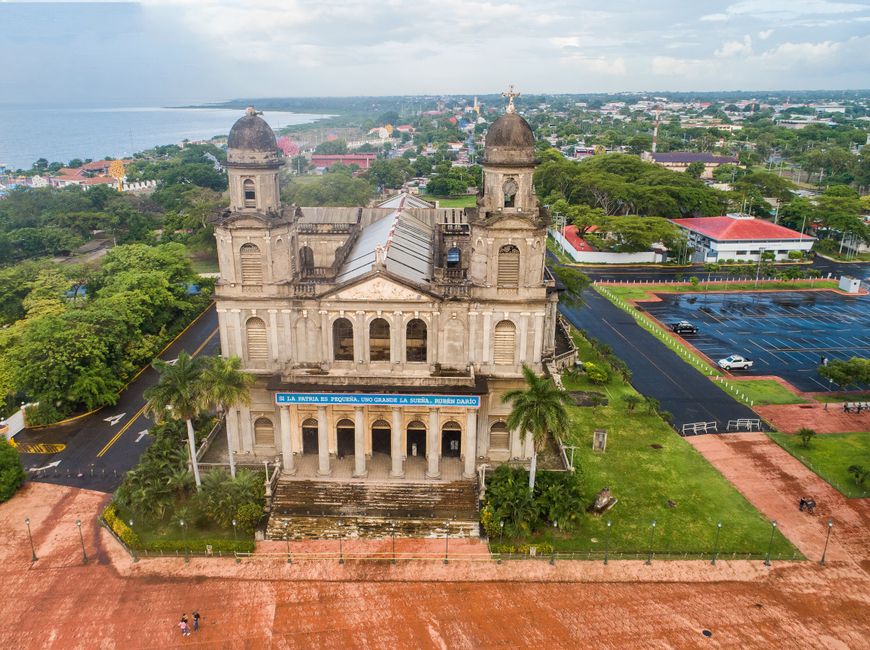
Nicaragua, the largest country in Central America, is a land of lakes and volcanoes. On its Pacific side, a chain of volcanic cones runs from the Gulf of Fonseca to Costa Rica, with Masaya, where you can look into a smoking crater, and Ometepe, an island of two volcanoes rising out of Lake Nicaragua. On the lake’s shore, Granada is one of the oldest colonial cities in the Americas, with colorful facades, churches and boat trips among hundreds of tiny islands; León, to the north, has the largest cathedral in Central America and the black slopes of Cerro Negro, where people sandboard down a young volcano. The Pacific coast has surf towns such as San Juan del Sur, with consistent offshore winds and nesting sea turtles, and the Caribbean side has the Corn Islands and a very different, English-speaking Creole culture. Prices are among the lowest in the region. Plan around the dry season, from about November to April on the Pacific side, and check the entry rules carefully before you go.
Right now in Nicaragua
- Tue 25–32°C 77–89°F 3 mm Showers
- Wed 25–31°C 76–88°F 4 mm Showers
- Thu 24–31°C 76–88°F 5 mm Showers
- Mon 12 Oct Indigenous Resistance Day
Weather: MET Norway (CC BY 4.0) · Air quality: OpenAQ · Holidays: Nager.Date
Multi-day tours of Nicaragua
Multi-day tours from local operators. You check dates and book on Viator, our partner; we may earn a commission at no extra cost to you. How we earn money
Nicaragua at a glance: lakes, volcanoes and two coasts
Nicaragua is a republic of about 7 million people, divided into 15 departments and two autonomous regions on the Caribbean coast. It borders Honduras to the north and Costa Rica to the south, between the Pacific Ocean and the Caribbean Sea. Lake Nicaragua (Cocibolca), the largest lake in Central America, and Lake Managua lie in a lowland that runs parallel to the Pacific. Spanish is the official language; English Creole, Miskito and other languages are spoken on the Caribbean coast. Managua is the capital. Nicaragua uses Central Standard Time (UTC−6) all year with no daylight saving time.
Nicaragua’s regions
- Granada, Masaya and the lakes: the colonial city of Granada, Las Isletas, Mombacho and Masaya volcanoes, the Laguna de Apoyo crater lake and the craft towns of the Pueblos Blancos.
- Ometepe and Rivas: the twin-volcano island of Ometepe in Lake Nicaragua, reached by ferry from San Jorge.
- The south Pacific coast: San Juan del Sur and the surf beaches around it, and the turtle beaches of La Flor.
- León and the north-west: León’s churches and murals, Cerro Negro and the Maribios volcanoes, and the beaches of Las Peñitas.
- The northern highlands: cool coffee country around Matagalpa, Jinotega and Estelí, with cigar factories and cloud forest.
- The Caribbean: Bluefields, Pearl Lagoon and the Corn Islands, reached mostly by air.
Where to go: Granada and San Juan del Sur
Granada
Founded in 1524, Granada lies on the north-west shore of Lake Nicaragua below Mombacho volcano. Its grid of colonial streets, painted houses with inner courtyards, churches and the pedestrian Calle La Calzada make it the most visited city in the country. Boat trips explore Las Isletas, and Masaya volcano is close by. See our Granada travel guide.
San Juan del Sur
A small town on a horseshoe bay on the south Pacific coast, about 30 km (19 miles) from the Costa Rican border, with a giant statue of Christ above the bay, surf beaches north and south, sunset sailing, and nesting turtles at the nearby La Flor refuge. See our San Juan del Sur travel guide.
More places worth the trip
- Ometepe: an island formed by the volcanoes Concepción and Maderas, with farms, petroglyphs, waterfalls and the Ojo de Agua spring, reached by ferry from San Jorge near Rivas.
- León: a lively university city with a UNESCO-listed cathedral, revolutionary murals and art museums, close to Cerro Negro and the Pacific beaches.
- Masaya Volcano National Park: one of the most accessible active volcanoes in the world, where you can drive almost to the rim of the Santiago crater.
- Laguna de Apoyo: a clear, warm crater lake for swimming and kayaking, between Granada and Masaya.
- The Corn Islands: two small Caribbean islands with white-sand beaches, reefs and lobster, reached by plane from Managua.
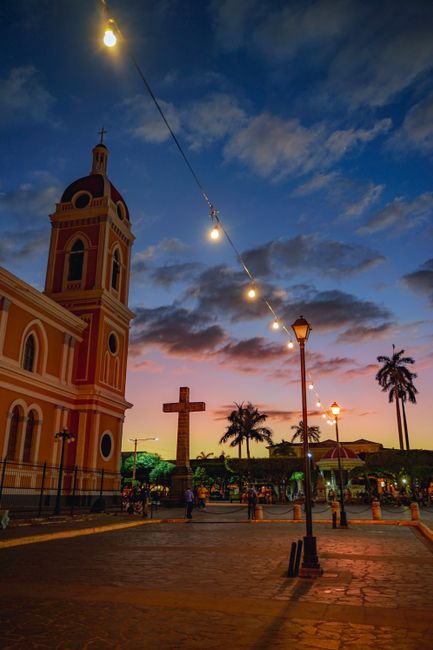
Granada, Nicaragua Travel Guide
Plan a trip to Granada in Nicaragua: the Parque Central and cathedral, La Merced's bell tower, the San Francisco Convent, Calle La Calzada, Las…
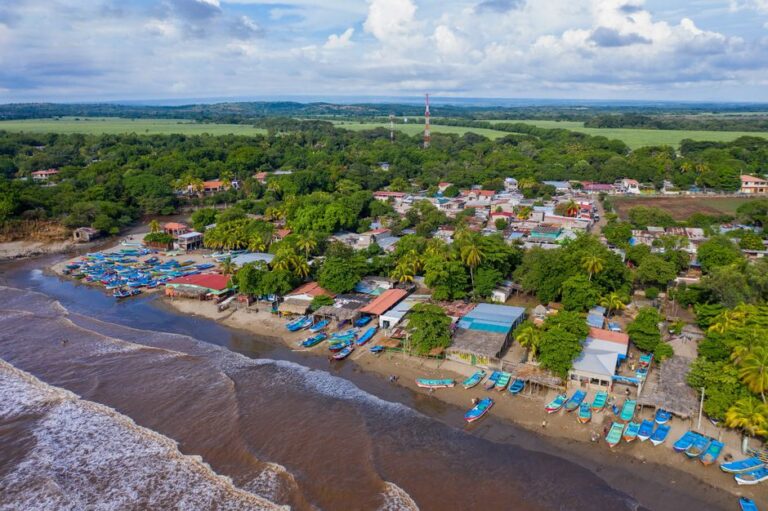
San Juan del Sur Travel Guide
Plan a trip to San Juan del Sur in Nicaragua: the town bay and the Christ of Mercy statue, Playa Maderas and the surf…
Best time to visit Nicaragua: dry and rainy seasons
The Pacific side, where most travelers go, has a dry season from about November to April, called “verano”, with sunshine and little rain; it becomes very hot and dusty in March and April, when the hills turn brown. The rainy season from about May to October, called “invierno”, brings green landscapes and afternoon or evening downpours, with a drier spell (the “canícula”) in July or August; September and October are usually the wettest months. The Caribbean coast is wet much of the year, with its driest period from about February to April. Temperatures in the lowlands are hot all year, about 30–33 °C (86–91 °F) by day; the northern highlands are cooler.
| Region | Dry season | Rainy season | Temperatures |
|---|---|---|---|
| Granada, León and the Pacific lowlands | November to April; hottest in March–April | May to October; wettest September–October | About 30–33 °C (86–91 °F) by day |
| San Juan del Sur and the south Pacific coast | November to April; windy December–March | May to October | Hot; sea about 26–29 °C (79–84 °F) |
| Northern highlands (Matagalpa, Estelí) | December to April | May to November | Mild days, cool nights |
| Caribbean coast and Corn Islands | February to April driest | Rain most of the year, heaviest June–December | Hot and humid |
Hurricanes: the eastern Pacific hurricane season runs from May 15 to November 30 and the Atlantic season from June 1 to November 30, according to NOAA’s National Hurricane Center. The Caribbean coast is the most exposed; hurricanes in recent years have caused serious damage there, while the Pacific side mainly gets heavy rain and flooding from tropical storms. Follow the Nicaraguan Institute of Territorial Studies (INETER) for weather and volcano updates, and obey evacuation orders.
Crowds, prices and events through the year
- December to April: the high season, busiest at Christmas, New Year and Holy Week, when Nicaraguans head to the beaches and San Juan del Sur fills up.
- December 7: La Gritería, the eve of the Immaculate Conception, when people go from house to house shouting “¿Quién causa tanta alegría?” and receive sweets; one of the country’s most distinctive celebrations.
- May to October: the green season, with lower prices and fewer visitors; the best months for surf on the Pacific coast.
- July to January: olive ridley turtles nest at La Flor near San Juan del Sur.
Public holidays
Banks and offices close on national holidays. The next ones, from October 2026:
| Holiday | Date | Good to know |
|---|---|---|
| Immaculate Conception | Tuesday, December 8, 2026 | La Gritería celebrations on the evening of December 7 |
| Christmas Day | Friday, December 25, 2026 | Nationwide |
| New Year’s Day | Friday, January 1, 2027 | Nationwide |
| Holy Thursday and Good Friday | March 25–26, 2027 | Peak beach travel |
| Labor Day | Saturday, May 1, 2027 | Nationwide |
| Mother’s Day | Sunday, May 30, 2027 | Nationwide |
| Anniversary of the 1979 Revolution | Monday, July 19, 2027 | National holiday |
| Battle of San Jacinto | Tuesday, September 14, 2027 | Start of the independence holidays |
| Independence Day | Wednesday, September 15, 2027 | Parades nationwide |
Cities also hold their own patron saint holidays, such as Managua in early August.
How long to stay: sample itineraries
7 days: Granada, Masaya and the coast
Three nights in Granada with Las Isletas, Masaya volcano at dusk and Laguna de Apoyo, then three nights in San Juan del Sur for beaches and surf.
10 days: lakes, volcanoes and León
Add two nights on Ometepe and two in León with a sandboarding trip on Cerro Negro.
2 weeks: Pacific and Caribbean
Add the coffee highlands of Matagalpa or Estelí, or fly from Managua to the Corn Islands for three nights. Travelers combining Nicaragua with Costa Rica usually cross at Peñas Blancas near San Juan del Sur; see our Costa Rica travel guide.
Entry, money and costs
Entry requirements (last reviewed October 2026)
Nicaragua’s immigration authority, the General Directorate of Migration and Foreign Affairs, decides who may enter and for how long. Its own website could not be reached from outside the country when we checked, so the details below come from the Canadian and UK governments, which say they obtain them from the Nicaraguan authorities:
- Visas: citizens of Canada and the UK need no visa for a tourist stay of up to 90 days, according to their governments; US and EU citizens also enter without a visa. The 90 days are not guaranteed: the officer decides your stay and writes it in your passport, according to the Canadian government.
- Passport: valid for at least six months beyond your stay.
- Onward ticket: you may be refused entry without one, according to the UK government.
- Arrival tax: US$10 in cash when you enter, according to the UK government.
- Departure tax: US$35 when you fly out, normally included in your airfare.
- Entry stamp: make sure your passport is stamped; you can be fined or delayed on departure without it.
- Yellow fever certificate: only if you arrive from a country with a risk of transmission.
Items you can’t bring: electronic cigarettes and similar devices are banned and can be confiscated at the border, and the possession and use of drones is prohibited under Law 1230 of December 2024, according to the UK and Canadian governments. Leave both at home.
Political activity: it is illegal for foreigners to take part in any political activity in Nicaragua, including protests and political meetings, and to use the national flag or its colors in campaigning or protests; foreigners who do so can be detained or deported, according to the UK government.
The CA-4 agreement
Nicaragua is part of the Central America-4 (CA-4) Border Control Agreement with Guatemala, El Salvador and Honduras. Tourists get one permitted stay of up to 90 days for the four countries combined, counted from the first CA-4 country you enter; it doesn’t restart when you cross between them, and you still pass immigration at each border. You can ask for an extension in Nicaragua before your time runs out, for a fee. If you are expelled from one CA-4 country, you can be excluded from the others too, according to the UK government.
Money: the córdoba
The currency is the córdoba (C$, NIO). The official rate on October 2, 2026, was about C$36.62 to US$1, according to the Executive Secretariat of the Central American Monetary Council (SECMCA), which publishes the central banks’ rates. US dollars are the only foreign currency freely exchangeable, and banks don’t change British pounds, according to the UK government; Canadian dollars can’t be exchanged either. Hotels, tours and many restaurants quote in dollars, and ATMs in cities and tourist towns dispense córdobas or US dollars. Credit cards are usually accepted in hotels and larger restaurants, but ATMs are scarce outside the main towns. Change money at banks or with official money changers carrying ID, often found in front of banks, rather than on the street.
Taxes and tipping
Prices carry 15% value-added tax (IVA), and hotels add a 2% tourism tax for the Nicaraguan Tourism Institute (INTUR); check whether quoted prices include them. Many restaurants add a 10% “propina” (tip) to the bill, which you can decline; otherwise tip about 10%. Tip guides and drivers for good service.
Typical travel costs
Nicaragua is one of the cheapest countries in Central America. These per-person, per-day estimates are a planning guide as of October 2026:
| Style | Estimated cost per day | What that looks like |
|---|---|---|
| Budget | about C$1,100–1,800 (US$30–50) | Hostel bed, local food (gallo pinto, fritangas), chicken buses, shared shuttles |
| Mid-range | about C$3,700–5,500 (US$100–150) | Colonial hotel or beach hotel room shared by two, restaurant meals, tours and shuttles |
| High-end | about C$11,000+ (US$300+) | Boutique hotels, beach resorts and eco-lodges, private drivers, a domestic flight |
The figures are our estimates, not official statistics.
Volcanoes: status and visiting rules (October 2026)
Nicaragua’s authorities monitor several active volcanoes, including Cerro Negro, Concepción, Momotombo, San Cristóbal, Masaya (Santiago crater) and Telica, according to the Canadian government. INETER publishes monthly volcano bulletins and live webcams.
- Masaya: inside Masaya Volcano National Park, between Managua and Granada. INETER describes the Santiago crater as currently active and measured average sulfur dioxide emissions of about 1,087 tonnes a day in May 2026. The park is open to the public every day from 8:30 a.m. to 7 p.m., according to the Ministry of the Environment and Natural Resources (MARENA), which reported 84,556 visitors in the first half of 2026. Visits to the crater viewpoint are short because of the gases; follow the rangers’ instructions.
- Concepción and Maderas (Ometepe): you must go with a local guide to climb them, according to the Canadian government. INETER lists Concepción at 1,610 m (5,282 ft), with 20 known eruptions, the most recent eruptive process starting in 2005.
- Cerro Negro: near León, a young cinder cone where tours hike up and sandboard down; go with a licensed operator.
- Mombacho: a dormant volcano next to Granada with cloud-forest trails in a nature reserve.
Eruptions can happen at any time, and ash may disrupt flights. Don’t hike volcanoes without an experienced guide, according to the UK government, and follow local authorities.
Getting there and getting around
Arrival airport
Augusto C. Sandino International (MGA) in Managua is the main gateway, with flights from US hubs such as Miami and Houston and from other Central American capitals. Granada is about 45 minutes to an hour away by road. See our United States travel guide if you are connecting there. Some travelers fly into Liberia or San José in Costa Rica and cross by land.
Land borders
- Peñas Blancas (Costa Rica): the main crossing, on the Pan-American Highway about 30 km (19 miles) from San Juan del Sur and 1.5 hours from Granada. International buses and shuttles cross here.
- El Guasaule and Las Manos (Honduras): crossings toward Tegucigalpa and the north.
Cross in daylight, keep your arrival tax in US dollars cash, and get your passport stamped.
Ferries and boats
Ferries and smaller boats cross Lake Nicaragua from San Jorge, near Rivas, to Moyogalpa on Ometepe in about an hour, several times a day. Boat tours of Las Isletas leave from Granada’s lakeshore. On the Caribbean side, boats link Bluefields, Pearl Lagoon and the Corn Islands. Some boat operators don’t carry recognized insurance, according to the UK government, so check before you travel and wear a life jacket.
Domestic flights
Small planes fly from Managua to the Corn Islands, Bluefields and other Caribbean towns, the only practical way to reach the Caribbean coast for most visitors.
Buses, shuttles and driving
Tourist shuttles connect Granada, León, San Juan del Sur, the airport and the Costa Rican border; chicken buses and minibuses are cheap but crowded. Roads between the main Pacific cities are paved, but driving standards are low, vehicles and taxis are often in poor condition, and there is no street lighting on highways, so don’t drive at night, according to the UK government. Right-hand-drive vehicles can’t be driven or imported. In cities, use radio-dispatched taxis or authorized taxis with red license plates, with the driver’s ID displayed, and don’t share taxis with strangers.
Culture, food and everyday etiquette
Nicaraguan culture blends Spanish colonial and Indigenous heritage on the Pacific side with Afro-Caribbean, Creole and Miskito traditions on the Caribbean. Poetry is a national passion, led by Rubén Darío, the father of Spanish-language modernism, born near León. Food to try: gallo pinto (rice and beans) at breakfast, vigorón (yuca, pork crackling and cabbage salad on a banana leaf), nacatamales on weekends, quesillo (tortilla with cheese and pickled onion), indio viejo, and on the Caribbean, rondón, a coconut seafood stew. Flor de Caña rum and coffee from Matagalpa and Jinotega are national prides.
Etiquette: greet people with “buenos días”, dress neatly in cities and churches, and ask before photographing people. Possession of even small quantities of drugs can lead to prison. Carry a copy of your passport and entry stamp.
Safety, health, accessibility and connectivity
Safety
Most visits to the main tourist areas are trouble-free, but there are risks to know about. According to the UK and Canadian governments:
- Crime: violent crime has affected foreigners. Take care in markets, bus stations and poorer areas of towns, and around the old cathedral in Managua; don’t walk there after dark. Don’t resist if robbed.
- Taxis: “express kidnappings” have happened in unauthorized taxis; use radio-dispatched or red-plated authorized taxis, and avoid colectivo minibuses and taxis called for you by strangers.
- Money changing: change money in banks or with official money changers, not on the street.
- Demonstrations: gatherings can turn violent and disrupt travel; foreigners may not take part in political activity of any kind.
- The sea: strong currents run off parts of the Pacific coast, people have drowned, and there are no lifeguards or warning signs.
- Diving: there have been diving fatalities off the Caribbean coast, and the country’s only hyperbaric chamber is in Puerto Cabezas, about five hours by speedboat from Corn Island.
For emergencies, dial 118 for the police, 128 for medical assistance and 115 for firefighters, according to the Canadian government.
Health and insurance
Public hospitals outside Managua are poorly equipped, and private hospitals often want payment up front in cash, according to the UK government, so buy travel insurance that covers medical treatment and evacuation. Dengue, Zika, chikungunya and malaria occur; use repellent and see a travel clinic. Drink bottled or filtered water.
Accessibility
Colonial streets have high curbs and narrow sidewalks, boats rarely have ramps, and many hotels are in old houses with steps. Some newer hotels in Managua and Granada have accessible rooms; ask in advance.
Connectivity and power
Mobile coverage from Claro and Tigo is good in cities and along the Pacific, weaker in the mountains and on the Caribbean coast. Nicaragua uses 120 V and US-style plugs, so visitors from the United States and Canada need no adapter.
Things to do: volcanoes, surfing, lakes and colonial cities
- Hiking: Concepción and Maderas on Ometepe with a guide, Mombacho’s cloud forest, and Cerro Negro near León.
- Surfing: the beaches north and south of San Juan del Sur and at Popoyo, with offshore winds much of the year.
- Boat trips: Las Isletas from Granada, the ferry to Ometepe, and sunset sails from San Juan del Sur.
- Beaches: the Pacific bays around San Juan del Sur and the white sand of the Corn Islands.
- City sightseeing: Granada’s colonial center and churches, León’s cathedral and murals.
- Snorkeling: the reefs around Little Corn Island.
What to pack
Pack light, breathable clothes for the heat, a light rain jacket from May to October, a fleece for the highlands and early volcano hikes, sturdy shoes for volcano trails, swimwear, a hat and strong sunscreen, insect repellent, a headlamp, a dry bag for boats, and US dollars in small notes, including US$10 for the arrival tax. Leave e-cigarettes and drones at home. Plugs are the same as in the US.
Nicaragua travel FAQ
When is the best time to visit Nicaragua?
November to April, the dry season on the Pacific side. May to October is greener and quieter, with afternoon rain, and is good for surfing.
Do I need a visa for Nicaragua?
US, Canadian, UK and EU citizens don’t need a visa for up to 90 days, which count toward the shared CA-4 limit. Immigration decides the length of your stay, and you may need an onward ticket.
How much is the entry fee for Nicaragua?
US$10 in cash on arrival, according to the UK government. A US$35 departure tax is normally included in your airfare.
Can I bring a drone or an e-cigarette to Nicaragua?
No. Both are banned, and e-cigarettes can be confiscated at the border.
What currency does Nicaragua use?
The córdoba, at about C$36.62 to US$1 in October 2026. US dollars are widely used for hotels and tours.
Can I visit the Masaya volcano?
Yes. Masaya Volcano National Park is open daily from 8:30 a.m. to 7 p.m., according to MARENA, and you can drive close to the active Santiago crater.
How do I get to Ometepe?
By ferry or boat from San Jorge, near Rivas, to Moyogalpa, about an hour across Lake Nicaragua.
Is Nicaragua part of the CA-4 agreement?
Yes, with Guatemala, El Salvador and Honduras: one 90-day stay covers all four countries combined.
When is hurricane season in Nicaragua?
May 15 to November 30 on the Pacific and June 1 to November 30 on the Caribbean side, which is the more exposed coast.
Can I drink the tap water in Nicaragua?
It’s safest to drink bottled or filtered water.
Is Nicaragua safe for tourists?
Most visits to Granada, León, Ometepe and San Juan del Sur are trouble-free. Use authorized taxis, avoid walking in poorer areas after dark, stay away from demonstrations, and be careful in the sea.
Sources and last review
Researched and last reviewed on 4 October 2026. Masaya’s active crater, its sulfur dioxide emissions and Concepción’s height and eruption history: the Nicaraguan Institute of Territorial Studies (INETER); Masaya Volcano National Park’s hours and visitor numbers: the Ministry of the Environment and Natural Resources (MARENA); the córdoba rate: the Executive Secretariat of the Central American Monetary Council (SECMCA); hurricane seasons: NOAA’s National Hurricane Center; visa-free stays for Canadians, the officer’s discretion, the CA-4 rules, the list of active volcanoes, guides on Ometepe, drones, e-cigarettes, money and emergency numbers: the Canadian government; passport validity, the onward ticket, the US$10 arrival tax and US$35 departure tax, the drone law, political activity, crime, taxis, money changers, sea and diving safety, boats, driving and health care: the UK government. Nicaragua’s immigration authority’s website and the tourism institute’s website could not be reached when we checked. US and EU visa exemptions, population, regions, seasons and temperatures, holidays, the hotel taxes, the ferry times, airport routes, border distances, culture and daily costs come from secondary sources or general knowledge and are flagged for checking; daily costs are our estimates. Prices and rules change, so check with the airline and official sources before you travel. For other trips in the region, see our Costa Rica, Panama and Mexico travel guides.
Plan your trip
Partner links: TravelerCenter may earn a commission if you book, at no extra cost to you.
🇪🇸 Useful Spanish phrases for Nicaragua
All 38 Spanish phrases: restaurant, hotel, emergencies, romance (printable) →