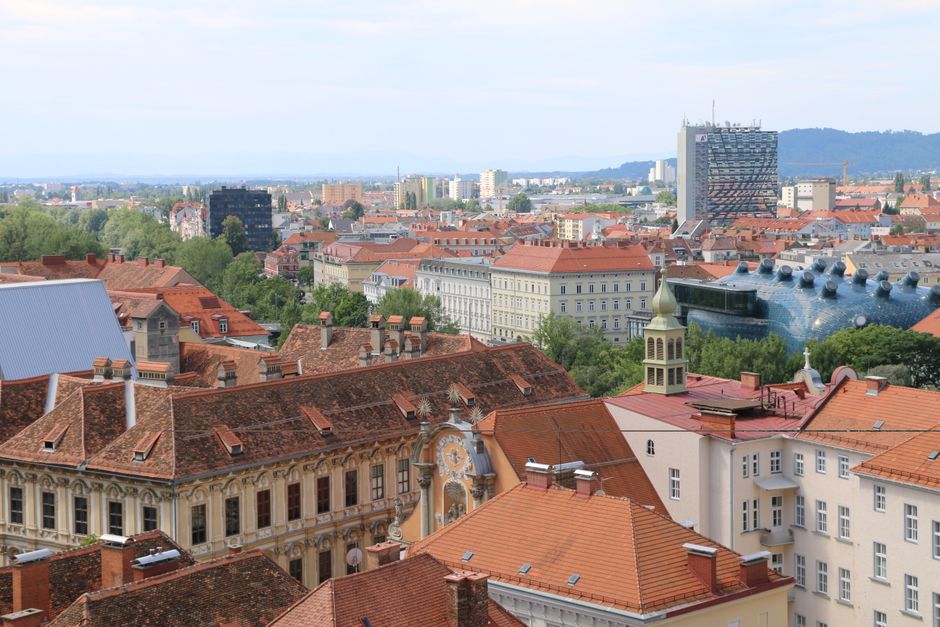
Graz, Austria’s second city and the capital of Styria, is the country’s best-kept secret: a sea of red-tiled roofs around a wooded hill, one of the best-preserved old towns in Central Europe, and a young, relaxed spirit thanks to more than 50,000 students. Its historic centre and Eggenberg Palace are a UNESCO World Heritage Site, while the bubble-shaped Kunsthaus and the floating Murinsel show its modern side. You come to climb (or slide down) the Schlossberg to the Clock Tower, wander the courtyards and lanes of the old town, see the world’s largest historic armoury and eat at farmers’ markets and wine taverns; the vineyards of southern Styria and the spas of the Thermenland are close by. Give it two days for the city, three or four with the countryside.
Right now in Graz
- Wed 7–21°C 44–70°F Clear
- Thu 10–19°C 50–65°F 4 mm Cloudy
- Fri 9–14°C 47–57°F Partly cloudy
Weather: MET Norway (CC BY 4.0) · Rates: ECB
Top tours in Graz
See all tours for Graz →
From local operators, with prices and reviews; you check availability and book on Viator, our partner. We may earn a commission at no extra cost to you. How we earn money
Graz at a glance
- Best for: Renaissance and baroque architecture, modern design, food and wine, a lively student scene and a less touristy city break.
- How long: 2 days for the old town, the Schlossberg, the Kunsthaus, the armoury and Eggenberg; 3–4 days to add the wine roads or a spa.
- Best time: May to October for terraces and wine; September and October for the harvest; late November to Christmas for the markets and the ice nativity scene.
- Getting in: trains from Vienna take about 2 hours 35 minutes; since December 2025, the new Koralm railway links Graz with Klagenfurt in about 40 minutes.
- Getting around: on foot in the centre, by tram beyond. As of October 2026, an hourly ticket costs €3.30 and also covers the Schlossberg funicular.
- Before you go: entry rules, money and driving are in our Austria travel guide.
Graz, area by area
Graz lies on the Mur river where it leaves the hills for the plains of southern Styria, at about 350 m. The old town spreads along the east bank below the Schlossberg; the west bank is livelier, more mixed and newer, with the main station about 2 km west.
The Altstadt
The UNESCO-listed old town between the Mur and the Stadtpark: the Hauptplatz with the town hall and food stalls, the Herrengasse with the Landhaus and its arcaded Renaissance courtyard, the narrow lanes of the Bermuda Triangle bar district, and the cathedral quarter. Best for: first visits and atmospheric stays.
Lend and Gries
Across the river, the former working-class districts around the Kunsthaus and Lendplatz are now the creative heart of the city, with galleries, design shops, a farmers’ market, bars and multicultural restaurants. Best for: food, nightlife and good-value boutique hotels.
St Leonhard and the university quarter
East of the Stadtpark, the university district has leafy streets, student cafés and the Kaiser-Josef-Platz farmers’ market. Best for: a local feel and quiet nights.
Top things to see in Graz
Prices and hours below were checked on the official sites in October 2026. They change, so check before you go.
The Schlossberg and the Clock Tower
The castle hill rises 123 m above the old town. Its fortress was so strong that Napoleon’s troops never took it, and they demolished it in 1809, but the people of Graz paid a ransom to save the Clock Tower (Uhrturm), the city’s symbol, whose big hand shows the hours and small hand the minutes. Today the hill is a park, with the bell tower, casemates used as an open-air stage, cafés and terraces looking out over a sea of red roofs.
There are three ways up: the 260 steps of the zigzag path from Schlossbergplatz; the glass Schlossberg lift through the rock; or the Schlossbergbahn funicular, running since 1894, every 15 minutes from Kaiser-Franz-Josef-Kai. Any Graz Linien city ticket covers the funicular: as of October 2026, an hourly ticket costs €3.30 and a 24-hour ticket €7.20. The fastest way down is the Slide (Schlossbergrutsche), the world’s tallest underground slide: 175 m long with a 64 m drop, about 40 seconds of spiralling through the rock. As of October 2026 it costs €6.50 (€10.90 with The Flight 4D cinema); riders must be at least 1.30 m tall.
The Kunsthaus and the Murinsel
Built for Graz’s year as European Capital of Culture in 2003, the Kunsthaus Graz by Peter Cook and Colin Fournier is a blue acrylic bubble with nozzle-like skylights, nicknamed the “Friendly Alien”, that lands among the old roofs of Lend. Its façade is a screen of lights at night. Inside, it shows changing exhibitions of contemporary art. As of October 2026 it opens Tuesday to Sunday 10:00–18:00 (closed on Mondays, 24 and 25 December); a 24-hour ticket costs €13 for adults. From the same year, the Murinsel, a steel-and-glass shell anchored in the river, holds a café and a small amphitheatre and works as a footbridge.
The Styrian Armoury
The Landeszeughaus on the Herrengasse, built in 1642–1647, is the largest historic armoury in the world still in its original building: about 32,000 suits of armour, helmets, swords, pikes, muskets and cannons from the 15th to the 18th centuries, ready to equip the local militia against Ottoman raids. Stacked floor to ceiling on four floors, it is an extraordinary sight. As of October 2026, it opens Tuesday to Sunday 10:00–18:00 from 1 April to 31 October; from November to 6 January it can be seen only on guided tours (in English at 12:30). Next door, step into the arcaded courtyard of the Landhaus, one of the finest Renaissance courtyards north of the Alps.
Eggenberg Palace
In the west of the city, Eggenberg is a baroque palace built in the 17th century as a symbol of the universe: 365 windows, 52 rooms on the piano nobile for the weeks of the year, 24 state rooms with painted ceilings, all set in a landscaped park with roaming peacocks. Added to the UNESCO listing in 2010, it also houses Joanneum collections of coins, archaeology and old masters. The state rooms can be seen only on guided tours, mostly from spring to autumn; check museum-joanneum.at for times. Take tram 1.
The cathedral and the Mausoleum
Graz Cathedral, a late Gothic former court church, has faded frescoes of the plague and Turkish raids on its south wall. Next to it, the Mausoleum of Emperor Ferdinand II, born in Graz, is one of the most important Mannerist buildings in Austria. Nearby, the Burg, the former imperial palace, has a remarkable Gothic double spiral staircase from 1499.
Monuments
- Clock Tower (Uhrturm)
- Eggenberg Palace
- Graz Opera
Churches and cathedrals
- Graz Cathedral
Museums
- Kunsthaus Graz
Other sights
- Murinsel
Peaks and mountains
- Schlossberg
Things to do in Graz
Eat and drink like a Styrian
Graz calls itself Austria’s culinary capital, and Styria is its larder. Try a salad with dark green Kürbiskernöl (pumpkin seed oil), Steirisches Backhendl (breaded fried chicken), Wurzelfleisch (pork with root vegetables and horseradish), and Käferbohnen, big speckled runner beans. Shop at the farmers’ markets on Kaiser-Josef-Platz and Lendplatz (Monday to Saturday mornings) and drink Styrian Sauvignon Blanc or the pale rosé Schilcher. In autumn, look for Sturm, the cloudy, half-fermented new wine. See our wine tasting guide.
Walk the courtyards and roofs
Graz is a city of hidden courtyards: duck into the passages off the Herrengasse, the Sporgasse and the Sackstrasse to find arcades, galleries and cafés. For a view of the roofscape, go up to the Schlossberg terraces at sunset, or to the rooftop café of a department store on the Hauptplatz. See our city sightseeing guide.
Festivals and culture
Graz is a UNESCO City of Design and a city of festivals. The classical music festival styriarte fills churches and courtyards in June and July; in autumn, steirischer herbst is one of Europe’s oldest festivals of contemporary art, and the Graz opera house, the second largest in Austria, opens its season. The Schlossberg casemates host open-air concerts and theatre in summer, and the Long Night of the Museums in early October opens collections until late.
Advent in Graz 2026
Graz is one of Austria’s most charming Christmas cities. The lights go on on 19 November 2026, and the Christmas markets on the Hauptplatz, Franziskanerplatz, the Mehlplatz, the Färberplatz, in front of the cathedral and on the Schlossberg open from 20 November to 24 December. The highlight is the ice nativity scene in the Landhaus courtyard, carved from about 35 tonnes of ice; in 2026, its 30th year, it can be seen free of charge from 28 November 2026 to 6 January 2027, daily 8:00–21:00. On 31 December, a light show on the Schlossberg welcomes the new year.
Activities and best months
- City sightseeingThe historic centre of Graz became a UNESCO World Heritage Site in 1999 and Eggenberg Palace joined it in 2010. Graz Tourism's one-day plan climbs the Schlossberg by the glass lift or funicular to the Clock Tower (whose large hand shows the hours), with the Landhaus courtyard, farmers' markets and the modern Kunsthaus nearby; Graz is also a UNESCO City of Design. · source
- CyclingGraz has a dense network of cycle paths and bike streets. The Mur Cycle Path, one of the best riverside routes, runs 361 km from the Hohe Tauern National Park through Graz to Bad Radkersburg and on into Slovenia and Croatia; north of the city it passes Rabenstein Castle and the Lurgrotte cave at Peggau. · source
- Wine tastingGraz is the gateway to Styria's eight wine roads in three wine regions. The South Styrian Wine Road, the oldest and best known, is about 45 minutes by car from Graz and runs 25.5 km past wineries and Buschenschänken (wine taverns serving cold platters with pumpkin seed oil); the Schilcher Wine Road in West Styria is named after the local rosé. The national tourist office notes the South Styrian route runs along the Slovenian border. · source
Day trips from Graz
South of the city, the South Styrian Wine Road winds along the Slovenian border through steep vineyards, hilltop taverns (Buschenschanken) and pumpkin fields, about an hour away by car; it is at its best in September and October. East, the Thermenland has thermal spas such as Bad Blumau, with its colourful Hundertwasser buildings, and the volcanic crag of Riegersburg Castle. West of Graz, the Piber stud farm breeds the Lipizzaner horses of Vienna’s Spanish Riding School. Since the Koralm railway opened, Klagenfurt and the Wörthersee are only about 40 minutes away by train, an easy day out for a swim in summer.
Nearby destinations
Getting to Graz
By train. Railjets from Vienna take about 2 hours 35 minutes over the spectacular Semmering railway, itself a UNESCO World Heritage Site; when the Semmering Base Tunnel opens, expected in 2030, the trip will take under two hours. The Koralm railway, opened on 14 December 2025, cut the journey from Graz to Klagenfurt from about three hours to about 40 minutes, and continues to Villach and Italy. Direct trains also run to Salzburg and Ljubljana.
By air. Graz Airport, in Feldkirchen about 10 km south, has flights to European hubs; S-Bahn trains and buses run to the city centre. Vienna Airport is about 2 hours away.
By car. Graz is on the A2 (Vienna–Klagenfurt) and A9 (Pyhrn) motorways; a vignette is needed. Park in a garage and walk; the centre has short-stay zones.
Getting around Graz
The old town is compact and best on foot. Graz Linien trams run from the main station to the Hauptplatz in about 10 minutes and on to Eggenberg and the suburbs. Prices rose on 1 July 2026: as of October 2026, an hourly ticket costs €3.30, a 24-hour ticket €7.20 and a weekly ticket €20.80, all valid on the Schlossberg funicular. Graz is flat and very bike-friendly, with paths along the Mur.
When to go and how long to stay
Graz is sheltered by the Alps to the north and west, so it is one of Austria’s sunniest and mildest cities, with warm summers, frequent summer thunderstorms and dry, cold winters, sometimes foggy. The table uses GeoSphere Austria’s 1991–2020 climate normals for the Graz University station.
| Season | Average temperature | Rain per month | Sunshine per month | What it’s like |
|---|---|---|---|---|
| Winter (Dec–Feb) | 0.6–2.7 °C | 20–40 mm | 87–129 hours | Cold, dry and sometimes foggy; Advent markets and the ice nativity scene |
| Spring (Mar–May) | 6.8 °C rising to 15.8 °C | 35–93 mm | 169–227 hours | Blossom, outdoor terraces reopening, asparagus season |
| Summer (Jun–Aug) | 19.4–21.2 °C | 121–129 mm | 238–253 hours | Warm to hot, with afternoon storms; festivals and open-air events |
| Autumn (Sep–Nov) | 16.1 °C falling to 6.0 °C | 94 falling to 54 mm | 188 falling to 89 hours | Wine harvest, pumpkins and golden vineyards |
Graz gets about 854 mm of rain and more than 2,000 hours of sunshine a year, with an average temperature of 11.1 °C. Winter is the driest season.
Graz in 2 days
Day 1: the Hauptplatz, the Landhaus courtyard and the armoury, the cathedral and Mausoleum, then up the Schlossberg for sunset and down the slide. Day 2: the Kunsthaus and the Murinsel, lunch in Lend, and the afternoon at Eggenberg Palace and its park.
Graz in 4 days
Add a day on the South Styrian Wine Road and a day at a Thermenland spa and Riegersburg Castle, or a train trip to Klagenfurt and the Wörthersee.
Weather month by month
Averages from GeoSphere Austria normals 1991–2020, Graz Airport · Last reviewed 4 Oct 2026
Where to stay in Graz
- Altstadt: historic hotels in Renaissance houses near the Hauptplatz and the Schlossberg.
- Lend: design and boutique hotels near the Kunsthaus, with the best bars and restaurants.
- Near the main station: modern hotels for train travellers, a short tram ride from the centre.
- In the wine country: farm stays and wine estates with rooms in southern Styria for a slower trip.
Practical tips for Graz
- Mondays: the Kunsthaus and the armoury are closed; plan the Schlossberg and the old town for that day.
- Use a city ticket for the funicular: no separate funicular ticket is needed.
- Book the armoury tours in winter: from November to early January it can be seen only on guided tours.
- Bring cash for the wine taverns: many Buschenschanken in the countryside take cash only.
What to pack for Graz
Comfortable shoes for the cobbles and the Schlossberg steps, a light waterproof for summer storms, sunglasses and a hat in summer, and a warm coat for winter evenings at the markets. Bring a small bag for market shopping and a bottle of pumpkin seed oil to take home (wrap it well).
What to pack
- City walking shoesLisbon and Porto are steep, with polished limestone cobbles that get slippery, so grippy soles matter.
- Day packs and anti-theft bagsA small zipped or anti-theft bag makes crowded trams and viewpoints less stressful.
- Rain jacketsFrom October to April Porto and Lisbon see rain on roughly a third of days.
- Travel adapters and convertersPortugal uses Type C and F sockets at 230 V, so most visitors from outside Europe need an adapter.
- Water bottles and hydration packsRiding in the Algarve and Alentejo heat needs more water than you expect.
- Wine bottle travel protectorsPort and Douro wines bought at the quintas travel home safely in checked luggage with padded bottle protectors.
Graz travel FAQ
Is Graz worth visiting?
Yes. It has a UNESCO-listed old town, the Schlossberg, striking modern architecture, a great food scene and far fewer tourists than Vienna or Salzburg.
How do you get up the Schlossberg?
By the 260 steps of the zigzag path, the glass lift through the rock, or the Schlossbergbahn funicular, which is covered by any Graz Linien ticket (€3.30 per hour as of October 2026).
How much is the Schlossberg slide?
As of October 2026, €6.50 per ride, or €10.90 with The Flight 4D cinema. Riders must be at least 1.30 m tall.
When is the Kunsthaus Graz open?
Tuesday to Sunday 10:00–18:00, closed on Mondays and on 24 and 25 December. A 24-hour ticket costs €13 for adults as of October 2026.
What is the UNESCO World Heritage Site in Graz?
The “City of Graz – Historic Centre and Schloss Eggenberg”: the old town was listed in 1999 and Eggenberg Palace was added in 2010.
When is the Graz ice nativity scene in 2026?
From 28 November 2026 to 6 January 2027 in the Landhaus courtyard, daily 8:00–21:00, free. The Christmas markets run from 20 November to 24 December.
How long is the train from Vienna to Graz?
About 2 hours 35 minutes by Railjet over the Semmering. Graz to Klagenfurt now takes about 40 minutes on the Koralm railway.
How many days do you need in Graz?
Two days for the city; three or four to add the southern Styrian wine roads, a spa or Klagenfurt.
When is the best time to visit Graz?
May to October for terraces, festivals and day trips to the vineyards, with September and October best for the wine harvest; or late November to Christmas for the Advent markets and the ice nativity scene.
Sources
- © OpenStreetMap contributors · ODbL · fetched 4 Oct 2026
- Wikidata · CC0 · fetched 4 Oct 2026
Sources and last review
Researched and last reviewed on 4 October 2026. Schlossbergbahn and Advent calendar: Holding Graz; the Slide and the ice nativity scene: Graz Tourismus; Kunsthaus and Styrian Armoury: Universalmuseum Joanneum; the Semmering Base Tunnel: ÖBB-Infrastruktur; climate: GeoSphere Austria 1991–2020 normals. The new transport fares, the Koralm railway journey time, population and UNESCO dates come partly from secondary sources, and Eggenberg tour times could not be checked; all are flagged. Prices, timetables and rules change, so check the official links before you go. For Austria-wide entry rules, money and transport, see our Austria travel guide.
Plan your trip
Partner links: TravelerCenter may earn a commission if you book, at no extra cost to you.
🇩🇪 Useful German phrases for Graz
All 38 German phrases: restaurant, hotel, emergencies, romance (printable) →