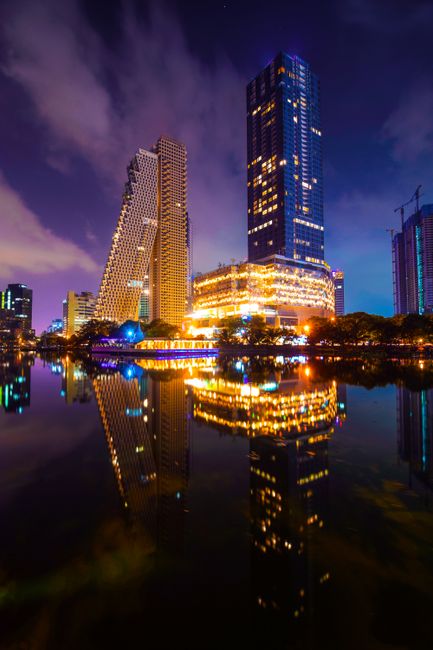
Colombo is Sri Lanka’s largest city, main port and commercial capital, a sprawling, energetic metropolis on the island’s west coast where colonial landmarks, Buddhist temples, Hindu kovils, mosques and churches stand among glass towers and crowded bazaars. Portuguese, Dutch and British traders all left their mark here, and the old Fort district, the market streets of Pettah and the grand avenues of Cinnamon Gardens still tell that story. Most visitors pass through quickly on the way from the airport to the beaches and the hill country, but a day or two rewards those who stay: the seafront promenade of Galle Face Green at sunset, the eclectic Gangaramaya Temple, the National Museum, excellent restaurants and street food, and a growing skyline crowned by the Lotus Tower and the reclaimed land of Port City. The legislative capital, Sri Jayawardenepura Kotte, lies on the city’s eastern edge, but Colombo remains the country’s real center. It is hot and humid all year; the driest months are January to March, and May and October to November are the wettest.
Right now in Colombo
- Wed25–30°C76–86°F8 mm rain
- Thu24–29°C75–85°F10 mm rain
- Fri24–27°C75–81°F6 mm rain
Top tours in Colombo
See all tours for Colombo →
From local operators, with prices and reviews; you check availability and book on Viator, our partner. We may earn a commission at no extra cost to you. How we earn money
Colombo at a glance
- Best for: colonial architecture, temples and markets, food and nightlife, shopping, and a first or last night in Sri Lanka.
- How long: 1–2 days for the main sights; many travelers spend their first or last night in Negombo, near the airport.
- Best time: December to March, when it is drier and sunny; the southwest monsoon brings heavy rain from May to September, and October and November are the wettest months.
- Getting there: Bandaranaike International Airport (CMB) is about 35 km (22 miles) north, 30–45 minutes by expressway; trains from Colombo Fort run along the coast and toward Kandy.
- Getting around: tuk-tuks, PickMe and Uber cars, buses, and walking in Fort and Pettah.
- Good to know: neighborhoods are known by postal numbers, from Colombo 1 (Fort) to Colombo 15; Colombo 3 (Kollupitiya) and Colombo 7 (Cinnamon Gardens) are the smart central districts.
- Before you go: the ETA, the free-visa list, money and general safety are in our Sri Lanka travel guide.
Colombo’s areas and where to stay
Colombo stretches for many kilometers along the coast. The historic core is in the north, around the port; the hotels, restaurants and embassies are spread along Galle Road and inland around Beira Lake and Viharamahadevi Park.
Fort and Pettah (Colombo 1 and 11)
The old Fort, the British-era business district beside the port, has the Dutch Hospital shopping and dining precinct, the clock-tower lighthouse, colonial banks and government buildings, and some of the city’s newest luxury hotels. Next door, Pettah is a maze of wholesale markets, spice shops, textile lanes and the red-and-white Jami Ul-Alfar Mosque. It is noisy and fascinating by day and quiet at night.
Galle Face and Kollupitiya (Colombo 2 and 3)
South of Fort, the long lawn of Galle Face Green faces the sea, with grand seafront hotels, the Shangri-La and the towers of Port City nearby. Inland, Kollupitiya and Slave Island hold Beira Lake and Gangaramaya Temple, plus many restaurants, cafés and bars; this is the most convenient base for most visitors.
Cinnamon Gardens (Colombo 7)
Colombo’s leafy, upscale district has wide avenues, colonial villas, the National Museum, Viharamahadevi Park, the Independence Memorial Hall, embassies and boutique hotels in converted mansions.
Bambalapitiya, Wellawatte and Mount Lavinia
Farther south along Galle Road, Bambalapitiya and Wellawatte are busy residential and shopping districts with good Tamil and South Indian food. Mount Lavinia, about 12 km (7.5 miles) from Fort, has a beach and the historic Mount Lavinia Hotel, a former governor’s residence.
Negombo
About 10 km (6 miles) from the airport and 35 km (22 miles) north of Colombo, the fishing town of Negombo has a long beach, a lagoon, Dutch-era canals and plenty of hotels, convenient for early flights.
Top things to see in Colombo
Gangaramaya Temple and Seema Malaka
Gangaramaya Temple, near Beira Lake, is one of Colombo’s most important Buddhist temples and certainly its most eclectic: a working monastery and school whose halls are crammed with Buddha statues, gifts from devotees, vintage cars, ivory, clocks and curiosities. It is the center of the Navam Perahera, a procession held around the February full moon. Nearby, on an island in Beira Lake, Seema Malaka is a serene meditation pavilion designed by the architect Geoffrey Bawa, reached by a footbridge. Remove your shoes and cover shoulders and knees.
The National Museum
In a white colonial building in Cinnamon Gardens, opened in 1877, Sri Lanka’s National Museum holds royal regalia including the throne and crown of the last Kandyan kings, Buddhist and Hindu bronzes, ancient stone carvings, masks and textiles; it is a good introduction before visiting the Cultural Triangle. The neighboring Natural History Museum shares the grounds. It is run by the Department of National Museums and closes on some public holidays.
Galle Face Green
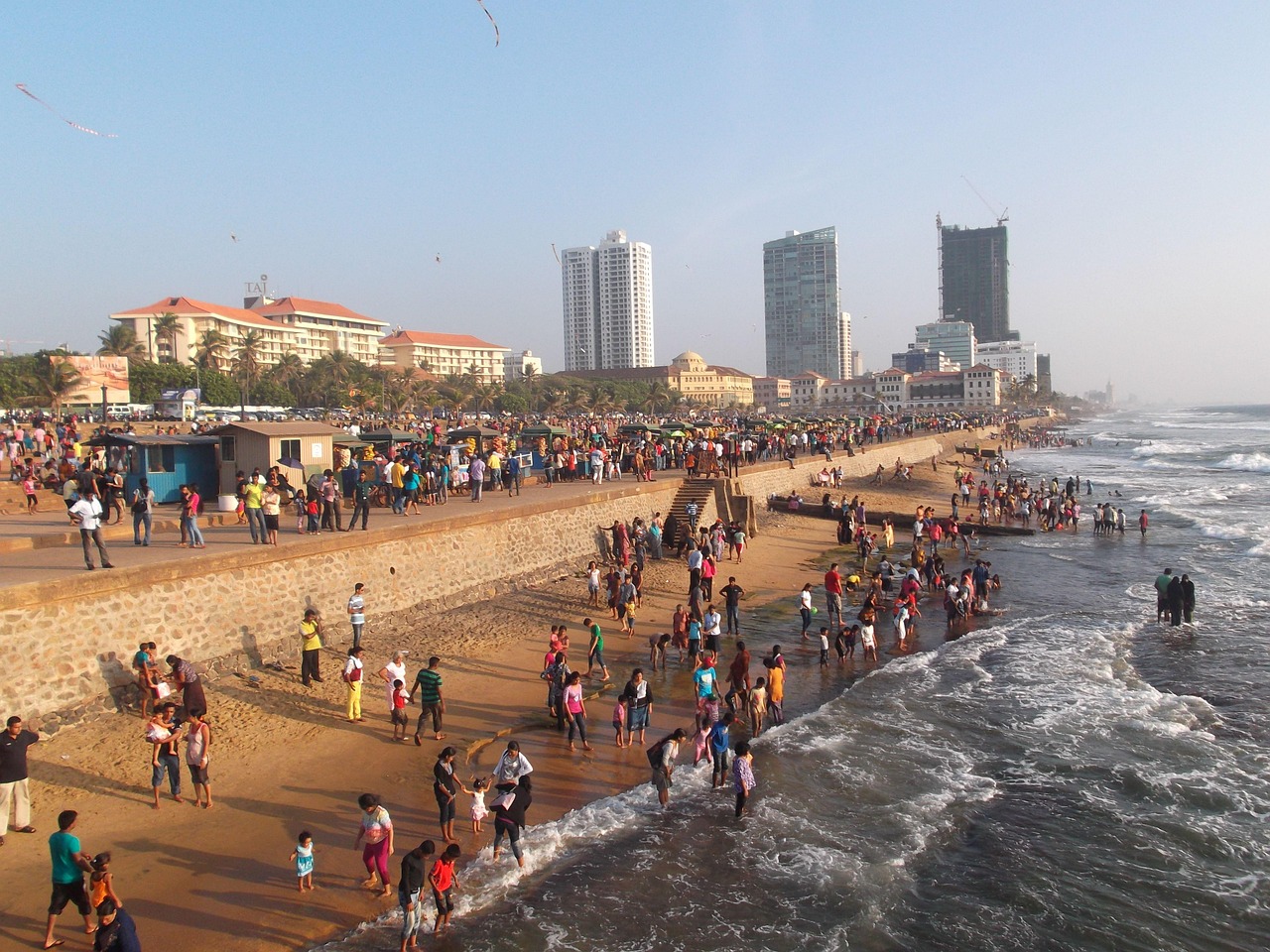
This half-kilometer-long seafront lawn, laid out by the British in the 1850s, comes alive in the late afternoon, when families fly kites and stroll, and stalls sell isso wade (prawn fritters), roasted corn and kottu as the sun sets over the Indian Ocean. The sea here is not safe for swimming. At the southern end stands the colonial Galle Face Hotel, opened in 1864.
Pettah markets and the Red Mosque
Pettah’s lanes are each devoted to a single trade: fabrics, electronics, spices, gold or hardware. The Jami Ul-Alfar Mosque, built in 1909 with candy-striped red-and-white brickwork, is the neighborhood’s landmark; visitors are welcome outside prayer times if modestly dressed. The Dutch Period Museum, in a 17th-century townhouse, and the Wolvendaal Church, built by the Dutch in 1749, are nearby.
Lotus Tower and Port City
The 350 m (1,150 ft) Colombo Lotus Tower, opened in 2022, is the tallest structure in South Asia, with an observation deck and restaurants; it is lit in changing colors at night. Along the shore next to Galle Face, Port City Colombo is a new district built on reclaimed land, with a waterfront promenade, a marina and shopping; much of it is still under development.
More classic sights
- Independence Memorial Hall: the pavilion in Cinnamon Gardens built to commemorate independence from Britain in 1948, modeled on Kandy’s royal audience hall.
- Viharamahadevi Park: the city’s largest park, with a large golden Buddha and shady paths.
- Dutch Hospital: a restored 17th-century hospital in Fort, now restaurants, cafés and shops.
- Old Parliament building and the Presidential Secretariat: colonial landmarks facing the sea.
- Sri Ponnambalawaneswaram and the Kathiresan kovils: ornate Hindu temples, the latter the focus of the Vel festival procession.
- Kelaniya Raja Maha Vihara: a revered temple about 10 km (6 miles) east, with fine murals; its Duruthu Perahera is held in January.
Other things to do in Colombo
Food and drink
Colombo is the best place in Sri Lanka to eat. Try rice and curry at a busy local restaurant at lunchtime; hoppers and string hoppers with curry for breakfast or dinner; kottu from roadside stalls in the evening; lamprais, the Dutch Burgher rice-and-curry parcel baked in a banana leaf; and crab curry, the city’s signature seafood dish. Jaffna-style Tamil restaurants in Wellawatte serve fiery crab and mutton curries, and Galle Face Green and the Dutch Hospital precinct are lively in the evening. Colombo also has the island’s widest choice of international restaurants, rooftop bars and cafés. Alcohol is not sold on poya (full-moon) days.
Shopping
Look for handloom textiles, batik, tea, spices, masks and lacquerware in the city’s design shops and government craft emporiums such as Laksala, and for bargains in Pettah’s markets. Buy gems and jewelry only from licensed dealers.
Festivals
The Navam Perahera at Gangaramaya in February and the Duruthu Perahera at Kelaniya in January bring elephants, drummers and dancers to the streets; Vesak, at the May full moon, fills the city with lanterns, illuminated pandals and stalls giving away free food. Hindu Colombo celebrates Vel in July or August and Deepavali in October or November. See our city sightseeing guide.
Day trips from Colombo
- Negombo: beach, lagoon boat trips and the fish market, about 1 hour north.
- Bentota and Beruwala: golden beaches, river safaris and Geoffrey Bawa’s Lunuganga garden, about 1.5–2 hours south by train or road. See our beaches guide.
- Galle: the Dutch fort town, about 1.5–2 hours by the Southern Expressway or 2.5–3 hours by coastal train; better with a night. See our Galle guide.
- Kandy: the Temple of the Sacred Tooth Relic, about 3–4 hours by road; in October 2026, trains from Colombo ran only as far as Peradeniya, just outside Kandy, while the last section was restored. See our Kandy guide.
- Sinharaja Forest Reserve: the UNESCO-listed rainforest, a long day trip by car or an overnight stay. See our hiking guide.
Nearby destinations
- Kandy95 km
- Nuwara Eliya100 km
- Galle107 km
- Mirissa128 km
- Ella130 km
- Sigiriya152 km
- Yala National Park186 km
Getting there and getting around
By air
Bandaranaike International Airport (CMB) at Katunayake is Sri Lanka’s main gateway, about 35 km (22 miles) north of the center. Taxis, PickMe and Uber cars take 30–45 minutes on the Colombo–Katunayake Expressway, depending on traffic; Airport Express buses run to the central bus stations, and a slow local train links Katunayake with Colombo Fort. If you arrive late or leave early, consider a night in Negombo. Before you fly, apply for your ETA on the official site, eta.gov.lk.
By train
Colombo Fort is the hub of Sri Lanka Railways. The coastal line runs south to Galle and Matara, with sea views most of the way, and the Main Line runs inland toward Kandy and the hill country. After Cyclone Ditwah, services toward the hills were restored in stages: in early October 2026, media reports citing Sri Lanka Railways said that trains from Colombo had resumed to Peradeniya and Gampola, while the Peradeniya–Kandy section was still closed for bridge repairs. Reserved seats are sold on the department’s seat-reservation website and at the station; check the current timetable before you plan.
By bus and car
Buses for every part of the country leave from the Central and Pettah bus stations, and air-conditioned expressway buses run to Galle, Matara and Kandy. Many visitors hire a car and driver in Colombo for a tour of the island.
Around the city
Tuk-tuks are the classic way to get around; use a metered one or book through PickMe or Uber, which show the price in advance. Fort and Pettah are walkable, though hot and crowded. City buses are cheap but confusing for visitors. Traffic is heavy at rush hours.
When to go and how long to stay
Colombo is hot and humid all year, with highs of 30–32 °C (86–90 °F) and warm nights. January to March is the driest and sunniest period. The southwest monsoon brings frequent heavy rain from May into September, and October and November are the wettest months of all, when inter-monsoon thunderstorms can flood streets. The table uses the 1991–2020 climate normals for the Colombo station of Sri Lanka’s Department of Meteorology, as submitted to the World Meteorological Organization (WMO): average daily highs and lows, total rain, and days with at least 1 mm of rain.
| Month | Average high / low | Rain (days with 1 mm or more) | What to expect |
|---|---|---|---|
| January | 31 °C (89 °F) / 23 °C (74 °F) | 80 mm (3.1 in), 5 days | Dry, sunny and breezy; peak season |
| February | 32 °C (89 °F) / 24 °C (74 °F) | 77 mm (3.0 in), 5 days | Dry and hot; Navam Perahera |
| March | 32 °C (90 °F) / 25 °C (77 °F) | 103 mm (4.0 in), 8 days | Hot, humid and mostly dry |
| April | 32 °C (90 °F) / 25 °C (78 °F) | 249 mm (9.8 in), 13 days | Afternoon storms; New Year holidays |
| May | 32 °C (89 °F) / 26 °C (79 °F) | 314 mm (12.3 in), 17 days | Monsoon arrives; Vesak lanterns |
| June | 31 °C (87 °F) / 26 °C (79 °F) | 197 mm (7.7 in), 15 days | Showery and windy; rough seas |
| July | 30 °C (87 °F) / 26 °C (79 °F) | 123 mm (4.8 in), 10 days | Showers with sunny spells |
| August | 30 °C (87 °F) / 26 °C (79 °F) | 116 mm (4.5 in), 10 days | Similar to July |
| September | 30 °C (87 °F) / 25 °C (78 °F) | 264 mm (10.4 in), 15 days | Rain increasing |
| October | 30 °C (87 °F) / 25 °C (76 °F) | 359 mm (14.1 in), 19 days | The wettest month; flooding possible |
| November | 31 °C (87 °F) / 24 °C (75 °F) | 346 mm (13.6 in), 16 days | Very wet; cyclone risk |
| December | 31 °C (88 °F) / 24 °C (74 °F) | 171 mm (6.7 in), 9 days | Drying out; festive season |
Colombo gets about 2,400 mm (94 in) of rain a year, more than twice as much as London or Seattle.
One day in Colombo
Start in Fort and Pettah in the cool of the morning, with the Dutch Hospital, the Red Mosque and the markets; lunch on rice and curry; visit Gangaramaya Temple and Seema Malaka in the afternoon; and end at Galle Face Green for the sunset and street food.
Two days
Add the National Museum, Cinnamon Gardens and Independence Memorial Hall, the Lotus Tower at dusk, and a crab curry dinner; or take a day trip to Kelaniya and Negombo.
Where to stay in Colombo
- Fort and Galle Face: seafront and luxury hotels, close to the sights and the station.
- Kollupitiya (Colombo 3): mid-range hotels and guesthouses, restaurants and nightlife.
- Cinnamon Gardens (Colombo 7): boutique hotels in colonial villas, quiet and leafy.
- Mount Lavinia: beach hotels about 30 minutes south of the center.
- Negombo: beach hotels and guesthouses near the airport, for the first or last night.
Rooms are busiest from December to March and around major events.
What a trip to Colombo costs
Prices are approximate, for October 2026, converted at about 330 rupees to the US dollar.
| Item | Typical cost |
|---|---|
| Rice and curry at a local restaurant | 600–1,200 LKR (about US$1.80–3.60) |
| Kottu or isso wade at a street stall | 500–1,200 LKR (about US$1.50–3.60) |
| Crab curry dinner in a well-known restaurant | 10,000–25,000 LKR (about US$30–75) per person |
| Tuk-tuk ride across the center | 400–1,200 LKR (about US$1.20–3.60) |
| PickMe or Uber car from the airport | 6,000–9,000 LKR (about US$18–27) |
| Gangaramaya Temple or museum entry | 500–2,000 LKR (about US$1.50–6) |
| Lotus Tower observation deck, foreign visitor | about 6,600 LKR (about US$20) |
| Mid-range hotel double, per night | 18,000–40,000 LKR (about US$55–120) |
Practical tips for Colombo
- Apply for your ETA first: every visitor needs one before arrival; use only eta.gov.lk.
- Use apps or meters: PickMe and Uber avoid fare haggling with tuk-tuk drivers.
- Dress for temples: cover shoulders and knees, and remove shoes and hats.
- Check poya days: bars and liquor shops close on full-moon days.
- Beat the heat: sightsee in the morning and late afternoon, and carry water.
- Allow time for traffic: leave plenty of time to reach the airport, especially at rush hour.
Safety
Colombo is generally safe, and violent crime against visitors is rare. The main risks are traffic and petty crime: cross roads carefully, as drivers rarely stop for pedestrians, and keep bags away from the road, as thieves on motorbikes sometimes snatch them. Be wary of friendly strangers who tell you that a temple festival is on “today only” and steer you into a tuk-tuk to a gem or souvenir shop; this is a common scam. The sea off Galle Face and much of the city’s coastline has strong currents and is not for swimming. In the monsoon months, especially May and October to November, heavy rain can flood roads quickly; follow Department of Meteorology forecasts and Disaster Management Center warnings. Roads around government buildings may close at short notice for security. Dengue fever is present, so use insect repellent. In an emergency, call 119 for police and 1990 for the Suwa Seriya ambulance.
What to pack for Colombo
Light, breathable clothes and sandals, a hat and sunscreen, an umbrella or rain jacket from April to November, insect repellent, and a shawl or long trousers and a shirt with sleeves for temples. Sri Lanka uses 230 V, with British three-pin (type G) and round-pin (type D) sockets. See our rain jackets and travel adapters guides.
Colombo travel FAQ
Is Colombo worth visiting?
Yes, for a day or two: its temples, colonial Fort and Pettah markets, Galle Face Green at sunset and food make a good introduction to Sri Lanka.
How far is Colombo airport from the city?
Bandaranaike International Airport is about 35 km (22 miles) north, 30–45 minutes by expressway outside rush hours.
Is Colombo the capital of Sri Lanka?
Colombo is the commercial capital and largest city; the legislative capital is Sri Jayawardenepura Kotte, on its eastern edge.
What is the best time to visit Colombo?
December to March, when it is driest. October and November are the wettest months, and May brings the southwest monsoon.
How do I get from Colombo to Kandy?
By road in about 3–4 hours. In October 2026, trains from Colombo ran to Peradeniya, near Kandy, while the last section was repaired after Cyclone Ditwah; check the current timetable.
How do I get from Colombo to Galle?
By the Southern Expressway in about 1.5–2 hours by car or bus, or by the coastal train from Colombo Fort in about 2.5–3 hours.
Can I use Uber in Colombo?
Yes. Uber and the local app PickMe both offer cars and tuk-tuks at prices shown in advance.
How many days do I need in Colombo?
One full day covers the highlights; two days allow time for museums, Cinnamon Gardens and a relaxed evening.
Can you swim in Colombo?
The sea along the city is rough and not safe for swimming; head to Mount Lavinia’s beach in calm weather, or better, to Negombo or the south coast.
Should I stay in Colombo or Negombo?
Stay in Colombo to see the city; Negombo is better for a quiet first or last night close to the airport.
Plan your trip
Partner links: TravelerCenter may earn a commission if you book, at no extra cost to you.
🇱🇰 Useful Sinhala phrases for Colombo
All 38 Sinhala phrases: restaurant, hotel, emergencies, romance (printable) →
Sources · last reviewed 4 October 2026
Researched and last reviewed on 4 October 2026. ETA rules: Sri Lanka’s Department of Immigration and Emigration (eta.gov.lk); train services and the Cyclone Ditwah restorations: Sri Lanka Railways, with the October 2026 Peradeniya and Gampola resumptions from local media citing the railway; climate normals: Sri Lanka’s Department of Meteorology via the World Meteorological Organization’s 1991–2020 normals; exchange rate: the Central Bank of Sri Lanka. Museum and temple details, building dates, the Lotus Tower height and price, travel times, transport details and typical prices are general references or estimates, flagged for checking. Prices and hours change, so check the official sites before you go. For entry rules, money and general safety, see our Sri Lanka travel guide.
Data: Weather: MET Norway (CC BY 4.0) · Sea temperature: NOAA CoastWatch · Rates: ECB · Costs: World Bank ICP and price levels · Wikidata (CC0)