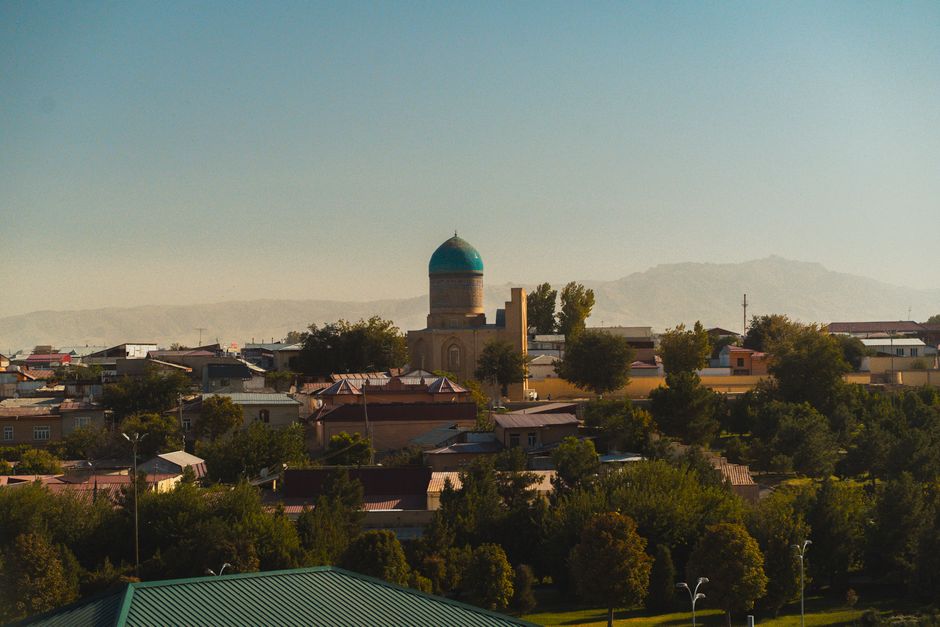
Samarkand is the legend of the Silk Road made real: a city of turquoise domes, soaring tiled gateways and shady avenues in the valley of the Zarafshan river, in the southeast of Uzbekistan. Founded more than 2,500 years ago as Marakanda, the capital of Sogdiana, it was taken by Alexander the Great, destroyed by Genghis Khan and rebuilt in glory by Amir Timur (Tamerlane), who made it the capital of his empire at the end of the 14th century and filled it with the finest buildings of the Islamic world. Today, Samarkand is Uzbekistan’s second-largest city and its most famous sight. Come for the Registan, the square of three madrasas that is one of the great architectural ensembles of Asia; the street of blue-tiled tombs at Shah-i-Zinda; Timur’s mausoleum, Gur-e Amir; the giant Bibi-Khanym Mosque and the Siab Bazaar beside it; and Ulugh Beg’s observatory. UNESCO inscribed the city as Samarkand – Crossroad of Cultures in 2001. Since 2011, the Afrosiyob high-speed train has linked Samarkand with Tashkent in a little over two hours. The best months are April, May, September and October; summers are hot and winters cold but quiet.
Right now in Samarkand
- Wed 8–22°C 46–72°F Cloudy
- Thu 12–27°C 53–80°F Clear
- Fri 13–26°C 55–78°F Clear
Weather: MET Norway (CC BY 4.0)
Top tours in Samarkand
See all tours for Samarkand →
From local operators, with prices and reviews; you check availability and book on Viator, our partner. We may earn a commission at no extra cost to you. How we earn money
Samarkand at a glance
- Best for: Timurid architecture, tiled mausoleums, bazaars, Silk Road history, crafts and food.
- How long: 2–3 days for the city, plus a day trip to Shakhrisabz.
- Best time: April to early June and September to October; July and August are hot, and December to February is cold.
- Getting there: by Afrosiyob train from Tashkent (a little over 2 hours) or Bukhara (about 1.5 hours); by air to Samarkand International Airport, about 7 km (4 miles) from the Registan; by road from Tajikistan via Penjikent.
- Getting around: on foot in the center, by ride-hailing taxi, bus or the small electric buses between the sights.
- Good to know: dress modestly at the mausoleums, which are places of pilgrimage, and keep your hotel registration slips.
- Before you go: visas, the registration rule, money and general safety are in our Uzbekistan travel guide.
Samarkand’s areas and where to stay
Samarkand has two faces: the old city around the Registan, Bibi-Khanym and Shah-i-Zinda to the east, and the Russian new town of tree-lined boulevards and 19th-century buildings to the west, built after the Russian conquest in 1868. Between them runs Tashkent Street, a pedestrian avenue linking the Registan with Bibi-Khanym.
Around the Registan
The most convenient base, with guesthouses and hotels within walking distance of the Registan, Gur-e Amir and the pedestrian street. Rooms in the old Jewish and Uzbek quarters (mahallas) behind the square are often in traditional houses with courtyards.
The old town near Bibi-Khanym
Family guesthouses in the lanes around the Siab Bazaar and Bibi-Khanym are close to Shah-i-Zinda and the bazaar, and the quietest at night.
The Russian new town
West of the Registan, along University Boulevard and around the city park, larger hotels, cafés and restaurants line shady streets about 15–20 minutes’ walk from the sights. This is the city’s liveliest area in the evening.
Silk Road Samarkand (the Eternal City)
On the eastern edge of town, the new Silk Road Samarkand tourist complex, built for international summits and opened in 2022, has international-brand resort hotels, a congress hall, a lake and the Boqiy Shahar (Eternal City), a reconstructed old-town quarter of craft shops and restaurants; it is about 15 minutes by taxi from the Registan.
Where to stay in Samarkand
- Registan area: guesthouses and boutique hotels within walking distance of everything.
- Bibi-Khanym and Siab Bazaar: quiet family guesthouses in old houses.
- New town: mid-range and business hotels near cafés and restaurants.
- Silk Road Samarkand: resort hotels with pools and spas, a short taxi ride from the center.
Rooms fill in April, May, September and October and around Navruz in March; book ahead.
Top things to see in Samarkand
The Registan
The Registan (“sandy place”) was the commercial and ceremonial heart of medieval Samarkand. Three monumental madrasas face its square: the Ulugh Beg Madrasa (1417–1420) on the left, built by Timur’s astronomer grandson, with star patterns on its portal; the Sher-Dor Madrasa (1619–1636) opposite, whose portal shows tigers chasing deer beneath human-faced suns, a rare image in Islamic art; and the Tilya-Kori Madrasa (1646–1660) in the middle, with a mosque whose interior glitters with gold. The courtyards are lined with craft shops. Foreign visitors paid about 100,000 som for a ticket in 2026, sold at the entrance; come early in the morning for quiet courtyards, and again at dusk, when the square is lit up and, on many evenings, a sound and light show is projected onto the facades. Viewing the square from outside is free.
Shah-i-Zinda
Northeast of the center, Shah-i-Zinda (“the living king”) is a narrow street of mausoleums climbing a hillside beside the ancient city of Afrasiab. It grew around the shrine of Kusam ibn Abbas, a cousin of the Prophet Muhammad said to have brought Islam to the region, and from the 14th and 15th centuries Timur’s relatives and nobles were buried here in tombs covered with some of the most exquisite glazed tilework anywhere. It is an active pilgrimage site: dress modestly, women should cover their hair, and stay quiet. Come early or late in the day for the best light; a ticket is charged.
Gur-e Amir
Timur’s mausoleum, the Gur-e Amir (“tomb of the king”), crowned by a ribbed turquoise dome, was begun in 1403 for his grandson and became the resting place of Timur himself, his sons and Ulugh Beg. Inside, the walls shine with gilded decoration, and Timur’s tomb is marked by a slab of dark green jade. It is beautifully lit at night and a short walk from the Registan.
Bibi-Khanym Mosque and the Siab Bazaar
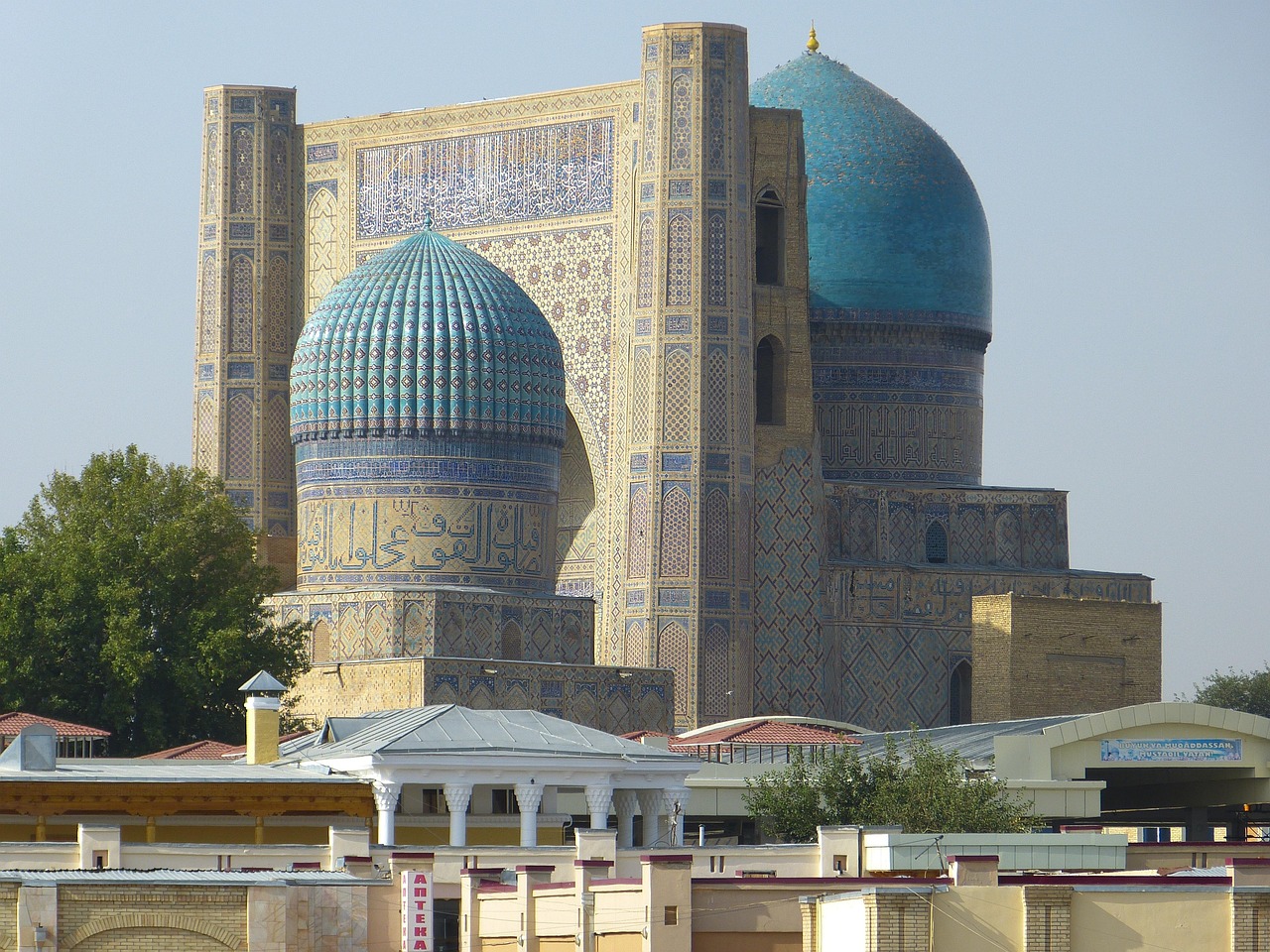
Timur ordered the Bibi-Khanym Mosque, one of the largest mosques of its time, after his campaign in India in 1399; built too fast, it began to crumble soon after and collapsed in an earthquake in 1897, and much of what you see is Soviet and later restoration. Its huge portal and the giant marble Quran stand in the courtyard. Next door, the Siab Bazaar is Samarkand’s main market, full of round Samarkand bread, dried fruit, nuts, spices, halva and fresh produce.
Ulugh Beg Observatory and Afrasiab
On a hill northeast of the center, the Ulugh Beg Observatory, built in the 1420s, held a giant sextant used to map more than a thousand stars with remarkable accuracy; the curved underground track of the instrument survives, with a small museum. Nearby, the grassy mounds of Afrasiab mark the ancient city destroyed by the Mongols, and the Afrasiab Museum displays the famous 7th-century murals of the Ambassadors’ Hall, showing envoys from China, Korea and Persia at the Sogdian court.
More classic sights
- Hazrat Khizr Mosque: a 19th-century mosque with a painted wooden porch on a hill opposite Bibi-Khanym, with views over the old city.
- Tomb of Daniel (Khoja Doniyor): an 18-meter-long tomb venerated by Muslims, Christians and Jews, on the banks of the Siab stream.
- Rukhobod Mausoleum and Ak-Saray: small Timurid tombs near Gur-e Amir.
- Museum of the History of Uzbek Culture and the Samarkand museums: archaeology and art of the region, part of the Samarkand State Museum-Reserve.
- The Russian new town: the Orthodox Cathedral of St. Alexius, University Boulevard and the 19th-century merchants’ houses.
Other things to do in Samarkand
Food and drink
Samarkand has its own version of plov, layered rather than mixed, with yellow carrots and meat on top, served at lunchtime in plov centers. Try the heavy, glazed Samarkand non, a round bread said to keep for months; somsa baked in a tandoor; shashlik grilled on skewers; lagman noodles; and norin, cold noodles with horse meat. Teahouses serve green tea with dried fruit and sweets, and the city has a long tradition of wine-making: the Khovrenko winery, founded in 1868, runs tastings of its sweet and fortified wines.
Crafts and workshops
At Konigil, a village about 10 km (6 miles) east of the city, the Meros workshop has revived Samarkand’s traditional silk paper, made from mulberry bark using water-driven mills, with craftspeople making pottery and oil. In the city, the Samarkand Bukhara Silk Carpets workshop shows hand-knotting and natural dyeing, and the madrasa courtyards of the Registan and Shah-i-Zinda have embroidery, ceramics and miniature painting.
Festivals
Navruz on March 21 brings music, sumalak and folk games to the Registan. In some years, Samarkand hosts the Sharq Taronalari (Melodies of the East) international music festival in late summer, held every two years on the Registan. See our city sightseeing guide.
Day trips from Samarkand
- Shakhrisabz: Timur’s birthplace, about 90 km (56 miles) south over the Takhtakaracha Pass, about 2 hours by road; see the giant ruined portal of his Ak-Saray (White Palace), the Kok Gumbaz mosque and the crypt prepared for Timur. Its historic center is a UNESCO World Heritage Site.
- Imam al-Bukhari Complex: the tomb of the 9th-century scholar of hadith, a major pilgrimage site about 25 km (16 miles) north of the city.
- Urgut: a mountain town about 40 km (25 miles) southeast with a large Sunday market, especially known for suzani embroideries.
- Nuratau mountains and Aydarkul: village homestays, walks and desert yurt camps with camel rides, best as an overnight trip on the way to Bukhara.
- Penjikent (Tajikistan): the ruins of a Sogdian city and the UNESCO site of Sarazm, across the border about 1 hour east; you need the right entry documents for Tajikistan. See our Tajikistan guide.
Getting there and getting around
By train
Samarkand’s railway station lies about 5 km (3 miles) north of the Registan; taxis and buses take 10–20 minutes. The Afrosiyob high-speed train reaches Tashkent in a little over two hours and Bukhara in about one and a half hours, with several departures a day. Since May 2026, the new Jaloliddin Manguberdi high-speed train has stopped in Samarkand on its way between Tashkent and Khiva. Slower Sharq trains are cheaper. Buy tickets on railway.uz, the official site and app of Uzbekistan Railways, or at the station, with your passport, and book early in spring and autumn.
By air
Samarkand International Airport (SKD), about 7 km (4 miles) from the center, has flights from Tashkent and international flights from cities such as Istanbul, Moscow and Dubai; see our Istanbul guide. It lets you fly into Samarkand and out of Tashkent or Urgench.
By road
Shared taxis and buses link Samarkand with Tashkent (about 4–5 hours), Bukhara and Shakhrisabz. The Penjikent–Samarkand border crossing to Tajikistan, about 40 km (25 miles) east, is the quickest way to the Fann Mountains.
Around town
The main sights are within about 2 km (1.2 miles) of each other along the pedestrian Tashkent Street and University Boulevard, so walking is the best way to get around; the observatory and Afrasiab are a short taxi ride further. Use ride-hailing apps such as Yandex Go for taxis, which are cheap; small electric shuttles also run along the tourist route.
When to go and how long to stay
Samarkand, at about 700 m (2,300 ft) above sea level, has a continental climate. Spring, from April to early June, brings warm, sunny days, green trees and occasional showers, and is the best and busiest time. Summer, from June to August, is hot and almost completely dry, with afternoon highs around 33–34 °C (91–94 °F); sightsee early and late. Autumn, from September to October, is warm and golden, with harvest fruit in the bazaars. Winter, from December to February, is cold, with frosts at night and occasional snow, but the monuments are nearly empty. The table uses the 1991–2020 climate normals for the Samarkand station of Uzhydromet, as submitted to the World Meteorological Organization (WMO): average daily highs and lows, total precipitation, and days with at least 1 mm of rain or snow.
| Month | Average high / low | Rain (days with 1 mm or more) | What to expect |
|---|---|---|---|
| January | 7 °C (45 °F) / −1 °C (30 °F) | 41 mm (1.6 in), 14 days | Cold; frosty nights; few visitors |
| February | 10 °C (49 °F) / 0 °C (32 °F) | 52 mm (2.1 in), 13 days | Cold and damp; quiet |
| March | 15 °C (60 °F) / 5 °C (40 °F) | 73 mm (2.9 in), 15 days | The wettest month; Navruz |
| April | 22 °C (71 °F) / 10 °C (50 °F) | 63 mm (2.5 in), 13 days | Warm and green; busy |
| May | 27 °C (81 °F) / 14 °C (58 °F) | 40 mm (1.6 in), 11 days | Excellent; peak season |
| June | 32 °C (90 °F) / 18 °C (65 °F) | 7 mm (0.3 in), 5 days | Hot and sunny |
| July | 34 °C (94 °F) / 20 °C (67 °F) | 2 mm (0.1 in), 2 days | The hottest month; dry |
| August | 33 °C (92 °F) / 18 °C (64 °F) | 2 mm (0.1 in), 2 days | Hot; melons and grapes |
| September | 29 °C (84 °F) / 14 °C (56 °F) | 3 mm (0.1 in), 2 days | Warm and dry; busy again |
| October | 22 °C (72 °F) / 8 °C (46 °F) | 16 mm (0.6 in), 6 days | Mild and golden; ideal |
| November | 14 °C (58 °F) / 3 °C (38 °F) | 40 mm (1.6 in), 10 days | Cool; rains return |
| December | 9 °C (49 °F) / 0 °C (32 °F) | 39 mm (1.5 in), 12 days | Cold; quiet |
Samarkand receives about 380 mm (15 in) of precipitation a year, almost all from November to May.
Two days in Samarkand
Day one, the Registan in the morning, Gur-e Amir and lunch at a plov center, then Bibi-Khanym, the Siab Bazaar and Hazrat Khizr, and back to the Registan for the evening lights. Day two, Shah-i-Zinda early, the Ulugh Beg Observatory and Afrasiab Museum, then the Konigil paper workshop and dinner in the new town.
Three to four days
Add a day trip to Shakhrisabz, the Imam al-Bukhari complex or the Sunday market in Urgut, or continue to Bukhara with a night in a yurt camp near Aydarkul.
What a trip to Samarkand costs
Prices are approximate, for October 2026, converted at about 11,800 som to the US dollar.
| Item | Typical cost |
|---|---|
| Afrosiyob train to Tashkent, economy | about 250,000–350,000 UZS (about US$21–30) |
| Registan ticket for foreign visitors | about 100,000 UZS (about US$8.50) |
| Shah-i-Zinda, Gur-e Amir or Bibi-Khanym entry | 30,000–60,000 UZS (about US$2.50–5) each |
| Plate of plov | 40,000–60,000 UZS (about US$3.40–5.10) |
| Dinner in a mid-range restaurant | 150,000–300,000 UZS (about US$13–25) per person |
| Taxi across the city by app | 15,000–35,000 UZS (about US$1.30–3) |
| Shared taxi or tour to Shakhrisabz | 150,000–600,000 UZS (about US$13–51) per seat or car |
| Guesthouse or mid-range hotel double, per night | 500,000–1,100,000 UZS (about US$42–93) |
Practical tips for Samarkand
- Time the Registan: go early for empty courtyards and return after dark for the lights, as the ticket price and rules allow.
- Dress for the shrines: cover shoulders and knees at Shah-i-Zinda, Gur-e Amir and the Imam al-Bukhari complex; women should carry a scarf.
- Book trains early: in spring and autumn, Afrosiyob seats sell out days or weeks ahead.
- Keep registration slips: your hotel registers you; keep the slips until you leave Uzbekistan.
- Carry cash: bazaars, small museums and guesthouses often accept only som.
- Bargain politely: in the madrasa shops and the bazaar, prices are open to discussion.
Safety
Samarkand is very safe, and violent crime against visitors is rare. Watch for pickpockets in the Siab Bazaar and at crowded evening events at the Registan, and use app-based taxis rather than unofficial drivers. Traffic is heavy on the main roads, and drivers don’t always stop at crossings, so take care crossing. In summer, the heat can be intense in the open squares: carry water and a hat. Some staircases and minarets are steep and uneven. Respect the rules at the shrines, where photography may be restricted inside, and avoid photographing police or government buildings. Carry your passport, as police may ask to see it. In an emergency, call 102 for police and 103 for an ambulance.
What to pack for Samarkand
Light, breathable clothes that cover shoulders and knees, a scarf for women at shrines, comfortable walking shoes for uneven paving, a hat and sunscreen from April to October, a warm jacket from November to March, and an umbrella in spring. Uzbekistan uses 220 V, with round two-pin plugs. See our hiking shoes and travel adapters guides.
Samarkand travel FAQ
How much does it cost to visit the Registan?
About 100,000 som for foreign visitors in 2026, sold at the entrance and covering the three madrasas; prices change, so check on arrival. Viewing the square from outside is free.
How do I get from Tashkent to Samarkand?
By the Afrosiyob high-speed train in a little over two hours, by slower Sharq trains, by domestic flight, or by shared taxi in about 4–5 hours.
How many days do I need in Samarkand?
Two days for the main sights, three if you want a day trip to Shakhrisabz or Konigil.
What is the best time to visit Samarkand?
April to early June and September to October, when days are warm and sunny. Summers are hot, and winters are cold but quiet.
Is the Registan lit up at night?
Yes. The square is illuminated every evening, and a sound and light show is projected on many nights, best seen from the viewing area facing the madrasas.
What should I wear in Samarkand?
Clothes that cover shoulders and knees at mosques and mausoleums; women should carry a scarf for Shah-i-Zinda and other shrines.
Can I take the train from Samarkand to Bukhara and Khiva?
Yes. The Afrosiyob reaches Bukhara in about one and a half hours, and since May 2026 a high-speed train has run on to Khiva via Urgench.
What is Shah-i-Zinda?
A street of richly tiled mausoleums from the 11th to the 19th centuries built around the shrine of Kusam ibn Abbas, a cousin of the Prophet; it is an active pilgrimage site.
Can I visit Tajikistan from Samarkand?
Yes, through the Penjikent–Samarkand border crossing about 40 km east, if you meet Tajikistan’s entry requirements. See our Tajikistan guide.
Where should I stay in Samarkand?
Near the Registan or Bibi-Khanym for walking access to the sights, in the Russian new town for cafés and nightlife, or at Silk Road Samarkand for resort hotels.
Sources and last review
Researched and last reviewed on 4 October 2026. Visas and registration: the Ministry of Foreign Affairs of Uzbekistan and the Uzbek government services portal; the Samarkand State Museum-Reserve’s own pages for its monuments and online ticketing; climate normals: Uzhydromet via the World Meteorological Organization’s 1991–2020 normals; the exchange rate: the Central Bank of the Republic of Uzbekistan. The Registan ticket price for foreign visitors and the 2026 high-speed train to Khiva are from secondary sources and local press reports, flagged for checking. Monument dates and history, the UNESCO inscription, the light show, distances, journey times, opening patterns and typical prices are general references or estimates, flagged for checking. Prices and rules change, so check locally before you go. For entry rules, money and general safety, see our Uzbekistan travel guide.
Plan your trip
Partner links: TravelerCenter may earn a commission if you book, at no extra cost to you.
🇺🇿 Useful Uzbek phrases for Samarkand
All 38 Uzbek phrases: restaurant, hotel, emergencies, romance (printable) →