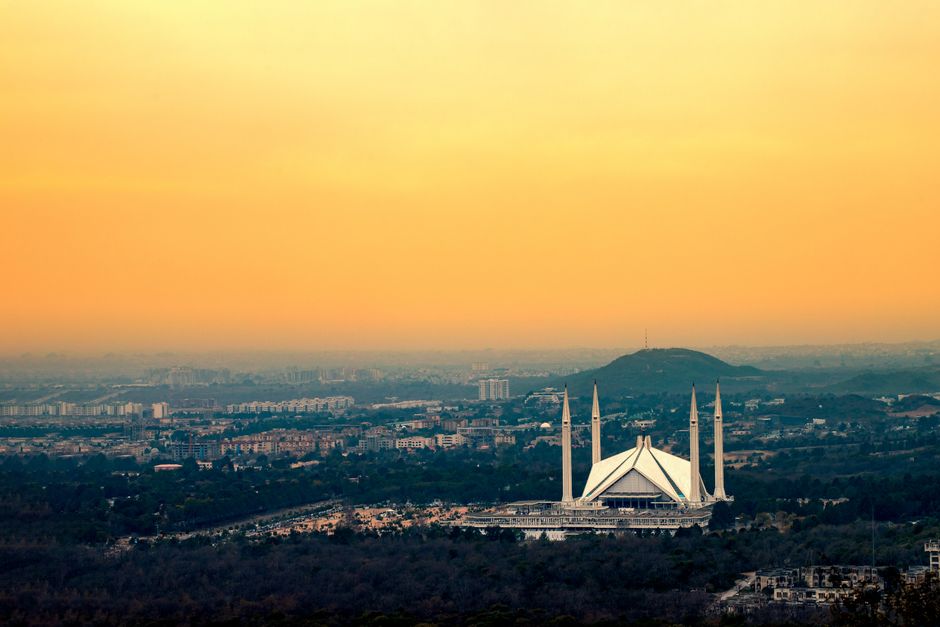
Islamabad, the capital of Pakistan, is unlike any other city in the country: a green, orderly, planned city laid out in the 1960s on a grid of sectors at the foot of the forested Margalla Hills, with wide avenues, parks and views of the mountains from almost everywhere. Its landmark is the Faisal Mosque, a vast, tent-like modern mosque with four pencil-thin minarets, one of the largest in the world; other sights include the petal-shaped Pakistan Monument, the Lok Virsa heritage museum, the old village of Saidpur and viewpoints such as Daman-e-Koh and Pir Sohawa above the city. Hiking trails lead straight from the city into Margalla Hills National Park, and its twin city, Rawalpindi, adds crowded bazaars and old neighborhoods. Islamabad is also the gateway to the north, with flights to Gilgit and Skardu and the start of the Karakoram Highway, and to the Gandharan Buddhist ruins of Taxila and the great fortress of Rohtas, both UNESCO World Heritage Sites. Security is tight, with checkpoints across the city, and although the capital is among the most secure places in Pakistan, it has been hit by attacks, most recently in February 2026. The best months are October to April; the monsoon from July to September brings heavy downpours.
Right now in Islamabad
- Wed 20–28°C 67–82°F Clear
- Thu 21–29°C 70–84°F Clear
- Fri 22–28°C 71–82°F 5 mm Mostly clear
Weather: MET Norway (CC BY 4.0) · Air quality: OpenAQ
Top tours in Islamabad
See all tours for Islamabad →
From local operators, with prices and reviews; you check availability and book on Viator, our partner. We may earn a commission at no extra cost to you. How we earn money
Islamabad at a glance
- Best for: the Faisal Mosque, museums and monuments, hiking in the Margalla Hills, viewpoints, food, and day trips to Taxila, Rohtas and Murree.
- How long: 2 days for the city; add 1–2 days for day trips.
- Best time: October to April; May and June are very hot, and July to September is the monsoon.
- Getting there: Islamabad International Airport is about 25–30 km (16–19 miles) west of the center; coaches run on the M2 motorway to Lahore in about 4.5–5 hours.
- Getting around: by ride-hailing app or hotel car; the Metrobus links Islamabad and Rawalpindi.
- Good to know: carry your passport for frequent police checkpoints.
- Before you go: the e-visa, permissions, money and general safety are in our Pakistan travel guide.
A planned capital
Pakistan decided to move its capital from Karachi in 1959, and the Greek planner Constantinos Doxiadis drew up a master plan for a new city beside Rawalpindi, which served as the interim capital while Islamabad was built through the 1960s. His grid of self-contained sectors, each with houses, schools, mosques, a market and green belts, was designed to grow in one direction toward the southwest, with the government at the head of the plan beneath the hills. The result is a city that feels spacious and calm, with tree-lined roads and wide parks, and some of the best mountain backdrops of any capital in the world.
Islamabad’s areas and where to stay
The city is divided into lettered and numbered sectors, such as F-6 or E-7, each with its own markaz (commercial center), running in rows below the Margalla Hills. The Blue Area along Jinnah Avenue is the business spine, and the government buildings stand at its eastern end on Constitution Avenue.
F-6 and F-7
The older sectors of F-6 (with Kohsar and Super markets) and F-7 (with Jinnah Super) are the liveliest, with restaurants, cafés, bookshops and guesthouses close to the hills and Daman-e-Koh.
E-7 and the diplomatic area
The leafy E-7 and the nearby Diplomatic Enclave have embassies, large houses and a few upscale hotels; the enclave itself is closed to the public.
The Blue Area and the center
Along Jinnah Avenue, the Blue Area has offices, banks, shopping centers and business hotels, a short ride from both the hills and the government district.
Rawalpindi
Islamabad’s older twin city, about 15 km (9 miles) south, has crowded bazaars, colonial cantonment buildings, the main railway station and cheaper hotels.
Where to stay in Islamabad
- Near the government district and the Serena: international hotels with strong security.
- F-6, F-7 and E-7: guesthouses and boutique hotels near restaurants and the hills.
- Blue Area: business hotels.
- Rawalpindi: budget hotels near the bazaars and the railway station.
Guesthouses are popular and good value, but choose ones with secure entrances, and book ahead around government events and Eid.
Top things to see in Islamabad
Faisal Mosque
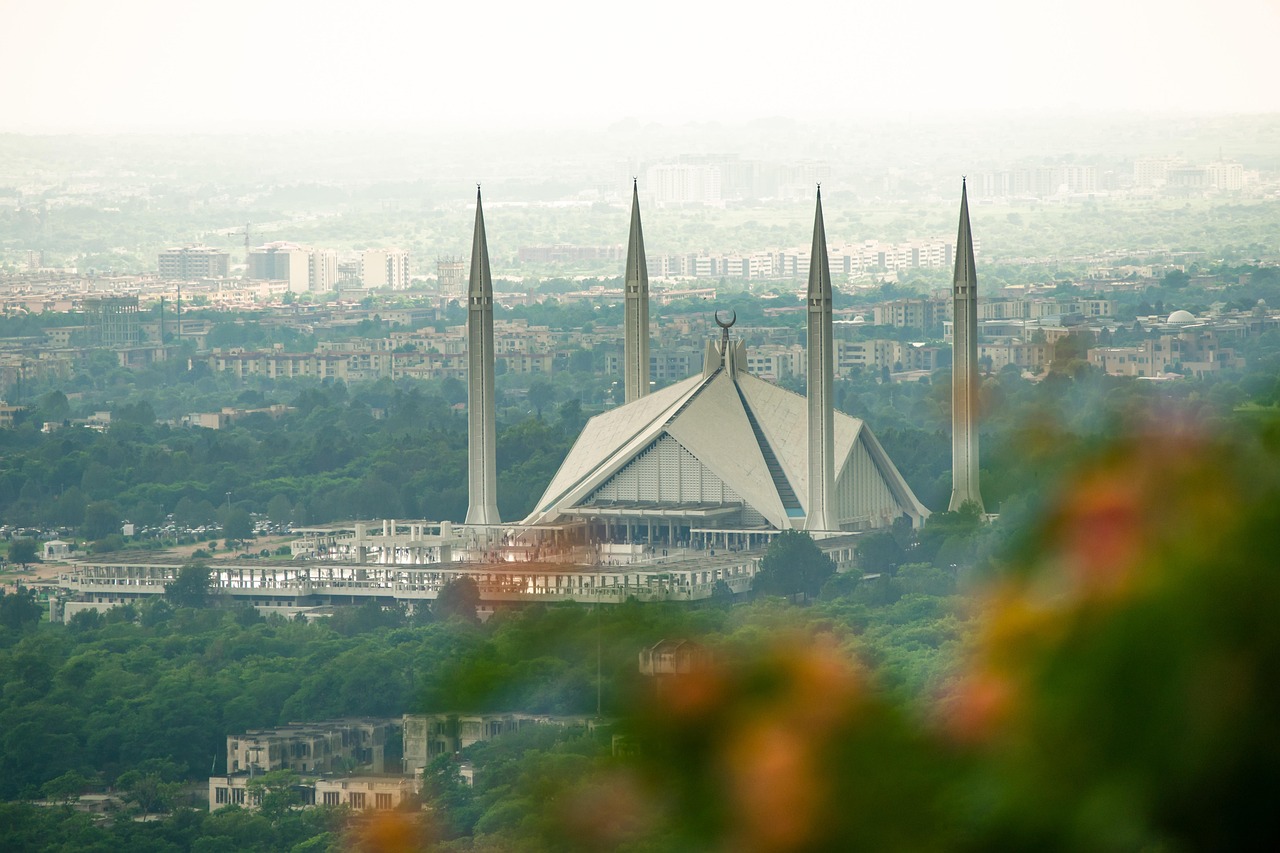
Designed by the Turkish architect Vedat Dalokay and completed in 1986, the Faisal Mosque was named after King Faisal of Saudi Arabia, who funded it. Its sloping, tent-like prayer hall, inspired by a Bedouin tent, sits between four minarets about 90 m (295 ft) tall at the foot of the Margalla Hills, and the mosque and its courtyard can hold tens of thousands of worshippers. Visitors are welcome outside prayer times; dress modestly, remove shoes and, for women, cover your head. It is especially beautiful at sunset.
Pakistan Monument and Museum
On the Shakarparian hills, the Pakistan Monument, opened in 2007, has four large granite petals representing the provinces and three smaller ones for the territories, decorated inside with murals of Pakistani history and landmarks. The adjoining museum covers the independence movement, and the hilltop gives views over the city.
Lok Virsa Heritage Museum
The Lok Virsa museum, also at Shakarparian, is the best place in the country to learn about Pakistan’s regional cultures, with costumes, crafts, musical instruments, carved woodwork and life-size scenes from Punjab, Sindh, Balochistan, Khyber Pakhtunkhwa, Gilgit-Baltistan and Kashmir.
Margalla Hills and Daman-e-Koh
The hills that rise behind the city form Margalla Hills National Park, with forested trails, monkeys and birds. Daman-e-Koh, a viewpoint and park halfway up, looks straight down the grid to the Faisal Mosque and Rawal Lake; higher up, Pir Sohawa has restaurants with panoramic terraces, popular at sunset.
Saidpur Village
At the foot of the hills, Saidpur Village, a centuries-old village restored as a heritage and dining area, has a Hindu temple, a gurdwara, a mosque, craft shops and restaurants in old stone buildings.
More classic sights
- Shah Faisal Avenue and Constitution Avenue: the government district, with Parliament House, the Supreme Court and the President’s House, viewed from outside.
- Rawal Lake: a reservoir with a lakeside park and boating.
- Lake View Park and Shakarparian: family parks with gardens and views.
- Golra Sharif: a famous Sufi shrine and an old railway station with a museum.
- Raja Bazaar in Rawalpindi: a crowded, colorful market district.
- Pakistan Museum of Natural History: fossils and wildlife in the Garden Avenue area.
Other things to do in Islamabad
Hiking in the Margalla Hills
Numbered trails climb into the national park from the city’s northern edge. Trail 3, from F-6, is the most popular, a steep climb of about an hour to a viewpoint and on to Pir Sohawa; Trail 5, from F-5, is gentler and follows a stream through forest. Start early, carry water, stay on marked trails and do not hike alone. Some trails close after fires or bad weather. See our hiking guide.
Food and drink
Islamabad’s markets have excellent restaurants serving karahi, barbecue, chapli kebabs, Peshawari dishes and biryani, along with many cafés, bakeries and international restaurants in F-6, F-7 and the Blue Area. Try tikka and kebabs at Melody Food Street, chai at a dhaba, and dinner with a view at Pir Sohawa or Daman-e-Koh. Alcohol is not served in restaurants.
Shopping
Jinnah Super and Kohsar Market have bookshops, craft shops and boutiques; the Centaurus Mall is the city’s largest; and Rawalpindi’s bazaars sell textiles, shoes and spices. Lok Virsa’s shop has quality regional crafts.
Cycling and parks
The flat sectors and wide avenues make Islamabad one of Pakistan’s best cities for cycling, and parks such as Fatima Jinnah Park (F-9) are good for walking. See our cycling and city sightseeing guides.
Day trips from Islamabad
- Taxila: the ruins of three ancient cities and Buddhist monasteries of Gandhara, including Jaulian, Mohra Moradu and Sirkap, with an excellent museum of Gandharan sculpture, about 35 km (22 miles) northwest; a UNESCO World Heritage Site.
- Rohtas Fort: a vast 16th-century fortress built by Sher Shah Suri near Jhelum, with massive gates and walls, about 2–2.5 hours southeast; a UNESCO World Heritage Site.
- Murree and the Galyat: colonial hill stations among pine forests at about 2,300 m (7,500 ft), about 1–1.5 hours northeast; very crowded on summer weekends and sometimes snowbound in winter.
- Khewra Salt Mine: illuminated salt chambers and a salt-brick mosque, about 2.5–3 hours south.
- Katas Raj Temples: a complex of ancient Hindu temples around a sacred pool in the Salt Range, about 2.5 hours south.
- Lahore: about 4.5–5 hours by coach. See our Lahore guide.
- The north: flights to Gilgit for the Hunza Valley. See our Hunza Valley guide.
Getting there and getting around
By air
Islamabad International Airport (ISB), opened in 2018, lies about 25–30 km (16–19 miles) west of the center, near Fateh Jang, about 30–45 minutes by car. It has flights from the Gulf hubs, Istanbul, London, Manchester, China and other Asian cities, and domestic flights to Karachi, Lahore, Gilgit, Skardu and other cities. Book a ride-hailing car or hotel transfer.
By road
The M2 motorway links Islamabad with Lahore, with comfortable coaches taking about 4.5–5 hours; the M1 leads to Peshawar, and the Karakoram Highway starts at Hasan Abdal, about 45 km (28 miles) northwest, on the way to Gilgit-Baltistan. Coach companies have terminals in Islamabad and Rawalpindi.
By train
The main station is in Rawalpindi, with trains to Lahore, Karachi and Peshawar; trains have been targeted by attacks in some provinces, and many visitors prefer coaches or flights.
Around the city
Use ride-hailing apps such as Careem, inDrive or Yango, or taxis booked through your hotel, rather than street taxis. The Metrobus runs from Pak Secretariat along Jinnah Avenue to Rawalpindi, with branches toward the airport; it is cheap and fast, though crowded at peak times. Distances between sectors are large, so walking works only within a markaz or in the hills.
When to go and how long to stay
Islamabad has a humid subtropical climate with distinct seasons. October and November are dry, sunny and pleasant, and February to April brings spring blossom; December and January are cool, with cold nights near 4 °C (39 °F) and occasional fog. May and June are very hot, with highs of 36–38 °C (97–101 °F), and the monsoon, from July to September, brings humid heat and heavy downpours, with more than 300 mm (12 in) of rain in each of July and August; flash floods can hit low-lying areas. The table uses the 1991–2020 climate normals for Islamabad from the Pakistan Meteorological Department, as submitted to the World Meteorological Organization (WMO): average daily highs and lows, total rain, and days with at least 1 mm of rain.
| Month | Average high / low | Rain (days with 1 mm or more) | What to expect |
|---|---|---|---|
| January | 18 °C (64 °F) / 4 °C (38 °F) | 55 mm (2.2 in), 5 days | Cool; cold nights and fog |
| February | 20 °C (68 °F) / 7 °C (44 °F) | 93 mm (3.7 in), 6 days | Mild; winter rain |
| March | 25 °C (77 °F) / 11 °C (53 °F) | 95 mm (3.7 in), 7 days | Spring blossom |
| April | 31 °C (87 °F) / 17 °C (62 °F) | 58 mm (2.3 in), 6 days | Warm and pleasant |
| May | 36 °C (97 °F) / 22 °C (71 °F) | 40 mm (1.6 in), 5 days | Hot |
| June | 38 °C (101 °F) / 25 °C (76 °F) | 78 mm (3.1 in), 6 days | The hottest month |
| July | 35 °C (96 °F) / 25 °C (77 °F) | 311 mm (12.2 in), 12 days | Monsoon downpours |
| August | 34 °C (93 °F) / 24 °C (76 °F) | 317 mm (12.5 in), 12 days | The wettest month; Independence Day |
| September | 33 °C (92 °F) / 22 °C (71 °F) | 135 mm (5.3 in), 6 days | Monsoon ending |
| October | 31 °C (88 °F) / 16 °C (60 °F) | 34 mm (1.4 in), 3 days | Dry, sunny and pleasant |
| November | 25 °C (78 °F) / 9 °C (48 °F) | 18 mm (0.7 in), 2 days | Crisp and clear |
| December | 20 °C (69 °F) / 5 °C (40 °F) | 26 mm (1.0 in), 2 days | Cool; cold nights |
Islamabad receives about 1,260 mm (50 in) of rain a year, more than half in July and August.
One day in Islamabad
An early hike on Trail 3 or a drive to Daman-e-Koh, the Pakistan Monument and Lok Virsa in the late morning, lunch in F-6 or F-7, Saidpur Village in the afternoon, and sunset at the Faisal Mosque, followed by dinner at Pir Sohawa.
Two or three days
Add Taxila’s ruins and museum, Rawalpindi’s bazaars, Rohtas Fort or Murree.
What a trip to Islamabad costs
Prices are approximate, for October 2026, converted at about 277 rupees to the US dollar.
| Item | Typical cost |
|---|---|
| Faisal Mosque | free |
| Pakistan Monument Museum entry for foreigners | about 500 PKR (about US$1.80) |
| Lok Virsa Museum entry for foreigners | about 500 PKR (about US$1.80) |
| Taxila Museum and sites for foreigners | about 1,000–1,500 PKR (about US$3.60–5.40) |
| Karahi dinner for two at a local restaurant | 2,500–4,500 PKR (about US$9–16) |
| Ride-hailing car across the city | 500–1,200 PKR (about US$1.80–4.30) |
| Ride-hailing car to the airport | 2,000–3,500 PKR (about US$7–13) |
| Metrobus ride | 30–60 PKR (about US$0.10–0.20) |
| Mid-range hotel or guesthouse double, per night | 12,000–30,000 PKR (about US$43–108) |
Practical tips for Islamabad
- Carry your passport: police checkpoints are common, especially at night.
- Use ride-hailing apps: street taxis are not recommended.
- Hike early: start Margalla trails at dawn in the hot months, and never alone.
- Check prayer times: the Faisal Mosque closes to visitors during prayers.
- Plan flights north with spare days: Gilgit and Skardu flights are often cancelled.
- Dress modestly: especially at mosques and shrines.
Safety
Islamabad has a heavy police and security presence and is among the more secure places in Pakistan, but it has been hit by terrorist attacks: on February 6, 2026, a suicide bombing at a mosque in the city killed at least 36 people, and in November 2025 a bombing outside the district courts killed 12. Be cautious in crowded places, at religious gatherings and near government buildings, avoid all protests, which often focus on the Red Mosque (Lal Masjid), Aabpara Market and the Press Club, and take extra care in the western sectors, such as I-8 to I-11, where security operations have taken place. Keep a low profile, vary your routines on longer stays and follow local news. Use ride-hailing apps or hotel cars rather than street taxis or crowded buses, and do not hike alone in the Margalla Hills. Heat from May to July and flash floods in the monsoon are the main natural hazards, and earth tremors are common. In an emergency, call 15 for police and 1122 for rescue and ambulance.
What to pack for Islamabad
Modest, breathable clothes that cover shoulders and legs, a scarf for mosques (essential for women), hiking shoes for the Margalla trails, a hat and sunscreen, an umbrella or rain jacket from July to September, a warm layer from November to February, and an adapter for round two-pin or British-style plugs. See our hiking shoes, rain jackets and travel adapters guides.
Islamabad travel FAQ
Is Islamabad worth visiting?
Yes, for a day or two: the Faisal Mosque, the Margalla Hills, Lok Virsa and the viewpoints are highlights, and it is the gateway to Taxila and the north.
Can I visit the Faisal Mosque as a tourist?
Yes, outside prayer times. Dress modestly, remove your shoes and, for women, cover your head.
How far is Islamabad airport from the city?
About 25–30 km (16–19 miles), 30–45 minutes by car.
How do I get from Islamabad to Hunza?
Fly to Gilgit in about an hour and drive 2–3 hours to Karimabad, or travel by road in 14–18 hours or more.
How do I get from Islamabad to Lahore?
By coach on the M2 motorway in about 4.5–5 hours, by train from Rawalpindi, or by a short flight.
What is the best hike in the Margalla Hills?
Trail 3 from F-6 is the most popular, a steep climb to a viewpoint and Pir Sohawa; Trail 5 is gentler.
How far is Taxila from Islamabad?
About 35 km (22 miles), 45 minutes to an hour by car.
What is the best time to visit Islamabad?
October to April. June is the hottest month, and July and August the wettest.
How many days do I need in Islamabad?
Two days for the city, or three or four with Taxila, Rohtas and Murree.
Is Islamabad safe for tourists?
It has strong security and many visitors, but it has been hit by attacks, most recently in February 2026; avoid crowds and protests, and follow local news.
Sources and last review
Researched and last reviewed on 5 October 2026. Climate normals: the Pakistan Meteorological Department via the World Meteorological Organization’s 1991–2020 normals; UNESCO listings of Taxila and Rohtas Fort: UNESCO. The February 2026 and November 2025 attacks, protest locations, the western sectors, taxis and public transport, flights to the north and the Karakoram Highway: the UK government’s factual safety pages. Exchange rate: a cross rate from the Central Bank of Myanmar’s published rates. The Faisal Mosque’s design and dimensions, the Pakistan Monument, the airport’s opening and distance, trail details, journey times, entry fees, emergency numbers and typical prices are general references or estimates, flagged for checking. Prices and rules change, so check locally before you go. For entry rules, money and general safety, see our Pakistan travel guide.
Plan your trip
Partner links: TravelerCenter may earn a commission if you book, at no extra cost to you.
🇵🇰 Useful Urdu phrases for Islamabad
All 38 Urdu phrases: restaurant, hotel, emergencies, romance (printable) →