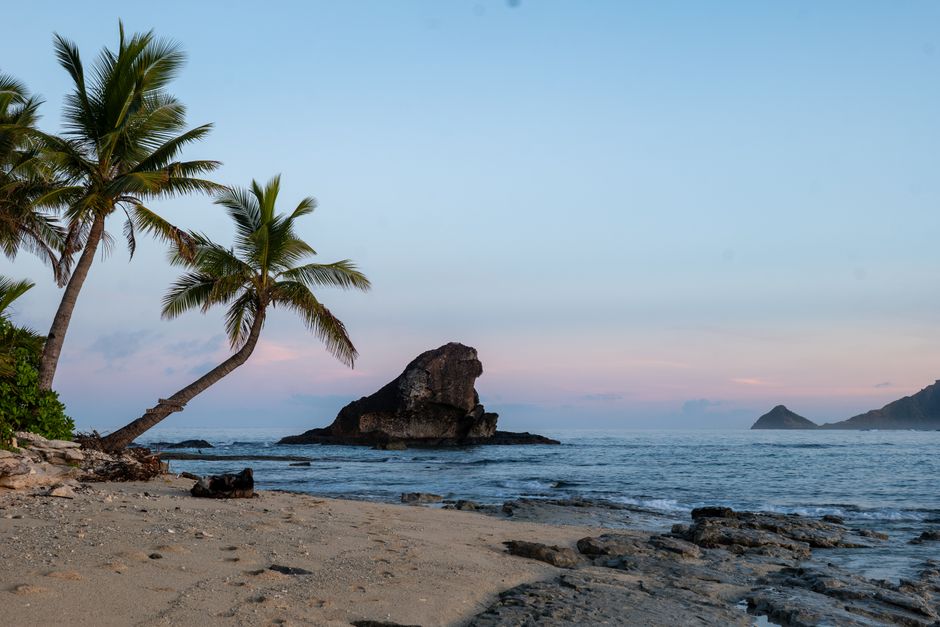
Fiji is an archipelago of more than 300 islands in the South Pacific, about 2,100 km (1,300 miles) north of New Zealand and a little over 3,000 km (1,900 miles) east of Australia. Most visitors land at Nadi on the dry western side of Viti Levu, the largest island, and head straight for the water: the resort islands of the Mamanuca group, a short boat ride off the coast; the volcanic, more remote Yasawa Islands farther north; or the hotels, reefs and villages of the Coral Coast along Viti Levu’s southern shore. Beyond them lie the capital, Suva, the soft-coral diving of Taveuni and Vanua Levu, and the quiet outer islands of Kadavu and Lau. Fiji’s warmth is as much about people as climate: the greeting “bula” follows you everywhere, villages welcome visitors with a kava ceremony, and iTaukei (Indigenous Fijian) and Indo-Fijian cultures mix in the food, festivals and markets. The dry season runs from about May to October; November to April is hotter, wetter and the tropical cyclone season. Citizens of the United States, Canada, the UK, the EU, Australia, New Zealand and many other countries get a visitor permit on arrival, and the departure tax is already included in your airline ticket.
Right now in Fiji
- Wed 21–27°C 70–80°F 1 mm Mostly clear
- Thu 21–27°C 70–80°F 1 mm Partly cloudy
- Fri 21–26°C 70–79°F 2 mm Mostly clear
Weather: MET Norway (CC BY 4.0)
Multi-day tours of Fiji
Multi-day tours from local operators. You check dates and book on Viator, our partner; we may earn a commission at no extra cost to you. How we earn money
Fiji at a glance
- Capital: Suva, on the wetter southeast coast of Viti Levu. Nadi, on the west coast, is the tourism hub and main international gateway.
- Population and size: about 900,000 people on 18,274 km² (7,056 sq miles) of land, spread over more than 300 islands, about a third of them inhabited. Viti Levu and Vanua Levu hold most of the population.
- Languages: English, iTaukei (Fijian) and Fiji Hindi. English is used in government, schools and tourism, so visitors rarely have trouble being understood. “Bula” means hello, “vinaka” thank you.
- Currency: the Fijian dollar (FJ$). On 5 October 2026 the Reserve Bank of Fiji’s rate was FJ$1 = US$0.44. VAT is 12.5% and is included in displayed prices.
- Time zone: Fiji Time, UTC+12. Fiji has not used daylight saving time in recent years.
- Driving: on the left.
- Entry: citizens of visa-exempt countries, including the US, Canada, the UK, EU countries, Australia and New Zealand, receive a visitor permit on arrival of up to four months. You need a passport valid for six months, a return or onward ticket and confirmed accommodation.
- Emergency numbers: 911 for an ambulance, 910 for the fire service, 917 for the police.
Fiji’s regions
Viti Levu is the main island: Nadi, Denarau and the sugarcane country of the dry west; the Coral Coast and Pacific Harbour along the south; Suva and the rainforested interior in the east. Just off Nadi, the Mamanuca Islands are a cluster of small resort islands, and beyond them the Yasawa Islands run north in a chain of about 20 high, volcanic islands. Vanua Levu, the second-largest island, has the yachting town of Savusavu, and neighboring Taveuni is known as the Garden Island. Kadavu lies south of Viti Levu, and the remote Lau Group stretches east toward Tonga. Levuka, on the island of Ovalau, was Fiji’s first colonial capital and is a UNESCO World Heritage Site.
Where to go: the islands, the reef and the main island
Nadi and Denarau
Nadi is where almost every trip starts and ends. The town itself is a busy, practical place with a colorful Hindu temple, the Sri Siva Subramaniya Swami Temple, a produce market and handicraft shops. Next door, Denarau Island is a purpose-built resort enclave of big-brand hotels, a golf course and Port Denarau, the marina from which most boats leave for the islands. Inland, the Sabeto Valley has the Garden of the Sleeping Giant, an orchid garden at the foot of the mountains, and the Sabeto hot springs and mud pools. Wailoaloa Beach, close to the airport, is the budget hub, with hostels and guesthouses.
The Mamanuca Islands
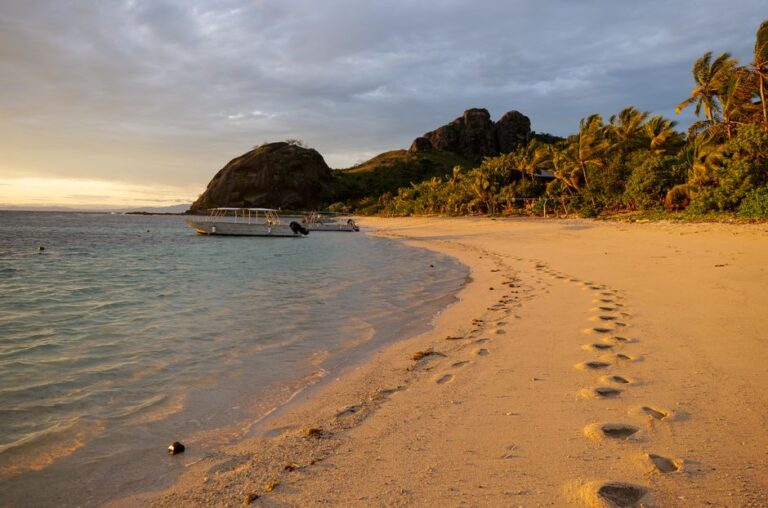
The Mamanuca Islands are the classic Fiji postcard: small, palm-covered islands with white beaches and resorts, 30 minutes to two hours by fast catamaran from Port Denarau. They range from family resorts with kids’ clubs to adults-only hideaways and Fiji’s first overwater bures, plus day-trip islands, a floating bar and world-famous surf breaks at Cloudbreak and Restaurants. Because they sit in the lee of Viti Levu, the Mamanucas are among the driest and sunniest parts of Fiji.
The Yasawa Islands
The Yasawa Islands are wilder and higher, with steep grassy hills, long beaches and villages. A daily high-speed catamaran, the Yasawa Flyer, runs up the chain from Port Denarau, and island-hopping between small resorts, from dorm-style backpacker places to secluded boutique lodges, is the way to see them. Highlights include swimming with manta rays in the channel off Drawaqa Island from about May to October, the Sawa-i-Lau limestone caves and the Blue Lagoon around Nanuya Lailai.
The Coral Coast and Pacific Harbour
The Coral Coast is the 80 km (50 mile) stretch of Queens Road along Viti Levu’s southern shore between Natadola Beach and Pacific Harbour. Resorts and villages sit behind a fringing reef, and you can explore by car: the Sigatoka Sand Dunes National Park, the Tavuni Hill Fort, the Sigatoka Valley, waterfalls behind Biausevu village and Natadola, often called the best beach on the main island. Farther east, Pacific Harbour is Fiji’s adventure capital, with shark dives in Beqa Lagoon, river rafting on the Upper Navua and firewalking from Beqa Island.
Suva
Suva, the capital, is a lively, multicultural Pacific city with colonial buildings, the Fiji Museum in Thurston Gardens, a huge municipal market and the University of the South Pacific. It rains much more here than in Nadi, and the city is a working capital rather than a resort, but it is worth a night or two for the culture and food, and for Colo-i-Suva Forest Park in the hills behind.
More to see
- Taveuni: Bouma National Heritage Park’s waterfalls and coastal walk, and the soft corals of the Rainbow Reef and Great White Wall in the Somosomo Strait.
- Savusavu (Vanua Levu): a sheltered yachting harbor, hot springs and black pearl farms.
- Kadavu: the Great Astrolabe Reef, birdwatching and simple eco-lodges.
- Levuka (Ovalau): a historic port town of wooden shopfronts, inscribed on the UNESCO World Heritage List in 2013.
- The Lau Group: remote islands with few visitor facilities, best reached on small cruise ships.
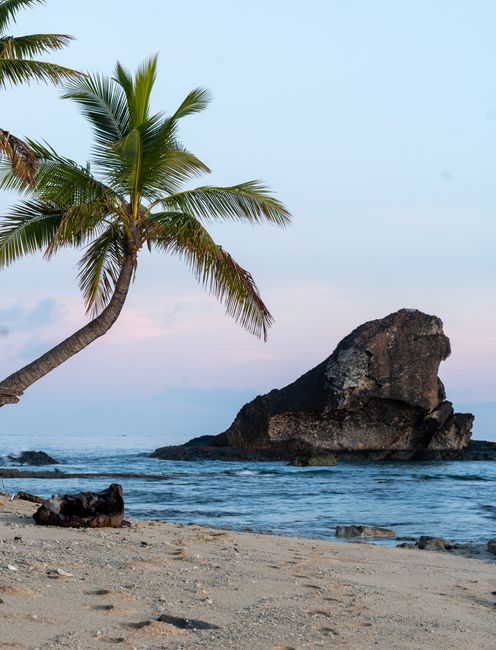
Coral Coast Travel Guide
Plan a trip to Fiji's Coral Coast on Viti Levu: Natadola Beach, the Sigatoka Sand Dunes National Park, Tavuni Hill Fort, the Kula Wild…
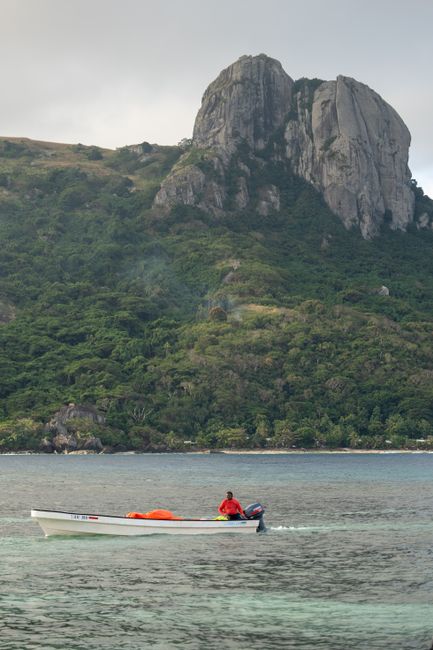
Mamanuca Islands Travel Guide
Plan a trip to the Mamanuca Islands, Fiji: which island to choose, from family resorts on Malolo Lailai and Castaway to adults-only Tokoriki and…
Nadi Travel Guide
Plan a trip to Nadi, Fiji's gateway: the Sri Siva Subramaniya Temple, Nadi Market, the Garden of the Sleeping Giant and Sabeto mud pools,…
Yasawa Islands Travel Guide
Plan a trip to Fiji's Yasawa Islands: the Yasawa Flyer from Port Denarau and its 2026/27 Bula Pass prices, island-hopping from Kuata and Waya…
Where to stay: resorts, overwater bures and island lodges
Fiji has accommodation for almost every budget, and the choice of island usually matters more than the choice of hotel.
- Island resorts (Mamanucas and Yasawas): most visitors stay at a single-resort island. Rooms are usually called bures, thatched or tin-roofed cottages, many right on the sand. Because there are no shops or restaurants beyond the resort on most islands, meal plans are common and sometimes compulsory, so compare the total price including food and boat transfers.
- Overwater bures: Fiji has only a handful, mainly in the Mamanucas and at Momi Bay on the mainland, so they book out early. Many resorts offer beachfront or pool bures instead.
- Denarau and Nadi: large chain hotels on Denarau, with easy airport and ferry access; budget guesthouses and hostels at Wailoaloa Beach.
- The Coral Coast: family resorts with kids’ clubs, mid-range hotels and some budget lodges, plus easy access to activities on the mainland.
- Backpacker islands: the Yasawas and some Mamanuca islands have dorm beds and simple bures with meals included, often booked as part of a pass on the Yasawa Flyer.
- Village stays: some villages offer homestays; you are expected to bring a sevusevu gift of kava and follow village customs.
Best time to visit Fiji
Fiji has a tropical climate with two seasons. The dry season runs from about May to October, with lower humidity, cooler nights and the most sunshine. The wet season runs from November to April: hotter and more humid, with heavy downpours, especially on the windward east side around Suva, and the risk of tropical cyclones. Rain falls very differently across the islands: Nadi and the western islands, in the rain shadow of Viti Levu’s mountains, get about two-thirds of the rain that Suva does, and many wet-season days still have long sunny spells.
| Month | Nadi high / low | Nadi rain | Suva high / low | Suva rain |
|---|---|---|---|---|
| Jan | 31 / 23 °C (89 / 74 °F) | 365 mm (14.4 in) | 31 / 25 °C (88 / 76 °F) | 343 mm (13.5 in) |
| Feb | 32 / 23 °C (89 / 74 °F) | 336 mm (13.2 in) | 32 / 25 °C (89 / 76 °F) | 276 mm (10.9 in) |
| Mar | 31 / 23 °C (88 / 74 °F) | 351 mm (13.8 in) | 31 / 25 °C (89 / 76 °F) | 340 mm (13.4 in) |
| Apr | 31 / 23 °C (87 / 73 °F) | 188 mm (7.4 in) | 30 / 24 °C (87 / 75 °F) | 335 mm (13.2 in) |
| May | 30 / 21 °C (85 / 70 °F) | 92 mm (3.6 in) | 29 / 23 °C (84 / 73 °F) | 233 mm (9.2 in) |
| Jun | 29 / 20 °C (84 / 68 °F) | 57 mm (2.2 in) | 28 / 22 °C (82 / 72 °F) | 156 mm (6.2 in) |
| Jul | 29 / 19 °C (83 / 67 °F) | 51 mm (2.0 in) | 27 / 21 °C (81 / 70 °F) | 136 mm (5.4 in) |
| Aug | 29 / 19 °C (83 / 67 °F) | 65 mm (2.5 in) | 27 / 21 °C (81 / 71 °F) | 144 mm (5.7 in) |
| Sep | 29 / 20 °C (85 / 69 °F) | 72 mm (2.8 in) | 28 / 22 °C (82 / 71 °F) | 188 mm (7.4 in) |
| Oct | 30 / 21 °C (86 / 70 °F) | 87 mm (3.4 in) | 29 / 23 °C (83 / 73 °F) | 248 mm (9.8 in) |
| Nov | 31 / 22 °C (87 / 72 °F) | 127 mm (5.0 in) | 30 / 23 °C (85 / 74 °F) | 247 mm (9.7 in) |
| Dec | 31 / 23 °C (89 / 73 °F) | 210 mm (8.3 in) | 31 / 24 °C (87 / 76 °F) | 344 mm (13.6 in) |
Figures are the 1991–2020 climate normals that the Fiji Meteorological Service submitted to the World Meteorological Organization (WMO), for Nadi Airport and Laucala Bay in Suva: mean daily maximum and minimum temperature and mean monthly rainfall. Nadi records about 2,000 mm (79 in) of rain a year on 103 days with at least 1 mm, and about 2,480 hours of sunshine; Suva gets nearly 3,000 mm (118 in) on 188 days. Each destination guide has its own month-by-month table.
Crowds and prices through the year
The busiest periods are the Australian and New Zealand school holidays (especially late June to July, late September to early October and the Christmas holidays) and the dry-season months of July to September, when resort prices peak. November, February and March are usually the cheapest months, with more rain and some cyclone risk. Diving is good all year; visibility is often best in the cooler dry season.
Seasons for wildlife, surf and festivals
- Manta rays: from about May to October in the channel between Drawaqa and Nanuya Balavu islands in the Yasawas.
- Surf: the biggest swells hit the Mamanuca reef breaks, such as Cloudbreak, from about April to October; the wet season brings smaller, cleaner days.
- Fiji Day (10 October): independence day, with parades and celebrations.
- Diwali: the Hindu festival of lights, a public holiday, usually in October or November; homes in Nadi, Lautoka and Suva are lit with lamps.
- Bula Festival in Nadi and the Hibiscus Festival in Suva are popular local carnivals; dates vary from year to year.
How long to stay: sample itineraries
Most visitors fly into Nadi and divide their time between one or two islands and the mainland. Inter-island boats leave in the morning, so plan a night in Nadi or Denarau at each end if your flight lands late or leaves early.
5 days: one island
Arrive in Nadi, take the boat from Port Denarau to a Mamanuca island resort for four nights, and spend your time snorkeling, kayaking and relaxing, with a day trip to the Cloud 9 floating bar or Monuriki, the island from the movie Cast Away.
7 to 10 days: island-hopping
One night in Nadi, then the Yasawa Flyer north for six to eight nights split among two to four island resorts, swimming with the mantas in season and visiting the Sawa-i-Lau caves, and back to Nadi for a final night or a few nights in the Mamanucas.
2 weeks: the islands and the main island
Mamanucas (3 nights), Yasawas (5), then a rental car or transfer along the Coral Coast (3), with a shark dive or rafting from Pacific Harbour, and a night in Suva (1) before flying out of Nausori or driving back to Nadi. Alternatively, swap the Yasawas for Taveuni’s diving and waterfalls, a short Fiji Link flight away.
Entry, money and costs
Entry requirements (as of October 2026)
Fiji’s Ministry of Immigration lists the countries whose citizens do not need a visa, including the United States, Canada, the United Kingdom, European Union countries, Australia and New Zealand. On arrival you receive a visitor permit for a period that can range from a few days up to a maximum of four months, and you can extend it once by up to two months. To enter you need:
- a passport valid for at least six months from the date you enter Fiji;
- a return or onward ticket;
- confirmation of your accommodation for the length of your visit.
Citizens of countries that are not on the exempt list must get a visa before traveling. Check the current list on the Ministry of Immigration website before you book, as it can change.
The passenger arrival card
Fiji still uses a paper Passenger Arrival Card, handed out by your airline, cruise line or flight crew before landing. Fill in both sides clearly; you present it with your passport at immigration, and the customs and biosecurity questions are on the same card. You must tick “Yes” in the customs section if you carry restricted goods, FJ$10,000 or more in cash (or the equivalent in foreign currency), or biosecurity risk items.
Customs and biosecurity
The Biosecurity Authority of Fiji asks you to declare all food, plants, seeds, fruit, wooden items, animal products and used outdoor equipment such as camping gear, sports shoes and tools, or drop them in the amnesty bins at the border. Failing to declare can bring an on-the-spot fine of FJ$400 (about US$177) and, if prosecuted, a fine of up to FJ$20,000 and six months in prison. Travelers aged 18 and over can bring in duty-free up to 3 liters of spirits, or 4.5 liters of wine or beer, up to 200 cigarettes or 200 g of tobacco, and other personal goods worth up to FJ$2,000.
Departure tax: already in your ticket
Fiji’s departure tax is collected through airline tickets, so there is nothing to pay at the airport. Under the 2025–2026 National Budget it rose from FJ$170 to FJ$200 (about US$88) on 1 August 2025; it appears in the taxes on your ticket.
Money, cards and taxes
The Fijian dollar is the only currency in everyday use. ATMs are found in Nadi, Denarau, Suva, Lautoka and at Nadi Airport, which has a bank counter open around the clock, but there are no banks on the Yasawa Islands and few on the outer islands, so bring enough cash for village visits, markets and small purchases. Cards are accepted at resorts, larger restaurants and tour operators, which often add a 2.5–3% card fee. VAT is 12.5%, cut from 15% on 1 August 2025 and included in displayed prices. From 1 September 2026, a new 5% Tourism Services Tax applies to tourism businesses with a turnover above FJ$2 million, so larger hotels and tour operators may show it on your bill. Visitors can claim back VAT on some purchases at the airport under the Tourist VAT Refund Scheme.
Tipping
Tipping is not part of Fijian culture and is never expected. Many resorts have a staff Christmas fund box at reception, which is the most welcome way to thank the whole team.
Typical travel costs
| Item (as of October 2026) | Fijian dollars | About US dollars |
|---|---|---|
| Departure tax (included in ticket) | FJ$200 | US$88 |
| Bula Pass, unlimited Yasawa Flyer trips for 5 days / 15 days | FJ$639 / FJ$945 | US$282 / US$417 |
| South Sea Island full-day trip, adult (lunch and drinks included) | FJ$285 | US$126 |
| Malamala Beach Club full-day pass | FJ$215 | US$95 |
| Coach transfer, Nadi hotels to Port Denarau, adult one way | FJ$11 | US$5 |
| Local beer at a bar or restaurant | about FJ$8–15 | about US$4–7 |
| Curry or kokoda in a casual restaurant | about FJ$18–35 | about US$8–15 |
| Hostel dorm bed in Nadi | about FJ$35–60 | about US$15–27 |
| Mid-range hotel room in Nadi or on the Coral Coast | about FJ$250–450 | about US$110–200 |
| Island resort bure for two, per night | about FJ$500–1,500 | about US$220–660 |
Boat fares and day trips are the operators’ published prices for travel from 1 September 2026 to 31 March 2027; a fuel surcharge has applied to South Sea Cruises resort transfers since 7 April 2026. Drinks, meals and rooms are typical ranges, not official figures, and vary widely by island and season. Conversions use the Reserve Bank of Fiji’s rate of US$0.44 to FJ$1 on 5 October 2026.
Getting there and getting around
Arrival airports
Nadi International Airport (NAN), about 9 km (6 miles) north of Nadi town, handles almost all international flights. Fiji Airways, the national airline, flies nonstop from cities in Australia and New Zealand, such as Sydney, Brisbane, Melbourne and Auckland, and from North America, Asia and other Pacific islands; Qantas, Virgin Australia, Air New Zealand and Jetstar also fly in. Flights from Sydney take about four hours, from Auckland about three, and from Los Angeles about 11. Nausori Airport (SUV), near Suva, has a few regional flights. Most cruise ships call at Suva, Lautoka or Denarau.
Domestic flights
Fiji Link, Fiji Airways’ regional airline, flies from Nadi and Suva to about a dozen destinations, including Labasa and Savusavu on Vanua Levu, Taveuni and Kadavu. Small planes mean strict baggage limits, usually 15 kg (33 lb) of checked baggage on domestic flights, and surfboards may travel on a later flight. Seaplanes and helicopters fly from Nadi to many Mamanuca and Yasawa resorts for those who prefer a scenic shortcut.
Boats to the islands
South Sea Cruises runs fast catamarans from Port Denarau to most Mamanuca and Yasawa resorts every day, with several departures to the closer islands. Its sister brand Yasawa Adventures Fiji, formerly Awesome Adventures, runs the Yasawa Flyer, a large catamaran with an air-conditioned lounge, bar and travel desk, which leaves Port Denarau each morning at about 8:45 a.m., calls at South Sea Island and the Yasawa resorts as far as the Blue Lagoon area, and returns by about 6 p.m. Check in 30 minutes before departure at the terminal at Port Denarau. Flexible hop-on, hop-off passes (the Bula Pass for boat transfers only, the Yasawa Pass including accommodation) cover 5 to 15 days. Coaches link most Nadi, Denarau and Wailoaloa hotels with the marina, and an early coach meets passengers at Nadi Airport in time for the Yasawa Flyer.
Driving and road transport
Queens Road follows Viti Levu’s south and west coasts from Nadi to Suva, about four to five hours’ drive via the Coral Coast; Kings Road goes the long way round the north via Ba and Rakiraki. You can drive on a valid overseas license in English. Drive on the left, slow down for villages, speed humps, animals and pedestrians, and avoid driving after dark if you can. Rental cars are available at Nadi Airport and in town. Local buses are cheap and frequent along Queens Road, and express coaches link Nadi and Suva. Taxis are plentiful in towns; agree on the fare or check that the meter is running.
Ferries to Vanua Levu and Taveuni
Car and passenger ferries cross from Viti Levu to Vanua Levu and Taveuni several times a week. They are slow and basic but inexpensive; most visitors fly instead.
Culture, food and everyday etiquette
iTaukei and Indo-Fijian culture
About half of Fijians are iTaukei, the Indigenous people of Fiji, and most of the rest are Indo-Fijians, descendants of laborers brought from India from 1879 to work on the sugar plantations, with smaller Chinese, European, Rotuman and other Pacific Islander communities. Village life is organized around the chief, the church and the extended family, and Sunday is a day of church and rest in villages. The kava ceremony, in which the slightly peppery, mildly numbing drink made from the root of the yaqona plant is shared from a coconut-shell cup, welcomes guests to villages and resorts alike: clap once before you receive the cup, say “bula” and drink it in one go.
Visiting a village
If you visit a village, go with a guide or as an invited guest, and bring a small bundle of kava root as a sevusevu gift to present to the chief. Dress modestly, covering shoulders and knees (a sulu, or sarong, is ideal), take off your hat and sunglasses, don’t touch anyone’s head, and speak quietly. Ask before taking photographs.
Food and drink
Fijian food mixes Pacific, Indian and Chinese influences. Try kokoda, raw fish marinated in lime and coconut cream; lovo, meat, fish and root vegetables cooked in an earth oven; palusami, taro leaves baked with coconut cream; Indo-Fijian curries with roti; and tropical fruit from the markets. Fiji Bitter and Fiji Gold are the local beers, and Fiji’s rum distilled from sugarcane is a good souvenir. Tap water is treated in the main towns, but many visitors drink bottled or filtered water, especially on the islands.
Safety, health and connectivity
Safety
Fiji is a relaxed and friendly destination; most risks are natural, at sea or on the road.
- Cyclone season (November to April): tropical cyclones can bring destructive winds, heavy rain, flooding and storm surge, and boat services stop when warnings are issued. In April 2026, Tropical Cyclone Vaianu suspended day trips and some resort transfers in the Mamanuca and Yasawa islands, and boats ran at reduced speed for several days afterward because of debris in the water. Follow the Fiji Meteorological Service and your resort’s instructions, and have travel insurance that covers weather disruption.
- Reef cuts and currents: coral cuts infect easily in the tropics; wear reef shoes, clean any cut straight away and keep it covered. Currents can be strong in passes and channels, especially near reef breaks and at tide changes; snorkel with a guide or at the resort’s marked areas, and never swim alone beyond the reef.
- Sun: the tropical sun is fierce all year. Use reef-safe sunscreen, a hat and a rash vest, and drink plenty of water.
- Dengue and other mosquito-borne diseases: dengue occurs in Fiji, with outbreaks most likely in the wet season. Use repellent day and night and choose rooms with screens or nets.
- Marine life: don’t touch or stand on coral, and avoid stonefish and cone shells in shallow water. Shark dives in Beqa Lagoon are run by licensed operators with strict briefings.
- Roads: drive defensively, especially at night, when pedestrians and animals are hard to see.
- Petty crime: low in resorts; in Nadi and Suva, keep valuables out of sight and take a taxi at night.
Health
Medical facilities are basic outside Suva, Lautoka and Nadi, and serious cases may need evacuation to Australia or New Zealand, so make sure your travel insurance includes medical evacuation. Bring any prescription medicines with a doctor’s letter. There are no required vaccinations for travelers arriving from most countries.
Connectivity and power
Vodafone Fiji and Digicel have counters at Nadi Airport selling SIM cards and eSIMs. Coverage is good on Viti Levu and patchy on the outer islands; many island resorts have Wi-Fi in the main building only, and some run generators for electricity at set hours. Power is 240 volts, 50 Hz, with the same Type I angled flat-pin plugs as in Australia and New Zealand.
Things to do: snorkeling, diving, island-hopping and culture
Fiji is made for the water: snorkeling straight off the beach at island resorts, diving the soft-coral walls of the Somosomo Strait or the bull shark dive in Beqa Lagoon, surfing the Mamanuca reef breaks, sailing and cruising between the islands, kayaking and paddleboarding in calm lagoons, and swimming with manta rays in the Yasawas. On land, walk to island summits for sunset views, visit a village and a kava ceremony, explore the Sigatoka Sand Dunes, raft the Navua River, soak in the Sabeto mud pools, browse Suva’s market and take a cooking class to learn kokoda and lovo.
What to pack
Pack light, quick-drying clothes, swimwear, a rash vest, reef shoes, a wide-brimmed hat, polarized sunglasses and reef-safe sunscreen, plus insect repellent and a light rain jacket for the wet season. Bring a sulu or sarong and a T-shirt that covers your shoulders for village visits, a dry bag for boat trips, seasickness tablets, a waterproof phone pouch and some cash in Fijian dollars for the islands. Plugs are Type I.
Fiji travel FAQ
Do I need a visa to visit Fiji?
Not if you are a citizen of a visa-exempt country, including the United States, Canada, the UK, EU countries, Australia and New Zealand. You get a visitor permit on arrival of up to four months. You need a passport valid for six months from your arrival, a return or onward ticket and confirmed accommodation.
Is there an arrival card for Fiji?
Yes. Fiji still uses a paper Passenger Arrival Card, which your airline or cruise ship gives you before arrival. It covers immigration, customs and biosecurity questions; complete both sides and hand it in with your passport.
Do I have to pay a departure tax when leaving Fiji?
No, not at the airport. The departure tax, FJ$200 since 1 August 2025, is included in the taxes on your airline ticket.
What currency is used in Fiji?
The Fijian dollar (FJ$). FJ$1 was worth about US$0.44 in early October 2026. Bring cash for the outer islands, where there are no banks or ATMs.
When is the best time to visit Fiji?
May to October is the dry season, with sunny days, cooler nights and the best conditions for island-hopping. November to April is hotter and wetter, and it is the cyclone season, but it is also cheaper and quieter outside school holidays.
Which is better, the Mamanuca or the Yasawa Islands?
The Mamanucas are closer to Nadi, with more resorts, family facilities and day trips. The Yasawas are farther, wilder and better for island-hopping and swimming with manta rays from May to October. Many visitors combine both.
How do I get to the islands from Nadi?
Most visitors take a fast catamaran from Port Denarau with South Sea Cruises or the Yasawa Flyer. Seaplanes and helicopters fly from Nadi Airport to many resorts, and some resorts run their own boat transfers.
Does Fiji have overwater bungalows?
Only a few, mainly in the Mamanuca Islands and at Momi Bay on the main island. They book out early, so reserve well ahead; many resorts offer beachfront bures with private pools instead.
Do I need to tip in Fiji?
No. Tipping is not expected. If you want to thank the staff, add something to the resort’s staff Christmas fund.
Is Fiji safe for tourists?
Generally yes. The main risks are natural: cyclones from November to April, strong currents and coral cuts, the tropical sun and mosquito-borne diseases such as dengue. In towns, take normal care with valuables.
How many days do you need in Fiji?
At least five days for one island resort, and 10 to 14 days to combine the Mamanucas, the Yasawas and the Coral Coast.
Can I drink the tap water in Fiji?
Water is treated in the main towns and at most large resorts, but many visitors stick to bottled or filtered water, especially on the outer islands and after heavy rain.
What plug adapter do I need for Fiji?
Type I, the angled two- or three-pin plug used in Australia and New Zealand. The supply is 240 volts.
Sources and last review
Researched and last reviewed on 5 October 2026. Visa exemptions, the visitor permit and entry conditions come from Fiji’s Ministry of Immigration; the arrival card, customs allowances, currency declaration and biosecurity penalties from the Fiji Revenue and Customs Service; the departure tax and VAT rate from the Ministry of Finance’s 2025–2026 Citizens’ Guide to the National Budget; the Tourism Services Tax from the Fiji Revenue and Customs Service and its 2026–2027 budget summary; the exchange rate from the Reserve Bank of Fiji; emergency numbers from Fiji’s National Disaster Management Office; boat schedules, passes, fares and the April 2026 cyclone disruption from South Sea Cruises and Yasawa Adventures Fiji; Fiji Link destinations and baggage from Fiji Airways; climate from the Fiji Meteorological Service’s 1991–2020 normals as published by the WMO; and area and population from Wikidata. Meal, drink and room prices, flight times, drive times, festival dates and some seasonal patterns are general estimates. Prices and rules change, so check the official sites before you go.
Plugs and power in Fiji
Fiji uses 240 V, 50 Hz and these plugs (left) and wall sockets (right):
All plug types and voltages by country → · Check what you need to pack →
Plan your trip
Partner links: TravelerCenter may earn a commission if you book, at no extra cost to you.