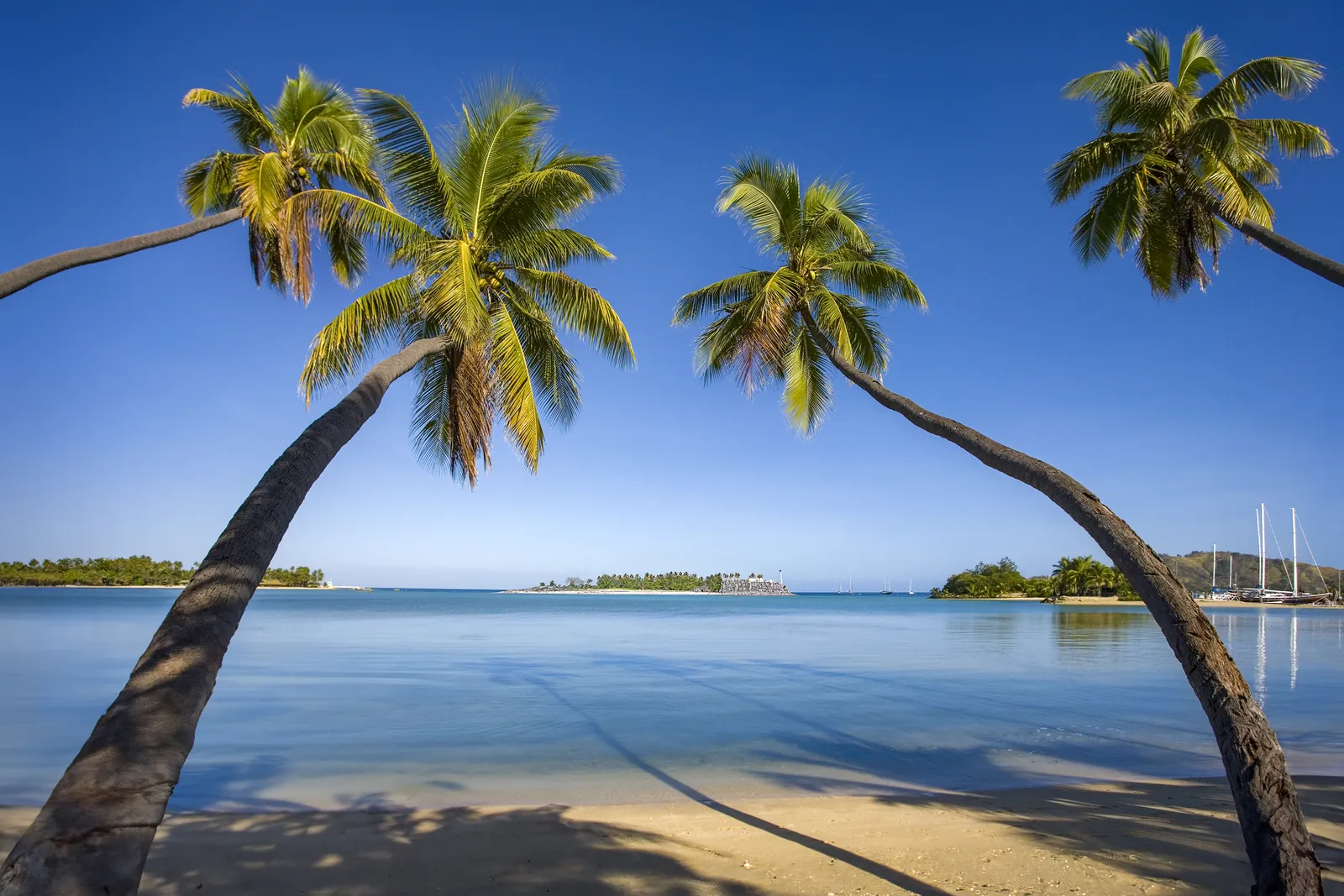
Short answer: For a first trip, the top places to visit in Fiji are the resort islands of the Mamanuca group, the wilder Yasawa Islands, Natadola Beach and the Coral Coast, the Sigatoka Sand Dunes and the shark dives and rivers of Pacific Harbour. Round out the list with Nadi and the Sabeto Valley, the waterfalls and soft corals of Taveuni, the capital Suva, the historic port of Levuka and the reefs of Kadavu.
Fiji has more than 300 islands, and almost every trip starts at Nadi, on the dry western side of Viti Levu, the main island. The list is ordered the way we would recommend places to a first-time visitor: the classic islands first, then the main island, then the outer islands for a longer trip. Practical details are as of October 2026; for entry rules, the arrival card and money, see our Fiji travel guide.
1. The Mamanuca Islands
Why it made the list: a scatter of about 20 small islands off Viti Levu’s west coast, the Mamanucas are the Fiji of the travel posters: palm-covered islands ringed by white sand and turquoise lagoons, most with a single resort. They sit in the rain shadow of the main island’s mountains, so they are among the sunniest places in Fiji, and you can be on a beach within a couple of hours of landing.
Best time to go: May to October, the dry season, which also brings the biggest surf; July to September is the busiest. November to April is hotter, wetter and the cyclone season, but cheaper.
Don’t miss: a swim and a pizza at Cloud 9, a two-level floating bar on the reef, and a day trip to Monuriki, the uninhabited island where the movie Cast Away was filmed. Expert surfers come for Cloudbreak.
Getting there and how long: fast catamarans from Port Denarau take 30 minutes to two hours, with several departures a day; seaplanes and helicopters fly from Nadi Airport in 10 to 20 minutes. Stay four to seven nights on one or two islands.
Practical note: check in at the South Sea Cruises desk at Port Denarau 30 minutes before departure. On most islands you eat where you stay, so compare resort prices including meals and boat transfers. See our Mamanuca Islands travel guide.
2. The Yasawa Islands
Why it made the list: a chain of about 20 volcanic islands stretching some 80 km (50 miles) north of the Mamanucas, the Yasawas are wilder and higher, with grassy hills, long beaches, small villages and no roads. They are Fiji’s best island-hopping destination.
Best time to go: May to October, for dry weather and the manta rays, which gather in the channel between Drawaqa and Nanuya Balavu islands in those months.
Don’t miss: swimming with manta rays, the limestone Sawa-i-Lau caves and the Blue Lagoon at the northern end of the chain, and a village visit with a kava ceremony.
Getting there and how long: the Yasawa Flyer catamaran leaves Port Denarau at about 8:45 a.m. daily, works its way north, and is back by about 6 p.m.; resorts send small boats out to meet it. Stay five to ten nights to island-hop.
Practical note: the Bula Pass gives unlimited Flyer trips from FJ$639 for five days, according to the operator, but accommodation is booked separately. There are no banks or ATMs in the Yasawas, so bring cash. See our Yasawa Islands travel guide.
3. Natadola Beach and the Coral Coast
Why it made the list: the Coral Coast is the sunny southern shore of Viti Levu, a ribbon of resorts, villages and beaches behind a fringing reef. At its western end, Natadola has a long white-sand beach with a gap in the reef, so it is the main island’s favorite swimming beach at any tide.
Best time to go: May to October for dry, sunny weather and cooler nights.
Don’t miss: a swim at Natadola, snorkeling in the lagoons at high tide and reef walks at low tide, and a village visit arranged by your resort.
Getting there and how long: about 60 to 90 minutes by road from Nadi Airport along the Queens Road. Stay three to five days.
Practical note: the Coral Coast lets you mix beach days with the rest of Fiji, and coach pickups link it with day trips to the Mamanucas, from about FJ$215. See our Coral Coast travel guide.
4. Sigatoka Sand Dunes National Park
Why it made the list: Fiji’s first national park protects a stretch of tall sand dunes at the mouth of the Sigatoka River, where archaeologists have found some of the oldest evidence of people in Fiji. It is an unexpected landscape for a tropical island.
Best time to go: the dry season, May to October, and early in the morning, before the sand gets very hot.
Don’t miss: the marked trails over the dunes and through forest to the windswept beach, then the Tavuni Hill Fort above the river, built in the 18th century.
Getting there and how long: the visitor center is on the Queens Road near Sigatoka, on the Coral Coast. Allow half a day.
Practical note: buy tickets at the visitor center, take water and a hat, and don’t swim at the river mouth. See our Coral Coast travel guide.
5. Pacific Harbour and Beqa Lagoon
Why it made the list: at the eastern end of the Coral Coast, about an hour from Suva, Pacific Harbour is Fiji’s adventure base: shark dives in Beqa Lagoon, whitewater rafting on the Upper Navua River and the firewalkers of Beqa Island.
Best time to go: May to October, when the weather is most settled.
Don’t miss: a shark dive with a licensed operator in Beqa Lagoon, for certified divers, or a rafting or longboat trip on the Navua River to waterfalls and villages.
Getting there and how long: about an hour by road from Suva, at the eastern end of the Queens Road along the Coral Coast. Two or three days is enough.
Practical note: shark dives come with strict briefings and guides; choose an established operator. Firewalking performances are held at some resorts. See our Coral Coast travel guide.
6. Nadi, Denarau and the Sabeto Valley
Why it made the list: Nadi is Fiji’s front door, and it rewards a day or two: the Sri Siva Subramaniya Swami Temple, the largest Hindu temple in the South Pacific, a busy produce market and curry houses, and, at the foot of the mountains, the Sabeto Valley’s orchid garden and mud pools.
Best time to go: May to October, the dry season; Nadi gets more sunshine and less rain than the east of Viti Levu.
Don’t miss: the Garden of the Sleeping Giant’s orchids, a soak in the Sabeto hot springs and mud pools, and dinner at the Port Denarau marina.
Getting there and how long: Nadi International Airport is about 9 km (6 miles) north of the town center, and Port Denarau is about 20 minutes away. One or two nights before or after the islands.
Practical note: island boats leave in the morning, so plan a night in Nadi or Denarau if your flight lands late. Coaches link most hotels with Port Denarau for FJ$11 per adult. See our Nadi travel guide.
7. Taveuni
Why it made the list: Taveuni, known as the Garden Island, is volcanic, green and quiet, with rainforest waterfalls on land and some of the world’s best soft-coral diving offshore in the Somosomo Strait.
Best time to go: May to October, the dry season. According to Tourism Fiji, June to August is the time to look for manta rays and whales in the strait.
Don’t miss: the triple Tavoro Waterfalls in Bouma National Heritage Park, where the first and tallest fall is an easy 10-minute walk from the visitor center, and a dive or snorkel on the Rainbow Reef.
Getting there and how long: a short Fiji Link domestic flight. Stay three or four days.
Practical note: the trail to the upper falls is steep and slippery in places, so wear good shoes and go with a local guide. Domestic flights allow 15 kg of checked baggage, so pack light. We do not have a Taveuni page yet; see our Fiji travel guide.
8. Suva
Why it made the list: Fiji’s capital is a lively, multicultural Pacific city with colonial buildings, a huge municipal market and the Fiji Museum. It is a working city rather than a resort, and the best place to learn about Fijian history and culture.
Best time to go: May to October. Suva gets much more rain than Nadi, nearly 3,000 mm (118 in) a year.
Don’t miss: the Fiji Museum in Thurston Gardens, open daily from 9 a.m. to 4:30 p.m. according to the museum, the municipal market, and the rainforest of Colo-i-Suva Forest Park in the hills behind the city.
Getting there and how long: by road from Nadi along the Coral Coast, or by Fiji Link to Nausori, Suva’s airport. Stay a night or two.
Practical note: carry an umbrella in any season. The museum closes on Christmas Day, New Year’s Day, Easter Sunday and Diwali. We do not have a Suva page yet; see our Fiji travel guide.
9. Levuka, Ovalau
Why it made the list: Levuka, on the island of Ovalau, was Fiji’s first colonial capital, and its historic port town of wooden shopfronts was inscribed on the UNESCO World Heritage List in 2013. It is Fiji’s most atmospheric step back in time.
Best time to go: May to October, the dry season.
Don’t miss: a slow walk along the waterfront and its old shopfronts, churches and lodges, and the views from the hills behind town.
Getting there and how long: Ovalau lies off Viti Levu’s east coast, reached by ferry or small plane from the Suva area. Allow two nights.
Practical note: facilities are simple and transport is limited, so book ahead and keep your plans flexible. We do not have a Levuka page yet; see our Fiji travel guide.
10. Kadavu
Why it made the list: south of Viti Levu, Kadavu is one of Fiji’s least developed islands, with simple eco-lodges, birdwatching and the Great Astrolabe Reef, a favorite of divers.
Best time to go: May to October, when seas are calmest for diving and boat transfers.
Don’t miss: diving or snorkeling the Great Astrolabe Reef, and village visits arranged by your lodge.
Getting there and how long: Fiji Link flies to Kadavu, and lodges collect guests by boat. Stay four nights or more.
Practical note: bring what you need from the main island, as shops and cash machines are scarce. We do not have a Kadavu page yet; see our Fiji travel guide.
How to fit them into one trip
Most visitors fly into Nadi and divide their time between one or two island groups and the main island. Inter-island boats leave in the morning, so plan a night in Nadi or Denarau at each end if your flights are late or early.
Five days: a Mamanuca island resort for four nights, with a day trip to Cloud 9 or Monuriki.
Seven to ten days: one night in Nadi, then the Yasawa Flyer north for six to eight nights split among two to four island resorts, with the mantas in season, and back to Nadi.
Two weeks: the Mamanucas (three nights) and the Yasawas (five), then the Coral Coast (three) with the Sigatoka dunes and a day at Pacific Harbour, and a night in Suva. Swap the Yasawas for Taveuni if diving is your priority.
Timing matters more than anywhere on this list: May to October is dry and settled, while November to April is the wet and cyclone season. Our best time to visit Fiji guide goes month by month, and our AI trip planner builds the day-by-day plan for your dates.
Plan your trip
Start with our Fiji travel guide for entry rules, the arrival card, the departure tax and money. Use the AI trip planner to turn this list into a route, check what to expect on your dates with the Destination weather tool, and build your beach list with the packing list tool.
Frequently asked questions
What is the most beautiful place in Fiji?
Most travelers name the Yasawa Islands, with their high green hills, long white beaches and the Blue Lagoon, or the small palm-covered islands of the Mamanucas. Underwater, Taveuni’s Rainbow Reef is the standout.
How many days do you need in Fiji?
Five days is enough for one island resort. A week to ten days lets you island-hop through the Yasawas, and two weeks covers the islands and the main island’s Coral Coast.
What is the best place in Fiji for first-time visitors?
The Mamanuca Islands. They are a short boat ride from Nadi, sunny and easy, with resorts for families, couples and budget travelers.
Is the Mamanucas or the Yasawas better?
The Mamanucas are closer and easier, with more resort choice and day trips. The Yasawas are wilder and more remote, best for island-hopping, village life and swimming with manta rays from May to October.
When is the best time to visit Fiji?
May to October, the dry season, with the most sunshine and lower humidity. July to September is the busiest; November, February and March are usually the cheapest months, but wetter, with cyclone risk.