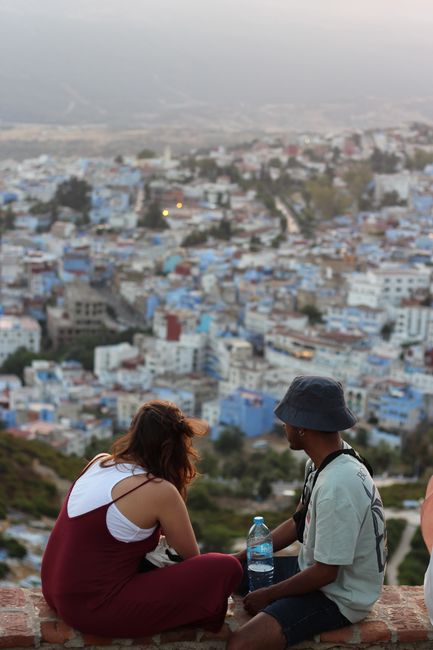
Chefchaouen, often just called Chaouen, is the famous “blue town” of Morocco: a small medina of lanes, stairways and houses washed in every shade of blue, tucked below two peaks of the Rif Mountains in the north of the country. It was founded in 1471 by Moulay Ali Ben Rached as a fortress against the Portuguese, and for centuries it was settled by Muslim and Jewish refugees from Andalusia, whose whitewashed houses, tiled roofs and wrought-iron windows still give it a Spanish feel. The town stayed closed to most outsiders until the Spanish arrived in 1920. Today it’s one of the most photographed places in Morocco and a favorite stop between Fez and Tangier, but it remains calm and friendly, with little of the hassle of the big cities. Wander the blue lanes in the early morning, visit the 15th-century Kasbah on the main square, Plaza Uta el-Hammam, walk up to the Spanish Mosque for sunset, and use the town as a base for hiking in Talassemtane National Park and to the Akchour waterfalls. At about 600 m (2,000 ft), it’s cooler than the plains, with fresh mountain air in summer and cold, wet winters.
Right now in Chefchaouen
- Wed 15–24°C 59–75°F 18 mm Mostly clear
- Thu 13–27°C 55–80°F Mostly clear
- Fri 14–21°C 58–70°F 5 mm Rain
Weather: MET Norway (CC BY 4.0)
Top tours in Chefchaouen
See all tours for Chefchaouen →
From local operators, with prices and reviews; you check availability and book on Viator, our partner. We may earn a commission at no extra cost to you. How we earn money
Chefchaouen at a glance
- Best for: the blue medina, photography, slow mornings, mountain views, hiking in the Rif and waterfalls.
- How long: 2 nights for the town; 3–4 with hiking or Akchour.
- Best time: April to June and September to October; winters are cold and rainy.
- Getting there: CTM bus or private transfer from Fez (about 4 hours), Tangier (2.5–3 hours) or Tetouan (about 1.5 hours). There’s no train.
- Getting around: on foot; the medina is steep and car-free. Taxis for the bus station and trailheads.
- Good to know: these are people’s homes, so ask before photographing residents and don’t block doorways.
- Before you go: visas, money and general safety are in our Morocco travel guide.
Chefchaouen areas and who each one suits
The medina climbs the hillside from the main square, Plaza Uta el-Hammam, toward the Ras el-Maa spring at the top. Below it, the small new town has the bus station, banks and modern hotels.
Around Plaza Uta el-Hammam
The cobbled main square, shaded by trees and lined with cafés, faces the Kasbah and the Grand Mosque. Guesthouses nearby are the most convenient and the liveliest in the evening. Best for first-time visitors and short stays.
The upper medina and Ras el-Maa
The steeper lanes of the Souika and Onsar quarters, near the spring and the river, are among the bluest and quietest, with riads that have terraces overlooking the valley. Expect plenty of steps. Best for photographers, couples and longer stays.
The new town and the hillside hotels
Hotels along the road above or below the medina have parking, pools and views, and are good if you’re driving. The new town is practical but less atmospheric.
Where to stay in Chefchaouen
- Guesthouse near Plaza Uta el-Hammam: central, easy to find, close to cafés.
- Riad in the upper medina: quiet lanes, views and blue walls on your doorstep.
- Hillside hotel with parking: for drivers, with pools and views.
- Guesthouse in Akchour or the national park: for hikers who want an early start.
Top things to see in Chefchaouen
The blue medina
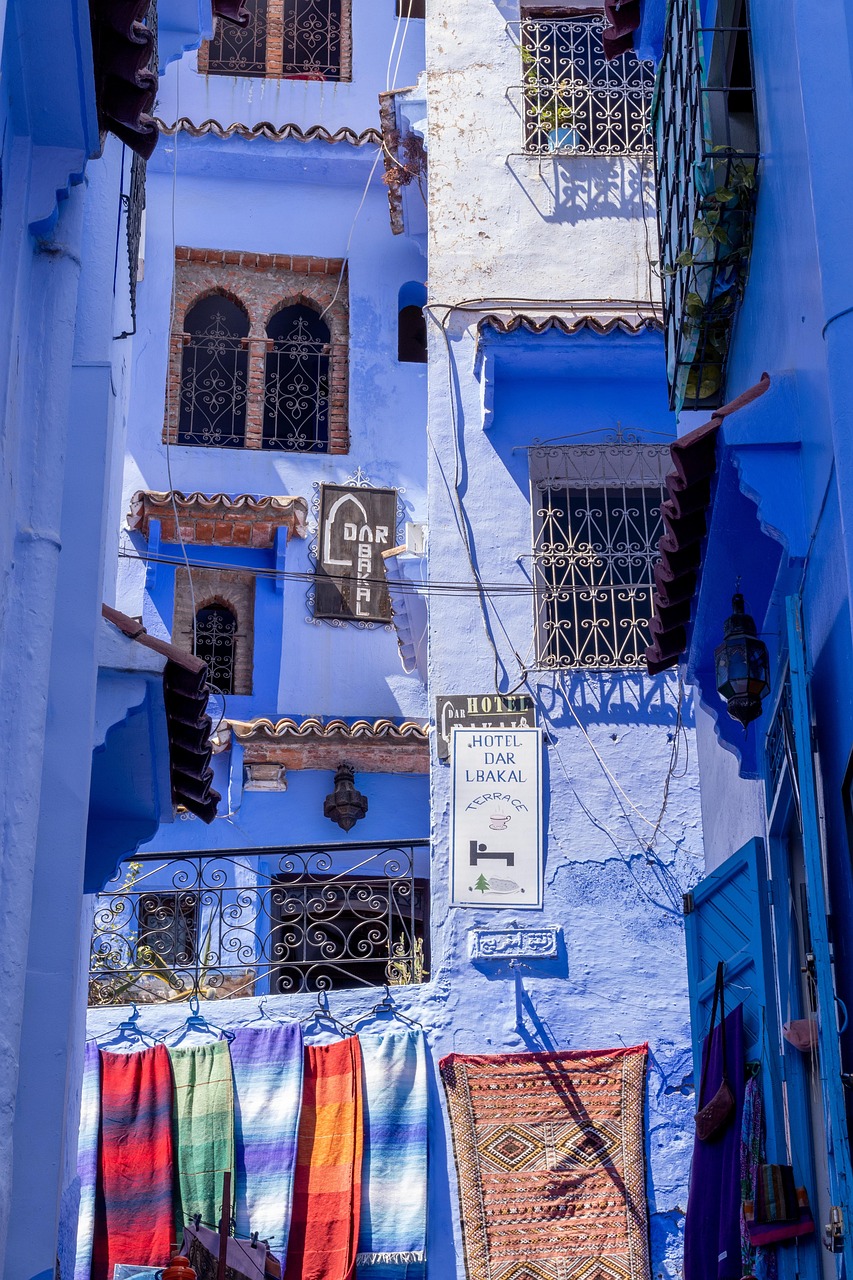
The joy of Chefchaouen is simply walking: up stairways, through archways and along lanes painted blue, with potted plants, carved doors and hand-woven blankets hanging outside small shops. Theories about the blue range from Jewish tradition to keeping mosquitoes away to tourism, and the color is renewed every year. Go early in the morning, before the day-trippers arrive and when the light is softest. The town is small enough that you can’t get lost for long; downhill always brings you back to the square.
The Kasbah
The Kasbah, on Plaza Uta el-Hammam, was built in 1471 during the reign of Emir Ali Ben Rached, according to the Ministry of Youth, Culture and Communication. Its ocher mud-brick walls with 13 towers enclose the old governor’s residence, a small mosque, a prison and a large Andalusian garden of about 2,300 m² (25,000 sq ft). Climb a tower for views over the blue rooftops and the square. The ministry lists entry at MAD 80 (about US$8) for foreign adults and MAD 40 for children aged 7 to 13; tickets can also be bought online.
Plaza Uta el-Hammam and the Grand Mosque
The main square is the heart of town life, with cafés serving mint tea and tagines under the trees. The 15th-century Grand Mosque, with its unusual octagonal minaret, stands beside the Kasbah; it is closed to non-Muslims.
Ras el-Maa
At the top of the medina, the Ras el-Maa spring gushes from the mountain into a small river, where women still wash clothes and carpets in the stone basins. Small cafés and bridges make it a pleasant place to sit, and it’s the start of the path to the Spanish Mosque.
The Spanish Mosque viewpoint
A 20–30 minute walk up the hill across the river from Ras el-Maa leads to the Spanish Mosque, a white mosque built by the Spanish in the 1920s and never used. It’s the best place to watch the sunset over the town and the valley; bring a flashlight for the walk back.
A town of refugees and traders
Chefchaouen grew in the 15th and 16th centuries as Muslims and Jews fleeing the Christian reconquest of Spain settled here, bringing Andalusian architecture, crafts and cooking. Its mountain position kept it isolated, and it was famously difficult for foreigners to visit until Spanish troops arrived in 1920; it then became part of the Spanish protectorate until Moroccan independence in 1956. Spanish is still widely understood here, alongside Arabic and French.
Other things to do in Chefchaouen
Food and drink
Chefchaouen is known for its fresh goat cheese, often served with olives and bread, for Rif honey, and for hearty dishes such as bissara (fava-bean soup), tagines with goat or lamb, and fried fish from the coast. Cafés around the square serve simple, good-value meals; alcohol is rarely available, except in a few hotels.
Crafts and shopping
Shop for hand-woven wool blankets and rugs, embroidered textiles, leather, woven baskets and the distinctive striped red-and-white cloths worn by Rif women. Prices are often lower than in Fez or Marrakech, and bargaining is relaxed. Several weaving workshops in the medina still use wooden hand looms, and the weavers are usually happy to show visitors how a blanket is made. Natural soaps, argan products and blue-pigment powders are popular small souvenirs.
Photographing the blue town
The most photographed spots are the stairways and doorways of the upper medina, the lanes around Ras el-Maa and the view from the Spanish Mosque. Morning light from about 7 to 9 a.m. is soft and the lanes are empty; midday sun flattens the blues. Some residents have decorated their doorsteps with pots and ask for a small tip for photos there; others prefer not to be photographed at all, so follow any signs and ask first. Drones need permission from Morocco’s civil aviation authority.
Hiking in the Rif
The mountains around town have trails for all levels, from the climb up Jebel el-Kelaa (about 1,600 m, or 5,250 ft) above the town to multi-day treks through the cedar and fir forests of Talassemtane National Park. Use a local guide for longer routes, as trails are not always well marked. See our hiking guide and our hiking shoes guide.
Day trips from Chefchaouen
Akchour waterfalls and God’s Bridge
About 1 hour by road east of Chefchaouen, Akchour is the start of two popular walks along the Farda river: one to a series of waterfalls and pools, and one to God’s Bridge (Pont de Dieu), a natural rock arch high over the gorge. Each takes about 2–4 hours round trip. Go with a grand taxi or a local guide; trails can be slippery, and rivers can rise quickly after rain.
Talassemtane National Park
The park protects the forests of the western Rif, including the rare Moroccan fir, with villages, gorges and viewpoints; guided treks run from one to several days.
Tetouan
About 1.5 hours north, the UNESCO-listed medina of Tetouan, with its Andalusian architecture and the National School of Arts and Crafts, makes a good stop on the way to Tangier. The medina is less touristy than Chefchaouen’s, with whitewashed lanes, artisans’ quarters and the Feddan square, and the Mediterranean beaches of Martil and M’diq are close by.
Fez and Tangier
Chefchaouen sits between the two, about 4 hours from Fez and 2.5–3 hours from Tangier; see our Fez and Tangier guides.
Nearby destinations
Getting there and getting around
By bus and road
CTM and other bus companies link Chefchaouen with Fez, Tangier, Tetouan, Rabat and Casablanca; the bus station is in the new town, about a 15-minute walk or short taxi ride below the medina. Book CTM tickets in advance in busy seasons. Private transfers are popular from Fez and Tangier. Roads through the Rif are winding, with slow trucks.
Flights and trains
There’s no train or airport in Chefchaouen. The nearest airports are Tangier (TNG), about 2.5 hours away, and Fes–Saïss (FEZ), about 4 hours away. From Tangier, you can connect to the Al Boraq high-speed train south.
Getting around
The medina is car-free and steep, so wear good shoes and travel light. Petit taxis run between the bus station, the new town and the medina gates, and grand taxis go to Akchour and nearby villages.
When to go and how long to stay
Chefchaouen has a mountain Mediterranean climate. Spring (April to June) is green and fresh, with flowers in the lanes; summer is warm and dry, cooler than the plains; autumn is pleasant; and winter (December to February) is cold and wet, with nights near freezing, occasional snow on the peaks, and many guesthouses without central heating. There’s no 1991–2020 station file for Chefchaouen in the WMO set, so the table uses the normals for Tetouan, the nearest station of Morocco’s General Directorate of Meteorology (DGM), on the coast about 60 km (37 miles) north, as published by the World Meteorological Organization (WMO). Because Chefchaouen is about 600 m (2,000 ft) higher, expect it to be a few degrees cooler than the table, especially at night, and wetter in winter. The table shows average daily highs and lows, total precipitation, and days with at least 1 mm of rain.
| Month | Average high / low | Rain (days with 1 mm or more) | What to expect |
|---|---|---|---|
| January | 17 °C (63 °F) / 9 °C (49 °F) | 93 mm (3.7 in), 8 days | Cold and wet in town; snow possible on the peaks |
| February | 18 °C (64 °F) / 10 °C (50 °F) | 87 mm (3.4 in), 7 days | Cold and wet |
| March | 19 °C (66 °F) / 12 °C (53 °F) | 73 mm (2.9 in), 7 days | Cool, showery; almond blossom |
| April | 21 °C (69 °F) / 13 °C (55 °F) | 62 mm (2.5 in), 7 days | Mild and green; good for hiking |
| May | 23 °C (74 °F) / 15 °C (59 °F) | 30 mm (1.2 in), 4 days | Warm and pleasant; excellent |
| June | 27 °C (81 °F) / 18 °C (65 °F) | 8 mm (0.3 in), 1 day | Warm; good for waterfalls and hikes |
| July | 30 °C (86 °F) / 21 °C (69 °F) | 1 mm (under 0.1 in), 0 days | Hot by day, cooler at night; busy with domestic visitors |
| August | 30 °C (87 °F) / 21 °C (71 °F) | 5 mm (0.2 in), 1 day | Hot by day; busy |
| September | 28 °C (82 °F) / 20 °C (67 °F) | 29 mm (1.1 in), 3 days | Warm; quieter |
| October | 24 °C (76 °F) / 16 °C (62 °F) | 75 mm (2.9 in), 7 days | Pleasant; first rains |
| November | 20 °C (69 °F) / 13 °C (55 °F) | 92 mm (3.6 in), 8 days | Cool and wet |
| December | 18 °C (65 °F) / 10 °C (51 °F) | 100 mm (4.0 in), 9 days | Cold and wet; quiet |
The Tetouan station receives about 650 mm (26 in) of rain a year, almost all between October and May; Chefchaouen, in the mountains, receives more.
Events worth planning around
Summer weekends and Moroccan holidays bring many domestic visitors; the town is quietest on weekdays outside July and August. During Ramadan, expected to begin in early February 2027, cafés open mostly after sunset.
How long to stay: 1, 2 and 4 nights
One night: the medina at sunset and again at dawn, with the Kasbah and Ras el-Maa. Two nights: add the Spanish Mosque at sunset, a café afternoon on the square and some shopping. Four nights: add Akchour, a hike in Talassemtane and a day in Tetouan.
Typical costs in Chefchaouen
Prices are approximate, for October 2026, converted at about MAD 9.85 to the US dollar (Bank Al-Maghrib reference rate).
| Item | Typical cost |
|---|---|
| Kasbah (foreign adult) | MAD 80 (about US$8) |
| Café meal on the square | MAD 60–130 (about US$6–13) |
| Grand taxi to Akchour (whole car, return) | MAD 300–500 (about US$30–50) |
| Local hiking guide, full day | MAD 300–600 (about US$30–60) |
| CTM bus to Fez | MAD 80–110 (about US$8–11) |
| Mid-range guesthouse double, per night | MAD 400–1,000 (about US$40–100) |
Safety in Chefchaouen
Chefchaouen is calm and one of Morocco’s safest towns, with little hassle. The Rif is a historic cannabis-growing area, and you may be offered hashish or tours of farms: drugs are illegal in Morocco, with severe penalties for possession and use, so refuse. Be respectful when taking photos: residents live behind those blue doors, and some lanes post signs asking visitors not to photograph people or houses. On mountain trails, carry water, tell someone your route, and hire a local guide for long hikes; heavy rain in winter can cause flash floods in the gorges at Akchour and make river paths dangerous. Roads through the Rif are narrow and winding, with fog and occasional landslides in winter, so avoid driving at night. In an emergency, call 190 for the police and 150 for an ambulance or fire.
Practical tips for Chefchaouen
- Go early: the lanes are quietest and the light is best before 9 a.m.
- Respect residents: ask before photographing people and don’t climb on steps or doorways.
- Pack warm layers: nights are cool even in spring and autumn, and cold in winter.
- Book buses ahead: CTM seats fill up at weekends and in summer.
- Carry cash: there are ATMs in the new town, but many small shops take only cash.
What to pack for Chefchaouen
Comfortable shoes with grip for steep, polished lanes, a fleece or warm sweater, a rain jacket from October to May, hiking shoes for Akchour and the national park, a flashlight for the Spanish Mosque walk, and clothes that cover shoulders and knees. Morocco uses 220 V with two-pin European sockets. See our hiking shoes, rain jackets and travel adapters guides.
Chefchaouen travel FAQ
Why is Chefchaouen blue?
There are many explanations, from Jewish tradition to keeping houses cool or insects away, and today the town repaints the walls every year because visitors love it.
How do I get to Chefchaouen from Fez?
By CTM bus or private transfer in about 4 hours; there’s no train.
How do I get to Chefchaouen from Tangier?
By bus, grand taxi or private transfer in about 2.5–3 hours.
How many days do I need in Chefchaouen?
Two nights for the town; three or four to add Akchour and hiking.
How much is the Chefchaouen Kasbah?
MAD 80 (about US$8) for foreign adults and MAD 40 for children aged 7 to 13, according to the Ministry of Youth, Culture and Communication.
Is Chefchaouen safe?
Yes, it’s one of Morocco’s safest and most relaxed towns. Refuse any drug offers, and take care on mountain trails and roads.
Can I visit Chefchaouen as a day trip?
It’s possible from Tangier or Tetouan, but the drive is long; staying overnight lets you see the lanes empty in the evening and early morning.
Is it cold in Chefchaouen in winter?
Yes, nights are near freezing and it rains often; bring warm layers and check that your guesthouse has heating.
How long is the hike to Akchour’s God’s Bridge?
About 2–4 hours round trip from the Akchour trailhead, which is about an hour’s drive from Chefchaouen.
What is the best time to visit Chefchaouen?
April to June and September to October, when days are mild and the countryside is green or golden.
Sources and last review
Researched and last reviewed on 5 October 2026. The Kasbah’s price, date and description: the Ministry of Youth, Culture and Communication’s official ticket site; the UNESCO listing of Tetouan: the UNESCO World Heritage Center; Al Boraq from Tangier: ONCF; drug penalties, flash floods, mountain roads and emergency numbers: the UK government’s factual safety pages, used for practical facts only; the exchange rate: Bank Al-Maghrib; climate normals: Morocco’s General Directorate of Meteorology via the World Meteorological Organization’s 1991–2020 normals (Tetouan station, used as the nearest proxy). The town’s founding and history, the blue color, the Spanish Mosque, Akchour, altitudes, bus times and typical prices are general references or estimates, flagged for checking. Prices and rules change, so check locally before you go. For visas, money and general safety, see our Morocco travel guide.
Plan your trip
Partner links: TravelerCenter may earn a commission if you book, at no extra cost to you.
🇪🇬 Useful Arabic phrases for Chefchaouen
All 38 Arabic phrases: restaurant, hotel, emergencies, romance (printable) →