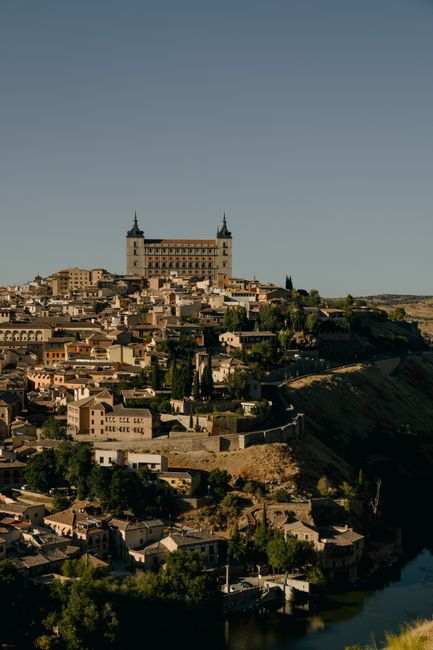
Toledo sits on a rocky hill wrapped in a loop of the Tagus River, a walled maze of steep lanes where Christian, Jewish and Muslim Spain left churches, synagogues and a mosque within a few minutes of each other. It was the capital of Visigothic Spain and later of Castile, and El Greco painted here for almost 40 years. Fast Avant trains from Madrid take about half an hour, so most people come for a day, but the city is at its best after the day-trippers leave, when the lanes go quiet and the cathedral is floodlit. The best months are March to May and late September to November; July and August average 35 °C.
Right now in Toledo
- Wed13–22°C56–72°F1 mm rain
- Thu12–23°C53–73°FMostly clear
- Fri9–19°C48–67°FClear
- Mon 12 Oct National Day of Spain (Fiesta Nacional de España)
Top tours in Toledo
See all tours for Toledo →
From local operators, with prices and reviews; you check availability and book on Viator, our partner. We may earn a commission at no extra cost to you. How we earn money
Toledo at a glance
- Best months: March–May and late September–November. Average highs are about 18–25 °C in spring and 23 °C in October (AEMET 1991–2020 normals). July and August average 35 °C.
- Days needed: 1 full day for the cathedral and the main monuments, 2 to see everything at an easy pace, walk the river and see the city lit up at night.
- Getting there: Renfe Avant trains from Madrid-Puerta de Atocha in about 33 minutes, or ALSA buses from Plaza Elíptica in about 50–75 minutes. The nearest airport is Madrid-Barajas (MAD).
- Getting around: on foot, but it’s hilly. Free public escalators carry you from the bottom of the walls up into the old town.
- Budget level: moderate. Most monuments cost €3–5, the cathedral €12, and a €14 wristband covers seven sights. See our Spain guide for money and entry rules.
Toledo’s old town and neighbourhoods
The whole hilltop inside the river loop is the Historic City of Toledo, a UNESCO World Heritage Site since 1986. Almost everything you’ll want to see is inside it, within a 15-minute walk of the cathedral, but the lanes twist, climb and dead-end, so expect to get lost at least once.
- Zocodover and the cathedral quarter: the triangular Plaza de Zocodover is the old town’s main square and meeting point, with the Alcázar above it and the cathedral a few minutes’ walk south. Busiest, with most shops and cafés. Best for a first, short stay.
- The Jewish quarter (Judería): the western side of the hill, around Santo Tomé, the two synagogues, San Juan de los Reyes and the El Greco Museum. Steep lanes ending in viewpoints over the river.
- Around San Román and the Jesuits: the high centre of the old town, with the Jesuit church, whose towers are among the best viewpoints in Toledo, and quieter residential streets.
- Puerta de Bisagra and the north walls: the main gate, the Mudéjar Puerta del Sol and the little Mosque of Cristo de la Luz. This is where the escalators and the road from the station arrive.
- Across the river (Los Cigarrales): the hills south of the Tagus, with country houses, a parador and the Mirador del Valle. You come for the view back over the city.
Top things to see in Toledo
Prices and hours below come from the official websites, as of October 2026. Many monuments switch to shorter winter hours on 16 October, closing at about 17:45 instead of 18:45, so check the day you go.
Toledo Cathedral (Catedral Primada)
Spain’s primate cathedral, built mostly between 1226 and 1493, is one of the great Gothic churches of Europe. Inside, look for the gilded altarpiece of the main chapel, the carved wooden choir stalls, the Baroque “Transparente”, where daylight falls through a hole cut in the vault, and the sacristy, hung with paintings by El Greco, Goya, Titian and Caravaggio. How to visit: a general ticket is €12 (as of October 2026), with a mobile audio guide, and covers the cathedral, choir, sacristy, cloister and the main chapels and rooms. Reduced tickets are €8 (over-65s, under-18 students, large families, youth-card holders) and €6 for children aged 8–14 with an adult; under-8s and Toledo residents go free. It opens Monday to Saturday 10:00–18:30 and Sunday 14:00–18:30, with last entry 30 minutes before closing. It closes on 1 January and 25 December and for some religious celebrations.
Lumina: an evening light, sound and projection show inside the cathedral, for €24.90, or €33 with a daytime ticket. It doesn’t run every night, so check the calendar.
Planning your visit: allow 1.5 hours. Buy online on busy days, especially Saturdays and spring holidays, and go at 10:00 or after 16:00, when tour groups thin out. Sunday mornings are for Mass only. The city’s tourist wristband (below) doesn’t include the cathedral.
The Alcázar and the Army Museum
The square fortress on the highest point of the city has been a Roman, Visigothic, Muslim and royal stronghold. It was almost destroyed in the 1936 siege of the Spanish Civil War, rebuilt, and since 2010 has housed Spain’s Army Museum (Museo del Ejército), with armour, weapons, uniforms and models covering centuries of Spanish military history, plus the archaeological remains in the foundations. How to visit: entry is €5 (as of October 2026), and free every Wednesday and on a few set dates (29 March, 18 April, 18 May, 12 October and 6 December). It opens Tuesday to Sunday 10:00–17:00, with ticket windows closing at 16:30, and closes on Mondays, 1 and 6 January, 1 May and 24, 25 and 31 December. The entrance is on Calle de la Paz. Allow 2 hours if you like history. The regional library on the Alcázar’s top floor has a café with one of the best views in town.
Monastery of San Juan de los Reyes
Isabella and Ferdinand founded this Franciscan monastery to celebrate their victory at Toro in 1476, and they first meant it as their burial place. Its two-storey Gothic cloister, with carved stone vines and animals, and an orange-tree garden in the middle, is one of the loveliest corners of Toledo. Outside, the chains of Christian captives freed from Granada still hang on the walls. How to visit: €4, or included in the tourist wristband. From 1 March to 15 October, it opens daily 10:00–18:45; from 16 October to February, it closes earlier (around 17:25–17:45). Ticket sales stop 20 minutes before closing. It’s closed on 1 January and 25 December.
Santo Tomé and El Greco’s Burial of the Count of Orgaz
This small parish church holds El Greco’s most famous painting, The Burial of the Count of Orgaz (1586–88), in the chapel it was painted for. Below, saints lower a 14th-century nobleman into his tomb, surrounded by Toledo’s gentlemen in black; above, heaven opens to receive his soul. Look for the boy in the corner, El Greco’s son. How to visit: €4, or included in the tourist wristband. It opens daily, 10:00–18:45 from 1 March to 15 October and 10:00–17:45 from 16 October to the end of February; ticket sales stop 10 minutes before closing. You visit only the painting’s chapel, so 15–20 minutes is enough, but queues build at midday.
The synagogues: El Tránsito and Santa María la Blanca
Two of the few medieval synagogues left in Spain stand a few minutes apart. El Tránsito, built around 1357 by Samuel ha-Leví, treasurer to King Peter I, has a prayer hall with a carved Mudéjar plaster frieze and a coffered wooden ceiling. It now houses the national Sephardic Museum (Museo Sefardí), on the history of Spain’s Jews. Santa María la Blanca, older and simpler, is a forest of white horseshoe arches on octagonal pillars, built by Muslim craftsmen for a Jewish congregation and later turned into a church.
How to visit El Tránsito (Museo Sefardí): €3, reduced €1.50, and free on Saturdays from 14:00, on Sundays and for under-18s, students aged 18–25 and over-65s (as of October 2026). A €5 ticket also covers the El Greco Museum and is valid for 5 days. It opens Tuesday to Saturday 9:30–20:00 and Sundays and holidays 10:00–15:00, and closes on Mondays. Ticket sales end 15 minutes before closing. How to visit Santa María la Blanca: €4, or included in the tourist wristband, with the same daily hours as the other wristband monuments.
The tourist wristband (pulsera turística)
The city’s tourist wristband costs €14 (as of October 2026) and gets you into seven monuments that cost €4 each on their own: San Juan de los Reyes, Santa María la Blanca, Santo Tomé, the Jesuit church (San Ildefonso), the Mosque of Cristo de la Luz, El Salvador church and the Real Colegio de Doncellas Nobles. It’s valid for seven days from purchase, and you can buy it online or at any of the seven ticket desks. It pays for itself after four sights. It does not include the cathedral, the Alcázar, El Tránsito or the El Greco Museum.
Mosque of Cristo de la Luz and the Jesuit towers
The tiny mosque of Bab al-Mardum, finished in 999, is one of the best-preserved buildings from Muslim Toledo: nine little domes on four columns, with a Mudéjar apse added when it became a church. Climb the towers of the Jesuit church of San Ildefonso for a rooftop view straight across to the cathedral. Both are included in the wristband.
Mirador del Valle
The classic postcard view of Toledo is from the hills across the Tagus: the whole city stacked on its rock, with the cathedral spire and the Alcázar on top. It’s free and best at sunset. How to visit: walk down to the Alcántara Bridge, cross, and follow the riverside path and road (about 4 km and a climb of about 75 metres, 40–50 minutes), or take a taxi or the tourist bus or train, which stop here.
Monasteries and convents
- Monastery of San Juan de los Reyes
Monuments
- Puente de San Martín
Churches and cathedrals
- Synagogue of Santa María la Blanca
- Toledo Cathedral
Museums
- El Greco Museum
- Synagogue of El Tránsito
Castles and forts
- Alcázar of Toledo
Things to do in Toledo
Ride the escalators up to the old town
The free Recaredo escalators (remonte mecánico), six flights set into the hillside by the old walls, take you from the car parks and bus stops below up to near the Puerta del Sol in a few minutes. As of October 2026, they run Monday to Thursday 7:00–23:00, Friday 7:00–2:00, Saturday 8:00–2:00 and Sundays and holidays 8:00–23:00. A second set at Safont, on the east side, runs from 7:00 to midnight (Fridays and Saturdays to 2:00). Hours change during Holy Week, Corpus Christi and Carnival.
Walk the river path
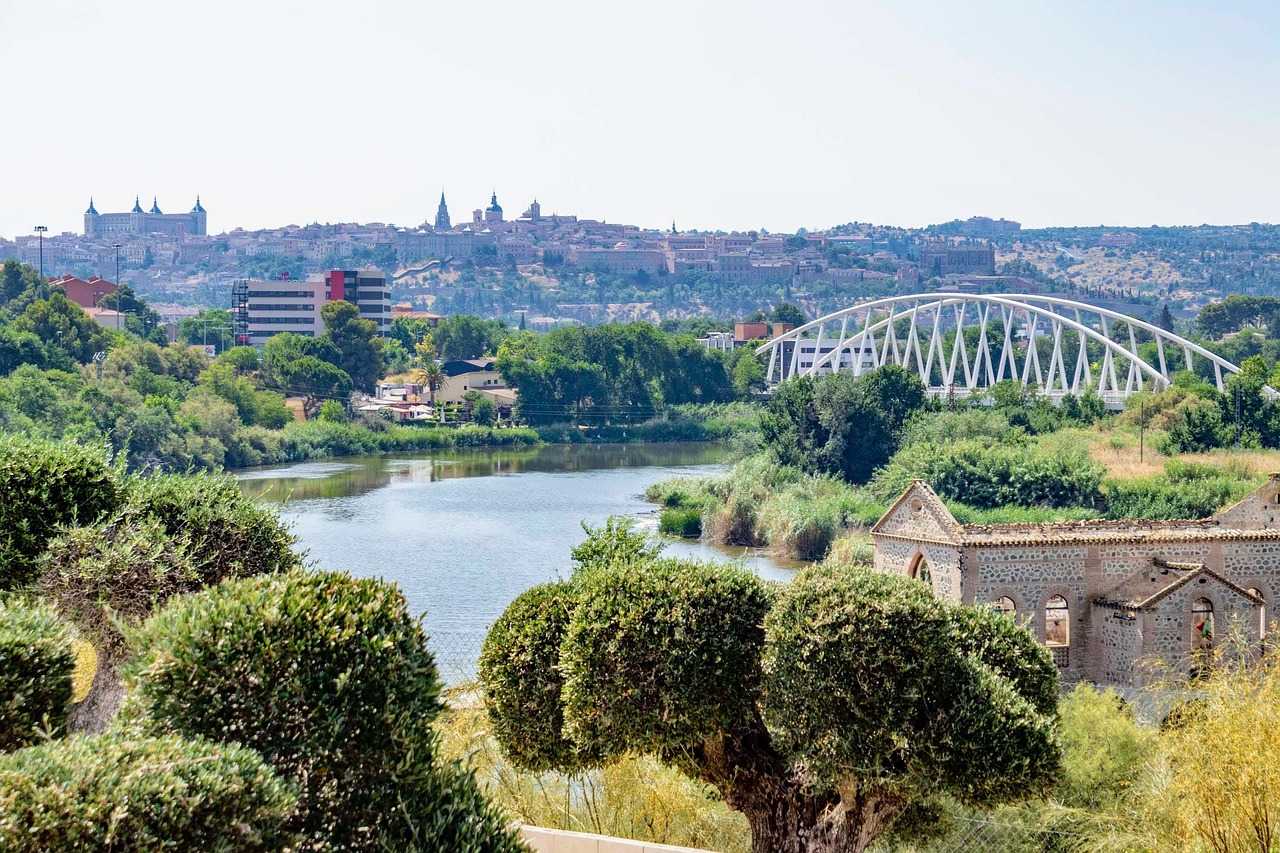
A path runs along the Tagus below the walls, between the medieval Alcántara and San Martín bridges, through rocks and trees with the city high above. It’s a peaceful break from the crowded lanes and a good way to reach the Mirador del Valle on foot. See our hiking guide for more walks.
See El Greco across the city
Besides Santo Tomé and the cathedral sacristy, El Greco’s work hangs in the El Greco Museum in the Jewish quarter and the Santa Cruz Museum near Zocodover. Follow him from one to the next and you get a walking tour of the old town too. See our city sightseeing guide for tours.
Eat marzipan, carcamusas and partridge
Toledo’s sweet is marzipan, made by convent nuns and old pastry shops, shaped into little figures or eels. For lunch, order carcamusas (a pork and vegetable stew served in a clay dish), perdiz estofada (stewed partridge), and Manchego cheese with a glass of La Mancha wine.
Stay for the evening
After about 18:00, the tour buses leave and the old town turns local: bars fill around Zocodover and the cathedral, monuments are floodlit, and the views from the walls are best. If you’re here in June, the Corpus Christi procession is Toledo’s biggest festival, with the streets covered in awnings and flowers.
Activities and best months
- City sightseeingThe walled old town on the Tagus is a UNESCO World Heritage site, the 'city of the three cultures': a Gothic cathedral, a 10th-century mosque and two synagogues within a few streets, best seen on foot through its winding lanes.
Day trips from Toledo
- Madrid: about 33 minutes by Avant train, for the Prado, the Royal Palace and late tapas. Read our Madrid guide, and plan ahead for the Prado and the Royal Palace.
- Consuegra: the white windmills of La Mancha on a ridge above the plain, with a castle, about 60 km south. A car or a tour is easiest.
- Segovia: the Roman aqueduct and the Alcázar, best combined via Madrid (change trains at Madrid); it’s a long day from Toledo. Read our Segovia guide.
- Aranjuez: the royal palace and riverside gardens, about 45 km east, by car or bus.
Getting there and getting around
By train from Madrid
Renfe’s Avant high-speed trains leave Madrid-Puerta de Atocha roughly every hour (less often at midday and weekends) and reach Toledo in about 33 minutes. Single fares are usually about €7–15, cheaper booked ahead, and trains fill on weekends, so book your return too. Toledo’s station is a neo-Mudéjar building below the old town: from there it’s a 20–25-minute uphill walk to Zocodover, or a few minutes on city bus 5 or 61/62 (€1.40 a ride in cash, as of October 2026) or by taxi.
By bus from Madrid
ALSA buses leave from the Plaza Elíptica interchange (metro lines 6 and 11) many times a day, taking about 50 minutes direct or up to 75 minutes with stops. Fares are lower than the train. Toledo’s bus station is just below the old town, near the Safont escalators.
By car and getting around
Toledo is about 70 km south of Madrid by the A-42 or the AP-41. Don’t drive into the old town: the lanes are narrow and access is restricted. Park in one of the car parks below the walls, such as at Recaredo, and ride the escalators up. Inside the walls, walk; wear shoes with grip, as the lanes are steep and cobbled. A little tourist train (Zocotren) and hop-on, hop-off buses loop around the river to the viewpoints.
When to go and how long to stay
Toledo has a hot, dry inland climate. In AEMET’s 1991–2020 normals, the average high is 35 °C in July and 34.5 °C in August, and the record is 44.2 °C (August 2021). The streets are steep stone with little shade, so summer afternoons are tiring. Winters are cool and sunny by day, but frosty at night.
| Season | Average high / low | Rainy days a month | What it’s like |
|---|---|---|---|
| Spring (Mar–May) | 18–25 °C / 5–12 °C | 5–6 | The best time to walk the hills. Busy at Easter and on weekends. |
| Summer (Jun–Aug) | 31–35 °C / 16–19 °C | 1–3 | Hot afternoons on shadeless stone. Sightsee early, rest at midday, go out after 19:00. Corpus Christi in June. |
| Autumn (Sep–Nov) | 16–29 °C / 6–15 °C | 3–7 | September is still hot; October is ideal. Winter hours from 16 October. |
| Winter (Dec–Feb) | 12–14 °C / 2–3 °C | 5–6 | Crisp, sunny days, frosty nights and the fewest visitors, except over Christmas. |
1 day in Toledo
Take an early Avant from Atocha and ride the escalators up. Visit the cathedral at 10:00, then walk to Santo Tomé, the two synagogues and San Juan de los Reyes on the wristband. Lunch in the Jewish quarter, then see the Alcázar or climb the Jesuit towers. Take a taxi to the Mirador del Valle before your evening train.
2 days in Toledo
Split the monuments over two days, add the Army Museum and the El Greco Museum, walk the river path to the Mirador del Valle at sunset, and spend the evening in the lit-up lanes once the day-trippers have gone. On day two, see the Cristo de la Luz mosque and the Santa Cruz Museum early, before the crowds.
As part of a central Spain trip
Base yourself in Madrid and add a night each in Toledo and Segovia, or continue south by high-speed train from Madrid to Córdoba and Seville.
Where to stay in Toledo
- First visit, short stay: inside the walls near Zocodover or the cathedral, steps from everything. Small hotels in old houses; some rooms are tiny.
- Quieter and atmospheric: the Jewish quarter, with views over the river from the west side of the hill.
- For the view: across the river in the Cigarrales, where the parador and country hotels look straight back at the city. You’ll need a taxi or car to get into town.
- With a car: pick a hotel with its own parking or one near the car parks below the walls, as you can’t drive freely inside them.
- In summer: make sure the room has air conditioning; old stone houses hold the heat.
Practical tips for Toledo
- Buy the wristband if you’ll see four or more of its seven monuments. Buy cathedral tickets separately.
- Mondays: the Army Museum and the Sephardic Museum close. The cathedral and the wristband monuments open daily.
- Free times: the Army Museum is free on Wednesdays, and the Sephardic Museum on Saturday afternoons and Sundays.
- Book the return train: evening Avants back to Madrid sell out on weekends and holidays.
- Dress: the cathedral and churches are places of worship; cover shoulders and avoid beachwear.
- Watch your step on the steep, polished cobbles, especially when wet. The emergency number is 112.
Weather month by month
What to pack for Toledo
Bring comfortable walking shoes with a good grip; Toledo is all steep stone lanes. From May to September, add a sun hat, sunglasses, sunscreen and a refillable water bottle, as there’s little shade and afternoons often pass 35 °C. A light scarf helps to cover shoulders in churches. From November to March, pack a warm jacket and layers: days can be sunny and mild, but nights drop to around freezing, and stone churches are cold inside.
What to pack
- City walking shoesLisbon and Porto are steep, with polished limestone cobbles that get slippery, so grippy soles matter.
- Day packs and anti-theft bagsA small zipped or anti-theft bag makes crowded trams and viewpoints less stressful.
- Rain jacketsFrom October to April Porto and Lisbon see rain on roughly a third of days.
- Travel adapters and convertersPortugal uses Type C and F sockets at 230 V, so most visitors from outside Europe need an adapter.
Toledo travel FAQ
How do I get from Madrid to Toledo?
The fastest way is a Renfe Avant train from Madrid-Puerta de Atocha, which takes about 33 minutes. ALSA buses from Plaza Elíptica take about 50–75 minutes and cost less.
Is Toledo worth an overnight stay?
Yes. A day trip covers the highlights, but the old town is at its best in the evening and early morning, when the tour groups have gone and the monuments are lit up.
How much does Toledo Cathedral cost?
A general ticket is €12 (as of October 2026), with an audio guide on your phone. Reduced tickets are €8 and €6, and under-8s go free.
What does the Toledo tourist wristband include?
For €14, it covers seven monuments: San Juan de los Reyes, Santa María la Blanca, Santo Tomé, the Jesuit church, Cristo de la Luz, El Salvador and the Colegio de Doncellas Nobles. It doesn’t include the cathedral, the Alcázar or El Tránsito.
Where can I see El Greco’s Burial of the Count of Orgaz?
In the church of Santo Tomé, in the chapel it was painted for. Entry is €4 or included in the wristband, and it opens daily.
When is the Army Museum in the Alcázar free?
Every Wednesday, plus a few set dates such as 18 May and 12 October. Otherwise it’s €5, and it’s closed on Mondays.
Are the escalators in Toledo free?
Yes. The Recaredo escalators run from 7:00 or 8:00 until 23:00, and until 2:00 on Friday and Saturday nights, linking the car parks below the walls with the old town.
Where is the best view of Toledo?
The Mirador del Valle, across the Tagus to the south. Walk there in 40–50 minutes from the Alcántara Bridge, or take a taxi, the tourist bus or the little train. Sunset is best.
What is the best time to visit Toledo?
March to May and late September to November. July and August average 35 °C, and the steep, shadeless lanes make afternoons hard work.
Can I drive into Toledo’s old town?
It’s best not to. Access is restricted and the lanes are very narrow. Park below the walls and take the free escalators up.
Can I visit Toledo and Segovia in one day?
Not comfortably. They’re on opposite sides of Madrid, on different train lines from different stations. Give each its own day, or better, a night each.
What food is Toledo known for?
Marzipan, carcamusas (pork stew), stewed partridge and Manchego cheese, with wine from La Mancha.
Plan your trip
Partner links: TravelerCenter may earn a commission if you book, at no extra cost to you.
🇪🇸 Useful Spanish phrases for Toledo
All 38 Spanish phrases: restaurant, hotel, emergencies, romance (printable) →
Sources · last reviewed 3 October 2026
Researched and last reviewed on 3 October 2026. Cathedral prices and hours come from its official website; the tourist wristband, San Juan de los Reyes and Santa María la Blanca from the official wristband site; Santo Tomé from the church’s own site; the Army Museum from the Spanish Army and the city’s tourism office; El Tránsito from the Sephardic Museum (Ministry of Culture); and the escalators from the Ayuntamiento de Toledo. Climate figures are AEMET’s 1991–2020 normals for Toledo. Train and bus times and fares were checked in travel references, as Renfe’s timetable could not be read directly. Prices, timetables and opening hours change, so check the official sites before you travel.
Also: spain.info · AEMET normals 1991–2020, Toledo (climate)
Data: Weather: MET Norway (CC BY 4.0) · Rates: ECB · Holidays: Nager.Date · Costs: World Bank ICP and price levels · © OpenStreetMap contributors (ODBL) · Wikidata (CC0)