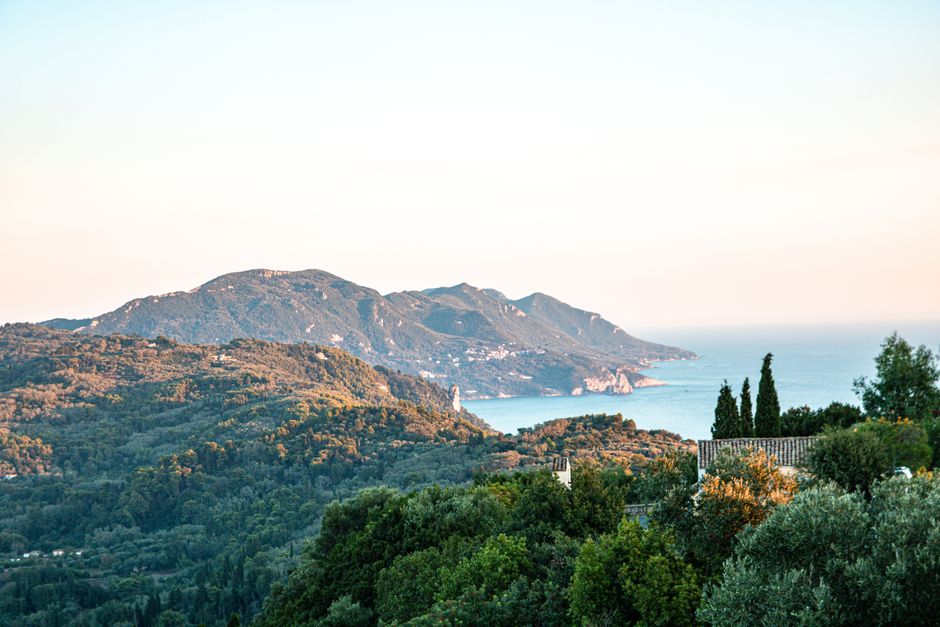
Corfu is the greenest of the big Greek islands: olive groves, cypresses and wooded hills drop to coves of turquoise water on the Ionian Sea, just off the coast of Albania. Its capital is unlike anywhere else in Greece. Centuries of Venetian, French and British rule left Corfu Town with two great fortresses, arcaded streets, Italianate squares and a cricket pitch, and its old town is a UNESCO World Heritage Site. Beyond it are the famous bays of Paleokastritsa, sandy beaches on the west coast, mountain villages and a long-distance walking trail. The best months are May, June and September. Give it at least five days, ideally a week.
Right now in Corfu (Corfu town)
- Wed 19–23°C 66–73°F Mostly clear
- Thu 19–21°C 66–71°F 6 mm Rain
- Fri 20–22°C 68–72°F 38 mm Heavy rain
Weather: MET Norway (CC BY 4.0) · Sea temperature: NOAA CoastWatch · Rates: ECB
Top tours in Corfu
See all tours for Corfu →
From local operators, with prices and reviews; you check availability and book on Viator, our partner. We may earn a commission at no extra cost to you. How we earn money
Corfu at a glance
- Best months: May–June and September; early October for walking. Average highs run from about 24 °C in May to 31 °C in July and August (Hellenic National Meteorological Service normals, Corfu). Corfu is greener and wetter than most of Greece, with heavy rain from October to March.
- Days needed: 2–3 for Corfu Town and a few beaches; 5–7 to see the north, the west coast and the south; about 10 for the Corfu Trail.
- Getting there: fly into Corfu airport (CFU), right next to town, or take a ferry from Igoumenitsa on the mainland or from Italy.
- Getting around: blue city buses around town, green buses to the resorts; a hire car is best for the villages and quieter beaches.
- Budget level: mid-range; the north-east coast is the most expensive, the south the cheapest. A per-room climate fee is added to every hotel bill. See our Greece guide for money, entry rules and daily costs.
Corfu’s areas and who each one suits
- Corfu Town (Kerkyra): the old town, the fortresses, the Liston and the Spianada, with museums, cafés and the best restaurants on the island. The obvious base without a car, and for culture lovers.
- The north-east coast (Kassiopi, Agios Stefanos, Kalami): pebbly coves, clear water, cypress-covered slopes and villas, with Albania across the strait. Upmarket, calm and lovely for families and couples.
- The north (Sidari, Agios Stefanos north-west, Arillas): sandstone cliffs, the Canal d’Amour and long sandy beaches; busy resorts mixed with quieter villages.
- The west coast (Paleokastritsa, Pelekas, Glyfada, Agios Gordios): the island’s most dramatic scenery, sandy beaches and sunsets. For beach lovers and photographers; the sea can be rough on windy days.
- The south (Issos, Lefkimmi, Kavos): long dunes and sandy beaches, a lagoon, traditional villages and, at Kavos, a party resort. Cheaper and flatter.
Top things to see in Corfu
Prices and hours below come from the Greek Ministry of Culture’s official site and the Achilleion’s own website, as of October 2026. The old combined ticket for Corfu Town’s sites has been abolished, so each site now has its own ticket. Summer hours run from 1 April to 31 October.
Corfu Town
The Old Town of Corfu became a UNESCO World Heritage Site in 2007 as a fortified Mediterranean port that held out against the Ottomans for four centuries. Start on the Spianada, one of the largest squares in Greece, where cricket has been played since British times. Along its western side runs the Liston, an arcaded terrace of cafés built under French rule and modelled on the Rue de Rivoli in Paris. Then wander into the kantounia, the narrow lanes of tall, faded Venetian houses with washing strung between them, to the church of Agios Spyridon, the island’s patron saint, whose red-domed bell tower is the town’s landmark. The town has several museums: the Archaeological Museum, with its famous Gorgon pediment (€10, €5 reduced; summer 08:00–20:00, closed on Tuesdays), the Antivouniotissa Museum of icons and the Asian Art Museum in the Palace of St Michael and St George, built for the British governor.
The Old Fortress and the New Fortress
The Old Fortress fills a rocky headland at the end of the Spianada, cut off from the town by a sea moat. Climb to the lighthouse at the top for the best view of Corfu Town, then visit the Doric-style church of St George, built by the British. How to visit: a ticket is €10; the €5 reduced ticket applies only to EU citizens over 65, and only from October to May. In 2026 it is open daily 08:00–18:30 from 1 to 15 October and 08:00–18:00 from 16 to 31 October, with last entry 20 minutes before closing; from 1 November it is open 08:30–15:30. On the other side of town, the Venetian New Fortress, above the old port, has tunnels and ramparts with views over the rooftops (€5, €3 reduced; 08:30–15:30 from April to October, closed on Tuesdays and all winter).
Kanoni, Mouse Island and Mon Repos
South of town, the Kanoni peninsula looks down on the island’s most photographed view: the little white Vlacherna monastery at the end of a causeway, and behind it Pontikonisi (Mouse Island), a tree-covered islet with a tiny Byzantine chapel, reached by small boat in summer. Planes landing at the airport roar overhead. Nearby, the wooded estate of Mon Repos, where Prince Philip was born in 1921, is a free park (open daily 08:00–20:00) with the ruins of ancient Corcyra and a museum in the villa (€10, €5 reduced).
The Achilleion
In the hills of Gastouri, 10 km south of town, Empress Elisabeth of Austria (Sisi) built a palace in the 1890s in honour of the Greek hero Achilles, later bought by the German Kaiser Wilhelm II. Its terraced gardens, full of statues, including a huge bronze Achilles, look out over the sea. Status as of October 2026: because of restoration works, only the outdoor areas and the Imperial Gardens are open; the palace rooms have been closed since 2021. A €11.5 million restoration was put out to tender in August 2026 and is planned to take 28 months from the contract, so do not expect the interior to reopen for several years. How to visit: a ticket is €7, €5 reduced; it is open 08:00–20:00 from April to October and 08:00–16:00 from November to March.
Paleokastritsa and Angelokastro
On the north-west coast, 25 km from town, Paleokastritsa is a cluster of small bays of startlingly clear water between wooded headlands. A 13th-century monastery sits on the headland above, free to visit, with a small museum and a lovely courtyard; dress modestly. Little boats leave the main beach for the sea caves along the cliffs, and the swimming in the coves is superb. Up the coast, the ruined Byzantine castle of Angelokastro crowns a rock 300 metres above the sea, with one of the best views on the island (€10, €5 reduced; 10:00–18:00 from April to October, closed on Tuesdays and all winter). At sunset, head to the hill village of Pelekas and the Kaiser’s Throne viewpoint.
Archaeological sites
- Temple of Artemis
Museums
- Achilleion
- Mon Repos
Castles and forts
- Angelokastro
- New Fortress of Corfu
- Old Fortress of Corfu
Peaks and mountains
- Mount Pantokrator
Beaches in Corfu
The west coast has the long sandy beaches and the sunsets; the north-east has sheltered pebble coves with very clear water. For more ideas, see our beach guide.
| Beach | Area | Type | Good for |
|---|---|---|---|
| Paleokastritsa bays | North-west | Small sand and pebble coves | Snorkelling, boat trips to caves |
| Glyfada | West | Long golden sand under cliffs | Swimming, sunsets, beach bars |
| Agios Gordios | West | Sandy bay with rock towers | Families, views |
| Issos and Halikounas | South-west | Long beaches and dunes by the Korission lagoon | Space, windsurfing and kitesurfing |
| Kassiopi and Kalami | North-east | Pebble coves, clear water | Snorkelling, quiet swims |
| Canal d’Amour, Sidari | North | Sandstone cliffs and tiny coves | Photos, swimming through rock channels |
| Agios Georgios Pagon and Arillas | North-west | Long sandy bays | Families, calm resorts |
The west-coast beaches face the open sea; on windy days the waves can be strong, so watch for flags and swim where there are lifeguards. Boat hire without a licence is common on the north-east coast, a lovely way to reach coves with no road. See our boat trips guide and snorkeling guide.
Hiking in Corfu and the Corfu Trail
Corfu’s green hills, olive groves and old mule paths make it one of the best Greek islands for walking, especially from March to early June and from late September to November, when the island is green and the heat is gone. See our hiking guide.
The Corfu Trail
The Corfu Trail runs the length of the island, about 200 km from near Kavos in the far south to the headland of Agia Ekaterini in the far north, taking most walkers about 10 days. Opened in 2001, it follows tracks, footpaths and quiet lanes through olive groves, hill villages, beaches and the slopes of Mount Pantokrator. It is waymarked, but marks can be faded or missing in places, so carry the official trail guide and a good walking map. You can walk it end to end, staying in village rooms, or pick out single sections as day walks; local companies offer self-guided holidays with luggage transfers.
Mount Pantokrator and day walks
Mount Pantokrator, at 906 m the highest point on the island, has a monastery on top and views to Albania and the mainland mountains. Walk up from the old village of Palia Perithia, a half-abandoned Venetian-era settlement with tavernas, or drive almost to the summit. Other good walks are the coastal path between Kassiopi and Agios Stefanos, the trail to Angelokastro and the paths around the Korission lagoon. In summer, the fire-season rules apply from 1 May to 31 October: no fires outdoors, and on very-high-risk days forests can be closed.
Activities and best months
- Beaches and swimmingPaleokastritsa's coves and sea caves, sandy Pelekas (Kontogialos), Agios Gordios and Glyfada on the west coast, dunes at Issos and Chalikounas by Lake Korission, and the Canal d'Amour at Sidari. · source
- Boat tripsThe north-east coast, below Mount Pantokrator, has small coves that are ideal to reach on boat trips. · source
Other things to do in Corfu
Easter in Corfu
Corfu’s Orthodox Easter is the most famous in Greece, with brass bands, processions and, at 11:00 on Holy Saturday, the botides: people throw clay pots full of water from the balconies of the old town, smashing them on the streets below to welcome the Resurrection. Book months ahead if you want to be there.
Food and drink
Corfiot cooking shows its Venetian past: try pastitsada (beef or rooster in a spiced tomato sauce with pasta), sofrito (veal in garlic, vinegar and parsley) and bourdeto (fish in a fiery red-pepper sauce). The island’s kumquats, brought by the British in the 19th century and now a protected product, are made into a sweet liqueur and candied fruit. There is also tsitsibira, a local ginger beer and another British legacy. Small wineries in the hills make local wines, and olive oil is everywhere. See our wine tasting guide.
Diving and cycling
Dive centres in Paleokastritsa, Agios Gordios and the north-east run trips to caves, reefs and walls, with very clear water from June to October. Road cyclists and e-bikers find quiet hill roads in the centre and the south. See our diving guide and cycling guide.
A day trip to Albania
From Corfu’s new port, boats cross to the Albanian town of Saranda in about 30 minutes by fast boat or 70–90 minutes by conventional ferry. Ionian Seaways, Finikas Lines and others run daily in season; a one-way foot-passenger ticket typically costs about €20–30. From Saranda, it is about 17 km to Butrint, a UNESCO-listed ancient city of Greek, Roman, Byzantine and Venetian ruins in a lagoon forest (about 1,000 lek for adults), and the Blue Eye spring is also within reach. Many visitors book an organised day tour that includes the crossing, transport and a guide.
- Documents: Albania is not in the EU or the Schengen area. EU citizens can enter with a passport or national ID card; UK and US citizens need a passport and, for short visits, no visa. Check the rules for your nationality.
- Coming back to Corfu: you re-enter the Schengen area. Since the EU Entry/Exit System became fully operational on 10 April 2026, non-EU travellers have their fingerprints and photo registered at the border, so allow extra time at the port. The ETIAS travel authorisation is not yet required; no start date has been set, and press reports point to 2027.
- Time and money: Albania is one hour behind Greece; euros are widely accepted in Saranda, but the local currency is the lek.
Ferries and day boats also run from Corfu to the small islands of Paxos and Antipaxos, about an hour or more south, with turquoise coves that are among the most beautiful in the Ionian.
Corfu on a cruise day
Corfu is one of the busiest cruise ports in the Mediterranean: in 2025 about 894,000 passengers arrived on 467 ship calls, and the port expects more than 500 calls in 2026. Ships dock at the new port, about 2–3 km from the old town: a 20–30 minute walk along the waterfront, a short taxi ride, or a shuttle bus offered by many cruise lines. With six to eight hours ashore, walk through the old town to the Spianada and the Liston, visit the Old Fortress, and then either take a taxi or tour to Kanoni and the Achilleion gardens or to Paleokastritsa for a swim. On days with several ships, the old town is busiest between about 10:00 and 15:00, and the Old Fortress queue is shortest at opening time. Greece charges cruise passengers a small per-visit fee, usually included in the cruise fare.
Nearby destinations
Getting there and getting around
Flights
Corfu Ioannis Kapodistrias airport (CFU), run by Fraport Greece, is only about 3 km south of the old town. It handled over 4.3 million passengers in 2024, with many direct flights from the UK and Europe from spring to autumn and from Athens all year. Blue city bus line 15 links the airport with the town and the port; a taxi to the old town takes about 10–15 minutes.
By ferry
- From the Greek mainland: car ferries cross from Igoumenitsa to Corfu Town in about 1 hour 15 minutes to 1 hour 30, all year and up to about 30 times a day in summer; some also go to Lefkimmi in the south. Buses run from Athens and Thessaloniki to Igoumenitsa.
- From Italy: overnight and day ferries sail from Brindisi (about 7 hours), Bari (about 9–10 hours) and Ancona (about 15 hours), some of them continuing to Igoumenitsa and Patras.
- To Paxos and Albania: fast boats and ferries leave from the new port in Corfu Town.
Buses, cars and taxis
- Blue city buses: serve Corfu Town and nearby areas such as Kanoni, the Achilleion, Pelekas, Benitses and Gouvia. As of October 2026, a ticket costs €1.30 in zone A and €1.80 in zone B, and a day ticket €5, a little more if bought on board.
- Green buses (KTEL): run from the station near the new port to the resorts, such as Paleokastritsa, Sidari, Kassiopi and Kavos; services are good in summer and thin in winter.
- Hire car: the best way to explore the villages, the west-coast beaches and the north. Roads are narrow and winding, and parking in town is hard; use the car parks near the new port and the Spianada.
- Taxis: plentiful in town and at the airport and port; agree on the fare for long trips.
When to go and how long to stay
Corfu has hot, dry summers and mild, very wet winters: it gets more rain than almost anywhere else in Greece, which is why it is so green. July and August are hot and busy, with the warmest sea. May, June and September are ideal, warm enough to swim with fewer people; October is lovely for walking, but the first autumn storms arrive. From November to March many resort hotels close, but Corfu Town stays lively all year, and Easter, usually in April, is the island’s great festival.
| Season | Average high / low | Days with rain a month | What it’s like |
|---|---|---|---|
| Spring (Mar–May) | 16–24 °C / 7–13 °C | 8–13 | Green and full of flowers; great for walking and Easter; sea cool until late May. |
| Summer (Jun–Aug) | 28–32 °C / 17–19 °C | 3–5 | Hot and sunny with occasional storms; peak beach season. |
| Autumn (Sep–Nov) | 19–28 °C / 10–17 °C | 7–15 | September is perfect; October is mild with more rain; November is wet. |
| Winter (Dec–Feb) | 14–15 °C / 5–7 °C | 13–17 | Mild but very rainy; quiet; many resorts closed. |
Figures are the Hellenic National Meteorological Service’s 1955–2010 averages for the Corfu station, the latest official normals published for the island; “days with rain” counts all days with measurable rain. Corfu gets about 1,100 mm of rain a year, roughly twice as much as Athens, and about 2,500 hours of sunshine.
3 days in Corfu
Stay in Corfu Town. One day for the old town, the Old Fortress and the Liston; one day for Kanoni, Mon Repos and the Achilleion gardens; and one day for Paleokastritsa, Angelokastro and sunset in Pelekas.
5–7 days in Corfu
Two or three nights in Corfu Town, then three or four nights on the north-east coast or the west coast. Add a day trip to Albania or to Paxos and Antipaxos, a walk on Mount Pantokrator and a beach day at Glyfada or Issos. With more time, continue to Kefalonia and Zakynthos further south, or to Meteora on the mainland, about two and a half to three hours’ drive from Igoumenitsa.
Where to stay in Corfu
- Culture and food: a boutique hotel or apartment in Corfu Town’s old town.
- Couples and families who want calm: the villas and small hotels of Kassiopi, Agios Stefanos and Kalami on the north-east coast.
- Beaches and sunsets: Paleokastritsa, Pelekas, Glyfada or Agios Gordios on the west coast.
- Walkers: village rooms along the Corfu Trail, or a base in the hills near Pantokrator.
- Without a car: Corfu Town, or a resort on a good green-bus route such as Paleokastritsa or Kassiopi.
Greece adds a climate resilience fee per room per night, set by type of accommodation. As of October 2026, from April to October it is €2 for 1–2 star hotels and rented rooms, €5 for 3 stars, €10 for 4 stars, €15 for 5 stars and €8 for short-term holiday rentals (€15 for houses over 80 m²); it is much lower from November to March.
Practical tips for Corfu
- Check the cruise schedule: on days with several ships in port, visit the old town early or late.
- Book Easter early: hotels in town fill months ahead.
- Roads: drive slowly on narrow hill roads, and expect buses on bends.
- Sea conditions: on windy days, choose the sheltered north-east coves over the west-coast beaches.
- Albania trip: take your passport or EU ID card, and allow time for border checks on the way back.
- Mosquitoes: Corfu’s greenery and wetlands mean mosquitoes in summer evenings; bring repellent.
- Emergencies: call 112.
Weather month by month
Averages from HNMS station averages 1955–2010, Corfu (airport) · Last reviewed 4 Oct 2026
What to pack for Corfu
For summer, pack light clothes, a sun hat, sunglasses, high-factor sunscreen, a swimsuit, water shoes for pebbly coves and a snorkel mask for the clear water of Paleokastritsa and the north-east. Bring comfortable walking shoes for the cobbled old town and the fortresses, and proper hiking shoes if you plan to walk the Corfu Trail. Add insect repellent for summer evenings, and a light scarf or shirt to cover shoulders in monasteries and churches. In spring and autumn, pack a rain jacket and a warm layer: Corfu’s rain can be heavy. Take your passport or EU ID card for a trip to Albania.
What to pack
- Day packs and anti-theft bagsCarries water, towel and sunscreen down the long stairways to Algarve coves.
- Dry bags and phone pouchesProtects phones and cameras from sand and spray on beaches reached by ferry or steep paths.
- Fleeces and warm layersIt is cooler at sea than on land, especially on morning whale-watching trips.
- Quick-dry beach towelsA sand-shedding quick-dry towel packs small for beach days and lido visits.
- Rain jacketsA windproof, waterproof shell keeps you warm on open boats, where wind and spray cool you quickly.
- Reef-friendly sunscreenSummer UV is strong on Portuguese beaches and there is little shade below the cliffs.
- Water shoesRocky coves, lava pools and weever fish in shallow sand make water shoes useful.
- WetsuitsOn the west and north coasts the sea stays around 16–18 °C even in summer, so a thin suit helps for long swims.
Corfu travel FAQ
How many days do you need in Corfu?
Three days for Corfu Town, Kanoni and Paleokastritsa; five to seven days to add the north-east coast, the west-coast beaches and a day trip to Albania or Paxos.
How much is the Old Fortress in Corfu?
€10 as of October 2026. It is open 08:00–18:00 in the second half of October and 08:30–15:30 in winter. There is no longer a combined ticket for Corfu Town’s sites.
Is the Achilleion open?
Only the gardens and outdoor areas, as of October 2026, for €7. The palace rooms have been closed since 2021 for restoration, and a 28-month restoration contract was put out to tender in August 2026.
Can you do a day trip from Corfu to Albania?
Yes. Boats cross to Saranda in about 30–90 minutes, and Butrint is a short drive from there. Take a passport (or an EU ID card); non-EU travellers are registered by the EU Entry/Exit System on the way back.
What can you do in Corfu on a cruise stop?
Walk from the new port into the old town, see the Spianada, the Liston and the Old Fortress, then take a taxi or tour to Kanoni and the Achilleion gardens or to Paleokastritsa for a swim.
How long is the Corfu Trail?
About 200 km from near Kavos in the south to Agia Ekaterini in the north, usually walked in about 10 days. Spring and autumn are the best seasons.
What are the best beaches in Corfu?
The coves of Paleokastritsa, Glyfada and Agios Gordios on the west coast, Issos in the south, the Canal d’Amour at Sidari and the clear pebble coves of Kassiopi and Kalami in the north-east.
Do I need a car in Corfu?
Not for Corfu Town and the main resorts, which buses serve. A car makes it much easier to reach the villages, Angelokastro, Pantokrator and the quieter beaches.
When is the best time to visit Corfu?
May, June and September, warm and sunny without the August crowds. Spring and autumn are best for walking; winter is mild but very wet.
How do I get from the mainland to Corfu?
By ferry from Igoumenitsa, in about 1 hour 15 minutes to 1 hour 30, all year; or by plane from Athens in about an hour. Ferries also come from Brindisi, Bari and Ancona in Italy.
What is special about Easter in Corfu?
Brass bands, candlelit processions and, at 11:00 on Holy Saturday, the throwing of clay pots from balconies in the old town. It is the island’s biggest event, so book early.
Sources
- © OpenStreetMap contributors · ODbL · fetched 4 Oct 2026
- Wikidata · CC0 · fetched 4 Oct 2026
Sources and last review
Researched and last reviewed on 4 October 2026. Prices and hours for the fortresses, museums, Mon Repos and Angelokastro come from the Greek Ministry of Culture’s official site; the Achilleion’s status, prices and restoration tender from its official website; Entry/Exit System and ETIAS dates from the European Commission; city bus fares from Corfu’s city bus company; and climate figures from the Hellenic National Meteorological Service. Cruise figures, ferry times and fares to Albania and Italy come from port data reported in the press and from ferry booking sites. Prices, timetables and border rules change, so check the official sites and operators before you travel.
Plan your trip
Partner links: TravelerCenter may earn a commission if you book, at no extra cost to you.
🇬🇷 Useful Greek phrases for Corfu
All 38 Greek phrases: restaurant, hotel, emergencies, romance (printable) →