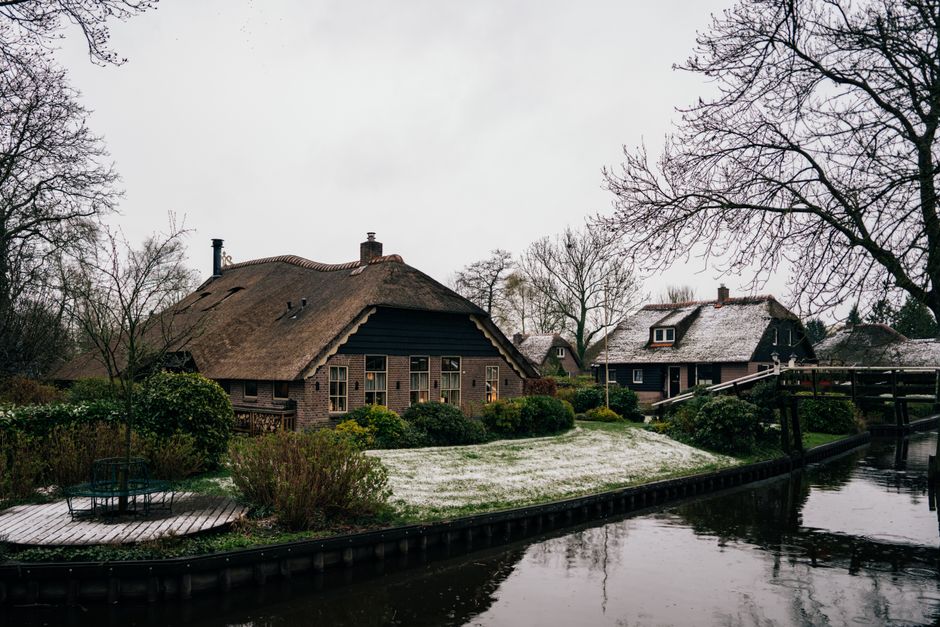
Giethoorn is the Netherlands’ famous water village: thatched farmhouses on their own little islands, linked by narrow canals and dozens of wooden footbridges, with no roads through the old centre. It lies in the province of Overijssel, on the edge of the Weerribben-Wieden National Park, a vast landscape of reed beds, lakes and peat marshes. You come to glide along the canals in a quiet electric boat or a traditional punt, walk the footpaths past the gardens, paddle a canoe into the national park and, in winter, perhaps skate. Giethoorn is also one of the most visited villages in the country, and summer days can be crowded, so it pays to come early, late or out of season, and to follow the local boating rules. It is about two hours from Amsterdam by train and bus. A day is enough for the village; stay a night to enjoy it when the day-trippers have gone.
Right now in Giethoorn
- Wed12–21°C54–70°FPartly cloudy
- Thu12–15°C53–59°F2 mm rain
- Fri11–14°C52–57°F6 mm rain
Top tours in Giethoorn
See all tours for Giethoorn →
From local operators, with prices and reviews; you check availability and book on Viator, our partner. We may earn a commission at no extra cost to you. How we earn money
Giethoorn at a glance
- Best for: boating and canoeing, village walks, nature and birdwatching, photography and a peaceful night away from the cities.
- How long: a half day to a day for the village; 2 days to explore the national park by canoe or bike.
- Best time: May, June and September for mild weather and fewer people; avoid summer weekends and public holidays if you can.
- Getting in: train to Steenwijk, then bus 70 to Giethoorn, about 15 minutes; or drive and park on the edge of the village.
- Boating rules: rental boats are electric, no amplified music, slow speeds, and in July, August and on public holidays wide private boats are banned from the main village canal in the middle of the day.
- Before you go: entry rules, money and general safety are in our Netherlands travel guide.
The village and how it came to be
Giethoorn’s canals were dug by peat cutters. From the Middle Ages, people dug out the peat for fuel, and the pits filled with water to form ditches, canals and lakes; the farmers then carried hay and cattle by flat-bottomed boat, because the ground was too soft for carts. Farmhouses with high thatched roofs stand on narrow strips of land, each reached by its own arched footbridge.
The village became famous after the Dutch director Bert Haanstra filmed his comedy Fanfare here in 1958. Today, the old centre stretches for several kilometres along the main village canal (the Dorpsgracht), with a footpath, the Binnenpad, running beside it. Around it lie the lakes and reed beds of the Wieden and, to the north, the Weerribben, which together form one of the largest peat wetlands in north-west Europe.
Things to do in Giethoorn
Rent a whisper boat
Hiring a small electric “whisper boat” (fluisterboot) for a few hours is the classic Giethoorn experience. Rental companies line the village and the main roads; no licence is needed for these small boats, and the staff explain how to steer and which routes to take. A good loop follows the Dorpsgracht through the village and returns across the open water of the Bovenwijde lake; allow two to three hours. Book ahead on summer weekends.
Take a canal boat tour
If you would rather be steered, open tour boats run hour-long trips through the village with commentary in several languages, and some continue into the national park. Traditional punts (punters), pushed with a pole as the farmers once did, offer a slower, quieter ride. See our boat trips guide.
Walk the village paths
You can see a lot on foot: follow the Binnenpad and the other village paths along the canals, crossing the little bridges, and stop at a café terrace by the water. The houses and gardens are private homes; enjoy them from the path and do not cross bridges marked private or step into gardens for photos.
Canoe and cycle in the national park
Weerribben-Wieden National Park is a world of reeds, peat ponds, alder woods and narrow channels, home to otters, purple herons, marsh harriers and rare butterflies. Rent a canoe or kayak in Giethoorn or nearby villages and paddle the quieter channels, or cycle the marked routes along the dykes to the visitor centre at Ossenzijl. See our cycling guide and hiking guide.
Small museums
Museum Giethoorn ‘t Olde Maat Uus, a historic farmhouse, shows how the peat-cutting and farming families lived on the water. A small private shell and mineral museum and several craft galleries are also in the village.
Winter skating
In a rare hard frost, when the ice is officially declared safe, the canals and lakes fill with skaters, and the village feels like an old Dutch winter painting. Only go on the ice when locals do and local ice clubs say it is safe.
- Weerribben-Wieden National Park
Activities and best months
- Boat tripsGiethoorn, the 'Venice of the Netherlands', is a short distance from Weerribben-Wieden National Park; electric boats, rowing boats and canoes can be rented in Giethoorn and elsewhere in the park to explore the waterways in peace and quiet.
- CyclingWeerribben-Wieden National Park, next to Giethoorn, has well-marked cycling routes such as the Stille Kiersche Wijde route.
- HikingWalkers in Weerribben-Wieden follow unpaved paths between quaking bogs and reed beds (the Weerribben walking route), with guided nature excursions; Holland.com also has a 4.3 km walking tour through Giethoorn.
Boating rules and crowds
Giethoorn is a village of a few thousand people that receives huge numbers of visitors, many on coach day trips, and at peak times the main canal can become a traffic jam of small boats. To protect the village, the municipality of Steenwijkerland has brought in boating and rental rules, tightened at the start of the 2025 season. As of October 2026:
- Electric rental boats: rental companies may only rent out boats with electric motors, which are quiet and clean.
- Width limit on the Dorpsgracht: on public holidays and in July and August, between 11:00 and 17:00, boats wider than 1.80 metres may not use the village canal between the Volkensvaart and the Molenvaart. Rental boats and permit holders are exempt, but owners of larger private boats must go around.
- Slow, quiet and sober: keep your speed low in the village canals (6 km/h is the usual limit), do not play amplified music, and keep alcohol away from whoever is steering; checks on noise, speed and drinking were stepped up from 2025.
- Licences and instruction: small electric boats need no licence, but rental firms must instruct you before you go, and inspectors check licences and instruction for larger groups on busy days.
- Courtesy on the water: keep to the right, give way to tour boats and punts, do not moor at private gardens, and do not grab the bridges or the banks.
Beating the crowds. Arrive before 10:00 or after 16:00, when tour coaches have left, and come on a weekday outside the summer school holidays. Spring and September are lovely. Staying overnight in the village or a nearby village lets you see Giethoorn at its quietest, in the soft evening and early-morning light.
Getting to Giethoorn
By train and bus. Take the train to Steenwijk, often with a change at Zwolle; the journey from Amsterdam takes about 1 hour 45 minutes to 2 hours, and a second-class single cost about €29 in October 2026. From Steenwijk station, bus 70 (towards Zwolle) reaches Giethoorn in about 15 minutes, usually once an hour in the daytime. You can tap a contactless bank card on both train and bus. Check the last bus back before you set out.
By car. Giethoorn is about 1 hour 30 minutes from Amsterdam. There are paid car parks at the edges of the village; you cannot drive into the old centre, which is reached on foot, by bike or by boat.
Organised tours. Many coach day trips from Amsterdam combine Giethoorn with other sights. They are convenient, but arrive at the busiest time of day; travelling independently gives you more freedom to come early or late.
Getting around Giethoorn
On foot along the canal paths, by boat, or by bike on the roads and cycle paths around the village. Some narrow village paths are for walkers only, and at busy times cycling may be restricted on them, so be ready to walk your bike.
When to go
Giethoorn lies inland in the north-east, so winters are a little colder and summers similar to the rest of the country. The table uses the WMO 1991–2020 temperature normals for Marknesse, about 17 km west of the village; the Dutch average is around 130 days of rain a year.
| Season | Average high / low | What it’s like |
|---|---|---|
| Spring (Mar–May) | 10–18 °C / 2–8 °C | Boat rentals open around Easter, birds nesting in the reeds, quieter weekdays |
| Summer (Jun–Aug) | 20–22 °C / 11–13 °C | Warmest, greenest and busiest; boating rules and crowds at their peak |
| Autumn (Sep–Nov) | 19 °C falling to 9 °C / 10 °C falling to 4 °C | September is lovely and calmer; boat rentals reduce from late October |
| Winter (Dec–Feb) | 5–6 °C / about 1 °C | Quiet village, misty mornings, frost on about 10–11 nights a month and occasional skating |
In practice, May, June and September give the best mix of weather and peace. July and August are the busiest months; come on a weekday, early or late.
Weather month by month
Where to stay near Giethoorn
- In the village: B&Bs and small hotels in thatched houses by the water, some with their own boats for guests.
- Around the lakes: holiday parks, campsites and cottages near the Bovenwijde and the national park.
- Steenwijk or Zwolle: towns with stations and more hotels, handy if you arrive by train.
Practical tips for Giethoorn
- Come early or late: the village is at its calmest before 10:00 and after 16:00.
- Respect privacy: people live in these houses; stay on public paths and keep your voice down.
- Book a boat: reserve electric boats in advance on summer weekends and public holidays.
- Bring layers: it can be breezy and cool on the open lakes even in summer.
- Insect repellent: mosquitoes can bite near the reed beds on still summer evenings.
What to pack for Giethoorn
A light waterproof and a warm layer for the boat, sun cream and a hat in summer, flat shoes with grip for wet bridges, insect repellent, and a dry bag for your phone if you plan to canoe.
What to pack
- Day packs and anti-theft bagsA 20–30 litre pack carries layers, water, a head torch and snacks on full-day levada walks.
- Dry bags and phone pouchesSpray soaks phones and cameras on open boats to the Algarve caves and on whale-watching trips.
- Fleeces and warm layersIt is cooler at sea than on land, especially on morning whale-watching trips.
- HeadlampsLevada routes such as PR1 and PR9 pass through long, dark, wet tunnels.
- Hiking shoes and bootsMadeira's levadas and the Azores' crater rims are wet, rocky and slippery, so grippy shoes matter more than anywhere else in Portugal.
- Rain jacketsA windproof, waterproof shell keeps you warm on open boats, where wind and spray cool you quickly.
- Reef-friendly sunscreenSun reflects off the water on cruises and cave tours.
- Trekking polesLong stone staircases and steep descents on Madeira's peaks and the Azores' crater rims are easier on the knees with poles.
- Water bottles and hydration packsRiding in the Algarve and Alentejo heat needs more water than you expect.
- Water shoesKayak and small-boat trips to the Algarve grottoes land on rock and wet sand.
Giethoorn travel FAQ
Do you need a licence to rent a boat in Giethoorn?
No, not for the small electric whisper boats rented in the village. The rental company will show you how to steer and give you a route map before you set off.
What are the boating rules in Giethoorn?
Go slowly, keep quiet (no amplified music), keep right and keep the skipper sober. On public holidays and in July and August between 11:00 and 17:00, private boats wider than 1.80 metres may not use the main village canal. All rental boats are electric.
Is Giethoorn too crowded?
It can be on summer weekends and holidays in the middle of the day. Come before 10:00 or after 16:00, on a weekday, or in spring or September, and it is far more peaceful.
How do I get from Amsterdam to Giethoorn by public transport?
Take the train to Steenwijk (often changing at Zwolle), then bus 70 to Giethoorn, about 15 minutes. Allow about 2 to 2 hours 30 minutes in total each way.
Is Giethoorn worth a day trip from Amsterdam?
Yes, if you like water and nature, but it is a long day. Staying a night lets you enjoy the village at its quietest and explore the national park.
Can you drive into Giethoorn?
Not into the old village, which has footpaths and canals instead of streets. Park at one of the paid car parks on the edge and walk, cycle or take a boat.
Nearby destinations
Plan your trip
Partner links: TravelerCenter may earn a commission if you book, at no extra cost to you.
🇳🇱 Useful Dutch phrases for Giethoorn
All 38 Dutch phrases: restaurant, hotel, emergencies, romance (printable) →
Sources · last reviewed 4 October 2026
Researched and last reviewed on 4 October 2026. Boating and rental rules: the Municipality of Steenwijkerland and the village’s information site Giethoorn.com, with the 2025 season measures as reported by local news; transport: NS and regional bus timetables; climate: WMO 1991–2020 climate normals for Marknesse. Prices, timetables and rules change, so check the official links before you go. For more canal cities, see our Amsterdam guide and Utrecht guide, and for entry rules and money our Netherlands travel guide.
Also: holland.com · KNMI normals 1991–2020, Groningen Airport Eelde (climate)
Data: Weather: MET Norway (CC BY 4.0) · Air quality: OpenAQ · Rates: ECB · Costs: World Bank ICP and price levels · © OpenStreetMap contributors (ODBL) · Wikidata (CC0)