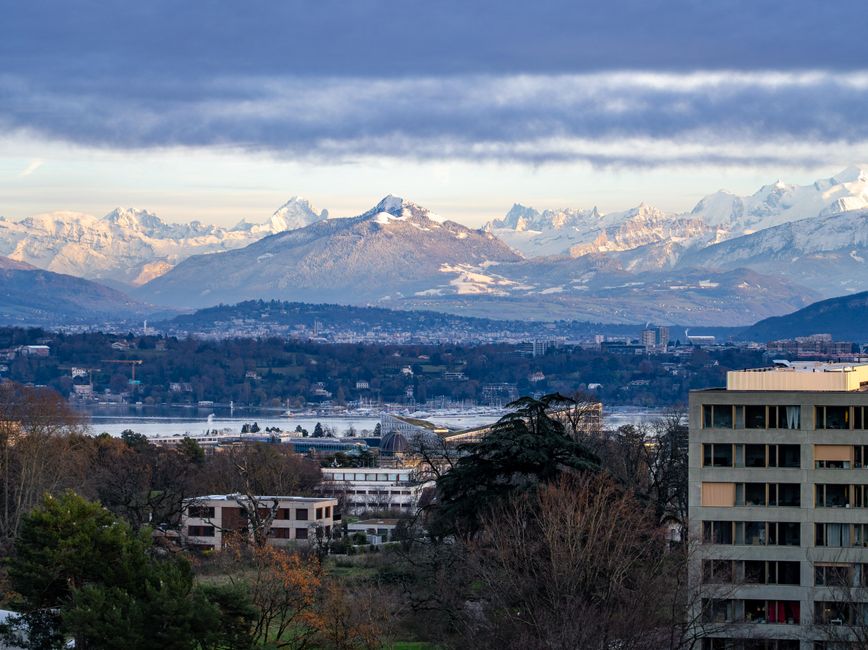
Geneva is a small city with a big address book. Wrapped around the tip of Lake Geneva, with the Jura on one side and Mont Blanc on the horizon, it is home to the United Nations’ European headquarters, the Red Cross, CERN and dozens of international organisations, and you hear French, English and a dozen other languages on every tram. For visitors it means a fountain shooting 140 m into the air, an old town of cobbled lanes around a cathedral you can climb, lakeside promenades and swimming baths, a free science centre at the home of the world’s largest particle physics laboratory, tours of the Palais des Nations, and easy trips to the Lavaux vineyards, Montreux and Chamonix. Give it two days, three with day trips.
Right now in Geneva
- Wed 12–20°C 54–69°F 9 mm Rain
- Thu 12–14°C 53–58°F 26 mm Rain
- Fri 8–13°C 46–56°F Mostly clear
Weather: MET Norway (CC BY 4.0) · Air quality: OpenAQ · Rates: ECB
Top tours in Geneva
See all tours for Geneva →
From local operators, with prices and reviews; you check availability and book on Viator, our partner. We may earn a commission at no extra cost to you. How we earn money
Geneva at a glance
- Best for: lake views and swimming, international history and diplomacy, science at CERN, museums, watches and chocolate, and a French-speaking base for the Alps and the Lake Geneva region.
- How long: 2 days for the lake, the old town, the UN and CERN; 3–4 days to add Lavaux, Montreux, the Salève or Chamonix.
- Best time: May to September for the lake and long evenings; December for the Escalade festival; autumn for wine country.
- Getting in: Geneva Airport is about 7 minutes by train from the main station, Cornavin.
- Getting around: trams, buses and yellow lake shuttles. Hotel and hostel guests get the free Geneva Transport Card for their whole stay.
- Before you go: rail passes, money, entry rules and mountain safety are in our Switzerland travel guide.
Geneva, area by area
The Rhône flows out of Lake Geneva right through the city centre, splitting it into the Rive Droite (right bank, north) with the station and the international district, and the Rive Gauche (left bank, south) with the old town, the shopping streets and the Jet d’Eau. The city is almost surrounded by France.
The Old Town (Vieille Ville)
On a hill on the left bank, the old town is a quiet quarter of fountains, antique shops and grand houses around St. Pierre Cathedral, the Place du Bourg-de-Four (the oldest square in the city, lined with cafés) and the town hall. Below, in the Parc des Bastions, the Reformation Wall shows Calvin and the other Protestant reformers, carved 100 m long. Best for: history and atmosphere.
Pâquis and the Rive Droite
Between the station and the lake, the Pâquis district has the city’s most varied, affordable restaurants, small bars and a lively, mixed street life, plus grand hotels along the Quai du Mont-Blanc. Best for: food, budget-friendly stays and the Bains des Pâquis.
The International Quarter
North of the centre, around the Place des Nations, are the Palais des Nations, the Red Cross Museum and many international agencies, next to the parks of the lake shore and the Botanical Garden. Best for: the UN and museums.
Plainpalais and Carouge
South of the old town, the Plainpalais plain hosts a big flea market, with student bars around it. Further south, Carouge was built by the kings of Sardinia in the 18th century as a rival town, and its low, colourful houses, courtyards and craft shops still feel Italian. Best for: markets, bars and a village feel.
Top things to see in Geneva
Prices and hours below were checked on the official sites in October 2026. They change, so check before you go.
The Jet d’Eau
Geneva’s symbol shoots 500 litres of lake water a second to a height of 140 m, leaving the nozzle at 200 km/h. It began in 1891 as a pressure-release valve for the city’s water network, about 30 m high, and became so popular that it was moved to its current spot and made much taller. You can walk out along the jetty from the Jardin Anglais side to stand under the spray (expect to get wet if the wind changes). In the 2026 summer season (4 May to 13 September) it ran from 9:00 to 23:15 and was lit at night; outside summer it runs shorter daytime hours. It is switched off in strong wind, when temperatures are near freezing and for maintenance; in 2026 it is closed for maintenance from 2 November to 3 December. Check SIG, the utility that runs it, on the day.
St. Pierre Cathedral
The cathedral, begun in the 12th century and given a classical façade in the 18th, became the church of John Calvin in the Reformation. Climb the towers for the best view in Geneva, over the rooftops, the lake and the Jet d’Eau to the Alps, and visit the archaeological site underneath, which shows 2,000 years of churches on this spot. As of October 2026, the towers cost CHF 7 for adults and CHF 4 for children aged 7–16; towers and archaeological site together cost CHF 12, and adding the International Museum of the Reformation next door CHF 18. In summer (June to September) it opens on weekdays from 9:30 to 18:30, Saturdays to 16:30 and Sundays from 12:00; the towers close 30 minutes before the church.
CERN Science Gateway
CERN, the European laboratory for particle physics, is where the World Wide Web was invented and the Higgs boson discovered, using the 27 km Large Hadron Collider that runs under the Swiss-French border. Its visitor centre, the Science Gateway, has hands-on exhibitions, lab workshops and shows that explain the universe from quarks to the Big Bang. Entry is free, but you need to register. As of October 2026, it opened Tuesday to Sunday, with exhibitions from 9:00 to 17:00 (last entry 16:30), and was closed on Mondays and from 24 to 25 December and 31 December to 1 January.
Guided tours. Free 90-minute guided tours of CERN’s sites are very popular. For individuals and families (1 to 11 people), they cannot be booked online in advance: places are released 2 hours before each tour, first come, first served, through a web app you use on site, and only about one visitor in ten gets a place, so arrive in the morning. Tours are mostly in English, recommended from age 14 and not suitable for young children. Groups of 12 to 48 people book online up to nine months ahead and must send everyone’s identity details at least 21 days before. There are no guided tours from 23 December 2026 to 5 January 2027. Tram 18 from Cornavin reaches the “CERN” stop in about 25 minutes.
The Palais des Nations
Built in the 1930s for the League of Nations, the Palais is now the United Nations Office at Geneva, the UN’s biggest site after New York. One-hour guided tours visit the Assembly Hall, the Council Chamber with its golden murals, and the Human Rights and Alliance of Civilizations Room with Miquel Barceló’s dripping, cave-like ceiling. As of October 2026, tours cost CHF 25 for adults, CHF 22 for students, seniors and disabled visitors, CHF 14 for ages 14–17 and CHF 13 for ages 6–13.
Booking and ID. Book online: dates for each month are released on the 20th of the month before, and individual tours sell out quickly. Bring a valid passport (or a national ID card from a Schengen country) and arrive at the Visitors’ Centre at the Pregny Gate, 14 Avenue de la Paix, 30 minutes early for the security check. The building is being renovated, so the route can change, and there are no tours on UN holidays. Opposite, on the Place des Nations, the 12 m Broken Chair by Daniel Berset stands as a protest against landmines.
The Red Cross Museum and other museums
The International Red Cross and Red Crescent Museum, opposite the UN, tells powerful stories of humanitarian work, from the founding of the Red Cross in Geneva in 1863 to today’s crises. As of October 2026, it cost CHF 15 for adults and CHF 10 reduced, free for under-12s, and opened Tuesday to Sunday from 10:00 to 17:00 (Thursdays to 20:00). Other highlights: the Patek Philippe Museum for five centuries of watches; the Musée d’Art et d’Histoire, the city’s big art and archaeology museum; the MEG ethnography museum; and the Maison Tavel, the oldest house in the city.
Museums
- Ariana Museum
- International Red Cross and Red Crescent Museum
- Museum of Art and History Geneva
Churches and cathedrals
- St. Pierre Cathedral
Monuments
- Reformation Wall
Other sights
- Jet d'Eau
- Palace of Nations
Things to do in Geneva
Swim at the Bains des Pâquis
A 1930s bathing pier on a jetty in the lake, the Bains des Pâquis is Geneva’s favourite hangout: swim off the wooden decks in summer, sunbathe, eat at the simple buvette, and in winter take the sauna, the hammam and a cold dip, followed by fondue. It opens every day, with hours depending on the weather. Genève-Plage on the other shore has a big pool, lawns and lake swimming in summer.
Cruise the lake
The little yellow Mouettes shuttle boats cross the harbour between Pâquis, Molard, Eaux-Vives and other stops as part of the public transport network. For longer trips, the CGN’s Belle Époque paddle steamers sail to Nyon, Lausanne-Ouchy, Montreux, Chillon and Évian in France; the Swiss Travel Pass is valid. See our boat trips guide.
Walk the lakeside parks
Follow the shore past the Jardin Anglais and its flower clock, made of thousands of plants, to the Parc La Grange with its rose garden, or on the other side to the Perle du Lac park and the Botanical Garden, which is free.
Markets, chocolate and food
The Plainpalais flea market runs on Wednesdays, Saturdays and Sundays. Geneva’s chocolatiers make pavés and, for the Escalade, chocolate cauldrons. Try fondue moitié-moitié, perch fillets from the lake, longeole sausage and wines from the canton’s own vineyards, among the largest wine-growing areas in Switzerland.
The Fête de l’Escalade
Every December, Geneva celebrates its victory over a night attack by the Duke of Savoy’s troops in 1602, when, legend says, a housewife poured a pot of hot vegetable soup on the attackers. The old town fills with costumed parades, fifes and drums, mulled wine and torches, and children smash chocolate soup pots. In 2026, the Escalade runs from 11 to 13 December, with the big historical parade on Sunday 13 December.
Activities and best months
- Beaches and swimmingGeneva swims in its lake in the city: the Bains des Pâquis (open all year, with sauna, hammam and winter fondue), a supervised bath at the foot of the Jet d'Eau with lanes and a children's pool, and Geneva's new free beach of sand and small pebbles with a park; a summer 'Beach Line' bus links the bathing spots. The lake is warm enough for most people in summer. · source
- Boat tripsOn Lake Geneva you can choose from short cruises along Geneva's shores with views of Mont Blanc, a solar-powered zero-emission boat, sunset dinner cruises on the Belle Époque steamers and a day trip to Lausanne and back; the colourful Mouette shuttle boats make quick crossings of the harbour. · source
- City sightseeingGeneva Tourism's top 10 starts with the 140-metre Jet d'Eau on the lakefront and the Flower Clock (1955) in the Jardin Anglais, then the Old Town, Switzerland's largest historic city centre, dominated by St. Peter's Cathedral, the heart of the Reformation; International Geneva (the Palais des Nations) and CERN are other highlights. · source
- Wine tastingGeneva is Switzerland's third-largest wine canton, with over 1,400 hectares of vines (Chasselas, Gamay, Pinot Noir). Satigny, the country's largest wine-growing commune, has many estates offering tours and tastings; the signposted Geneva Wine Trail links wineries across the countryside, and open-cellar days and harvest festivals take place in season. · source
Day trips from Geneva
The Salève, Geneva’s mountain, is actually in France: a cable car from Étrembières climbs to 1,100 m for the classic view of the city, the lake and Mont Blanc. As of October 2026, a same-day return cost €18 for adults. Take your passport. Lausanne is about 40 minutes by train, with the Olympic Museum, a Gothic cathedral and the lakeside at Ouchy. Beyond it, the UNESCO-listed Lavaux vineyard terraces and Montreux with the Château de Chillon are about an hour away. Lakeside towns such as Nyon, with its Roman museum, and the walled medieval village of Yvoire in France are easy by boat. Chamonix and Mont Blanc are about 1 hour 15 minutes away by road; and Gruyères, with its castle and cheese, about 1 hour 30 minutes.
Nearby destinations
- Annecy33 km
- Chamonix63 km
- Montreux64 km
- Courchevel95 km
- Val d'Isère105 km
- Lyon112 km
- Zermatt125 km
- Bern129 km
Getting to Geneva
By air. Geneva Airport (GVA) is about 5 km from the centre. The airport station is under the terminal, with up to seven trains an hour to Cornavin in about 7 minutes and direct trains to Lausanne, Bern, Zurich and Lucerne. Note that the free 80-minute public transport ticket once given out in the baggage hall was discontinued in 2022; a zone 10 ticket costs CHF 3 as of October 2026, and the trip is free with the Geneva Transport Card or the Swiss Travel Pass. The airport has a French sector for some flights to and from France.
By train. Geneva Cornavin has fast trains to Lausanne (about 35–40 minutes), Bern (about 1 hour 45 minutes) and Zurich (about 2 hours 40 minutes), plus TGV Lyria trains to Paris in about 3 hours 15 minutes and regional trains to Lyon. The cross-border Léman Express links Geneva with 45 stations in Switzerland and France, including Annecy and Évian.
By car. Geneva is on the A1 motorway (vignette required in Switzerland). Parking in the centre is expensive; use park-and-ride sites on the edge of the city.
Getting around: the Geneva Transport Card
Geneva’s public transport, run by tpg and the unireso network, includes trams, buses, regional trains and the Mouettes boats. Guests of hotels, youth hostels and campsites in the canton get the free Geneva Transport Card, which is emailed about three days before arrival and covers zone 10 (almost the whole canton) for the whole stay, including the train from the airport. Otherwise, as of October 2026, a single ticket started at CHF 2 for short trips and a day pass cost CHF 7.50 (CHF 5.60 from 9:00). The Geneva City Pass, sold by Geneva Tourism for 24, 48 or 72 hours, gives free entry or discounts at around 60 attractions and tours, with or without transport.
When to go and how long to stay
Geneva has warm summers, cool winters and a fair amount of rain spread through the year. Fog often settles over the lake in late autumn and winter, while the cold north-east wind called the bise can blow for days and coat the lakeside railings with ice. The table uses MeteoSwiss climate normals for 1991–2020 at Genève-Cointrin.
| Season | Average daily high | What it’s like |
|---|---|---|
| Winter (Dec–Feb) | 5–7 °C | Cold, often grey or foggy, with bise wind; Escalade and Christmas |
| Spring (Mar–May) | 12 °C rising to 20 °C | Blossom in the parks; changeable weather |
| Summer (Jun–Aug) | 24–27 °C | Warm to hot and sunny; lake swimming and long evenings |
| Autumn (Sep–Nov) | 21 °C falling to 9 °C | Mild and golden in September, grape harvest; wetter October |
Geneva gets about 950 mm of rain a year, with October usually the wettest month and February the driest. July is the warmest month, with average highs of about 27 °C.
Geneva in 1 day
Start at the Jet d’Eau and walk the lakefront to the Jardin Anglais, climb up to the old town and the cathedral towers, have lunch on the Place du Bourg-de-Four and see the Reformation Wall. In the afternoon, take a tour of the Palais des Nations or visit the Red Cross Museum, then end with a swim or a drink at the Bains des Pâquis.
Geneva in 3 days
Spend a morning at CERN’s Science Gateway (and try for a guided tour), explore Carouge, then take a lake steamer or the train to Lavaux and Montreux for a day, or ride the cable car up the Salève.
Weather month by month
Averages from MeteoSwiss normals 1991–2020, Geneva Cointrin (airport) · Last reviewed 4 Oct 2026
Where to stay in Geneva
- Rive Droite and Pâquis: close to the station and the lake, with everything from grand palace hotels to budget rooms.
- Old Town: a few small, atmospheric hotels in the cobbled lanes.
- Eaux-Vives: lakeside residential area on the left bank, near the Jet d’Eau and Genève-Plage.
- Carouge: village charm, good restaurants, a short tram ride from the centre.
- Near the airport: business hotels and better value, 7 minutes by train from the centre.
Hotel prices in Geneva follow the diplomatic and conference calendar: big UN sessions, trade fairs and watch fairs can fill the city. Book early, and remember the free Geneva Transport Card that comes with any hotel stay.
Practical tips for Geneva
- Bring your passport: you need it for the UN tour, and day trips often cross into France.
- Arrive early at CERN: individual tour places are released on site 2 hours before each tour.
- Book the UN on the 20th: tour dates for the next month open then.
- Check the Jet d’Eau: it stops in strong wind, frost and for maintenance.
- Speak French: a “bonjour” goes a long way; English is widely spoken.
- Plan for Sundays: most shops close; the station and airport shops stay open.
What to pack for Geneva
Comfortable shoes for the old town’s cobbles and hills, swimwear and a towel for the lake baths in summer, a windproof jacket for the bise and a warm coat in winter, and smart-casual clothes if you have meetings or dine out. Bring a Type J plug adapter; two-pin European plugs fit.
What to pack
- City walking shoesLisbon and Porto are steep, with polished limestone cobbles that get slippery, so grippy soles matter.
- Day packs and anti-theft bagsCarries water, towel and sunscreen down the long stairways to Algarve coves.
- Dry bags and phone pouchesProtects phones and cameras from sand and spray on beaches reached by ferry or steep paths.
- Fleeces and warm layersIt is cooler at sea than on land, especially on morning whale-watching trips.
- Quick-dry beach towelsA sand-shedding quick-dry towel packs small for beach days and lido visits.
- Rain jacketsA windproof, waterproof shell keeps you warm on open boats, where wind and spray cool you quickly.
- Reef-friendly sunscreenSummer UV is strong on Portuguese beaches and there is little shade below the cliffs.
- Travel adapters and convertersPortugal uses Type C and F sockets at 230 V, so most visitors from outside Europe need an adapter.
- Water shoesRocky coves, lava pools and weever fish in shallow sand make water shoes useful.
- WetsuitsOn the west and north coasts the sea stays around 16–18 °C even in summer, so a thin suit helps for long swims.
- Wine bottle travel protectorsPort and Douro wines bought at the quintas travel home safely in checked luggage with padded bottle protectors.
Geneva travel FAQ
Is it free to visit CERN?
Yes. The Science Gateway exhibitions are free (registration required) and open Tuesday to Sunday. Guided tours are also free, but individuals can only get a place on the day, 2 hours before each tour, first come, first served.
Can you book a CERN tour in advance?
Only groups of 12 to 48 people can book online, up to nine months ahead. Individuals and families register on site through CERN’s web app when places open 2 hours before each tour. Arrive in the morning for the best chance.
How much is a tour of the Palais des Nations?
As of October 2026, CHF 25 for adults, CHF 22 for students and seniors, CHF 14 for ages 14–17 and CHF 13 for ages 6–13. Book online and bring a passport or Schengen ID card.
When does the Jet d’Eau run?
Most of the year, during the day, with long hours and night lighting in summer (9:00 to 23:15 in the 2026 summer season). It is switched off in strong wind, near freezing and for maintenance, which in 2026 runs from 2 November to 3 December.
Is public transport free in Geneva?
It is free for guests of hotels, hostels and campsites, who get the Geneva Transport Card for their whole stay, including the airport train. Others pay from CHF 2 a trip or CHF 7.50 for a day pass as of October 2026.
Is there still a free ticket at Geneva Airport?
No. The free ticket machine in the baggage hall was removed at the end of 2021. Hotel guests travel free with the Geneva Transport Card; others buy a zone 10 ticket.
Can you swim in Lake Geneva?
Yes. The Bains des Pâquis and Genève-Plage are the classic spots, and locals swim from many lakeside steps in summer. The water is clean and reaches about 20–24 °C in July and August.
How many days do you need in Geneva?
Two days for the lake, the old town, the UN and CERN; three or four to add Lavaux, Montreux, the Salève or Chamonix.
When is the Escalade in 2026?
From 11 to 13 December 2026 in the old town, with the historical parade on Sunday 13 December.
Can I visit Chamonix from Geneva?
Yes. Chamonix is about 1 hour 15 minutes by road, with shuttle buses from Geneva Airport. Bring your passport. See our Chamonix guide.
Is the Geneva Motor Show still held?
No. The organisers cancelled the show in 2024, and the 2024 edition was the last.
Sources
- © OpenStreetMap contributors · ODbL · fetched 4 Oct 2026
- Wikidata · CC0 · fetched 4 Oct 2026
Sources and last review
Researched and last reviewed on 4 October 2026. CERN hours and tour rules: visit.cern; Palais des Nations prices and booking: the United Nations Office at Geneva (ungeneva.org); Jet d’Eau: SIG and tpg; Geneva Transport Card and fares: tpg; airport trains: Geneva Airport; cathedral towers: the Cathedral of St. Pierre; Red Cross Museum; the Escalade: Geneva Tourism (geneve.com); Salève fares: Téléphérique du Salève; climate: MeteoSwiss 1991–2020 normals for Genève-Cointrin, read via a secondary summary. The end of the Motor Show and of the airport ticket, the Jet d’Eau’s winter hours and train times come partly from secondary sources and are flagged for checking. Prices, timetables and rules change, so check the official links before you go. For rail passes, money and entry rules, see our Switzerland travel guide.
Plan your trip
Partner links: TravelerCenter may earn a commission if you book, at no extra cost to you.
🇩🇪 Useful German phrases for Geneva
All 38 German phrases: restaurant, hotel, emergencies, romance (printable) →