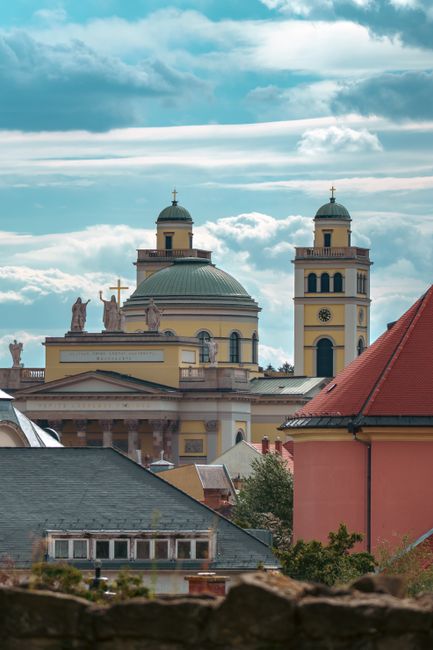
Eger is a small baroque city in the foothills of the Bükk mountains, two hours north-east of Budapest, and one of the most enjoyable places in Hungary. Its castle is the scene of the country’s favourite heroic tale, the 1552 siege in which a few thousand defenders held off a vast Ottoman army. Below it, a compact old town of churches, pastel houses and cafés surrounds a slender Ottoman minaret, the northernmost in Europe. Just outside the centre, the Valley of the Beautiful Women is lined with cellars cut into the hillside, where you taste Bull’s Blood red wine straight from the barrel, and a thermal bath and an old Turkish bath round off the day. Give it a long day trip from Budapest, or better, one or two nights.
Right now in Eger
- Wed 11–23°C 52–73°F Clear
- Thu 11–25°C 51–76°F 4 mm Partly cloudy
- Fri 13–15°C 56–58°F 3 mm Cloudy
Weather: MET Norway (CC BY 4.0) · Rates: ECB
Top tours in Eger
See all tours for Eger →
From local operators, with prices and reviews; you check availability and book on Viator, our partner. We may earn a commission at no extra cost to you. How we earn money
Eger at a glance
- Best for: history and castles, wine tasting in cellars, baroque architecture, thermal baths and walks in the Bükk hills.
- How long: 1 day for the castle, the minaret and the wine valley; 2–3 days to add the baths and day trips to Szilvásvárad or Tokaj.
- Best time: May, June, September and October; September and October bring the grape harvest.
- Getting in: direct trains from Budapest-Keleti run about hourly and take just under two hours; by car, take the M3 motorway (e-matrica required).
- Getting around: the centre is walkable; the wine valley is a 20- to 30-minute walk or a ride on the little tourist train.
- Before you go: Hungary uses the forint; carry cash for small cellars. Entry rules and money are covered on our Hungary country page.
Eger, area by area
The castle hill
The castle stands on a hill at the north-east edge of the old town, its walls and bastions looking down over the roofs. Inside are museums, the ruins of a Gothic bishop’s palace and cathedral, and underground casemates. Best for: history and views.
The old town
Dobó István Square, with its statue of the castle’s commander and the Minorite Church, is the heart of town. Pedestrian streets lead to the minaret, the archbishop’s basilica and the Lyceum, with the Eger stream running through the centre. Best for: cafés, churches and hotels within walking distance of everything.
The Valley of the Beautiful Women and the spa quarter
South-west of the centre, the Szépasszony-völgy is a horseshoe of cellars with terraces and simple restaurants. Closer in, the Archbishop’s Garden park holds the thermal bath and the Turkish bath. Best for: evenings of wine and relaxing soaks.
Top things to see in Eger
Prices and hours below were checked on the official sites in October 2026. They change, so check before you go.
Eger Castle and the Dobó István Castle Museum
In 1552, Captain István Dobó and about 2,000 soldiers, helped by the women of the town who famously poured boiling oil and pitch on the attackers, held Eger Castle for more than a month against an Ottoman army many times larger. The story became a national legend through Géza Gárdonyi’s novel Egri csillagok (Eclipse of the Crescent Moon), which every Hungarian reads at school; the writer’s grave is in the castle. The Ottomans did take Eger in 1596 and held it for 91 years. Today you can walk the walls and bastions, visit the history and art exhibitions, the Hall of Heroes with Dobó’s tomb, and the underground casemates, which can be visited only on a guided tour.
Tickets. As of October 2026, an adult ticket costs 4,800 Ft and a reduced ticket (ages 6 to 26 and 62 to 70) 2,800 Ft, including the castle exhibitions, the daily guided tours and the museum’s town sites, such as the Gárdonyi Géza Memorial House; an evening ticket, sold in the last hour, costs 2,400 Ft with limited access. The castle gate is open daily 6:00–22:00, with exhibitions open 9:00–18:00 and the ticket office 9:00–18:30 until 31 October 2026; check winter hours after that. Exhibitions are free on national holidays (15 March, 20 August and 23 October), which also makes those days very busy.
The minaret
The 40-metre minaret, built in the early 17th century beside a mosque that has long since gone, is the northernmost surviving Ottoman minaret in Europe. You can climb its 97 narrow, steep spiral steps to the balcony for a view over the town; it is not for the claustrophobic. As of October 2026, entry costs about 1,000 Ft, and it opens daily from 10:00 to about 16:45 until early November, with shorter winter hours and closures in bad weather.
Eger Basilica
Hungary’s second-largest church, a neoclassical cathedral of the 1830s with a broad staircase and columned portico. It is free to enter outside services, and short organ recitals are often held on summer days.
The Lyceum and its camera obscura
Opposite the basilica, the huge baroque Lyceum, now part of Eszterházy Károly Catholic University, holds a beautiful frescoed library and, at the top of its tower, an astronomical museum and a 19th-century camera obscura that projects a live image of the town onto a table. Check opening times, as they vary by season and with university events.
Dobó István Square and the Minorite Church
The main square is framed by the twin-towered baroque Minorite Church of St Anthony of Padua, one of the finest in Central Europe, and by bronze statues of the castle’s defenders. It is the setting for markets, concerts and Christmas events.
Churches and cathedrals
- Eger Basilica
- Minorite Church, Eger
Museums
- Eger Castle
- Lyceum of Eger
Historic centres
- Dobó István Square
Viewpoints
- Eger Minaret
Other sights
- Valley of the Beautiful Women (Szépasszony-völgy)
The Valley of the Beautiful Women and Eger wine
Eger is one of Hungary’s best-known wine regions. Its most famous wine is Egri Bikavér (Bull’s Blood), a blend of red grapes such as Kékfrankos, Cabernet and Merlot; legend says the defenders of 1552 drank red wine before battle and the Ottomans thought it was bull’s blood. Its white counterpart is Egri Csillag (Star of Eger), a fresh blend of local white grapes.
The Szépasszony-völgy (Valley of the Beautiful Women) is the easiest place to taste them: a few dozen cellars dug into the soft volcanic tuff, each with a small bar or terrace, where the winemaker or a family member fills your glass from the barrel, sometimes with a glass pipette called a lopó. Tasting glasses are cheap, and you can buy wine by the bottle or have a plastic bottle filled to take away. Many cellars open from late morning to the evening from spring to October, fewer in winter; carry some cash. Walk there in 20 to 30 minutes from the centre, or take the little tourist train in season, and take a taxi back if you have enjoyed the wine. For a more formal visit, several larger wineries on the edge of town run tours and tastings by appointment. See our wine tasting guide.
Festivals. Eger’s calendar follows the wine year: a Bikavér festival in summer, castle games with costumed soldiers and archery recalling the siege, harvest celebrations in September and October, and a small Advent market on Dobó István Square in December. Dates change each year, so check with the local tourist office (Tourinform Eger) before you plan around an event. Even without a festival, a summer evening in the valley, with music drifting from the cellar terraces, is one of the nicest experiences in Hungary.
Eger’s thermal bath and Turkish bath
In the leafy Archbishop’s Garden, a short walk from the centre, the Eger Thermal Bath has outdoor and indoor thermal, swimming and children’s pools. As of October 2026 (prices from 1 September 2026), an adult day ticket costs 4,600 Ft and an afternoon ticket from 15:00 costs 3,000 Ft. Next door, the restored Turkish Bath (Török fürdő) has a 17th-century Ottoman dome over a hot pool, plus modern thermal pools, saunas and treatments; it costs a 3,600 Ft supplement on top of the thermal bath ticket. Its wellness section opens 16:30–21:00 on Mondays and Tuesdays, 15:00–21:00 on Wednesdays and Thursdays, 13:00–21:00 on Fridays and 9:00–21:00 at weekends and on holidays; leave the pools 30 minutes before closing. Bring a swimsuit, towel and flip-flops.
Activities and best months
- City sightseeingEger Castle, scene of the 1552 siege, holds the Dobó István Castle Museum: walls and bastions, exhibitions, the Hall of Heroes and the casemates on a guided tour; the castle ticket also covers the museum's sites in town. The baroque old town, the minaret, the Basilica and the Lyceum are within walking distance. · source
- Wine tastingUnder Eger runs about 130 km of cellars cut into the tuff; the best-known row is the Valley of the Beautiful Women (Szépasszony-völgy), with more than 150 cellars where local producers pour Egri Bikavér and other wines, a short walk from the centre. · source
Day trips from Eger
- Szilvásvárad and the Szalajka Valley: 30 km north, in the Bükk National Park, a forest valley of streams, small waterfalls and trout ponds with a narrow-gauge forest railway in season; also home to a famous Lipizzaner stud.
- The Bükk hills: beech forests, limestone cliffs and caves; good walking from Felsőtárkány or Szilvásvárad. See our hiking guide.
- Noszvaj: a village 10 km east with cave dwellings carved into the rock and a baroque mansion.
- The Mátra and Kékes: Hungary’s highest peak (1,014 m), about an hour west, with forest trails and viewpoints.
- Tokaj: the sweet-wine region, about an hour and a half by car, for cellar visits; better with a night.
- Miskolctapolca and Lillafüred: a cave bath and a lakeside palace hotel in the hills near Miskolc, about an hour away.
Nearby destinations
- Budapest109 km
- Banská Štiavnica126 km
- High Tatras142 km
- Zakopane159 km
- Lake Balaton231 km
- Kraków243 km
- Bratislava244 km
- Hévíz270 km
Getting there and getting around
By train. MÁV’s InterRégió trains run about hourly from Budapest-Keleti to Eger via Hatvan and Füzesabony, taking just under two hours with no change. Eger station is about 15 to 20 minutes’ walk south of the old town, or a short bus or taxi ride. For Tokaj and Miskolc, change at Füzesabony. By car. Take the M3 motorway towards Miskolc and turn off at Füzesabony; motorways need an e-matrica vignette (as of October 2026, 5,550 Ft for one day or 6,900 Ft for ten days for a car). Park outside the pedestrian centre. By bus. Volánbusz coaches link Eger with Budapest and with villages in the Bükk and Mátra. In town, everything in the centre is within walking distance.
When to go and how long to stay
Eger has warm summers and cold winters, a little colder than Budapest. HungaroMet publishes no climate table for Eger itself, so the table uses its official 1991–2020 averages for Miskolc, about 60 km to the north-east, which has a very similar climate.
| Season | Average daily high | Average nightly low | Rain per month | What it’s like |
|---|---|---|---|---|
| Winter (Dec–Feb) | 2.0–4.8 °C | −3.9 to −2.6 °C | 28–39 mm | Cold, frost and some snow; steaming baths and a Christmas market |
| Spring (Mar–May) | 11.0 °C rising to 22.5 °C | 1.1 °C rising to 10.6 °C | 31–67 mm | Fresh and green, good for walks in the Bükk |
| Summer (Jun–Aug) | 26.1–28.1 °C | 14.4–16.0 °C | 65–91 mm | Warm to hot, with thunderstorms; wine and castle festivals |
| Autumn (Sep–Nov) | 22.3 °C falling to 8.7 °C | 11.2 °C falling to 2.1 °C | 44–54 mm | Harvest time, golden forests, cellars at their liveliest |
Miskolc gets about 640 mm of rain a year, most of it in June and July.
Eger in 1 day
Take an early train from Budapest. Spend the morning at the castle, have lunch on Dobó István Square, climb the minaret and look into the basilica, then walk out to the Valley of the Beautiful Women for wine tasting before the evening train back.
Eger in 3 days
Day 1 as above, staying the night. Day 2: the Lyceum and its camera obscura in the morning, the thermal bath and Turkish bath in the afternoon, and dinner in a cellar restaurant. Day 3: Szilvásvárad and the Szalajka Valley, or a drive to Tokaj.
Weather month by month
Averages from HungaroMet normals 1991–2020, Eger · Last reviewed 4 Oct 2026
Where to stay in Eger
- Old town: small hotels and guesthouses in baroque houses, steps from the castle and restaurants.
- Near the baths: spa hotels and apartments around the Archbishop’s Garden, a short walk from the centre.
- Near the wine valley: guesthouses where you can walk home after the cellars.
- Countryside: wellness hotels in Noszvaj, Demjén or Egerszalók, with their own thermal pools; best with a car.
Eger is busiest at summer weekends and on national holidays; book ahead for those. A small tourist tax per night is added to the bill.
Practical tips for Eger
- Read the story first: the castle means far more if you know the 1552 siege; an English translation of Gárdonyi’s novel is widely available.
- Carry cash in the wine valley: some small cellars don’t take cards.
- Don’t drive after tasting: Hungary has zero tolerance for alcohol at the wheel.
- Check winter hours: the castle exhibitions, the minaret and cellars keep shorter hours from November.
What to pack for Eger
Comfortable shoes for the castle hill and cobbles, hiking shoes for the Bükk, a swimsuit, towel and flip-flops or water shoes for the baths, a light rain jacket for summer storms, and a warm layer for cool cellars, which stay at about 10–12 °C all year.
What to pack
- City walking shoesLisbon and Porto are steep, with polished limestone cobbles that get slippery, so grippy soles matter.
- Day packs and anti-theft bagsA small zipped or anti-theft bag makes crowded trams and viewpoints less stressful.
- Rain jacketsFrom October to April Porto and Lisbon see rain on roughly a third of days.
- Travel adapters and convertersPortugal uses Type C and F sockets at 230 V, so most visitors from outside Europe need an adapter.
- Wine bottle travel protectorsPort and Douro wines bought at the quintas travel home safely in checked luggage with padded bottle protectors.
Eger travel FAQ
How much does Eger Castle cost?
As of October 2026, 4,800 Ft for adults and 2,800 Ft for ages 6 to 26 and 62 to 70, including the exhibitions and daily guided tours. An evening ticket in the last hour costs 2,400 Ft.
Can you visit Eger as a day trip from Budapest?
Yes. Direct trains from Budapest-Keleti take just under two hours and run about hourly, leaving time for the castle, the minaret and the wine valley. A night lets you enjoy the cellars and baths without rushing.
What is the Valley of the Beautiful Women?
A valley on the edge of Eger lined with a few dozen wine cellars cut into the hillside, where you taste local wines such as Egri Bikavér from the barrel. It is a 20- to 30-minute walk from the centre.
What is Egri Bikavér?
Bull’s Blood, Eger’s signature red blend, often based on Kékfrankos. Its white partner is Egri Csillag (Star of Eger).
Can you climb the Eger minaret?
Yes, up 97 very narrow spiral steps to the balcony. As of October 2026 it costs about 1,000 Ft and opens daily from 10:00, with shorter hours in winter and closures in bad weather.
How much is the thermal bath in Eger?
As of October 2026, 4,600 Ft for an adult day ticket or 3,000 Ft after 15:00. The Turkish Bath costs a 3,600 Ft supplement.
How many days do you need in Eger?
One full day covers the highlights; two or three let you add the baths, the Lyceum and a day trip to Szilvásvárad or Tokaj.
When is the best time to visit Eger?
May, June, September and October, for pleasant weather and, in autumn, the grape harvest. Winter is cold but good for the baths.
Sources
- © OpenStreetMap contributors · ODbL · fetched 4 Oct 2026
- Wikidata · CC0 · fetched 4 Oct 2026
Sources and last review
Researched and last reviewed on 4 October 2026. Castle tickets and hours: Dobó István Castle Museum; thermal bath and Turkish Bath prices and hours: Eger Termál; trains: MÁV; e-matrica: National Toll Payment Services; climate: HungaroMet 1991–2020 averages for Miskolc. The minaret’s price and hours, train times and the Lyceum’s opening details come from secondary sources and are flagged for checking. Prices, timetables and rules change, so check the official sites before you go.
Plan your trip
Partner links: TravelerCenter may earn a commission if you book, at no extra cost to you.
🇭🇺 Useful Hungarian phrases for Eger
All 38 Hungarian phrases: restaurant, hotel, emergencies, romance (printable) →