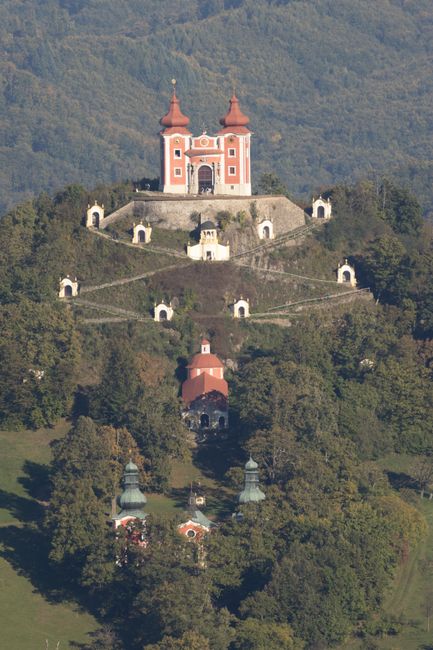
Banská Štiavnica is Slovakia’s most beautiful small town: an old silver and gold mining town of about 10,000 people, built on the steep slopes of a collapsed volcano in the hills of central Slovakia, with two castles, a baroque Calvary on a hilltop and Renaissance burghers’ houses stacked up the sides of a valley. For centuries it was one of the richest mining towns in Europe, and in 1762 it got the world’s first mining academy. Today the whole town and the mining landscape around it, including dozens of man-made lakes called tajchy, are on the UNESCO World Heritage list. You come to go underground in a real mine, climb the Calvary at sunset, swim in a tajch in summer and enjoy a town full of cafés, galleries and students. It is about two hours from Bratislava by car. Give it two days for the town and the mines, three or four to add the lakes, the hills and the villages around.
Right now in Banská Štiavnica
- Wed4–18°C39–64°FPartly cloudy
- Thu8–19°C46–67°F13 mm rain
- Fri7–14°C45–57°FClear
Top tours in Banská Štiavnica
See all tours for Banská Štiavnica →
From local operators, with prices and reviews; you check availability and book on Viator, our partner. We may earn a commission at no extra cost to you. How we earn money
Banská Štiavnica at a glance
- Best for: UNESCO townscape, mining history underground, castles and viewpoints, lake swimming and easy hikes, autumn colours and a slow weekend.
- How long: 2 days for the town, the castles, the Calvary and the Open-air Mining Museum; 3–4 days to add the tajchy, Sitno hill and the gold mine at Hodruša-Hámre.
- Best time: May to October; July and August for swimming in the tajchy; September for the Salamander festival; December for the Christmas market.
- Getting in: by car from Bratislava in under 2 hours; by train with a change at Hronská Dúbrava onto a scenic branch line; by bus from Zvolen, Banská Bystrica or Bratislava.
- Getting around: on foot, up and down steep lanes. As of October 2026, the Open-air Mining Museum cost €14 and the Old Castle €8.
- Before you go: entry rules, money and general safety are in our Slovakia travel guide.
Banská Štiavnica, area by area
The town has no flat centre. Its streets follow the old mining valleys and climb in terraces, so the main sights are close as the crow flies but linked by steep lanes and steps. Most visitors spend their time in the historic core between the two castles, with the Calvary on its own hill to the east.
Holy Trinity Square and the upper town
The sloping Námestie sv. Trojice (Holy Trinity Square) is the heart of the town, lined with the houses of rich mining families and crowned by a tall baroque plague column of 1759–1764. Above it stand the Old Castle and the Church of St Catherine; on the square are the information centre and cafés. On the morning of 18 March 2023, a fire spread across the roofs of seven historic buildings on and near the square; they have been rebuilt step by step, and some interiors, such as the mineral exhibition in the Berggericht, are still closed. Best for: first visits, cafés and evening walks.
Radničné námestie and Kammerhofská
Below the main square, the Town Hall Square has the late-Gothic Church of St Catherine and the town hall, whose clock is famous for its swapped hands: the long hand shows the hours and the short one the minutes. Kammerhofská street runs down past the Kammerhof, the former seat of the royal mining chamber, to the bus stops and the lower town. Best for: museums and quick access to buses.
The New Castle and Akademická
To the south, the white New Castle watches over the town from its own hill, and Akademická street leads to the buildings of the former Mining and Forestry Academy, with a botanical garden laid out by its professors. Best for: quiet stays and views back over the roofs.
Top things to see in Banská Štiavnica
Most museums belong to the Slovak Mining Museum (Slovenské banské múzeum). Prices and hours below were checked on its website in October 2026 and apply from 1 October; hours change by season, so check before you go.
The Open-air Mining Museum
The highlight of any visit. About 1 km from the centre, in a valley below the Klinger tajch, the museum combines a surface exhibition of mining machinery and a geological park with a guided trip into a real mine. You put on a helmet and lamp and go down 130 steps and follow the passages where miners worked from the Middle Ages to the 20th century; the most precious piece underground is a horse-driven winding machine, the only one left in Slovakia. The tour takes 90–100 minutes, the temperature underground is 8–10 °C, and it is not for people with claustrophobia.
Tickets and hours. As of October 2026, entry costs €14 (reduced €7 for children over 6, over-62s and students); the surface exhibition alone costs €2. In October 2026, tours run Wednesday to Sunday at 10:00, 12:00, 14:00 and 16:00, with hourly tours on 31 October and 1 November. Booking ahead is recommended, and tours in English must be booked at least 24 hours in advance for a €20 surcharge.
The Old Castle
The Starý zámok began as a Romanesque church in the 13th century and was turned into a fortress against the Ottomans in the 16th, so the courtyard still has the shape of a nave. Inside are the town’s history (including a charter of 1275), the original statues from the plague column, a lapidarium, historic clocks and a striking new display of painted shooting targets. As of October 2026, it costs €8 (family €20) and opens Wednesday to Sunday, 9:00–17:00.
The New Castle
The Nový zámok, built in 1564–1571, is a compact Renaissance tower-fortress that was part of a chain of watchtowers warning the mining towns of Ottoman raids. Its floors tell the story of the Turkish wars, with weapons, painted targets and life-size figures, and the top has the best view of the old town. As of October 2026, it costs €5 and opens Tuesday to Saturday, 9:00–17:00.
The Calvary (Kalvária)
On the volcanic cone of Scharffenberg, east of the centre, the Calvary is one of the finest baroque calvaries in Europe: a group of 23 chapels, churches and statues built by the Jesuits from 1744, climbing to an Upper Church with a view over the whole town. It was restored over many years and looks splendid again. The walk up from the centre takes about 30 minutes, and the grounds are free and open all year; the chapels’ interiors and the tower of the Upper Church open only at certain times. Go for sunset.
Kammerhof and the Glanzenberg adit
The Kammerhof, the former seat of the mining chamber, houses the exhibition “Mining in Slovakia”, with models of the water-powered machines that kept the deep mines dry; it costs €8 and opens Tuesday to Saturday, 9:00–17:00. The Glanzenberg adit, a medieval tunnel that starts right under the town, can be visited on short guided tours for €9; in October 2026, these ran on Fridays at 13:00 and Saturdays at 11:00 and 13:00. The Jozef Kollár Gallery is closed in October 2026.
Churches, gates and the Klopačka
Walk through the Piargska brána, the last surviving town gate, to see how the town once closed itself off; look for the Klopačka, a small tower from which a wooden board was knocked to call miners to their shifts; and peer into the Church of St Catherine with its late-Gothic vaults.
The tajchy: the mining lakes
To power the pumps and machines that kept the deep mines from flooding, engineers of the 16th to 18th centuries built a network of artificial lakes, dams and channels in the hills around the town. There were about 60; 24 survive. Today they are drinking-water reservoirs, fishing ponds and, in summer, the local swimming spots. Počúvadlo, south of town at the foot of Sitno, is the most popular, with a beach, cafés and woods around it. Klinger, right above the Open-air Mining Museum, is the closest to town. Veľká Vodárenská, one of the biggest, is a drinking-water reservoir, so check the signs before swimming. The water is cool and fresh even in August.
Things to do in Banská Štiavnica
Hike to Sitno and the volcanic hills
The town sits in the Štiavnica Mountains, the eroded remains of a huge volcano. The classic walk is to Sitno (1,009 m), the highest peak, with a lookout tower; the marked trail from Počúvadlo takes about an hour up. Shorter routes link the tajchy and the viewpoints around town, including the marked “Štiavnica from above” walk that starts on Holy Trinity Square and takes 2.5–3 hours. See our hiking guide.
Gold mine at Hodruša-Hámre and the Svätý Anton manor
In the village of Hodruša-Hámre, a 20-minute drive west, a historic gold and silver mine, presented as 700 years old, has guided underground tours, and the baroque manor of Svätý Anton, a short drive south, has period rooms and a park. Both are popular half-day trips by car.
Cafés, food and town walks
For a small town, Banská Štiavnica has a lively café and restaurant scene, much of it run by people who moved here from the cities. Try local cheese, game and the town’s own craft beer, and join a guided walk: the information centre arranges guides in English for €60 an hour. See our city sightseeing guide.
Festivals: Salamander Days and the Christmas market
The town’s big festival is Salamander Days (Salamandrové dni) in September, a celebration of the mining tradition whose highlight is the evening Salamander procession, a winding parade of more than 500 costumed miners, students and characters through the town. In 2026 it took place on 10–12 September, with the procession on Friday 11 September at 20:00 and, for the first time, a “White Night” of contemporary art on the Saturday. In winter, the Slovak Mining Museum holds the Štjavnycký vjanočný jarmok, a Christmas craft market in and around the Kammerhof, on Friday 11 and Saturday 12 December 2026.
Getting to Banská Štiavnica
By car. From Bratislava, take the R1 expressway toward Banská Bystrica; the trip takes under 2 hours. The town tourist board recommends the turn-off at Hronská Breznica via Banská Belá, which has the gentlest climbs and is best kept in winter and fog. The turn-off at Žarnovica via Hodruša-Hámre is steep and winding.
By train. Trains on the line between Nové Zámky and Zvolen stop at Hronská Dúbrava, where a small diesel train takes the scenic branch line through hills, bridges and a tunnel to Banská Štiavnica. From Bratislava, allow about 3–3.5 hours with the change; services on the branch line are few, so check the timetable on zssk.sk. Banská Štiavnica station is almost 3 km from the centre: about 35 minutes on foot or a taxi for about €2–4.
By bus. Buses are more frequent than trains and link the town with Zvolen, Žiar nad Hronom, Banská Bystrica and Žarnovica; a direct line runs to Bratislava.
Getting around Banská Štiavnica
Walk. The centre is small but steep, with cobbles and steps everywhere. The town asks drivers not to drive through the centre at all: Holy Trinity Square is a residents’ zone and parking in the old town is only on marked spaces. Use the collecting car parks on Dolná, Mládežnícka and Akademická streets, where parking costs €2 an hour and the first hour is free on Dolná and Mládežnícka; the car parks under the New Castle, on J. K. Hella and under the Calvary cost €4 for 2 hours or €8 a day. Pay by SMS or with the ParkDots app. To reach the tajchy and Sitno without a car, take a taxi or walk the marked trails.
When to go and how long to stay
Banská Štiavnica has a mild hill climate with warm summers and cold, snowy winters. The table uses the Slovak Hydrometeorological Institute (SHMÚ) 1991–2020 averages for Sliač, the nearest main weather station, about 25 km away in the Hron valley, as published by the World Meteorological Organization. The town lies some 300 m higher, so expect it a little cooler, with more snow in winter.
| Season | Average high | Average low | Rain per month | What it’s like |
|---|---|---|---|---|
| Winter (Dec–Feb) | 1–5 °C | −6 to −4 °C | 42–52 mm | Cold, often snowy and foggy; quiet town, Christmas market in December, cross-country skiing nearby |
| Spring (Mar–May) | 10 °C rising to 22 °C | −1 °C rising to 8 °C | 44–72 mm | Fresh green hills, museums return to fuller hours |
| Summer (Jun–Aug) | 25–27 °C | 12–13 °C | 64–91 mm | Warm days, swimming in the tajchy, busy weekends and summer events; thunderstorms |
| Autumn (Sep–Nov) | 21 °C falling to 8 °C | 9 °C falling to 1 °C | 56–63 mm | Salamander Days in September, golden beech woods in October, misty mornings |
Sliač gets about 715 mm of rain a year and around 1,920 hours of sunshine, most of it from May to August.
Banská Štiavnica in 2 days
Day 1: Holy Trinity Square, the Old Castle, the Church of St Catherine and the town hall clock, then the New Castle and sunset at the Calvary. Day 2: the Open-air Mining Museum in the morning, the Kammerhof or the Glanzenberg adit in the afternoon, and dinner in town.
Banská Štiavnica in 4 days
Add a day at the tajchy and on Sitno, and a day for the gold mine at Hodruša-Hámre and the Svätý Anton manor. With a car, continue to the High Tatras, about 3 hours north-east.
Where to stay in Banská Štiavnica
- The historic centre: guesthouses and small hotels in old burghers’ houses around Holy Trinity Square and the town hall; atmospheric but steep, and parking is limited.
- Below the New Castle and on Akademická: quieter streets with views and easier parking.
- At the tajchy: lakeside hotels and cottages at Počúvadlo and other lakes, best in summer and with a car.
Practical tips for Banská Štiavnica
- Mind the closing days: in October 2026, the Old Castle and the mining museum close on Mondays and Tuesdays, and the New Castle and the Kammerhof on Sundays and Mondays.
- Book the mine: reserve the Open-air Mining Museum, especially for weekends and for an English tour.
- Information centre: on Holy Trinity Square 1, open 8:00–16:00, closed Sundays.
- Weekdays are calmer: the town fills with visitors from Bratislava on summer weekends.
What to pack for Banská Štiavnica
Comfortable shoes with a good grip for steep cobbles and steps, a warm layer for the mine tour (8–10 °C underground, even in July), a light rain jacket, and swimwear and a towel in summer for the tajchy. In winter, bring a warm coat and boots for snowy lanes.
Banská Štiavnica travel FAQ
Why is Banská Štiavnica a UNESCO site?
For its historic mining town and the technical monuments around it: mines, adits and a network of artificial lakes built to power the machines that drained the mines. It was inscribed on the World Heritage list in 1993.
How much is the Open-air Mining Museum?
As of October 2026, the underground tour cost €14 (reduced €7), and the surface exhibition alone €2. Tours last 90–100 minutes; book ahead, and at least 24 hours ahead for English.
Can you visit Banská Štiavnica as a day trip from Bratislava?
Yes, by car: it is under 2 hours each way, enough for the centre, one castle and the Calvary. By public transport the trip is longer, so an overnight stay is better.
How do I get to Banská Štiavnica by train?
Take a train on the Nové Zámky–Zvolen line to Hronská Dúbrava and change to the branch line to Banská Štiavnica. The station is almost 3 km from the centre, so take a taxi or walk 35 minutes.
When are the Salamander Days?
Every September. In 2026 they ran on 10–12 September, with the Salamander procession on the evening of 11 September.
Can you swim in the tajchy?
Yes, in several of them in summer, most popularly at Počúvadlo and Klinger. Some lakes supply drinking water, so check the signs.
Is the Calvary in Banská Štiavnica free?
The grounds are free and open all year. Some chapel interiors and the tower of the Upper Church open only at set times, and the tower charges a fee.
Where can I park in Banská Štiavnica?
Use the collecting car parks on Dolná, Mládežnícka or Akademická streets (€2 an hour; the first hour is free on Dolná and Mládežnícka) and walk in. Don’t drive through the historic centre.
How many days do you need in Banská Štiavnica?
Two days covers the town, the castles, the Calvary and the mine. Stay three or four to enjoy the lakes, hike Sitno and visit the gold mine at Hodruša-Hámre.
Nearby destinations
- Budapest107 km
- High Tatras120 km
- Zakopane121 km
- Eger126 km
- Bratislava136 km
- Brno186 km
- Vienna188 km
- Kraków194 km
Plan your trip
Partner links: TravelerCenter may earn a commission if you book, at no extra cost to you.
🇸🇰 Useful Slovak phrases for Banská Štiavnica
All 38 Slovak phrases: restaurant, hotel, emergencies, romance (printable) →
Sources · last reviewed 4 October 2026
Researched and last reviewed on 4 October 2026. Museum prices and October 2026 hours for the Open-air Mining Museum, the Old and New Castles, the Kammerhof and the Glanzenberg adit: the Slovak Mining Museum (muzeumbs.sk); the Christmas market dates: the Slovak Mining Museum; getting there, parking, the information centre and the tajchy: the Banská Štiavnica regional tourist board (banskastiavnica.travel); Salamander Days 2026: the festival organisers (stiavnickysalamander.sk); climate: SHMÚ 1991–2020 normals for Sliač as published by the World Meteorological Organization. Calvary opening details, the 2023 fire and train journey times come partly from secondary sources and are flagged for checking. Prices, timetables and opening hours change, so check the official links before you go. For entry rules, money and general safety, see our Slovakia travel guide; for the capital, our Bratislava guide; and for a longer trip, our Budapest guide.
Data: Weather: MET Norway (CC BY 4.0) · Air quality: OpenAQ · Rates: ECB · Costs: World Bank ICP and price levels · Wikidata (CC0)