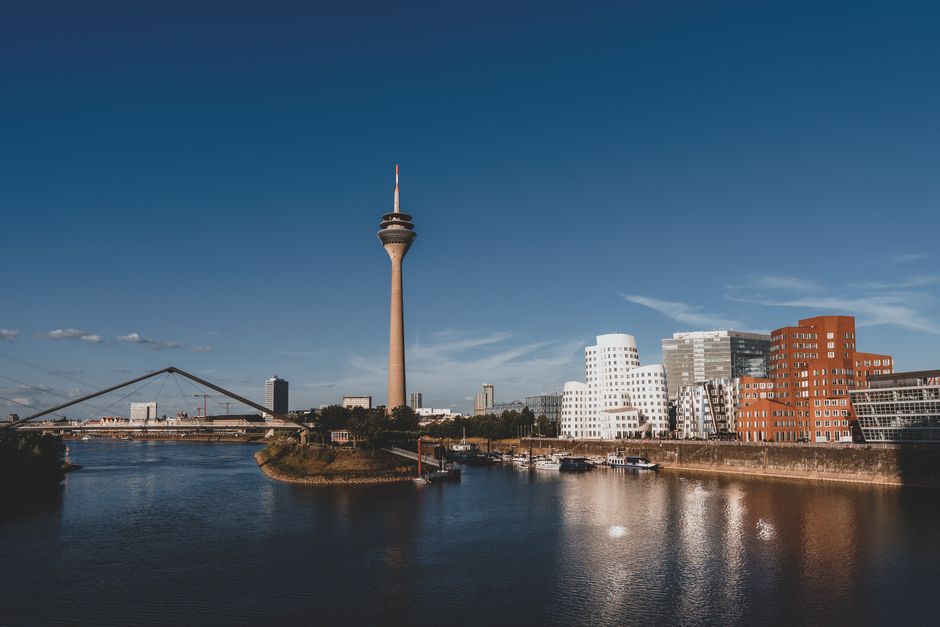
Düsseldorf, the capital of North Rhine-Westphalia, is a stylish, easy-going city on the Rhine, known for fashion, art and a beer you can only really drink here. You come for the Altstadt, the old town packed with brewery pubs serving dark Altbier, the riverside promenade at sunset, window-shopping on the Königsallee, Frank Gehry’s leaning buildings in the MedienHafen, the view from the Rheinturm and two of Germany’s best modern art museums. It is only 25 minutes by train from Cologne, and its carnival is one of the country’s wildest. Give it two days for the city, three to add Schloss Benrath, Kaiserswerth or a day in Cologne.
Right now in Düsseldorf
- Wed11–21°C52–70°F7 mm rain
- Thu12–15°C53–59°F6 mm rain
- Fri8–13°C47–55°F8 mm rain
Top tours in Düsseldorf
See all tours for Düsseldorf →
From local operators, with prices and reviews; you check availability and book on Viator, our partner. We may earn a commission at no extra cost to you. How we earn money
Düsseldorf at a glance
- Best for: brewery pubs and nightlife, modern art and architecture, shopping, riverside walks, carnival and Christmas markets.
- How long: 2 days for the Altstadt, the Rhine, the Kö, the MedienHafen and the K20; 3 days to add Benrath, Kaiserswerth or Cologne.
- Best time: May to September for the promenade and beer gardens; 19 November to 30 December 2026 for the Christmas markets; early February 2027 for carnival.
- Getting in: Düsseldorf Airport is 15 to 20 minutes from the main station by S-Bahn or U-Bahn; trains to Cologne take about 25 minutes.
- Getting around: on foot in the centre, by tram and U-Bahn beyond. As of October 2026, a single city ticket cost €3.80 and the Rheinturm platform €12.50.
- Before you go: entry rules, money and general safety are in our Germany travel guide.
Düsseldorf, area by area
The centre lies on the east bank of the Rhine. The Altstadt and the riverside promenade face the water, the Königsallee and the shopping streets run just inland, and the MedienHafen and the Rheinturm sit a little upstream. You can walk between all of them in under half an hour.
The Altstadt
The old town is small, less than a square kilometre, but it holds hundreds of pubs, bars and restaurants, earning it the nickname “the longest bar in the world”. Around the Marktplatz, with the town hall and the equestrian statue of Elector Jan Wellem, and the Burgplatz with its lone castle tower, the lanes fill every evening. Best for: Altbier, nightlife and first visits.
Königsallee and the Hofgarten
The “Kö” is Düsseldorf’s grand boulevard, with chestnut trees on both sides of a narrow canal, luxury shops on the east side and banks on the west. At its northern end, the Kö-Bogen buildings, one by Daniel Libeskind and one with a façade of hornbeam hedges, lead into the Hofgarten, the city’s central park. Best for: shopping, cafés and people-watching.
The MedienHafen
The old Rhine port has become a quarter of media companies, offices, hotels and restaurants in bold modern buildings, with Frank Gehry’s Neuer Zollhof as its landmark and the Rheinturm next door. Best for: architecture, dinner by the water and modern hotels.
Immermannstraße and the Japanese quarter
Between the main station and the Kö, Düsseldorf has one of Europe’s largest Japanese communities, with ramen bars, bakeries, bookshops and supermarkets. Best for: noodle lunches and hotels near the station.
Oberkassel, Pempelfort and Flingern
Across the river, leafy Oberkassel has Art Nouveau houses and the best view back to the Altstadt from the Rhine meadows. Pempelfort and Flingern, north and east of the centre, are residential districts with independent shops, cafés and restaurants. Best for: a local feel and apartment stays.
Top things to see in Düsseldorf
Prices and hours below were checked on the official sites in October 2026. They change, so check before you go.
The Altstadt and its brewery pubs
Düsseldorf’s own beer is Altbier, a copper-brown, top-fermented beer with a bitter finish, served from wooden barrels in small 0.25-litre glasses. The best place to drink it is in one of the old house breweries, with their dark wood rooms, scrubbed tables and blue-aproned waiters, the Köbes, who are famously brisk. Uerige, Zum Schlüssel and Füchschen brew in the Altstadt, and Schumacher’s original brewery pub is on Oststraße near the Kö. The rule: a Köbes keeps bringing fresh glasses and marking them on your beer mat until you put the mat on top of your glass.
Eat what the brewery pubs serve: Halve Hahn, which is not half a chicken but a rye roll with a thick slice of mature Gouda and mustard; Rheinischer Sauerbraten, marinated beef with raisins; Himmel un Ääd, black pudding with mashed potato and apple; and anything with Düsseldorf’s spicy brown mustard. The Altstadt is busy and good-natured every evening, and packed on Friday and Saturday nights.
The Rhine promenade
Since the riverside road was moved into a tunnel in the 1990s, a wide promenade has run along the Rhine from the Burgplatz past the Altstadt to the state parliament and the MedienHafen. Its terraced steps fill with people at sunset, and the long run of cafés and bars under the river wall, known as the Kasematten, is the place to sit outside on a warm evening. Boats leave from the Burgplatz pier for short Rhine cruises in the season. See our boat trips guide.
Königsallee
The Kö is about a kilometre long, and even if you don’t shop, it is a pleasant stroll beside the canal and the Triton fountain at its northern end. The side streets and the Schadowstraße have the high-street brands; the arcades and the Kö itself have the designer labels.
The MedienHafen and the Gehry buildings
Frank Gehry’s Neuer Zollhof, completed at the end of the 1990s, is three twisting towers that seem to lean and sway: one in white plaster, one in shining steel and one in red brick. Around them, the old harbour basins are lined with modern offices and older warehouses, including the building with colourful climbing figures on its façade. Walk along the quays at sunset, then up to the Rheinturm.
The Rheinturm
Düsseldorf’s 240 m television tower, opened in 1982, has an observation deck and the M168 bar 168 m up, with views over the bends of the Rhine and the whole city. Its shaft doubles as a giant clock: the lights down its side tell the time. As of October 2026, entry cost €12.50 for adults, €9 for teenagers aged 14 to 17 and over-65s, €8 for children aged 6 to 13 and €30 for a family, with children under 6 free. Early Bird tickets before 12:00 and Late Night tickets from 20:00 cost €8. The deck is open daily 10:00–24:00. Pay online or by card on site; cash is no longer accepted.
K20 and K21: the Kunstsammlung NRW
The state’s art collection is split between two buildings. K20, on the Grabbeplatz in a curving black granite building, shows 20th-century art, with one of the world’s finest collections of Paul Klee alongside Picasso, Matisse, the Expressionists, Warhol and Joseph Beuys, who taught in Düsseldorf. K21, in the old state parliament building (the Ständehaus) beside a lake south of the centre, shows contemporary art from the 1980s onwards.
Visiting. As of October 2026, the K20 collection cost €10 (€8 reduced), the K21 collection €9 (€7 reduced), and a combined ticket for both houses, including exhibitions, €21; under-18s go free. Some special exhibitions need a timed ticket. Both open Tuesday to Sunday and holidays 11:00–18:00 and are closed on Mondays; on the first Wednesday of the month they stay open until 22:00, with free entry from 18:00. Both are closed on 24, 25 and 31 December and on Altweiber and Rose Monday during carnival.
Schloss Benrath
In the southern suburb of Benrath, this pink rococo summer palace was built in the 1750s and 1760s by Nicolas de Pigage for Elector Carl Theodor, with a long lake in front and a large formal park running down to the Rhine. The park is free and open all day. As of October 2026, the main building, the Museum of Garden Art and the Natural History Museum opened Saturday and Sunday 11:00–18:00, Monday and Tuesday 11:00–17:00 and Friday 14:00–17:00. Tickets are sold online and in the museum shop, not inside the museums; check the official site for prices and guided tours. Allow half a day, and come by S-Bahn to Düsseldorf-Benrath.
Things to do in Düsseldorf
Kaiserswerth and the Rhine meadows
North of the city, the village of Kaiserswerth has the ruins of an imperial palace of Emperor Frederick Barbarossa on the riverbank, a Romanesque basilica and quiet baroque streets. Get there by U-Bahn, then walk or cycle back along the Rhine. See our cycling guide.
Day trip: Cologne
Düsseldorf and Cologne are friendly rivals, and the trains between them take about 25 minutes. Go for the twin-spired cathedral, the Romanesque churches and the museums, and taste the competition: Cologne drinks its own pale Kölsch, never Altbier. Read our Cologne guide.
Further up the Rhine
For castles and vineyards, head south past Cologne and Bonn to the Middle Rhine Valley, between Koblenz and Bingen. It is a long day trip from Düsseldorf; better to spend a night or two. See our Middle Rhine Valley guide.
Carnival in Düsseldorf: 2026–2027
Düsseldorf’s carnival, the “fifth season”, starts on 11 November 2026 at 11:11, when the Hoppeditz, the carnival jester, wakes up on the Marktplatz in front of the town hall. The street carnival comes in February. On Altweiber (Women’s Carnival Day), Thursday 4 February 2027, from 11:11, women storm the town hall and cut off men’s ties, and the Altstadt becomes one big costumed party. The children’s and youth procession is on Saturday 6 February from 14:00, and on Sunday 7 February the Kö-Treiben brings costumes and home-made floats to the Königsallee. The highlight is the Rose Monday parade (Rosenmontagszug) on Monday 8 February 2027 from 12:30, famous for the satirical political floats of Jacques Tilly. Everything ends on Ash Wednesday, 10 February.
Wear a costume, keep valuables in an inside pocket, and book hotels early. Some shops and museums, including K20 and K21, close on Altweiber and Rose Monday.
Christmas in Düsseldorf
Düsseldorf’s Christmas market is really a string of themed markets across the centre, from the Altstadt’s Marktplatz and Burgplatz to the Schadowplatz and the Königsallee, lined with hundreds of fir trees. In 2026 it runs from Thursday 19 November to Wednesday 30 December, Sunday to Thursday 11:00–20:00 and Friday and Saturday 11:00–21:00. On 24 December it opens 11:00–15:00, on 26 December 14:00–21:00, and it is closed on Sunday 22 November and on Christmas Day. A big wheel on the Burgplatz lifts you 55 m above the river, and there is ice skating on the Kö. Heinrich-Heine-Allee is the most central U-Bahn stop.
Getting to Düsseldorf
By air. Düsseldorf Airport (DUS) is North Rhine-Westphalia’s largest, with many European and some long-haul flights. There are two ways in. Below the terminal, the Flughafen Terminal station has the S11 S-Bahn to the main station and the U80 light rail, which reaches the Hauptbahnhof in about 18 minutes, generally every 20 minutes. Regional, long-distance and other S-Bahn trains stop at the separate Düsseldorf Flughafen station at the edge of the airport, linked to the terminals by the SkyTrain, a hanging monorail, in about 7 minutes; it runs every 5 to 7 minutes from 03:45 to 00:45. As of October 2026, a VRR single ticket for the city fare zone A cost €3.80 and a 24-hour ticket €7.60.
By train. Düsseldorf Hauptbahnhof is on the main ICE lines: Cologne is about 25 minutes away, Frankfurt Airport and Frankfurt about 1 hour 30 minutes, and Amsterdam and Brussels can be reached directly or with one change. Book on bahn.de for advance fares.
By car. The city is ringed by motorways (A3, A44, A46, A52, A57). Parking in the centre is expensive, and the Altstadt is pedestrianised.
Getting around Düsseldorf
The Altstadt, the Kö, the promenade and the MedienHafen are all walkable. Trams, U-Bahn and buses run by Rheinbahn, plus the S-Bahn, use VRR tickets; the city is fare zone A. The Deutschlandticket covers all of it (see our Germany guide), and the DüsseldorfCard adds transport and discounts. Cycling along the Rhine is easy and flat.
When to go and how long to stay
Düsseldorf has a mild, damp climate shaped by the Atlantic: cool summers, soft winters with little frost, and rain in every month. The table uses the Deutscher Wetterdienst (DWD) 1991–2020 averages for the Düsseldorf weather station at the airport: average temperature over day and night, rainfall and hours of sunshine per month.
| Season | Average temperature | Rain per month | Sunshine per month | What it’s like |
|---|---|---|---|---|
| Winter (Dec–Feb) | 3.5–4.2 °C | 57–70 mm | 47–73 hours | Mild but grey and damp; Christmas markets to 30 December, carnival in February |
| Spring (Mar–May) | 6.9 °C rising to 14.3 °C | 46–61 mm | 125–202 hours | Blossom in the Hofgarten and Benrath, the first terrace evenings |
| Summer (Jun–Aug) | 17.3–19.4 °C | 66–77 mm | 194–208 hours | Pleasantly warm with showers; the promenade, beer gardens and Rhine meadows at their best |
| Autumn (Sep–Nov) | 15.2 °C falling to 7.1 °C | 60–64 mm | 150 falling to 63 hours | Mild September, trade fairs, the start of carnival on 11 November |
Düsseldorf averages about 750 mm of rain a year and 1,610 hours of sunshine; July is the warmest month. Bring an umbrella whatever the season. Big trade fairs at the Messe, such as the boat show in January, push up hotel prices.
Düsseldorf in 2 days
Day 1: the Altstadt and the Burgplatz, the Rhine promenade, lunch in a brewery pub, the Kö in the afternoon and dinner back in the Altstadt. Day 2: K20 in the morning, then the MedienHafen and the Rheinturm at sunset, with dinner by the harbour.
Düsseldorf in 3 days
Add Schloss Benrath and K21, or a morning in Kaiserswerth and a bike ride along the Rhine, or a day in Cologne.
Where to stay in Düsseldorf
- Altstadt: in the middle of everything, but noisy at night; ask for a room at the back.
- Königsallee and the centre: upmarket hotels, a short walk from the Altstadt.
- Around the Hauptbahnhof and Immermannstraße: the best value and handy for the airport and day trips.
- MedienHafen: modern design hotels by the water.
- Oberkassel: quiet, green and a walk across the bridge to the Altstadt.
Book early for carnival, Advent weekends and big trade fairs, when rooms are scarce and prices rise sharply.
Practical tips for Düsseldorf
- Learn the beer-mat rule: put your mat on your glass when you’ve had enough Altbier.
- Know the closing days: K20 and K21 close on Mondays; Benrath’s museums on Wednesdays and Thursdays.
- Bring a card for the Rheinturm: the tower no longer takes cash.
- Use the first Wednesday: K20 and K21 are free from 18:00 to 22:00 on the first Wednesday of the month.
- Check the fair calendar: hotel prices can double during big trade fairs at the Messe.
- Carry cash for the pubs: some traditional brewery pubs prefer cash.
What to pack for Düsseldorf
An umbrella or light waterproof at any time of year, comfortable shoes for the promenade and cobbles, and a smarter outfit if you plan an evening on the Kö or a good restaurant. In winter, a warm coat, hat and gloves for the Christmas markets; for carnival, a costume, even a simple one, and a warm layer underneath, since parades mean hours outside in February.
Düsseldorf travel FAQ
Is Düsseldorf worth visiting?
Yes. It packs a lively old town full of brewery pubs, a fine riverside promenade, the Königsallee, Gehry’s buildings in the MedienHafen and first-class modern art into a compact, walkable centre, and Cologne is 25 minutes away.
Why is the Altstadt called the longest bar in the world?
Because hundreds of pubs, bars and restaurants are packed side by side into an old town of less than a square kilometre, so that the bars seem to run into one another along the lanes.
What is Altbier and where can I drink it?
A dark, top-fermented beer with a bitter finish, Düsseldorf’s local style. Drink it from the barrel in the house breweries, such as Uerige, Zum Schlüssel and Füchschen in the Altstadt, or Schumacher on Oststraße.
How much does the Rheinturm cost?
As of October 2026, €12.50 for adults, €8 for children aged 6 to 13 and €30 for a family, or €8 for everyone before 12:00 and after 20:00. The deck, 168 m up, is open daily 10:00–24:00, and payment is by card only.
When is Düsseldorf carnival in 2027?
The street carnival runs from Altweiber on Thursday 4 February 2027 to Ash Wednesday on 10 February, with the Rose Monday parade on 8 February from 12:30. The season opens on 11 November 2026 at 11:11.
When are the Düsseldorf Christmas markets in 2026?
From 19 November to 30 December 2026, Sunday to Thursday 11:00–20:00 and Friday and Saturday 11:00–21:00, closed on 22 November and 25 December, with short hours on 24 and 26 December.
How do I get from Düsseldorf Airport to the city centre?
From the station under the terminal, take the S11 S-Bahn or the U80, which reaches the Hauptbahnhof in about 18 minutes. Long-distance and regional trains use Düsseldorf Flughafen station, linked by the SkyTrain. A VRR single in zone A cost €3.80 as of October 2026.
How far is Düsseldorf from Cologne?
About 40 km. Frequent regional and ICE trains take about 25 minutes, so it is an easy day trip either way.
How many days do you need in Düsseldorf?
Two days cover the Altstadt, the promenade, the Kö, the MedienHafen, the Rheinturm and K20. A third lets you add Benrath, Kaiserswerth or Cologne.
Nearby destinations
- Cologne34 km
- Maastricht86 km
- Middle Rhine Valley112 km
- Utrecht149 km
- Antwerp166 km
- Brussels175 km
- Giethoorn175 km
- Rotterdam177 km
Plan your trip
Partner links: TravelerCenter may earn a commission if you book, at no extra cost to you.
🇩🇪 Useful German phrases for Düsseldorf
All 38 German phrases: restaurant, hotel, emergencies, romance (printable) →
Sources · last reviewed 4 October 2026
Researched and last reviewed on 4 October 2026. Rheinturm prices and hours: the Rheinturm’s own site; K20 and K21: the Kunstsammlung Nordrhein-Westfalen; Schloss Benrath hours and park: the Benrath Palace and Park Foundation; carnival 2026–2027 and Christmas market dates: Visit Düsseldorf (the city’s tourist board); airport trains and the SkyTrain: Düsseldorf Airport; fares: the VRR price table valid from 1 June 2026; climate: Deutscher Wetterdienst 1991–2020 averages for Düsseldorf. Train times and some details are approximate and flagged for checking. Prices, timetables and rules change, so check the official links before you go. For entry rules, money and general safety, see our Germany travel guide; for the neighbouring city, our Cologne guide; and for castles on the river, our Middle Rhine Valley guide.
Data: Weather: MET Norway (CC BY 4.0) · Air quality: OpenAQ · Rates: ECB · Costs: World Bank ICP and price levels · Wikidata (CC0)