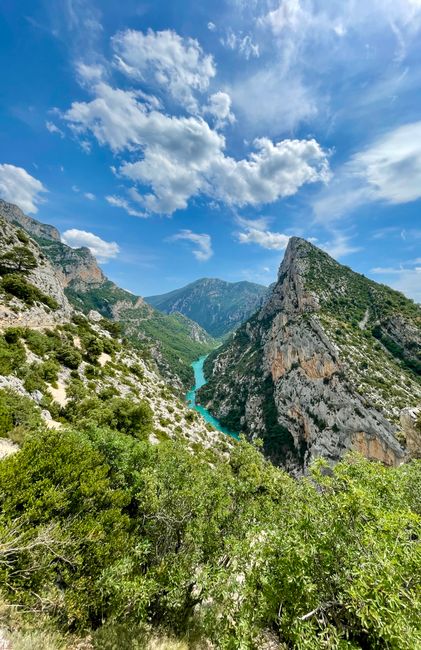
The Gorges du Verdon is France’s most famous canyon: a gash about 25 km long, with limestone cliffs up to 700 m high and jade-green water, on the border of the Alpes-de-Haute-Provence and the Var in inland Provence. You come to drive the rim roads and stop at dizzying viewpoints, paddle a pedal boat or kayak from the turquoise Lac de Sainte-Croix into the mouth of the gorge, hike the legendary Sentier Blanc-Martel along the bottom, and stay in the faience village of Moustiers-Sainte-Marie or the river town of Castellane. It suits road-trippers, hikers, families and outdoor lovers; give it at least two days, ideally three to five with a car.
Right now in Verdon Gorge (Castellane)
- Wed11–15°C51–59°F35 mm rain
- Thu9–18°C49–64°F2 mm rain
- Fri6–18°C42–64°FMostly clear
Top tours in Verdon Gorge
See all tours for Verdon Gorge →
From local operators, with prices and reviews; you check availability and book on Viator, our partner. We may earn a commission at no extra cost to you. How we earn money
Gorges du Verdon at a glance
- Best for: scenic drives, canyon viewpoints, hiking, kayaking and pedal boats, rafting, climbing, lake swimming and Provençal villages.
- How long: 2 days for the rim roads and the lake; 3–5 days with the Blanc-Martel hike, Castellane and the lavender of Valensole.
- Best time: May, June and September; July and August are hot and crowded but best for the lake. Spring and autumn are best for the Blanc-Martel.
- Getting in: there is no railway; drive about 2 hours from Marseille or 2¼ hours from Nice, or take regional ZOU! coaches with changes.
- Getting around: a car is almost essential; a seasonal park shuttle serves the Blanc-Martel trail.
- Before you go: entry rules, money and general safety are in our France travel guide; for the wider region, see our Provence guide.
The Verdon’s areas and who each one suits
The Grand Canyon du Verdon runs roughly from Castellane in the east to the Pont du Galetas in the west, where the river spills into the Lac de Sainte-Croix. The north bank lies in the Alpes-de-Haute-Provence, the south bank in the Var. Most of the area is within the Parc naturel régional du Verdon, which manages the trails, the shuttle and visitor information from its base near Moustiers.
Moustiers-Sainte-Marie and the lake
The prettiest village and the busiest base, near the western end of the canyon and a short drive from the lake beaches and the boat hire at the Pont du Galetas. Best for: first visits, families and anyone combining the canyon with the lake and the lavender plateau.
La Palud-sur-Verdon and the north rim
A small mountain village above the deepest part of the canyon, start of the Route des Crêtes and of the Blanc-Martel shuttle, and the base for the Verdon’s famous rock climbing. Best for: hikers, climbers and anyone who wants to be right on the canyon.
Castellane and the upper gorge
A lively old town under a huge rock crowned by a chapel, at the eastern entrance to the gorges and on the Route Napoléon. It is the centre for rafting and other white-water sports. Best for: active travellers, campers and those arriving from Nice.
Aiguines and the south rim
On the Var side, the village of Aiguines, with its turreted château, looks over the lake, and the Corniche Sublime road follows the southern rim. Best for: quieter stays and views of the lake and canyon together.
Top things to see in the Gorges du Verdon
Most of the canyon is free to enjoy: viewpoints, villages and trails cost nothing. Rules and dates below were checked with the regional park and tourist offices in October 2026; check before you go.
Route des Crêtes
The classic drive: a loop of about 23 km from La Palud-sur-Verdon along the north rim, with about 15 viewpoints (belvédères) looking more than 700 m straight down to the river, and griffon vultures often soaring at eye level. Part of the road, between the Jas d’Aire and the Chalet de la Maline, is one way, so drive it in the signed direction. The central section is closed every winter because of ice and rockfalls, from the fourth Friday of November to the fourth Friday of March (reopening on 26 March 2027); the ends of the road stay open to some viewpoints and to the Chalet de la Maline. Go early in the morning or late in the afternoon for the best light and fewer cars, and never stand on the low parapets.
Point Sublime and the Couloir Samson
Near Rougon, a short walk from the road leads to the Point Sublime, a balcony over the canyon’s eastern entrance, with a park information point (Maison de Site). Below it, a side road descends towards the Couloir Samson, a narrow cleft where the river squeezes between the walls. This is the end of the Blanc-Martel trail.
Lac de Sainte-Croix and the Pont du Galetas
Created when the Sainte-Croix dam was built in 1973–74, this turquoise reservoir of about 2,200 hectares is the fourth-largest artificial lake in France and a drinking-water reserve for much of Provence. At its eastern end, the Pont du Galetas spans the mouth of the gorge, and from the boat bases here you can paddle or putter a couple of kilometres up between the cliffs. Canoes, kayaks, pedal boats and electric boats can be hired at the Base Nautique de l’Étoile by the bridge and at La Cadeno beach near Moustiers; in summer, book online at least 48 hours ahead and go early. See our boat trips guide.
Lake rules. Petrol and diesel engines are banned on the lake, except for rescue services, so boats are electric, rowed or pedalled. A licence is needed for engines over 6 hp (4.5 kW), and powered boats are limited to 20 km/h, and to 3 km/h within 50 m of the shore. Life jackets are compulsory in canoes, kayaks and on paddleboards, and for children under 12 on any boat. Boats may go up the gorge only as far as the yellow buoys; beyond is a protected zone for the endangered Apron du Rhône fish. The gorge is closed to boats when the wind exceeds 28 km/h, and paddleboards are not allowed in the gorge at all. Night navigation, water-skiing, towed rings and scuba diving are banned, as is jumping from cliffs and bridges, which causes accidents every year.
Moustiers-Sainte-Marie
One of the most beautiful villages in Provence, built in a cleft in the cliffs with a waterfall running through it and a gold star hanging on a chain between the two rock walls. Climb the stepped path to the chapel of Notre-Dame-de-Beauvoir for the view, and browse the workshops of the faïenciers, whose painted earthenware has been famous since the 17th century. The Musée de la Faïence, in a former mansion in the village, displays more than 500 pieces; from early April to late October, guided visits start at 9:30 every morning except Tuesdays and Sundays. Check the tourist office for opening times and prices. Coaches are banned from the village centre from April to October; park in the car parks at the bottom of the village and walk up.
Castellane and Notre-Dame du Roc
Castellane’s old streets, fountains and cafés sit beneath a sheer rock with the chapel of Notre-Dame du Roc on top, reached by a steep path from behind the church in about half an hour. The view takes in the town, the river and the start of the gorges.
The Corniche Sublime
On the Var side, the road from Aiguines along the south rim has its own spectacular stops, including the Balcons de la Mescla, where the Artuby joins the Verdon, and the high Pont de l’Artuby bridge. Driving both rims, Moustiers, La Palud, Castellane and Aiguines makes a full loop of about 130 km: allow a whole day with stops.
Hiking the Sentier Blanc-Martel
Named after the explorers Édouard-Alfred Martel and Isidore Blanc, who first travelled the whole canyon in 1905, this is the Verdon’s great walk: about 15 km one way from the Chalet de la Maline, near La Palud, to the Point Sublime, with about 600 m of ascent and roughly 5½ hours of walking without breaks. It follows the river through forest and boulder fields, climbs metal ladders and stairs, and passes through long, dark tunnels near the end. The park rates it difficult: it is not suitable for young children or people afraid of heights, and dogs and mountain bikes are not allowed.
- Current status: after a rockfall, a municipal order from the commune of Rougon (August 2026) closes the stretch between the exit of the Couloir Samson and the Point Sublime. The hike is still possible: from the turning area at the Couloir Samson, follow the road (RD23A) and then the GR 49 path up to the Point Sublime, with no change in total time. Do not try to cross the closed section.
- The shuttle: because the trail is not a loop, the park’s Navette Blanc-Martel runs from La Palud-sur-Verdon (free car park) to the Chalet de la Maline in the morning and back from the Point Sublime in the afternoon, giving you about 7 hours. In 2026 it ran at weekends from 3 April to 28 June, daily from 29 June to 14 September, and Thursday to Monday from 17 September to 1 November. Book a seat online; as of October 2026 a one-way ticket costs €4.50, and the ZOU! line 450 bus from the Point Sublime costs €2.50 on board.
- Season and kit: spring and autumn are best; avoid July and August (heat and crowds) and winter (frequent rockfalls). Bring hiking shoes, a torch for the tunnels, at least 3 litres of water each, food, a warm layer and a hat.
Other walks include the Sentier de l’Imbut on the south bank, short trails to the Route des Crêtes viewpoints and the paths around the lake; the park’s walking map of the gorges, with 24 routes, costs €4 at the tourist offices. See our hiking guide.
Water sports and river safety
The Verdon is controlled by a chain of EDF hydroelectric dams, and the water level below them can rise suddenly and dangerously when water is released or turbines start, sometimes automatically, creating currents and siphons. Never camp, picnic or linger on the riverbed, and get out of the water at once if it starts to rise.
- Swimming: swim in the lakes, ideally at the supervised beaches open in July and August at Sainte-Croix-du-Verdon, Bauduen, Les Salles-sur-Verdon and the Galetas beach at Aiguines. Swimming in the river itself is banned between the Point Sublime and the Pont du Galetas, both for safety and to protect the Apron du Rhône; elsewhere on the river it is risky and accidents happen every year. See our beaches guide for more lake and sea swimming ideas.
- Rafting: trips run from Castellane on the upper Verdon, roughly from spring to October, using EDF’s water releases; in summer the releases are typically on set days, which the rafting companies publish. Always go with a licensed operator.
- Canyoning and aqua-rando: guided trips in side gorges, mostly in summer, with wetsuits and helmets provided.
- Kayaking: calm paddling on the Lac de Sainte-Croix and into the gorge mouth; the upper river is for guided white-water trips only.
- Climbing: the walls around La Palud have more than 900 equipped routes, many very long and serious; beginners should go with a guide.
Fire risk. The Mediterranean scrub burns easily in summer. Fires and camping stoves are banned, and on days of high fire risk, access to some woods and trails may be restricted; check the prefecture’s daily fire-risk maps for the Var and the Alpes-de-Haute-Provence before hiking from June to September. Water bombers may scoop water from the lake: if one flies over you, head for the shore.
Day trips from the Gorges du Verdon
The Valensole plateau
West of Moustiers, the Valensole plateau is covered in lavender and lavandin fields that flower from late June to mid-July, before the harvest. It is one of the classic sights of Provence; stay on the edges of the fields and do not pick the flowers.
The other Verdon lakes
Downstream, the smaller lakes of Quinson and Esparron sit in the Basses Gorges, quieter canyons good for paddling; upstream, the Lac de Castillon lies above Castellane. Together with Chaudanne, they make up the five Verdon lakes.
Aix, Marseille and the Riviera
The Verdon fits neatly into a wider trip: Aix-en-Provence is about 1¾ hours away, Marseille about 2 hours, and Nice and the French Riviera about 2¼ hours by car.
Nearby destinations
- Provence38 km
- French Riviera55 km
- Saint-Tropez59 km
- Cannes60 km
- Aix-en-Provence75 km
- Nice76 km
- Monte Carlo88 km
- Marseille92 km
Getting there and getting around
Arriving
There is no railway to the gorges. The nearest stations are Manosque–Gréoux-les-Bains, Digne-les-Bains and Aix-en-Provence TGV, and the nearest airports are Marseille-Provence and Nice Côte d’Azur. By car, the Moustiers tourist office gives about 1¾ hours from Aix-en-Provence, 2 hours from Marseille and 2¼ hours from Nice: from the A51 motorway, take exit 18 (Manosque) towards Valensole, or exit 17 (Vinon-sur-Verdon) via Gréoux-les-Bains and Riez. From Nice, the Route Napoléon leads to Castellane. If you pick up a hire car in Marseille or Nice, check those cities’ low-emission rules in our city guides.
By ZOU! coach. The Provence-Alpes-Côte d’Azur region’s network has a few useful lines: line 67 from Marseille-Saint-Charles and Aix-en-Provence bus station to Riez via Gréoux-les-Bains; line 450 from Riez to Moustiers (all year) and on to La Palud and Castellane in season; line 132 from Manosque station to Riez; and line 51 from Nice to Digne via Castellane. Services are infrequent, so check timetables and connections on zou.maregionsud.fr before you travel.
Car or public transport?
A car is by far the easiest way to see the canyon. Roads are narrow, winding and busy in summer, with few places to pass; allow plenty of time, use the pull-offs and watch for cyclists. Car parks at the main viewpoints and beaches fill up by late morning in July and August, and Moustiers has paid car parks at the bottom of the village (pay with the Flowbird app). Without a car, base yourself in Moustiers or Castellane, use line 450 and the Blanc-Martel shuttle, and book boat hire near the lake.
When to go and how long to stay
The Verdon has a mountain-Mediterranean climate: hot, dry summers with storms, cold, clear winters with frost most nights, and heavy autumn rain. The table uses Météo-France’s 1991–2020 normals for Castellane, at 729 m at the eastern end of the canyon. Moustiers and the lake shore, a little lower, are slightly milder; the rims at La Palud, around 900–1,000 m, are cooler.
| Season | Average high / low | Rainy days per month | What it’s like | Good for |
|---|---|---|---|---|
| Winter (Dec–Feb) | 9–11 °C / −5 to −4 °C | 5–7 | Cold, crisp, often sunny; frosty nights; Route des Crêtes partly closed | Quiet viewpoints, Moustiers out of season |
| Spring (Mar–May) | 15–21 °C / −2 to 5 °C | 6–9 | Fresh, green, changeable | Blanc-Martel, hiking, climbing |
| Summer (Jun–Aug) | 26–29 °C / 9–11 °C | 5–7 | Hot, dry days with storms; cool nights; very busy | Lake swimming, boats, rafting, lavender |
| Autumn (Sep–Nov) | 24 °C falling to 13 °C / 7 °C falling to 0 °C | 7–9 | Warm September, then the wettest months | Hiking, quieter boating in September |
Castellane gets about 1,000 mm of rain a year, with October and November the wettest months, and about 28 days a year above 30 °C. Nights are cold: frost is recorded on about 140 nights a year.
2 days in the Gorges du Verdon
Day 1: Moustiers in the morning, then a pedal boat or kayak into the gorge from the Pont du Galetas and a swim at a lake beach. Day 2: the Route des Crêtes early, lunch in La Palud, the Point Sublime, and on to Castellane for sunset from Notre-Dame du Roc.
3 days in the Gorges du Verdon
Add the Sentier Blanc-Martel with the shuttle (in season, and not in midsummer heat), or a rafting trip from Castellane, then drive back along the Corniche Sublime via Aiguines.
5 days or more
Add the lavender of Valensole in early summer, the quieter lakes of Quinson and Esparron, a climbing or canyoning day, and continue to Aix, the coast or the Luberon villages.
Where to stay in the Gorges du Verdon
- Moustiers-Sainte-Marie: charming hotels and guesthouses; close to the lake and the lavender; book early for summer.
- Castellane: the most choice of campsites and simple hotels; ideal for rafting and arriving from Nice.
- La Palud-sur-Verdon: a few guesthouses, a gîte and campsites right on the canyon; best for hikers and climbers.
- Lake villages: Sainte-Croix-du-Verdon, Bauduen, Les Salles-sur-Verdon and Aiguines for holiday rentals by the water.
A nightly tourist tax (taxe de séjour) is added per adult; under-18s are exempt, and rates differ by commune. In Moustiers-Sainte-Marie, collected by Provence-Alpes-Agglomération, the rates are unchanged for 2026: €1.65 per adult per night in a 3-star hotel or rental, €2.64 in a 4-star and €3.41 in a 5-star, including the department’s surcharge; unclassified rentals pay 5% of the nightly price plus the surcharge, up to a cap. In Castellane, the Alpes-Provence-Verdon intercommunality’s latest published rates are €1.87 in a 3-star, €2.86 in a 4-star and €3.85 in a 5-star. Communes on the Var side set their own rates; your host will tell you.
Practical tips for the Gorges du Verdon
- Start early: in summer, be at the viewpoints and boat hire by 9:00; car parks fill and boats run out by late morning.
- Fuel and cash: petrol stations are few between villages; fill up in Moustiers, Castellane or Riez.
- Respect the river: never swim in the protected stretch, stay off the riverbed below dams, and pick up all your litter.
- Watch the weather: storms build fast in summer afternoons; leave the canyon floor and exposed rims if thunder starts.
- Flocks and guard dogs: on the plateaus you may meet sheep guarded by large white patou dogs; stay calm, walk around the flock and never cross it.
- Emergencies: call 112.
What to pack for the Gorges du Verdon
In summer: swimwear, water shoes for the pebbly lake shores, a quick-dry towel, a sun hat, sunglasses, high-factor sunscreen and a large refillable water bottle. For hiking, bring sturdy shoes with grip, a head torch for the Blanc-Martel tunnels, at least 3 litres of water each and a light rain jacket for storms. In spring and autumn, add a warm fleece: mornings and evenings on the rims are cold. A dry bag protects your phone and keys in a kayak.
Gorges du Verdon travel FAQ
Can you swim in the Gorges du Verdon?
Swim in the Lac de Sainte-Croix and the other lakes, ideally at the supervised beaches open in July and August. Swimming in the river is banned between the Point Sublime and the Pont du Galetas, and dangerous elsewhere because of sudden dam releases.
Can you rent a boat to go into the gorge?
Yes. Pedal boats, canoes, kayaks and electric boats are hired at the Pont du Galetas and on the lake shore, and can go up the gorge as far as the yellow buoys. Petrol engines are banned, paddleboards are not allowed in the gorge, and it closes to boats when the wind exceeds 28 km/h.
Is the Sentier Blanc-Martel open?
Yes, with a detour. As of October 2026, a rockfall has closed the stretch from the Couloir Samson to the Point Sublime by municipal order; walkers follow the RD23A road and the GR 49 path instead, with no change in total time.
How long is the Blanc-Martel hike?
About 15 km one way, with roughly 600 m of ascent and 5½ hours of walking without breaks. It has ladders and dark tunnels, so bring a torch and at least 3 litres of water each. Dogs are not allowed.
When does the Blanc-Martel shuttle run?
In 2026: weekends from 3 April to 28 June, daily from 29 June to 14 September, and Thursday to Monday from 17 September to 1 November. Book online; a one-way ticket costs €4.50 as of October 2026.
Is the Route des Crêtes open in winter?
Only partly. The central section closes from the fourth Friday of November to the fourth Friday of March because of ice and rockfalls, reopening on 26 March 2027; the ends of the loop stay open to some viewpoints.
Can you visit the Gorges du Verdon without a car?
It is possible but limited. ZOU! line 67 runs from Marseille and Aix to Riez, line 450 continues to Moustiers and, in season, to La Palud and Castellane, and line 51 links Nice and Castellane. Services are infrequent, so plan carefully.
Is it better to stay in Moustiers or Castellane?
Moustiers for the lake, the lavender and a beautiful village; Castellane for rafting, campsites and easier access from Nice. Both are about an hour apart by the north rim road.
When is the best time to visit the Gorges du Verdon?
May, June and September, for pleasant temperatures and fewer crowds. July and August are best for swimming and boating but hot and busy; spring and autumn are best for hiking.
How much is the tourist tax in Moustiers-Sainte-Marie?
In 2026, €1.65 per adult per night in a 3-star hotel or rental, €2.64 in a 4-star and €3.41 in a 5-star, including the department’s surcharge. Under-18s are exempt.
Plan your trip
Partner links: TravelerCenter may earn a commission if you book, at no extra cost to you.
🇫🇷 Useful French phrases for Verdon Gorge
All 38 French phrases: restaurant, hotel, emergencies, romance (printable) →
Sources · last reviewed 4 October 2026
Researched and last reviewed on 4 October 2026. Blanc-Martel trail status, shuttle dates and fares, river swimming rules and lake navigation rules: the Parc naturel régional du Verdon; Moustiers, the faience museum, boat hire bases and access: the Moustiers-Sainte-Marie tourist office; Route des Crêtes winter closure: the Castellane-Verdon tourist office; rafting water releases: local rafting operators; tourist tax: Provence-Alpes-Agglomération and the French tax authority’s open data; climate: Météo-France normals for Castellane. Prices, timetables, trail closures and fire-risk rules change, so check the official sites before you go. For entry rules, money and general safety, see our France travel guide.
Data: Weather: MET Norway (CC BY 4.0) · Rates: ECB · Costs: World Bank ICP and price levels · © OpenStreetMap contributors (ODBL) · Wikidata (CC0)