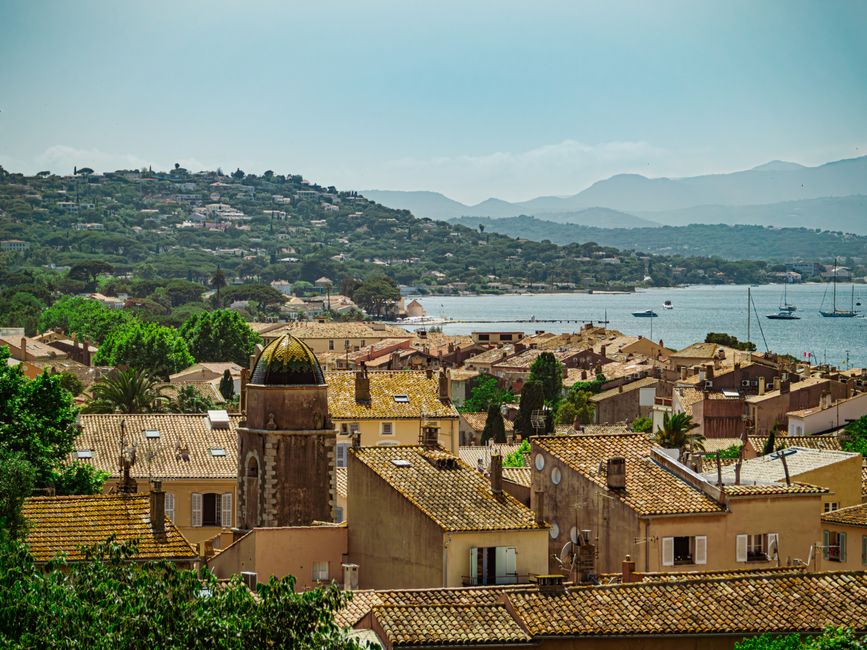
Saint-Tropez is a small fishing port that became a legend: painters such as Paul Signac and Henri Matisse came for the light in the 1890s and 1900s, Brigitte Bardot and the film “And God Created Woman” made it famous in the 1950s, and today superyachts line the harbour in front of the pastel houses. Behind the glamour it is still a pretty Provençal village, with a hilltop citadel, a superb museum of early modern art, a market under the plane trees and coastal paths to the long sandy beach of Pampelonne. Visit outside July and August if you can, come by boat to avoid the traffic, and give it one or two days, more for a beach holiday on the peninsula.
Right now in Saint-Tropez
- Wed 17–21°C 62–69°F 39 mm Heavy rain
- Thu 15–22°C 60–71°F 5 mm Partly cloudy
- Fri 11–22°C 52–71°F Clear
Weather: MET Norway (CC BY 4.0) · Sea temperature: NOAA CoastWatch · Rates: ECB
Top tours in Saint-Tropez
See all tours for Saint-Tropez →
From local operators, with prices and reviews; you check availability and book on Viator, our partner. We may earn a commission at no extra cost to you. How we earn money
Saint-Tropez at a glance
- Best for: harbour life, art, the Place des Lices market, Pampelonne’s beaches, coastal walks, boat trips and sailing regattas.
- How long: a day for the village, 2–3 days with the beaches and coast path, a week for a beach holiday around the gulf.
- Best time: May, June and September, warm enough to swim with fewer crowds; late September for Les Voiles de Saint-Tropez.
- Getting in: there is no railway. Take a ZOU! bus from Saint-Raphaël or Toulon, or a boat from Sainte-Maxime and other gulf ports (20 minutes from Sainte-Maxime); the nearest airports are Toulon-Hyères and Nice.
- Getting around: the village is tiny and walkable; summer traffic on the only main road is notoriously slow.
- Before you go: entry rules, money, trains and general safety are on our France travel guide; for the wider coast, see our Nice guide.
Saint-Tropez’s areas and who each one suits
Saint-Tropez sits on the south shore of the gulf that bears its name, at the tip of a peninsula it shares with Ramatuelle and Gassin. The old village crowds around the port; the beaches lie east and south, mostly in Ramatuelle.
The port and La Ponche
The Vieux Port, with its café terraces, art sellers and yachts, and La Ponche, the old fishermen’s quarter behind it, with a tiny beach and narrow lanes. The heart of Saint-Tropez, with boutique hotels, and busy until late in summer.
Place des Lices and the village
The big square of plane trees and pétanque players, with its twice-weekly market, the lanes of boutiques around it and the Italianate bell tower of Notre-Dame de l’Assomption. Lively and central, with small hotels and guesthouses.
Les Salins, Les Canoubiers and the peninsula
East of the village, pine woods, villas and quieter beaches such as Les Salins and Les Canoubiers. Calmer and greener, best with a car, a bike or a boat.
Pampelonne and Ramatuelle
The famous sandy beach is in the neighbouring commune of Ramatuelle, about 5 km south, with the hilltop villages of Ramatuelle and Gassin above it. Best for beach holidays, campsites and villas; a car or scooter helps.
Top things to see in Saint-Tropez
Prices and hours below come from the official City of Saint-Tropez websites, as of October 2026.
The Vieux Port
The port is Saint-Tropez’s stage. Watch the yachts back in, browse the painters’ easels on the Quai Jean Jaurès, have a coffee at one of the famous terraces and walk out along the jetty, the Môle Jean Réveille, for the view back to the village and across the gulf to Sainte-Maxime. Early morning, when the fishing boats come in and the quays are quiet, is the best time.
The Citadel and the maritime history museum
The 17th-century hexagonal citadel on the hill above the village has thick walls, a moat, peacocks in the gardens and the best panorama in Saint-Tropez. Its keep houses the Musée d’histoire maritime, which tells the story of Saint-Tropez’s sailors, from fishermen and shipbuilders to explorers and naval officers. How to visit: open every day, 10:00–17:30 from 1 October to 31 March and 10:00–18:30 from 1 April to 30 September, with last entry 30 minutes before closing; closed on 1 January, 1 and 17 May, 11 November and 25 December. Entry is €5, free for under-12s (as of October 2026).
Musée de l’Annonciade
In a former chapel by the port, this small museum is one of the best collections of early modern French painting outside Paris: works by Signac, who settled here in 1892, and by the pointillists and Fauves he drew to the town, including Matisse, Derain, Bonnard, Marquet and Van Dongen. How to visit: open Tuesday to Sunday, 10:00–18:00 in April, May, June and October and 10:00–17:00 from November to March; every day 10:00–19:00 in July, August and September. It closes from 15 to 30 November and from 15 January to 10 February, and on public holidays such as 1 January, 1 May and 25 December. Entry is €5 or €6 depending on the exhibition, €3.50 reduced, free for under-12s (as of October 2026).
Place des Lices and the market
On Tuesday and Saturday mornings the Place des Lices fills with one of the best markets on the coast: fruit and vegetables, cheese, olives, flowers, Provençal fabrics and second-hand finds. At other times, locals play pétanque under the plane trees. Try the tarte tropézienne, a brioche filled with cream, created by a local baker in the 1950s.
La Ponche and the old village
Wander from the port through the Porte de la Poissonnerie, past the old fish market, to the little beach and tower of La Ponche, then up the lanes to the church of Notre-Dame de l’Assomption, with its ochre and yellow bell tower. The village also has a small museum of gendarmerie and cinema, in the old police station from the famous French films.
Beaches and the coast path
Pampelonne
The crescent of fine sand runs for about 4.5 km along the bay of Pampelonne in Ramatuelle, with clear, shallow water. It mixes famous beach clubs, where you pay for a sunbed and a long lunch, with free public stretches and car parks behind the dunes. It is busiest from mid-July to late August; come early, or in June and September, when it is far calmer. See our beaches guide.
Other beaches
Closer to the village, Les Graniers below the citadel and the little La Ponche beach are walkable from the port. Les Salins, east of town, is a quieter sandy cove with pines, and the rocky inlets along the coast path are good for snorkelling on calm days.
The Sentier du littoral
The coastal path follows the shore from the port past the Graniers, Les Canoubiers and Les Salins around the peninsula to Pampelonne and beyond, through pine woods and over rocks, with swimming spots along the way. From the village to Les Salins is a pleasant half-day; the full route to Pampelonne is long and partly rough, so wear proper shoes and carry water. In summer, check the Var fire-risk map the evening before, as access to some wooded areas can be restricted. See our hiking guide.
Other things to do in Saint-Tropez
Boat trips around the gulf
From the port, boats tour the bay of Les Canoubiers and the villas of the rich and famous, or head out to the red cliffs of the Estérel and the Îles d’Hyères. See our boat trips guide.
Wine and food
The peninsula is Côtes de Provence country, famous for rosé. Many estates around Ramatuelle, Gassin and La Croix-Valmer welcome visitors for a wine tasting. In the village, fish restaurants around La Ponche and simple places near the Place des Lices are better value than the port terraces.
Les Voiles de Saint-Tropez and other events
Every autumn, hundreds of classic and modern yachts race in the gulf during Les Voiles de Saint-Tropez, organised by the Société Nautique de Saint-Tropez. The 2026 edition runs from 26 September to 4 October; the 2027 dates had not been announced as of October 2026. Watch from the jetty, the citadel or the coast path, or take a boat out to see the fleet. Rooms are scarce that week.
- The Bravade (16–18 May): Saint-Tropez’s festival, held since the 16th century, in honour of its patron saint, Tropez, with processions, costumes and musket salvoes; the museums close on 17 May.
- Summer: concerts, fireworks and art events in July and August.
Day trips from Saint-Tropez
The gulf and the Maures hills are full of easy outings. Times are approximate and summer traffic can double them.
Ramatuelle and Gassin
Two medieval villages on the hills above Pampelonne, with narrow lanes, views over vineyards and the sea, and good restaurants; the Paillas hills and their windmills are lovely at sunset. About 15–20 minutes by car.
Port Grimaud and Grimaud
Port Grimaud is a lakeside village of canals and colourful houses built in the 1960s, reached by boat from Saint-Tropez; above it, the old village of Grimaud has a ruined castle with views over the gulf.
The Îles d’Hyères
In season, boats from the gulf make day trips to Porquerolles, with its white-sand beaches and bike paths, and Port-Cros, a national park island with an underwater snorkelling trail.
Cannes, the Estérel and Nice
The red cliffs of the Estérel begin past Saint-Raphaël, and Cannes is about 1 h 30 away by car outside summer; from Saint-Raphaël, coastal trains run on to Cannes and Nice. See our Nice guide and our Monaco guide for further along the coast.
Nearby destinations
- French Riviera6 km
- Cannes44 km
- Verdon Gorge59 km
- Nice70 km
- Monte Carlo82 km
- Provence96 km
- Aix-en-Provence101 km
- Marseille102 km
Getting there and getting around
By boat (the best way in summer)
Les Bateaux Verts run frequent shuttles across the gulf to the Vieux Port, avoiding the traffic. As of October 2026, the 20-minute crossing from Sainte-Maxime costs €9.20 one way or €16.30 return for adults (€5 / €9.20 for children aged 4–11), with departures every 20–40 minutes in season and fewer in winter; they also sail from Port Grimaud, Les Marines de Cogolin and Les Issambres. From spring to autumn, the Bateaux de Saint-Raphaël sail from Saint-Raphaël, and Trans Côte d’Azur runs day trips from Cannes and Nice; check each operator’s season and fares.
By bus
Saint-Tropez has no railway station. ZOU! bus line 876 links Saint-Tropez bus station with Saint-Raphaël bus station, next to the Saint-Raphaël-Valescure train station, via Grimaud and Sainte-Maxime, about every hour; the journey takes roughly 1 h 15–1 h 30, longer in summer traffic. Line 878 runs along the coast to Toulon via Le Lavandou. Fares are low and flat; check the ZOU! website for the current price and timetables, which change by season.
By car and parking
A single main road leads onto the peninsula, and from June to September the jams at La Foux, at the head of the gulf, can last an hour or more. Arrive before 9:00 or after 18:00, or park in Sainte-Maxime and take the boat. In the village, use the big car parks at the Parking du Port and the Parc des Lices, which fill up early in summer; parking at Pampelonne is in paid fields behind the beach. A cycle path links Sainte-Maxime and Ramatuelle with Saint-Tropez, and a small electric shuttle bus runs around the village. As of October 2026 we found no low-emission zone on the peninsula.
Nearest airports and stations
Toulon-Hyères airport is the closest, about an hour away by car in normal traffic; Nice Côte d’Azur airport, with many more flights, is about 1 h 30–2 h by road. The nearest TGV stations are Saint-Raphaël-Valescure and Toulon; from Nice, the coastal train reaches Saint-Raphaël, where you change to the 876 bus.
When to go and how long to stay
Saint-Tropez has a sunny Mediterranean climate, with hot, dry summers and mild winters, and the mistral can blow hard on some days, especially in winter and spring. There is no Météo-France station with 1991–2020 normals on the peninsula itself, so the table uses the official 1991–2020 normals for Fréjus, about 30 km north-east on the same coast: average daily highs and lows, and days with at least 1 mm of rain.
| Season | Average high / low | Rainy days per month | What it’s like | Good for |
|---|---|---|---|---|
| Winter (Dec–Feb) | 13–14 °C / 4–5 °C | 5–7 | Mild, quiet, many places closed | The village and museums without crowds |
| Spring (Mar–May) | 16–22 °C / 6–13 °C | 5–6 | Fresh and flowery; sea still cool | Walking the coast path, the Bravade in May |
| Summer (Jun–Aug) | 26–29 °C / 16–19 °C | 1–3 | Hot, dry and very busy; heavy traffic | Beaches, boat trips, nightlife |
| Autumn (Sep–Nov) | 26 °C falling to 17 °C / 15 °C falling to 8 °C | 5 in September, 7–8 in Oct–Nov | Warm September, then autumn storms | Swimming in September, Les Voiles, wine harvest |
Fréjus gets about 785 mm of rain a year, more than half of it from September to December, often in short, heavy storms. August is the warmest month, with an average high of about 29 °C. The sea is warmest in August and early September, at around 24–25 °C. Many hotels, beach clubs and restaurants close from November to March.
How long to stay: 1-, 2- and 3-day plans
1 day: the port and La Ponche early, the Annonciade museum, lunch near the Place des Lices (on a market day if you can), then the citadel for the view and a swim at Les Graniers.
2 days: add the coast path to Les Salins or a day at Pampelonne. 3 days: add Ramatuelle and Gassin, a boat trip around the gulf, or a wine estate.
Where to stay in Saint-Tropez
- The port and La Ponche: for the full Saint-Tropez experience; small rooms and high prices in summer.
- Around the Place des Lices: village guesthouses and boutique hotels, a little calmer.
- Pampelonne and Ramatuelle: beach hotels, villas and campsites; best with a car.
- Sainte-Maxime, Port Grimaud or Cogolin: better value across the gulf, with boats to Saint-Tropez.
Saint-Tropez charges a tourist tax (taxe de séjour) per person per night. According to the official government database of rates, as of 2026 it is €1.15 in 1-star hotels, B&Bs and hostels, €1.44 in 2-star, €2.45 in 3-star, €3.74 in 4-star and €5.04 in 5-star hotels, and €6.91 in palaces; unclassified rentals pay 7.2% of the price per person per night, within a legal cap. These totals include the Var department’s 10% surcharge and the 34% regional surcharge that funds the new Provence–Côte d’Azur railway line. Ramatuelle, where Pampelonne lies, sets its own slightly lower rates. Under-18s are exempt.
Practical tips for Saint-Tropez
- Come by sea: in summer, park in Sainte-Maxime and take the 20-minute boat rather than queue on the road.
- Market days: Tuesday and Saturday mornings on the Place des Lices.
- Fire risk: in summer, check the Var prefecture’s access map for the next day, published around 18:00 on risque-prevention-incendie.fr; on the highest levels, access to the Maures and other wooded hills is banned.
- Budget: port terraces and beach clubs are expensive; picnic from the market and swim from the public beaches.
- Off season: from November to March many hotels and restaurants close, and the museums have shorter hours.
- Emergencies: call 112.
What to pack for Saint-Tropez
Pack a swimsuit, sunscreen, a sun hat and sunglasses, a light cover-up and sandals for the village, and walking shoes with grip for the rocky coast path. A mask and snorkel are useful for the coves. Bring one smart outfit for dinner, a windproof layer for mistral days and boat trips, and from November to March a warm jacket for cool evenings.
Saint-Tropez travel FAQ
How do you get to Saint-Tropez without a car?
By boat or bus. Les Bateaux Verts sail from Sainte-Maxime to the Vieux Port in 20 minutes for €9.20 one way as of October 2026, and ZOU! bus 876 runs from Saint-Raphaël bus station, next to the train station, in about 1 h 15–1 h 30. There is no railway station in Saint-Tropez.
Is there a train station in Saint-Tropez?
No. The nearest stations are Saint-Raphaël-Valescure and Toulon, both with TGV trains; from Saint-Raphaël, take ZOU! bus 876 or a seasonal boat.
How many days do you need in Saint-Tropez?
One day covers the port, the citadel, the Annonciade museum and the market. Two or three days lets you add Pampelonne, the coast path and the hill villages of Ramatuelle and Gassin.
Where is Pampelonne beach?
In the commune of Ramatuelle, about 5 km south of Saint-Tropez. It is about 4.5 km of fine sand, with private beach clubs and free public sections; arrive early in July and August.
How much is the Saint-Tropez citadel?
€5 for adults and free for under-12s, as of October 2026. The citadel and its maritime history museum open every day, 10:00–17:30 from October to March and 10:00–18:30 from April to September.
What is in the Musée de l’Annonciade?
Paintings by Signac, Matisse, Derain, Bonnard, Marquet and other pointillists and Fauves who worked in Saint-Tropez. As of October 2026 entry is €5 or €6, and it closes from 15 to 30 November and on Mondays outside summer.
When is the Saint-Tropez market?
On Tuesday and Saturday mornings on the Place des Lices, with food, flowers, clothes and second-hand stalls. Go early for the best choice.
When are Les Voiles de Saint-Tropez?
The 2026 regatta runs from 26 September to 4 October; the 2027 dates had not been announced as of October 2026. It takes place every year in late September and early October.
How bad is the traffic to Saint-Tropez in summer?
Very bad at peak times: the single main road onto the peninsula jams at La Foux, often for an hour or more in July and August. Arrive early or late, or park in Sainte-Maxime and take the boat.
How much is the tourist tax in Saint-Tropez?
As of 2026, from €1.15 per person per night in 1-star hotels, B&Bs and hostels to €3.74 in 4-star and €5.04 in 5-star hotels, including the department and regional surcharges. Unclassified rentals pay 7.2% of the price. Under-18s pay nothing.
When is the best time to visit Saint-Tropez?
May, June and September, when the sea is warm enough to swim and the village is calmer than in July and August. Late September brings Les Voiles regatta.
Sources and last review
Researched and last reviewed on 4 October 2026. Museum hours and prices and transport links: the City of Saint-Tropez; boat fares: Les Bateaux Verts’ 2026 timetable; buses: the ZOU! regional network; regatta dates: Les Voiles de Saint-Tropez; fire-risk rules: the Var prefecture map; tourist tax: the French tax authority’s open data on local rates; climate: Météo-France 1991–2020 normals for Fréjus. Prices, timetables and opening hours change, so check the official sites before you travel. For entry rules, money and general safety, see our France travel guide.
Plan your trip
Partner links: TravelerCenter may earn a commission if you book, at no extra cost to you.
🇫🇷 Useful French phrases for Saint-Tropez
All 38 French phrases: restaurant, hotel, emergencies, romance (printable) →