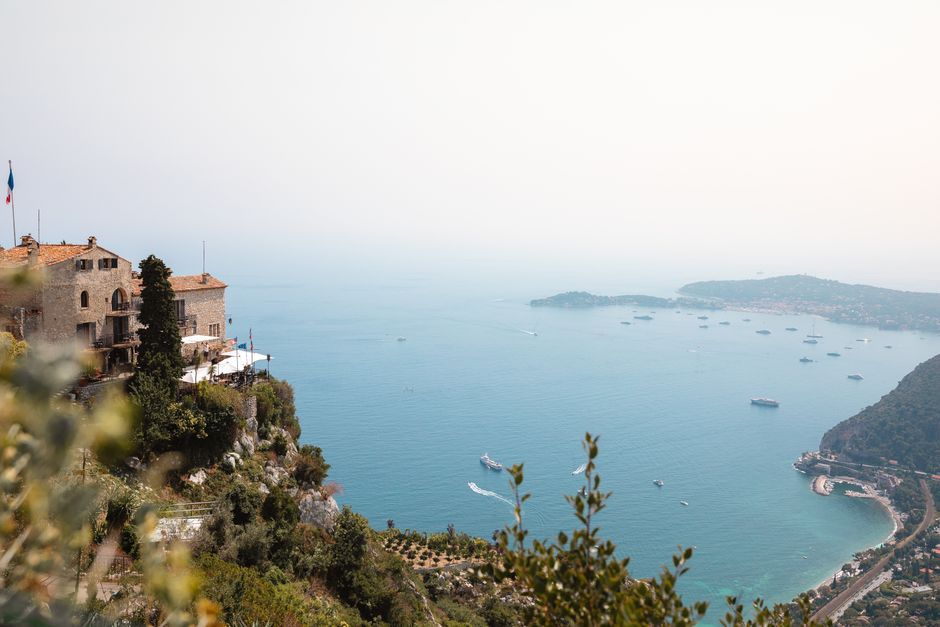
The French Riviera, the Côte d’Azur, is the sunny stretch of Mediterranean coast between the Italian border and the red rocks of the Estérel, with Saint-Tropez just beyond. In a couple of hours along the shore you pass Menton’s lemon gardens, the tiny principality of Monaco, perched villages such as Èze, the big city of Nice, the ramparts of Antibes, the film-festival town of Cannes and the coves of the Estérel, with the perfume town of Grasse and the hill villages behind. A good coastal railway links most of it, so you can base yourself in one place and explore. The best months are May, June and September; give it at least five days, ideally a week.
Right now in French Riviera (Nice)
- Wed17–20°C63–67°F44 mm rain
- Thu16–22°C60–71°F16 mm rain
- Fri13–21°C55–70°F1 mm rain
Top tours in French Riviera
See all tours for French Riviera →
From local operators, with prices and reviews; you check availability and book on Viator, our partner. We may earn a commission at no extra cost to you. How we earn money
The French Riviera at a glance
- Best months: May–June and September–early October. On the coast, average highs run from about 21 °C in May to 28 °C in August, with only 2–5 rainy days a month from May to September (Météo-France normals 1991–2020, Nice airport). The sea is warmest, around 24–25 °C, in August and early September.
- Days needed: 5 days for Nice, Monaco, Èze, Antibes and Cannes; 7–10 with Menton, the hill villages, the Estérel and Saint-Tropez.
- Getting there: Nice Côte d’Azur airport (NCE) is the gateway, with flights from all over Europe and beyond; TGV trains run from Paris to Cannes and Nice in roughly 5–6 hours.
- Getting around: regional ZOU! trains run along the coast from Saint-Raphaël to Menton and on to Ventimiglia in Italy; buses reach the hill villages. A car helps only for the backcountry and Saint-Tropez.
- Budget level: one of the most expensive parts of France, especially for rooms in July and August and in Monaco, Cannes and Saint-Tropez. Markets, picnics, public beaches and the trains keep costs down. A tourist tax is added per person per night. See our France guide for money, entry rules and daily costs.
The Riviera’s areas and who each one suits
The coast runs roughly east to west from the Italian border to the Estérel. Monaco is an independent country in the middle of it, with an open border.
Nice
The Riviera’s capital and transport hub: an old town, a castle hill, the Promenade des Anglais, pebble beaches, the Matisse and Chagall museums and a lively food scene. The most practical base for exploring without a car. Read our Nice travel guide.
Monaco
The second-smallest country in the world, 20 minutes by train from Nice: the Prince’s Palace on the Rock, the Oceanographic Museum, the Casino and the Formula 1 street circuit. A day trip for most visitors, a splurge for an overnight stay. Read our Monaco travel guide and our Monte Carlo guide.
Menton and the Riviera villages
Between Nice and the Italian border lies the most dramatic stretch of coast, where the Alps drop into the sea: Villefranche-sur-Mer with its deep bay, the villas of Cap Ferrat and Beaulieu, the perched village of Èze, Roquebrune-Cap-Martin and finally Menton, a colourful old town with lemon trees, gardens and the mildest winters in France. Best for couples, walkers and slow travel.
Antibes and Juan-les-Pins
Antibes has old ramparts, a Provençal market, the Picasso Museum in the Château Grimaldi and the yachts of Port Vauban; Juan-les-Pins next door has sandy beaches, nightlife and the Jazz à Juan festival in July. Cap d’Antibes between them has a beautiful coastal path. Good for families and beach holidays.
Cannes and the Lérins Islands
The Croisette, sandy beaches, the Palais des Festivals and the old quarter of Le Suquet, plus two car-free islands a short ferry ride away, one with a fort where the Man in the Iron Mask was held and one with a working monastery. Glamorous during the Film Festival and big trade fairs, relaxed the rest of the year. Our Cannes guide covers it in detail.
The Estérel coast
West of Cannes, the red porphyry cliffs of the Massif de l’Estérel plunge into a blue sea, with small coves, the Corniche d’Or coast road and seaside towns such as Théoule-sur-Mer, Agay and Saint-Raphaël. Wilder and cheaper than the rest of the Riviera; for hikers, snorkellers and road-trippers.
Saint-Tropez and its peninsula
Just beyond the Estérel in the Var, the famous little port of Saint-Tropez, its art museum, market and citadel, and the long sandy beach of Pampelonne. There is no railway: come by bus from Saint-Raphaël or by boat from Sainte-Maxime. Our Saint-Tropez guide has the details.
Grasse and the hill villages
Inland, the perfume town of Grasse and a string of medieval villages on hilltops and cliffs: Saint-Paul-de-Vence, Vence, Tourrettes-sur-Loup and Gourdon. Cooler in summer, full of art, and easiest by car.
Top things to see on the French Riviera
Prices and hours for individual sights are on our city guides; check the official sites before you go.
The Promenade des Anglais and Vieux Nice
Seven kilometres of palm-lined seafront around the Baie des Anges, part of a UNESCO World Heritage Site since 2021, and the maze of the old town behind it, with the Cours Saleya flower and food market. Climb Castle Hill for the view at sunset.
Monaco’s Rock and Monte Carlo
Watch the changing of the guard outside the Prince’s Palace just before noon, visit the Oceanographic Museum built into the cliff, then walk down to Port Hercule and up to Casino Square and the Grand Prix hairpin.
Èze and Villefranche-sur-Mer
Èze is a medieval village on a rock about 400 m above the sea, with an exotic garden at the top; walk up or down the steep Nietzsche path to Èze-sur-Mer station. Villefranche, a few minutes from Nice by train, has a citadel, a sheltered beach and a chapel decorated by Jean Cocteau.
Menton
The last town before Italy, with an Italianate old town climbing to a hilltop cemetery, the Jean Cocteau museum, subtropical gardens and lemon groves. Every February, the Fête du Citron fills the town with sculptures made of citrus fruit.
Antibes and the Picasso Museum
Picasso worked in the Château Grimaldi on the ramparts in 1946, and the museum keeps the works he made there. Combine it with the covered market, a walk on the ramparts and the Cap d’Antibes coastal path.
The Lérins Islands
Fifteen to twenty minutes by boat from Cannes, Sainte-Marguerite has pine woods, coves and the Fort Royal museum, and Saint-Honorat has a monastery where monks still make wine. They are the Riviera’s best escape from the crowds. See our boat trips guide.
Saint-Paul-de-Vence and the Fondation Maeght
A walled hill village of galleries and lanes, where artists such as Chagall lived; Chagall is buried in its cemetery. Just outside, the Fondation Maeght is one of France’s great modern-art museums, with works by Miró, Giacometti, Braque and Chagall in a garden setting.
Beaches: pebbles, sand and coves
Riviera beaches vary a lot. From Menton to Nice, most are pebble or shingle, with clear water that gets deep quickly: bring water shoes. Sand begins west of Nice, at Antibes, Juan-les-Pins and Cannes, and returns at Saint-Raphaël and Pampelonne near Saint-Tropez. The Estérel has small rocky and red-sand coves, ideal for snorkelling. Most towns mix free public beaches, with showers and summer lifeguards, and private beach clubs where you pay for a sunbed and lunch. The sea is coolest in March and April, around 14–15 °C, and warmest, about 24–25 °C, in August and early September.
Events on the Riviera in 2027
- Nice Carnival (9–28 February 2027): parades and flower battles on the Promenade, with the theme “Vive l’Amour”.
- Menton Lemon Festival (13–28 February 2027): the 93rd Fête du Citron, on the theme “Douce France”, with giant citrus sculptures in the Biovès gardens and parades of floats; official ticket sales open on 5 October 2026.
- Cannes Film Festival (11–22 May 2027): the 80th edition. Most screenings are for professionals, but the open-air Cinéma de la Plage is free.
- Monaco Grand Prix (3–6 June 2027): the Formula 1 race moves to early June in 2027, with the race on Sunday 6 June; roads and sights in Monaco are disrupted for days around it.
- July: Jazz à Juan in Juan-les-Pins and summer fireworks festivals in Cannes, Monaco and other towns.
- Late September: Les Voiles de Saint-Tropez, a classic and modern yacht regatta (26 September–4 October in 2026).
Other things to do on the Riviera
Walk the coastal paths
Some of the best walks in France follow the shore: around Cap Ferrat and Cap d’Antibes, the Cap Martin path from Roquebrune to Monaco, and the Estérel trails above the red cliffs. Start early in summer and carry water. See our hiking guide.
Get out on the water
Boat trips run from Nice, Cannes, Antibes and Saint-Raphaël along the coast, to Monaco, the Lérins Islands and Saint-Tropez, and around the Estérel’s coves. Clear water around Villefranche, Cap Ferrat and the Lérins suits snorkelling and diving.
Perfume, art and food
Grasse’s perfume houses run tours and workshops where you make your own scent. Art lovers can follow Matisse, Chagall, Picasso, Renoir and Cocteau from Nice to Antibes, Cagnes-sur-Mer and Menton. Eat socca and pissaladière in Nice, bouillabaisse in the ports and Provence rosé everywhere; see our wine tasting guide.
Nearby destinations
- Saint-Tropez6 km
- Cannes39 km
- Verdon Gorge55 km
- Nice65 km
- Monte Carlo77 km
- Provence93 km
- Aix-en-Provence101 km
- Marseille104 km
Getting there and getting around
Arriving
Nice Côte d’Azur airport, 7 km west of central Nice, is the main gateway, with flights from across Europe and beyond. Tram line 2 runs into Nice in under 30 minutes, and ZOU! airport express buses run along the coast: line 80 to Monaco and Menton, line 81 to Cannes, and line 82 to Antibes; as of October 2026 a single on lines 80 and 81 costs €21.40 online. The coastal railway is reached from Nice Saint-Augustin station, next to the airport’s Grand Arénas tram stop. TGV trains from Paris Gare de Lyon reach Saint-Raphaël, Cannes, Antibes and Nice; for Saint-Tropez, Toulon-Hyères airport is closer.
The coastal train
Regional ZOU! trains (formerly TER) run frequently along the coast between Saint-Raphaël, Cannes, Antibes, Nice, Monaco, Menton and Ventimiglia. Approximate times from Nice-Ville: Monaco about 20 minutes, Menton about 35 minutes, Antibes 20–25 minutes, Cannes 30–40 minutes and Saint-Raphaël about an hour. Buy tickets on the SNCF Connect app or at the station, and expect crowded trains on summer weekends.
Buses
In Nice and its neighbouring towns, Lignes d’Azur trams and buses cost €1.70 a trip (as of October 2026); Cannes has its own Palm Bus network, at €1.80. ZOU! regional buses reach the hill villages, such as Èze, Saint-Paul-de-Vence, Vence and Grasse, and line 876 runs from Saint-Raphaël to Saint-Tropez. Many lines run less often on Sundays and outside summer.
Driving
A car is useful for the hill villages, the Estérel’s Corniche d’Or and Saint-Tropez, but coastal traffic in summer is slow and parking is expensive. The A8 motorway runs behind the coast, with tolls. Nice’s low-emission zone (ZFE) applies only to lorries, buses and coaches of Crit’Air 4 and 5, not to cars, as of October 2026. Monaco has no border checks.
When to go and how long to stay
The Riviera has one of the mildest climates in France: warm, dry summers cooled by the sea breeze, sunny winters and most of its rain in autumn, often in short, heavy storms that can cause flash floods. Nice gets about 2,750 hours of sunshine a year.
| Season | Average high / low | Rainy days a month | What it’s like |
|---|---|---|---|
| Spring (Mar–May) | 15–21 °C / 8–15 °C | 5–6 | Mild and flowery; the sea is still cool (about 15–18 °C). Good for walking and the Film Festival in May. |
| Summer (Jun–Aug) | 25–28 °C / 18–21 °C | 2–4 | Warm, sunny and crowded; beaches full, rooms at their dearest, fire-risk closures in the hills. |
| Autumn (Sep–Nov) | 17–25 °C / 10–18 °C | 5–9 | September is perfect beach weather; October and November bring heavy rain on some days. |
| Winter (Dec–Feb) | 13–14 °C / 6–7 °C | 5–6 | Mild, sunny and quiet; Carnival in Nice and the Lemon Festival in Menton in February. |
Figures are Météo-France’s 1991–2020 normals for Nice airport (rainy day = at least 1 mm of rain). Cannes is similar by day and a few degrees colder at night; Menton is the mildest in winter, and the hill villages are cooler.
5 days on the Riviera
Base yourself in Nice. Spend two days in the city, one on the eastern coast (Villefranche, Èze and Monaco), one in Antibes, and one in Cannes with a boat to Île Sainte-Marguerite.
7 days on the Riviera
Add Menton and the Cap Martin path, and a day inland for Saint-Paul-de-Vence, the Fondation Maeght and Grasse, by car or bus.
10 days or more
Move to Cannes or Saint-Raphaël for the second half: drive or hike the Estérel, then spend two nights around Saint-Tropez and Pampelonne. Finish in Provence or Marseille, or cross to Italy by train from Menton.
Where to stay on the French Riviera
- Without a car: Nice, for the airport, trains and buses in every direction; or Antibes and Cannes, which are smaller and also on the railway.
- Romance and views: Villefranche, Èze or Beaulieu, between Nice and Monaco.
- Mild winters and value: Menton, which is calmer and usually cheaper than Nice.
- Beach holiday: Juan-les-Pins, Cannes or Saint-Raphaël for sand and families; Pampelonne for Saint-Tropez.
- Hill-village calm: Saint-Paul-de-Vence, Vence or a farmhouse near Grasse, with a car.
Every town charges a tourist tax (taxe de séjour) per person per night, set by each town and star rating, and in the Alpes-Maritimes and the Var it includes a 34% surcharge that funds the new Provence–Côte d’Azur railway line. As examples, a night in a 4-star hotel costs €3.48 per adult in Nice, €3.35 in Cannes and €3.74 in Saint-Tropez in 2026. Under-18s are exempt.
Practical tips for the French Riviera
- Check the fire-risk maps in summer: from mid-June to mid-September, access to wooded hills in the Alpes-Maritimes can be advised against or banned depending on the weather, and the Var, including the Estérel and the Maures, publishes its own map; both are updated around 18:00 for the next day on risque-prevention-incendie.fr. Fires and barbecues are banned outdoors.
- Water shoes: essential on the pebble beaches from Nice to Menton.
- Avoid the big events if you don’t need them: prices soar during the Monaco Grand Prix, the Cannes Film Festival and Cannes trade fairs.
- Trains in summer: travel early or late to avoid packed coastal trains, and keep bags in front of you; pickpockets work the crowds.
- Autumn storms: heavy rain in October and November can cause flash floods; follow Météo-France warnings.
- Emergencies: call 112 in France and in Monaco.
What to pack for the French Riviera
For the coast, bring water shoes for the pebbles, a swimsuit, sunscreen, sunglasses and a hat, plus a light cover-up for walking from the beach into town. Comfortable walking shoes with grip help on the steep lanes of Èze, Menton and the coastal paths. Add one smarter outfit for Monaco’s Casino or a Cannes restaurant, and a mask and snorkel for the Lérins and the Estérel coves. From November to March, pack a warm layer and a light waterproof jacket, as evenings drop to 6–7 °C and autumn storms can be heavy.
French Riviera travel FAQ
What is the best base for the French Riviera?
Nice, for most people: it has the airport, the main station and buses and trains in every direction, so Monaco, Èze, Antibes and Cannes are all day trips. Antibes and Cannes are good smaller bases on the railway.
How many days do you need on the French Riviera?
Five days covers Nice, Monaco, Èze, Antibes and Cannes. Seven to ten days lets you add Menton, the hill villages, the Estérel and Saint-Tropez.
Do you need a car on the French Riviera?
Not for the coast between Saint-Raphaël and Menton, which the regional train covers. A car helps for the hill villages, the Corniche d’Or through the Estérel and Saint-Tropez, but summer traffic and parking are difficult.
How long is the train from Nice to Monaco and Cannes?
About 20 minutes to Monaco and 30–40 minutes to Cannes by regional ZOU! train from Nice-Ville, as of October 2026. Menton is about 35 minutes and Antibes 20–25 minutes.
What is the best time to visit the French Riviera?
May, June and September, with average highs of 21–28 °C on the coast, warm seas and fewer crowds than July and August. Winter is mild and sunny, with the Nice Carnival and the Menton Lemon Festival in February.
When is the Monaco Grand Prix in 2027?
From 3 to 6 June 2027, with the race on Sunday 6 June. It moves to early June in 2027, and it is the first Monaco Grand Prix with the Sprint format.
When is the Menton Lemon Festival in 2027?
From 13 to 28 February 2027, on the theme “Douce France”. Official ticket sales for the parades and seating open on 5 October 2026.
When is the Cannes Film Festival in 2027?
The 80th Festival de Cannes runs from 11 to 22 May 2027. Most screenings are for accredited professionals, but the open-air Cinéma de la Plage on Plage Macé is free for everyone.
Are the beaches on the French Riviera sandy?
Some are. From Menton to Nice they are mostly pebbles; Antibes, Juan-les-Pins, Cannes, Saint-Raphaël and Pampelonne near Saint-Tropez have sand. The sea is warmest, about 24–25 °C, in August and early September.
Can I hike on the Riviera in summer?
Yes, but start early and check the fire-risk maps for the Alpes-Maritimes and the Var, updated around 18:00 for the next day; from mid-June to mid-September, wooded hills can close on high-risk days.
Is there a low-emission zone on the Riviera?
Nice has one, but as of October 2026 it applies only to lorries, buses and coaches of Crit’Air 4 and 5, not to private cars. A Crit’Air sticker is still worth having if you drive elsewhere in France.
How much is the tourist tax on the Riviera?
It depends on the town and the accommodation. In 2026 a 4-star hotel costs €3.48 per adult per night in Nice, €3.35 in Cannes and €3.74 in Saint-Tropez, including a 34% regional railway surcharge. Under-18s pay nothing.
Plan your trip
Partner links: TravelerCenter may earn a commission if you book, at no extra cost to you.
🇫🇷 Useful French phrases for French Riviera
All 38 French phrases: restaurant, hotel, emergencies, romance (printable) →
Sources · last reviewed 4 October 2026
Researched and last reviewed on 4 October 2026. Event dates come from the Nice Côte d’Azur tourist office, the Menton Lemon Festival, the Festival de Cannes, the Automobile Club de Monaco and Les Voiles de Saint-Tropez; transport from Nice Côte d’Azur airport, the ZOU! network, Lignes d’Azur and Palm Bus; the low-emission zone from the Métropole Nice Côte d’Azur; fire-risk rules from the Alpes-Maritimes and Var prefectures’ maps; tourist tax from the French tax authority’s open data and the Métropole Nice Côte d’Azur; climate from Météo-France’s 1991–2020 normals for Nice airport. Train times are approximate. Prices, timetables and opening hours change, so check the official sites before you travel.
Data: Weather: MET Norway (CC BY 4.0) · Sea temperature: NOAA CoastWatch · Air quality: OpenAQ · Rates: ECB · Costs: World Bank ICP and price levels · Wikidata (CC0)