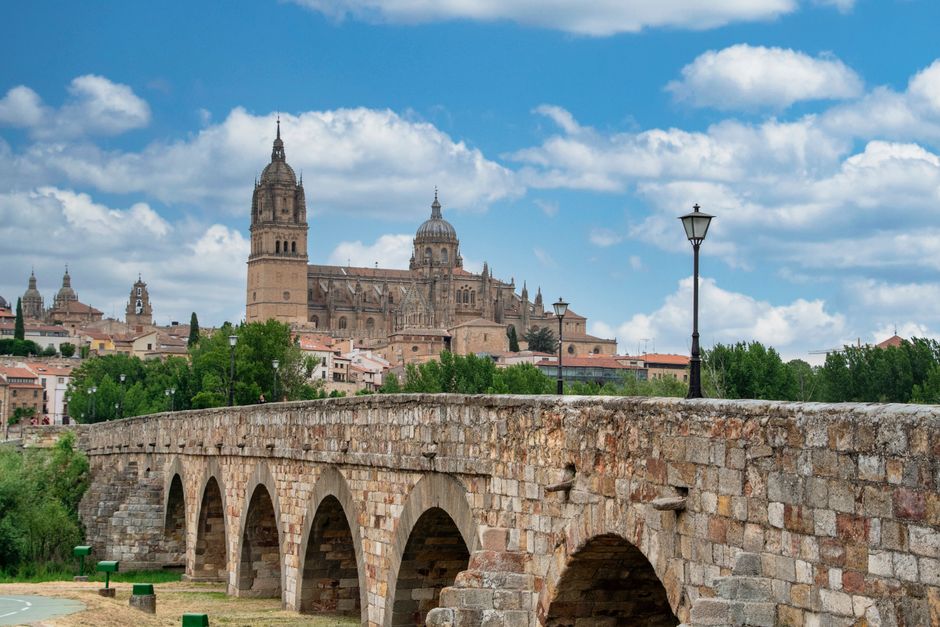
Salamanca is the golden city of Castile: a university town on the river Tormes whose old centre, built in a warm sandstone that glows at sunset, is a UNESCO World Heritage Site. It has one of Europe’s oldest universities, founded in 1218, two cathedrals side by side, the most beautiful main square in Spain and tens of thousands of students who keep its tapas bars busy every night of the week. It is compact, walkable and easy to reach from Madrid by train or coach, but it rewards a night or two far more than a rushed day trip: the lights come on in the Plaza Mayor after dark and the whole old town turns gold. Summers are hot and dry, winters cold and clear; the best months are April to June and September to October.
Right now in Salamanca
- Wed12–20°C53–67°F3 mm rain
- Thu9–17°C47–63°FPartly cloudy
- Fri6–15°C42–58°FClear
- Mon 12 Oct National Day of Spain (Fiesta Nacional de España)
Top tours in Salamanca
See all tours for Salamanca →
From local operators, with prices and reviews; you check availability and book on Viator, our partner. We may earn a commission at no extra cost to you. How we earn money
Salamanca at a glance
- Best for: Renaissance and Gothic architecture, university history, a lively student atmosphere, tapas and Spanish-language courses.
- How long: 1 full day for the highlights; 2 days to see the cathedrals, the university and the museums at an easy pace; 3 days to add Ciudad Rodrigo or the Sierra de Francia.
- Best time: April to June and September to October. July and August average highs of about 31 °C; winter nights often drop below freezing.
- Getting there: trains from Madrid-Chamartín, coaches from Madrid’s Estación Sur and Madrid-Barajas airport, about 210 km away. Salamanca’s own airport has very few flights.
- Getting around: on foot. The old town is small and largely pedestrian; city buses link the train and bus stations with the centre.
- Before you go: entry rules, money, trains and general safety are on our Spain travel guide.
Salamanca’s neighbourhoods and who each one suits
Almost everything a visitor wants lies within a 15-minute walk of the Plaza Mayor, between the square and the river.
The old town and the Plaza Mayor
The UNESCO-listed core, from the Plaza Mayor down the Rúa Mayor to the cathedrals, the university and the Casa de las Conchas. Every sight is on your doorstep and the streets are beautiful at night. It is the obvious base for a first visit or a short stay; rooms facing busy bar streets can be noisy at weekends, so ask for an inside room.
The university quarter and the river
The quieter southern slope of the old town, around the Patio de Escuelas, the convents of San Esteban and Las Dueñas, the Casa Lis and the Huerto de Calixto y Melibea garden, running down to the Roman bridge. Good for couples and anyone who wants calm evenings with the sights still a few steps away.
Van Dyck and the modern centre
North of the Plaza Mayor, around the Gran Vía, the Mercado Central and the Calle Van Dyck, is everyday Salamanca: shops, cheaper hotels and the city’s best-known tapas street, where locals go rather than tourists. Practical for anyone arriving by train or coach and for longer stays.
Barrio del Oeste and Tejares
West of the old town, the Barrio del Oeste is a residential district turned open-air gallery, with dozens of murals painted on garage doors and walls. It suits repeat visitors, language students and anyone looking for a local feel and lower prices; the old town is a 10–15 minute walk away.
Top things to see in Salamanca
Prices and hours below were checked on the official sites in October 2026, unless we say otherwise; check again before you go.
The Plaza Mayor
Built between 1729 and 1755 to a design by Alberto de Churriguera, the Plaza Mayor is a great Baroque square enclosed by four arcaded ranges of golden stone, with the town hall on its north side. Medallions above the arches show Spanish kings and famous figures. It is free, open day and night, and the living room of the city: students meet “under the clock”, families stroll in the evening and cafés fill the arcades. Come back after dark, when the whole square is lit up.
The University of Salamanca and its frog
The Escuelas Mayores, the university’s historic building, hides behind one of the finest Plateresque façades in Spain, carved like lace in the early 16th century on the Calle Libreros. Tradition says that students who spot the small frog sitting on a skull among the carvings will pass their exams. Inside, you can see the lecture halls round the cloister, including Fray Luis de León’s, the grand staircase and the old library, one of the oldest university libraries in Europe. According to the university’s museum site, entry costs €10, €5 for students and retired visitors, and is free for under-12s; an audio guide costs €2. It opens Monday to Saturday 10:00–20:00 from 1 April to 15 October and 10:00–19:00 from 16 October to 31 March, and 10:00–14:00 on Sundays and holidays. That page still lists closure dates from an earlier year, so check before you go. Across the Patio de Escuelas, the Cielo de Salamanca, a 15th-century painted ceiling of the zodiac and constellations, is free to see.
The New and Old Cathedrals
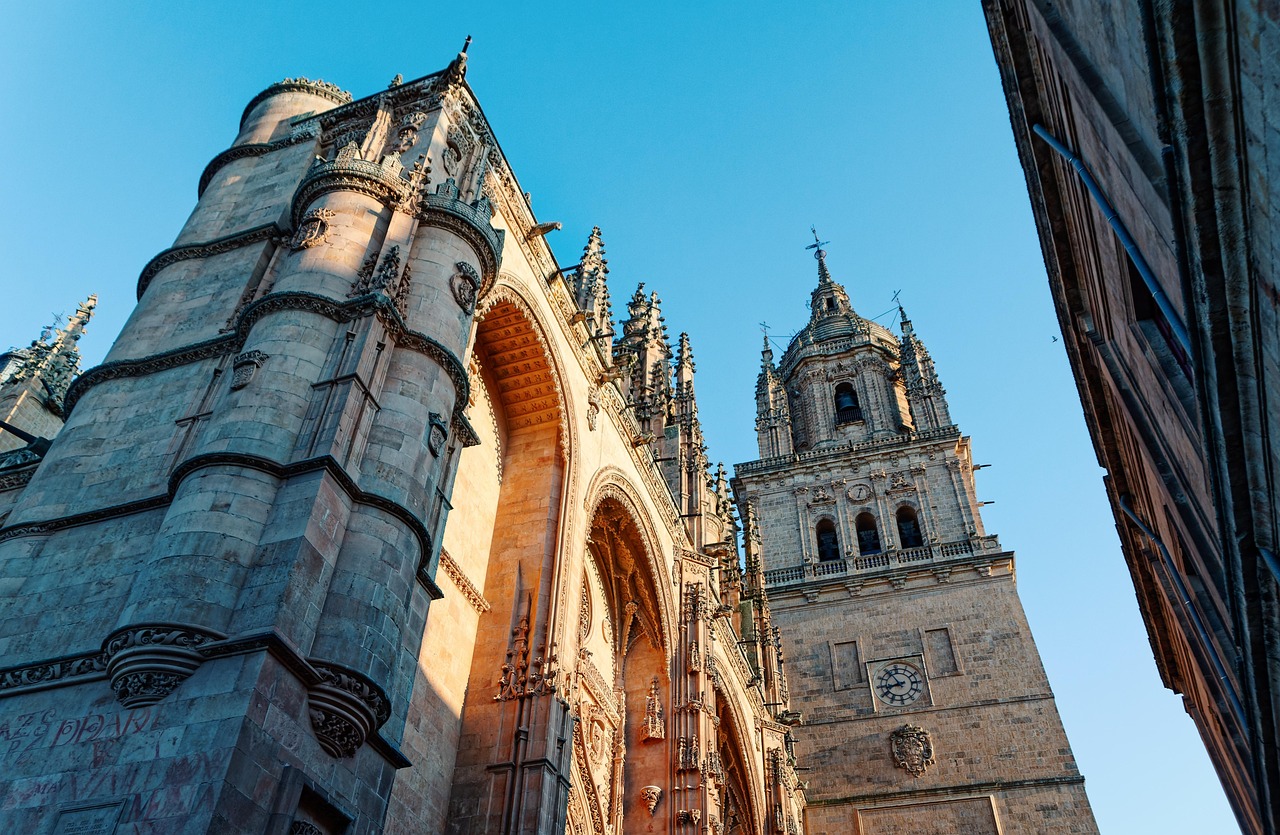
Salamanca has two cathedrals joined together. The Old Cathedral, from the 12th century, is Romanesque, with the scaled dome of the Torre del Gallo and a 15th-century altarpiece of 53 painted panels by Dello Delli. When the city outgrew it, the vast late-Gothic New Cathedral was built alongside from 1513, and finished more than two centuries later. Look for the astronaut and the dragon eating an ice cream that a stonemason added to the Puerta de Ramos during a 1992 restoration. As of October 2026 one ticket covers both cathedrals, the cloister, the chapter rooms and the exhibitions in the Bishop’s Palace: €10 general and €9 for over-65s and students, free for children up to 6, with the audio guide included. It opens Monday to Saturday 10:00–20:00 (last entry 19:15) and Sunday 10:00–18:00 (last entry 17:15).
Ieronimus: the cathedral towers
For the best views over the city, climb the medieval towers and walkways of the cathedrals with Ieronimus, entering through the Torre Mocha on the Plaza Juan XXIII. The route passes through old guardrooms, along the triforium high inside the New Cathedral, out on to the Anaya terrace and up to the bell chamber. As of October 2026 it opens every day, 10:00–20:00 from March to December (last entry 19:00) and 10:00–18:00 in January and February, and costs €6. On some evenings there are night visits with music and lighting for €10; check the calendar on the official site.
Casa de las Conchas and the Clerecía
The late 15th-century Casa de las Conchas is covered with about 300 carved scallop shells, the emblem of the Order of Santiago. Today it is a public library, so you can step into its Gothic courtyard for free during opening hours. Across the street rises the Clerecía, the huge Baroque Jesuit college now used by the Pontifical University; its towers can be climbed on the Scala Coeli visit, for some of the best views of the old town. Check the times and price with the tourist office, as we could not read an official page for them.
Casa Lis: the Art Nouveau and Art Deco museum
A modernist mansion with a stained-glass façade over the old city walls, the Casa Lis holds a delightful collection of Art Nouveau and Art Deco glass, bronzes, jewellery, dolls and posters. As of October 2026 the museum lists €7 for adults, €3 for students and retired visitors, and free entry for under-14s, with free entry on Thursday mornings. From 1 June it opens daily 10:00–19:00; from 19 October winter hours apply: Monday to Friday 11:00–17:00, Saturday 11:00–20:00 and Sunday 11:00–15:00. It closes on 25 December and 1 and 6 January.
More to see
- Convento de San Esteban: the Dominican convent with a carved Plateresque façade like a giant altarpiece, a quiet cloister and a huge Baroque altarpiece by José de Churriguera.
- Convento de las Dueñas: a small convent with one of the most richly carved Renaissance cloisters in Spain; the nuns sell sweets.
- The Roman bridge: the old bridge over the Tormes, partly Roman, with an Iron Age stone boar (verraco) at its end and the classic view of the cathedrals.
- Huerto de Calixto y Melibea: a small walled garden on the old walls, linked to the lovers of La Celestina, with views to the river.
- Casa Museo Unamuno: the rector’s house of the writer Miguel de Unamuno, next to the university; according to the university, entry is €4 and it opens Monday to Saturday mornings.
- DA2 (Domus Artium 2002): the city’s contemporary art centre, in a former prison.
Other things to do in Salamanca
Tapas and local food
Salamanca is a great tapas city, cheaper than Madrid and full of students. Start around the Plaza Mayor and the Rúa, then head for the Calle Van Dyck, lined with bars where locals order small plates and a caña. Look for Iberian ham from nearby Guijuelo, hornazo (a bread pie filled with pork loin, chorizo and egg), farinato sausage with fried eggs, and roast suckling lamb or kid. The Mercado Central, just off the Plaza Mayor, is the place for cheese, ham and picnic food.
Walking tours and the evening light
The best way to see Salamanca is on foot. Walk from the Plaza Mayor down the Rúa Mayor to the cathedrals, round the Patio de Escuelas and down to the Roman bridge, then cross the river for the view back as the sandstone turns gold at sunset. Free and paid walking tours start from the Plaza Mayor. See our city sightseeing guide for ideas.
Learning Spanish
Salamanca is one of the most popular places in the world to learn Spanish, with the university’s own courses and many private schools offering one-week to term-long programmes. The Castilian accent is clear and the city small and friendly, so it is easy to practise with locals in the bars.
Walking and cycling by the Tormes
Riverside paths follow the Tormes on both banks, with green parks and views of the old town, flat and good for an easy walk, run or bike ride. For proper hikes, head south to the Sierra de Francia and Las Batuecas. See our hiking and cycling guides.
Day trips and onward travel
Ciudad Rodrigo and the Sierra de Francia
Ciudad Rodrigo, about 90 km south-west near the Portuguese border, is a walled frontier town with a fine cathedral, a castle (now a parador) and a famous carnival. South of Salamanca, the Sierra de Francia has some of Spain’s best-preserved mountain villages: La Alberca, with timber-framed houses and narrow lanes, Mogarraz, with portraits of its residents painted on the façades, and Miranda del Castañar, plus the Peña de Francia peak and the Las Batuecas valley. You really need a car for the villages.
Ávila, Zamora, Segovia and Madrid
Ávila, with its complete medieval walls, is about 100 km east, and Zamora, a quiet Romanesque city on the Duero, about 65 km north. Both are an easy day out by car or bus. Salamanca also combines well with Segovia and Madrid on a tour of the historic cities of Castile, and with Portugal to the west, where the road continues to the Douro and Porto.
Nearby destinations
- Segovia130 km
- Douro Valley157 km
- Madrid176 km
- Toledo184 km
- Porto248 km
- Coimbra248 km
- Picos de Europa259 km
Getting there and getting around
By train
Renfe trains run from Madrid-Chamartín to Salamanca station, north-east of the centre, in roughly 1 hour 30 minutes to 1 hour 45 minutes on the fastest services, with several departures a day. There are also trains from Valladolid and Ávila. From the station it is a 20-minute walk or a short bus or taxi ride to the Plaza Mayor. Book ahead for Friday and Sunday evenings, which are busy with students. Check times on Renfe’s website before you travel.
By coach and from Madrid airport
Avanza runs frequent coaches between Madrid’s Estación Sur and Salamanca’s bus station, which is about 15 minutes’ walk from the Plaza Mayor, and some services start at Madrid-Barajas airport, so you can travel straight from your flight without going into Madrid. Fares are usually lower than the train’s, and the journey takes about 2 hours 30 minutes to 3 hours. Avanza tickets are named: carry the passport or ID card you booked with. Salamanca’s own airport, at Matacán, has very few scheduled flights; Madrid-Barajas is the usual gateway.
On foot, by bus and by car
You will walk almost everywhere in Salamanca; the old town is small, hilly in places and largely closed to general traffic. City buses link the train and bus stations with the centre. If you arrive by car, leave it in a public car park on the edge of the old town or at your hotel, since access to the historic centre is restricted and parking there is scarce. We could not confirm the details of any low-emission zone for visitors’ cars, so check with your hotel before you drive in.
When to go and how long to stay
Salamanca sits about 800 m above sea level on the Castilian plateau, so it has a dry continental climate: hot sunny summers, cold winters with frosty nights, and little rain at any time. The table uses AEMET’s 1991–2020 climate normals for the Salamanca airport weather station at Matacán, about 15 km east of the city and 790 m up: average daily highs and lows, and days with at least 1 mm of rain. Nights in town are usually a little milder than at the airport.
| Season | Average high / low | Rainy days per month | What it’s like | Good for |
|---|---|---|---|---|
| Winter (Dec–Feb) | 9–12 °C / -1 °C | 5–6 | Cold and often sunny, with frost and some fog | Museums, cathedrals, low prices, Christmas lights |
| Spring (Mar–May) | 15–22 °C / 1–7 °C | 6–8 | Fresh and green, the wettest spell in April | Sightseeing, Easter week, day trips |
| Summer (Jun–Aug) | 28–31 °C / 10–12 °C | 2–4 | Hot, dry and sunny days with cool nights | Evenings in the Plaza Mayor, terraces, the Sierra de Francia |
| Autumn (Sep–Nov) | 26 °C falling to 13 °C / 9 °C falling to 2 °C | 4 in September, 8 in October | Warm in September, crisp and golden later | Sightseeing, walking, food |
The airport station averages only about 355 mm of rain a year, with October the wettest month and July and August almost dry. It sees about 2,880 hours of sunshine a year. Pack a warm coat from November to March: daytime sun can be deceptive and the nights are cold.
Events worth planning around
- Easter week (Semana Santa): solemn processions through the old town, with the cathedrals as a backdrop.
- Lunes de Aguas: the Monday a week after Easter Monday, when locals picnic by the river with hornazo.
- September: the city’s fiestas and fair in honour of the Virgen de la Vega, around 8 September, with concerts and a livestock fair.
- Term time: from late September to June the city is full of students; it is quieter in August.
How long to stay: 1, 2 and 3 days
1 day: morning at the university and the Casa de las Conchas, lunch on the Rúa, the cathedrals and the Ieronimus towers in the afternoon, then the Roman bridge at sunset and tapas around the Plaza Mayor after dark.
2 days: add the Casa Lis, the convents of San Esteban and Las Dueñas, the Clerecía towers and an evening on the Calle Van Dyck. 3 days: add Ciudad Rodrigo, or La Alberca and the Sierra de Francia by car.
Where to stay in Salamanca and the tourist tax
- Around the Plaza Mayor: the most atmospheric choice, with everything on foot; can be lively at weekends.
- Near the cathedrals and the university: quieter evenings among the monuments, including hotels in former palaces and convents.
- Gran Vía and Van Dyck: good value, close to the tapas bars and handy for the bus and train stations.
- Across the river: hotels with views of the old town, a short walk over the Roman bridge.
Rooms are scarce and more expensive during Easter week, at graduation time in June, during the September fiestas and on long weekends, when many visitors come from Madrid. Salamanca is otherwise one of the better-value historic cities in Spain. As of October 2026 we found no tourist tax in Salamanca or anywhere in Castile and León; check with your accommodation when you book.
Practical tips for Salamanca
- Find the frog: look on the right-hand pilaster of the university façade, on a skull; or let a guide point it out.
- Sundays: the university closes at 14:00 and the cathedrals at 18:00, so see them on a weekday if you can.
- Go up high: the Ieronimus towers and the Clerecía towers give two very different views; late afternoon light is best.
- Eat late: lunch from about 14:00, dinner from 21:00; tapas bars are busy from 20:00.
- Cash and cards: cards are taken almost everywhere, including in most tapas bars.
- Emergencies: call 112.
What to pack for Salamanca
Comfortable walking shoes with a good grip are the most important thing: the old town is paved with stone that gets slippery, and the tower visits involve narrow spiral stairs. In summer bring a sun hat, sunglasses and a refillable water bottle, plus a light jumper for evenings, which cool down quickly on the plateau. From November to March pack a warm coat, a hat and gloves for frosty nights and mornings. A small daypack is useful, as big bags are awkward on the tower walkways.
Salamanca travel FAQ
Is Salamanca worth visiting?
Yes. Its UNESCO-listed old town, the Plaza Mayor, the university and the two cathedrals make it one of the most beautiful cities in Spain, and it is livelier and cheaper than many historic towns thanks to its students.
Can I visit Salamanca as a day trip from Madrid?
Yes, with the fastest trains taking roughly 1 hour 30 minutes each way, but it is a long day. Stay one night if you can, to see the Plaza Mayor and the cathedrals lit up after dark.
How much does it cost to visit Salamanca Cathedral?
As of October 2026, €10 (€9 for over-65s and students), covering both the New and Old Cathedrals, the cloister and the Bishop’s Palace exhibitions, with an audio guide. The Ieronimus tower visit is a separate €6 ticket.
Where is the frog on the University of Salamanca?
On the Plateresque façade of the Escuelas Mayores, in the Patio de Escuelas: it sits on a skull on the right-hand side of the carvings. Shops all over town sell frog souvenirs.
How much is the University of Salamanca visit?
The university lists €10 for adults and €5 for students and retired visitors, free under 12. It opens Monday to Saturday from 10:00 and closes at 14:00 on Sundays and holidays.
How do I get from Madrid airport to Salamanca?
Take an Avanza coach, as some services leave directly from Madrid-Barajas, or go into Madrid and take a train from Chamartín. Book coach seats ahead, as tickets are named and popular times sell out.
Is there a tourist tax in Salamanca?
As of October 2026 we found none in Salamanca or elsewhere in Castile and León. Ask your accommodation when you book, in case this changes.
What is the best time to visit Salamanca?
April to June and September to October, when days are warm and sunny. July and August are hot, with average highs of about 31 °C, and winter nights fall below freezing.
How many days do I need in Salamanca?
One full day covers the main sights; two let you see the museums and convents at a gentle pace and enjoy the evenings. Add a third for Ciudad Rodrigo or the Sierra de Francia.
Plan your trip
Partner links: TravelerCenter may earn a commission if you book, at no extra cost to you.
🇪🇸 Useful Spanish phrases for Salamanca
All 38 Spanish phrases: restaurant, hotel, emergencies, romance (printable) →
Sources · last reviewed 4 October 2026
Researched and last reviewed on 4 October 2026. Cathedral prices and hours: the Cathedral of Salamanca; tower visits: Ieronimus; university and Casa Museo Unamuno prices and hours: the University of Salamanca’s museum site; Casa Lis prices and hours: the Museo Casa Lis; coaches: Avanza; climate: AEMET’s 1991–2020 normals for Salamanca-Matacán, published through the WMO. Train journey times, coach journey times, the Scala Coeli visit, the traffic rules in the old town and the absence of a tourist tax come from general references and are flagged for checking. Prices, hours and timetables change, so check the official sites before you go. For entry rules, money and general safety, see our Spain travel guide.
Data: Weather: MET Norway (CC BY 4.0) · Rates: ECB · Holidays: Nager.Date · Costs: World Bank ICP and price levels · Wikidata (CC0)