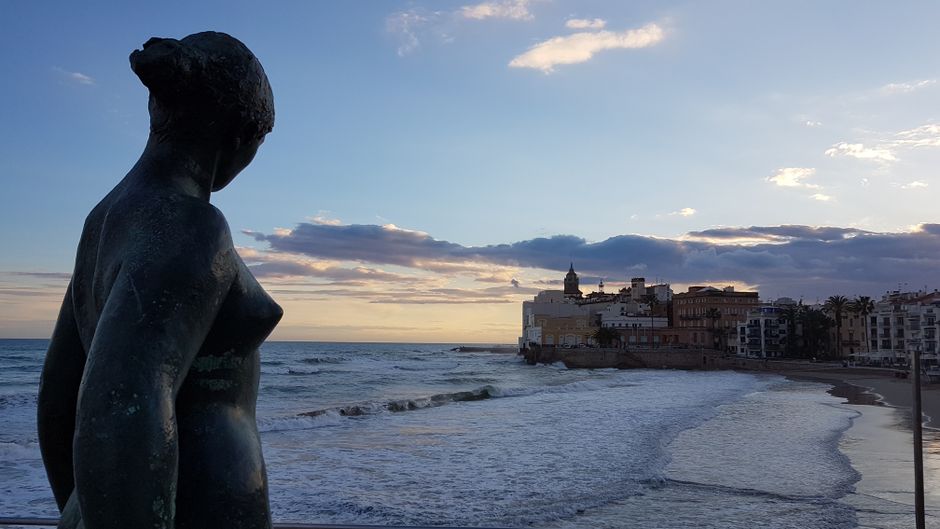
Sitges is a seaside town about 35 km south-west of Barcelona, squeezed between the limestone hills of the Garraf and the Mediterranean. It has a whitewashed old town, a Baroque church on a rocky headland above the sea, more than a dozen beaches, and a long artistic history that left behind two of Catalonia’s most charming museums, Cau Ferrat and Maricel. It is also famous for its festivals: one of Spain’s wildest carnivals, flower carpets for Corpus Christi and the world’s best-known fantasy film festival every October. Sitges is famously welcoming to LGBTQ+ travellers and lively all year, and only about 40 minutes from Barcelona by train. Further south lies the Costa Daurada. The best months are May to October.
Right now in Sitges
- Wed 17–24°C 62–75°F 2 mm Partly cloudy
- Thu 16–22°C 60–72°F 3 mm Showers
- Fri 15–21°C 59–69°F Clear
- Mon 12 Oct National Day of Spain (Fiesta Nacional de España)
Weather: MET Norway (CC BY 4.0) · Sea temperature: NOAA CoastWatch · Rates: ECB · Holidays: Nager.Date
Top tours in Sitges
See all tours for Sitges →
From local operators, with prices and reviews; you check availability and book on Viator, our partner. We may earn a commission at no extra cost to you. How we earn money
Sitges at a glance
- Best for: beaches within reach of Barcelona, art and Modernista architecture, festivals and nightlife, LGBTQ+ travellers, and cava country next door.
- How long: a day trip from Barcelona; 2–3 days for the beaches, museums and a Penedès winery; longer as a relaxed beach base.
- Best time: May to October for the beaches (average highs of 26–30 °C in summer); February for Carnival and October for the film festival.
- Getting there: Rodalies line R2 Sud trains from Barcelona Sants and Passeig de Gràcia in about 40 minutes; Bus Garraf coaches from Barcelona airport and the city.
- Getting around: on foot. The station is about ten minutes’ walk from the seafront and the old town, and the beaches line the town.
- Before you go: entry rules, money, trains and general safety are on our Spain travel guide.
Sitges’s areas and who each one suits
Sitges is small enough to cross on foot in half an hour. The old town sits around the church headland; beaches run east to the Aiguadolç marina and west towards Terramar.
The old town and La Punta
White houses, narrow lanes and flower-hung balconies climb to La Punta, the headland with the parish church, the museums and the Maricel palace. Around it are the main shopping streets, many restaurants and the bars of Carrer del Primer de Maig, nicknamed “Sin Street”. Great for first-timers and people who want everything on the doorstep; streets near the bars are noisy at night in summer.
The Passeig de la Ribera and the central beaches
The palm-lined seafront promenade runs west from the church past La Ribera and La Fragata beaches, lined with terraces and hotels. Lively from morning to late, with the classic Sitges view back to the church. Best for beach lovers who also want the town’s buzz.
Terramar and the west
West of the centre, the seafront continues for about 2 km past Modernista and “American” villas built by Sitges families who made their fortunes in the Americas, to the Terramar district with its garden-city houses, golf course and quieter beaches. Calmer and greener, ideal for families and longer stays.
Aiguadolç and the Garraf side
East of the church, small beaches such as Sant Sebastià and Balmins lead to the Port d’Aiguadolç marina, under the Garraf hills. Hotels here are close to the sea and the walking trails, and boats leave from the marina. Good for active travellers, sailors and couples.
Top things to see in Sitges
Prices and hours below were checked on the official sites in October 2026, unless we say otherwise; check again before you go. The town’s museums are run by the Consorci del Patrimoni de Sitges (Museus de Sitges); entry is free for under-17s and on the first Wednesday of each month.
The church of Sant Bartomeu i Santa Tecla
Sitges’s symbol is its parish church, built in the 17th century on the rocky headland of La Punta, right above the sea, with a Baroque bell tower and a façade that glows at sunset. The terrace in front, the Baluard, is the town’s best viewpoint over the beaches. The church is used for worship, so visit outside mass times and dress respectfully. Steps lead down from the terrace to the small beach of Sant Sebastià on one side and the seafront promenade on the other.
Cau Ferrat Museum
The painter and writer Santiago Rusiñol turned two fishermen’s houses on La Punta into his home and studio in the 1890s, and they became the centre of the Modernista art movement, with parties and exhibitions that drew artists from Barcelona, including the young Picasso. Today his house holds his collection of wrought iron, ceramics and glass, paintings by Rusiñol, Ramon Casas and others, and two paintings by El Greco, all in rooms that look straight out over the sea. A single ticket covers Cau Ferrat and the Maricel Museum next door: as of October 2026 it costs €12, €8 reduced and €6 for pensioners and Carnet Jove holders. From April to October both museums open Tuesday to Sunday, 10:00–19:00; from November to March, 10:00–17:00. They close on Mondays and on a few holidays, including 25 and 26 December and 1 and 6 January.
Maricel Museum and the Palau de Maricel
The American industrialist Charles Deering bought old buildings on the headland in the 1910s and turned them into the Maricel (“sea and sky”), a palace of white arches, courtyards and terraces facing the Mediterranean. The Maricel Museum shows art from the Romanesque period to the 20th century, including Catalan Modernista and Noucentista works and a fine collection of marine paintings. The palace’s grand rooms across the street are visited separately on guided tours: from September to June on Sundays, at 10:00 in English and later in Catalan and Spanish; in July and August on Tuesdays and Wednesdays. As of October 2026 the palace tour costs €12 (€9 reduced), and the museums recommend booking ahead, as places are limited. A combined ticket for Cau Ferrat, Maricel and the Fundació Stämpfli costs €17.
The beaches
The town’s tourist office lists 18 beaches, from Les Botigues in the east, by far the largest, to small coves inside the Garraf park. The central beaches, La Ribera, La Fragata, Sant Sebastià and La Bassa Rodona, are sandy, urban and close to bars and showers; La Bassa Rodona is the traditional gay beach. Terramar is wide and family-friendly. East towards Garraf, coves such as Balmins and Cala Morisca are smaller and wilder, and some are nudist. The water is calm most of the summer. See our beaches and snorkeling guides.
More to see
- Fundació Stämpfli: a museum of contemporary art in the old town, open weekends 10:00–14:00; €7 as of October 2026.
- Museu Romàntic (Can Llopis): a 19th-century family house, temporarily closed for renovation as of October 2026.
- The “American” houses: mansions in the old town and along the Passeig de la Ribera built by locals returning rich from Cuba and the Americas.
- Mercat Vell: the old market hall by the station, now used for exhibitions and events.
- Port d’Aiguadolç: the marina east of town, with seafood restaurants and boat trips along the Garraf cliffs.
Other things to do in Sitges
Walk or cycle in the Garraf Natural Park
Right behind Sitges, the Garraf massif is a natural park of white limestone hills, dry scrub, palmetto and hidden valleys dropping to the sea, managed by the Provincial Council of Barcelona. Trails climb from Sitges and from the little village of Garraf, with its striped beach huts and the Celler Güell winery buildings designed by Gaudí’s workshop. Paths lead to viewpoints, a Buddhist monastery and the coves. Take plenty of water and avoid the hottest hours in summer; access may be restricted on days of high fire risk. See our hiking and cycling guides.
Food, Malvasia and cava
Try xató, a winter salad of endive, salt cod and anchovies with a romesco-style sauce that is the pride of the Garraf coast, and seafood rice by the beach. Sitges has its own sweet wine, Malvasia de Sitges, made from vines first planted in medieval times. Inland, the Penedès is Spain’s main cava region: Sant Sadurní d’Anoia has dozens of cava cellars, many with tours, and Vilafranca del Penedès has a wine museum. Early October brings Sitges’s Grape Harvest Festival. See our wine tasting guide.
On the water
From the Aiguadolç marina you can join sailing trips, rent paddleboards and kayaks, or take a boat along the Garraf cliffs to swim in coves that are hard to reach on foot. See our boat trips guide.
Day trips and onward travel
Barcelona
Many visitors stay in Sitges and visit Barcelona by train, or the other way round: R2 Sud trains reach Sants and Passeig de Gràcia, for the Sagrada Família and the Gaudí houses, in about 40 minutes. It is a good way to enjoy the city by day and the beach and quieter nights in Sitges.
The Penedès and the Costa Daurada
The cava cellars of Sant Sadurní d’Anoia and the old town of Vilafranca del Penedès are about 30–40 minutes inland by car. Along the coast to the south, the neighbouring town of Vilanova i la Geltrú has a railway museum and long beaches, and beyond it the Costa Daurada leads to Roman Tarragona, Salou and PortAventura. R2 Sud trains continue south to Vilanova and Sant Vicenç de Calders, where you can change for Tarragona.
Nearby destinations
- Barcelona35 km
- Costa Daurada77 km
- Girona118 km
- Andorra la Vella144 km
- Costa Brava147 km
- Peñíscola153 km
- Mallorca206 km
- Carcassonne225 km
Getting there and getting around
By train from Barcelona
The easiest way to Sitges is the Rodalies R2 Sud line, which runs from Barcelona’s Estació de França through Passeig de Gràcia and Sants, then along the coast through Castelldefels to Sitges, Vilanova i la Geltrú and Sant Vicenç de Calders. According to Rodalies de Catalunya, on working days trains between Vilanova and Barcelona run every 10 minutes at peak times and every 15 minutes off-peak, so there are several trains an hour to Sitges; the trip from Sants takes about 40 minutes. Catalonia’s regional trains have had serious disruption in 2026, including network-wide suspensions in bad weather, so check the Rodalies app or website on the day.
From Barcelona airport
Josep Tarradellas Barcelona-El Prat airport is about 25 km away. Aena lists a Bus Garraf line between Barcelona and El Vendrell that stops at the airport (Terminal 1, arrivals level) and at Sitges; check its timetable and fares on the operator’s site before you fly. By train, take the R2 Nord from the station by Terminal 2 (a shuttle bus links Terminal 1) to El Prat de Llobregat and change there to an R2 Sud train south to Sitges. A taxi takes about 30 minutes in normal traffic.
Driving and parking
Sitges is reached by the C-32 motorway (with tolls through the Garraf tunnels) or the slow, winding C-31 coast road. You do not need a car in town, and parking near the beaches is scarce and mostly paid in summer, so use the car parks on the edge of the centre. The town council has planned a low-emission zone (ZBE) for the centre, but as of October 2026 we found no sign that one is being enforced; check the council’s mobility pages before driving an older car into the centre.
When to go and how long to stay
Sitges has a mild Mediterranean climate, with hot, humid summers, mild winters and rain mostly in autumn. There is no long-term AEMET station in Sitges itself, so the table uses AEMET’s 1991–2020 climate normals for the Barcelona airport weather station, on the same coast about 23 km to the north-east: average daily highs and lows, and days with at least 1 mm of rain. Sitges, sheltered by the Garraf hills, is often a little sunnier.
| Season | Average high / low | Rainy days per month | What it’s like | Good for |
|---|---|---|---|---|
| Winter (Dec–Feb) | 14–15 °C / 6–7 °C | 4 | Mild, mostly sunny, quiet outside Carnival | Carnival, museums, walking in the Garraf |
| Spring (Mar–May) | 17–22 °C / 9–15 °C | 4–6 | Pleasant and green, sea still cool | Walking, Corpus flower carpets, first beach days |
| Summer (Jun–Aug) | 26–30 °C / 19–22 °C | 2–4 | Hot, humid and busy, with Pride and festivals | Beaches, boat trips, nightlife |
| Autumn (Sep–Nov) | 27 °C falling to 18 °C / 19 °C falling to 10 °C | 5–7 | Warm sea in September; the rainiest season, with occasional heavy storms | Swimming in September, the film festival, wine harvest |
Barcelona airport averages about 570 mm of rain a year on some 53 rainy days, with September and October the wettest months. The sea is warmest from July to September.
Events worth planning around
- February: Carnival, a week of parades ending on Ash Wednesday, with the famous night parades of the Debauchery and the Extermination; in 2026 it ran from 12 to 18 February.
- Corpus Christi (late May or June): the streets of the old town are covered in carpets of flowers for the Sunday procession; in 2026 it was on 7 June.
- June: Sitges Pride (10–14 June in 2026).
- 23–24 August and 22–23 September: the town festivals of Sant Bartomeu and Santa Tecla, with fireworks, giants and traditional dances.
- October: the Grape Harvest Festival (2–4 October 2026) and the Sitges International Fantastic Film Festival of Catalonia, from 8 to 18 October 2026, with its Zombie Walk.
How long to stay: 1, 2 and 4 days
1 day: the church and the Baluard terrace, Cau Ferrat and Maricel, lunch by the sea and an afternoon on the beach, with sunset from the promenade.
2 days: add a morning walk in the Garraf park and a swim in a cove, or the Sunday tour of the Palau de Maricel. 4 days: add a cava visit in the Penedès and a day in Barcelona by train.
Where to stay in Sitges and the tourist tax
- Old town: small hotels and apartments next to the bars, museums and beaches; lively at night.
- Passeig de la Ribera: sea-view hotels on the main promenade.
- Terramar: quieter, with villas, gardens and family-friendly hotels.
- Aiguadolç: near the marina and the Garraf trails.
Prices peak in July and August and during Carnival, Pride and the film festival, when rooms sell out early. Catalonia charges a tourist tax on every night in tourist accommodation, collected by the hotel or rental. Since 1 April 2026, outside Barcelona city, the Agència Tributària de Catalunya lists these rates per person per night: €4.50 in 5-star hotels and luxury campsites, €1.80 in 4-star hotels, €1.75 in tourist flats, €0.90 in other hotels and campsites, and €0.80 in youth hostels. It applies from age 17 and for up to 7 nights in the same place, and the rates rise on 1 April 2027. Towns may add a local surcharge of up to €4 from 1 October 2026, but as of October 2026 Sitges does not appear on the agency’s list of towns that have approved one; check with your accommodation.
Practical tips for Sitges
- Mondays: the museums are closed every Monday; plan beach time instead.
- Free museum day: Cau Ferrat and Maricel are free on the first Wednesday of each month, and always for under-17s.
- Book festivals early: Carnival, Pride and the film festival fill the town; film tickets go on sale weeks ahead.
- Check the trains: look at Rodalies service updates before a day trip, especially in bad weather.
- Language: Catalan and Spanish are both official; English is widely spoken in the centre.
- Emergencies: call 112.
What to pack for Sitges
From May to October bring swimwear, a beach towel, sunglasses, a sun hat and high-factor sunscreen; the beaches are sandy, but water shoes help in the rocky Garraf coves. Light, breathable clothes suit the humid summer, with something smarter for dinners and nights out. For walks in the Garraf park, pack trainers or walking shoes, a refillable water bottle and sun protection, as there is little shade. In autumn add a light rain jacket for sudden storms, and from November to April a warm layer for the evenings. For Carnival, most people bring or buy a costume.
Sitges travel FAQ
How do I get from Barcelona to Sitges?
Take a Rodalies R2 Sud train from Barcelona Sants or Passeig de Gràcia; it takes about 40 minutes and runs several times an hour. Check Rodalies service updates on the day.
How do I get from Barcelona airport to Sitges?
Aena lists a Bus Garraf line from Terminal 1 arrivals that stops in Sitges. By train, take the R2 Nord from Terminal 2 to El Prat de Llobregat and change to the R2 Sud. A taxi takes about 30 minutes.
How much are the Cau Ferrat and Maricel museums?
As of October 2026 one ticket for both costs €12, €8 reduced and €6 for pensioners; under-17s are free, and everyone is free on the first Wednesday of the month. They open Tuesday to Sunday, 10:00–19:00 until October and 10:00–17:00 from November.
When is the Sitges Film Festival?
Every October. The 59th Sitges International Fantastic Film Festival of Catalonia runs from 8 to 18 October 2026, with screenings across town and the popular Zombie Walk.
When is Sitges Carnival?
In February, during the week before Lent, ending on Ash Wednesday. In 2026 it ran from 12 to 18 February; in 2027 Ash Wednesday falls on 10 February, so expect it in early February.
Is there a tourist tax in Sitges?
Yes, the Catalan tax: as of October 2026, from €0.80 in youth hostels to €4.50 in 5-star hotels per person per night, from age 17 and for up to 7 nights. Sitges had not added a local surcharge as of October 2026.
Which is the best beach in Sitges?
La Ribera and La Fragata are the lively central beaches, Terramar is best for families and Les Botigues is the biggest. For a quieter swim, walk east to Balmins or the coves of the Garraf park.
Is Sitges worth a day trip from Barcelona?
Yes: in one day you can see the church and the museums on La Punta, walk the seafront and swim. Stay a night or two to enjoy the evenings and the Garraf park.
Sources and last review
Researched and last reviewed on 4 October 2026. Museum prices and hours: Museus de Sitges (Consorci del Patrimoni de Sitges); beaches and festival dates: Sitges Tourism, the town’s official tourism site; film festival dates: the Sitges Film Festival; R2 Sud frequencies and service notices: Rodalies de Catalunya; airport bus: Aena; tourist tax and local surcharges: the Agència Tributària de Catalunya; low-emission zone plans: Sitges Town Council; climate: AEMET’s 1991–2020 normals for Barcelona airport, as published by the WMO. Train and taxi journey times, the airport train change, the status of the low-emission zone, church hours and the Garraf park details are general references and flagged for checking. Prices, hours and timetables change, so check the official sites before you go. For entry rules, money and general safety, see our Spain travel guide.
Plan your trip
Partner links: TravelerCenter may earn a commission if you book, at no extra cost to you.
🇪🇸 Useful Spanish phrases for Sitges
All 38 Spanish phrases: restaurant, hotel, emergencies, romance (printable) →