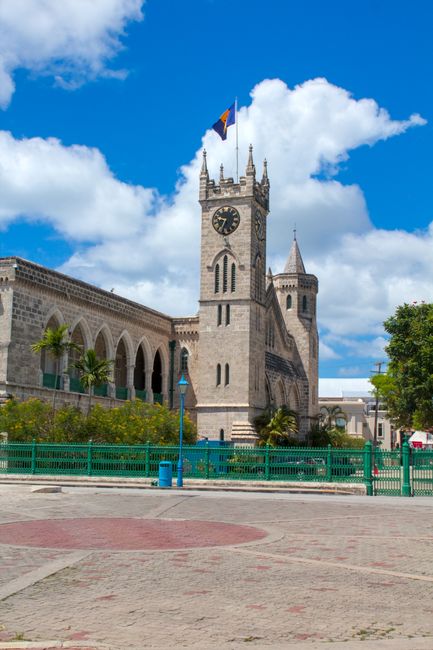
Barbados is the most easterly island of the Caribbean, a coral-limestone island about 34 km (21 miles) long that sits out in the Atlantic beyond the main chain of the Lesser Antilles. It packs a lot into a small space: calm, turquoise water and fine sand on the west coast, lively bars and reef breaks on the south coast, wild Atlantic surf at Bathsheba on the east, green hills, caves and old plantation houses in between, and a capital, Bridgetown, whose historic center and Garrison are a UNESCO World Heritage Site. It is English-speaking, easy to get around, proud of its rum, cricket and Friday-night fish fry, and well connected by nonstop flights from the United States, Canada and the UK. December to April is the dry, breezy peak season; May, June and November are quieter and cheaper. A week is a good first visit.
Right now in Barbados
- Tue 25–30°C 77–86°F 10 mm Partly cloudy
- Wed 24–30°C 74–87°F 10 mm Showers
- Thu 25–30°C 77–86°F 5 mm Showers
Weather: MET Norway (CC BY 4.0)
Multi-day tours of Barbados
Multi-day tours from local operators. You check dates and book on Viator, our partner; we may earn a commission at no extra cost to you. How we earn money
Barbados at a glance: overview and geography
Barbados covers about 432 km² (167 square miles). Unlike its volcanic neighbors, it is built mostly of coral limestone, which is why the beaches are pale, the water so clear and the tap water naturally filtered. The land rises gently from the sheltered west and south coasts to a central ridge at Mount Hillaby, 340 m (1,115 feet) high, then drops to the rugged Scotland District and the Atlantic-facing east coast. The island is divided into 11 parishes. About 270,000 people live here, many of them along the built-up strip that runs from Speightstown in the north-west, through Bridgetown, to Oistins and the airport in the south.
Barbados was settled by the English in 1627 and stayed under British rule for more than three centuries, longer than almost any other Caribbean island, which shows in its parish churches, cricket grounds and driving on the left. Sugar plantations worked by enslaved Africans made it one of the richest colonies in the Americas; slavery was abolished in the 1830s. Barbados became independent on 30 November 1966 and a parliamentary republic, with its own president replacing the British monarch, on 30 November 2021. Historic Bridgetown and its Garrison were inscribed by UNESCO in 2011. Rihanna, born in Bridgetown, is a National Hero.
Time zone: Barbados runs on Atlantic Standard Time (UTC−4) all year, with no daylight saving time. That is the same as New York in summer and one hour ahead of it in winter.
The coasts and areas
- Bridgetown and the Garrison: the capital around the Careenage inlet, with Parliament, National Heroes Square and the Garrison Savannah just south of town; Carlisle Bay and its shipwrecks are right next door.
- The west coast (Platinum Coast): Paynes Bay, Holetown and Speightstown, with calm Caribbean water, luxury resorts, villas and the Folkestone Marine Reserve.
- The south coast: Hastings, Rockley, Worthing, St Lawrence Gap and Oistins, the island’s busiest and best-value area for hotels, restaurants and nightlife, with windsurfing and kitesurfing at Silver Sands.
- The south-east: Crane Beach, Bottom Bay and other cliff-backed Atlantic beaches near the airport.
- The east coast and Scotland District: Bathsheba’s giant boulders and surf, Cattlewash, Andromeda Botanic Gardens and green, hilly countryside.
- The center and north: Harrison’s Cave, Hunte’s Gardens, Gun Hill, St Nicholas Abbey, Cherry Tree Hill and the Animal Flower Cave at the island’s northern tip.
Where to go: Bridgetown, the west and south coasts, and Bathsheba
Most visitors stay on the west or south coast and explore the rest on day trips. Nothing on the island is much more than an hour’s drive away, though traffic around Bridgetown is slow at rush hour. The west coast suits couples and anyone who wants calm water and a quieter evening; the south coast suits families, budgets and people who want restaurants and bars within walking distance.
Bridgetown and the Garrison
Bridgetown is a working Caribbean capital rather than a polished resort town, and that is part of its charm. Walk around the Careenage, where fishing boats and pleasure craft tie up, cross the Chamberlain Bridge to National Heroes Square and the neo-Gothic Parliament Buildings (with a small museum on Barbados’s democracy), and browse the shops of Broad Street and Swan Street. The 17th-century Nidhe Israel Synagogue and its museum recall one of the oldest Jewish communities in the Americas. South of town, the Garrison Savannah, once the headquarters of British forces in the eastern Caribbean, is now a horse-racing track ringed by historic military buildings, the Barbados Museum and George Washington House, where the future US president stayed in 1751, his only journey outside North America.
The west coast: Holetown, Paynes Bay and Speightstown
The sheltered Caribbean side is the Barbados of the brochures: soft sand, gentle water, sunsets over the sea and some of the Caribbean’s most famous resorts. Holetown, where the first English settlers landed in 1627, has restaurants, shops and the Folkestone Marine Reserve, where you can snorkel from the beach. Boat trips from the west coast stop to swim with green and hawksbill turtles. Further north, Speightstown is an old trading port with a slower, more local pace, and Mullins and Heywoods beaches are quieter alternatives.
The south coast: Carlisle Bay, St Lawrence Gap and Oistins
Carlisle Bay, on the edge of Bridgetown, has a long sandy beach and several shallow shipwrecks that are among the easiest wreck snorkels and dives in the Caribbean. East along the coast, Hastings and Rockley (Accra Beach) have a boardwalk, and St Lawrence Gap is a strip of restaurants, bars and small hotels. Oistins is a fishing town best known for its Friday-night Fish Fry, when stalls grill flying fish, marlin and mahi-mahi and locals and visitors dance to music in the open air. Beyond Oistins, Miami Beach (Enterprise) has a calm side and a wavy side, and Silver Sands is the base for windsurfing and kitesurfing.
The east coast: Bathsheba and the Scotland District
The Atlantic side feels like a different island. At Bathsheba, huge mushroom-shaped boulders sit in the surf, and the reef break known as the Soup Bowl draws experienced surfers. The sea here is rough and swimming is mostly limited to small rock pools at low tide. Nearby, Andromeda Botanic Gardens tumble down a hillside above the ocean, and the drive through the Scotland District and up to Cherry Tree Hill gives the island’s best views.
The interior: caves, gardens and plantation houses
Harrison’s Cave is a crystallized limestone cave with streams and pools, toured by electric tram. Hunte’s Gardens is a lush private garden set in a sinkhole. Gun Hill Signal Station has a white lion carved by a British soldier and wide views. In the north, St Nicholas Abbey is a 1658 Jacobean mansion with a working rum distillery and a heritage railway, and the Barbados Wildlife Reserve lets you see the island’s green monkeys up close. At the northern tip, the Animal Flower Cave opens onto the Atlantic.
A few more worth your time
Crane Beach, with pinkish sand and bodyboarding waves below a cliff-top hotel; Bottom Bay, a palm-fringed cove reached by steps; a cricket match at Kensington Oval; the Mount Gay visitor center near Bridgetown, one of the oldest rum brands in the world; Sunbury Plantation House; and a sunset catamaran cruise along the west coast.
Best time to visit Barbados
Barbados is warm all year, with afternoon highs around 29–31 °C (84–88 °F) in every month and a cooling trade wind from the east. The real seasons are dry and wet. The dry season runs roughly from December to May, with sunny days and short showers; the wet season, from June to November, brings more humidity, heavier downpours and the risk of tropical storms. The table uses the official 1991–2020 normals for the Charnocks station near the airport in the south of the island, reported by Barbados to the World Meteorological Organization; the west coast is similar, while the hills are a little cooler and wetter.
| Season (Charnocks, 1991–2020) | Average afternoon high | Rainfall a month | Days with rain a month | What it’s like |
|---|---|---|---|---|
| Winter (Dec–Feb) | 29–30 °C (84–85 °F) | 43–88 mm (1.7–3.5 in) | 9–12 | Dry, breezy and sunny; peak season with the highest prices. |
| Spring (Mar–May) | 30–31 °C (85–87 °F) | 38–72 mm (1.5–2.8 in) | 8 | The driest months; calm seas on the west coast; Easter is busy. |
| Summer (Jun–Aug) | 31 °C (87–88 °F) | 101–146 mm (4.0–5.7 in) | 11–16 | Hot and humid with heavy showers; Crop Over festival; hurricane season begins. |
| Autumn (Sep–Nov) | 30–31 °C (87–88 °F) | 163–174 mm (6.4–6.8 in) | 13–15 | The wettest, stickiest months and the peak of the storm season; quiet and cheap. |
Annual rainfall at Charnocks averages about 1,234 mm (49 inches). The sea stays warm enough for long swims all year, at around 26 °C (79 °F) in February and 28–29 °C (82–84 °F) from August to October.
Hurricane season and Hurricane Beryl
The Atlantic hurricane season runs from 1 June to 30 November, with the peak from August to October. Barbados lies at the south-eastern edge of the main hurricane belt and is hit less often than islands further north, but it is not immune. On 1 July 2024, Hurricane Beryl, a major hurricane, passed to the south of the island. Barbados escaped the worst, but storm surge and waves wrecked much of the fishing fleet moored at the Bridgetown Fisheries Complex, along with its breakwater, docks and jetties, according to the Fisheries Division, which is now running a recovery and fishing vessel replacement program. Hotels and beaches reopened quickly. The 2026 season has been unusually quiet so far: through early October 2026 the US National Hurricane Center had recorded no Atlantic hurricanes and issued no storm watches or warnings for Barbados. If you travel between June and November, buy travel insurance that covers storms, keep an eye on the Barbados Meteorological Services, and follow your hotel’s instructions if a storm approaches.
Sargassum seaweed
Since 2011, large rafts of sargassum seaweed have drifted across the Atlantic into the Caribbean, mostly from about March to September. In Barbados they wash up mainly on the east and south-east coasts, such as Bathsheba, Crane Beach and Bottom Bay, and occasionally on the south coast; the sheltered west coast is usually clear. Rotting piles smell of sulfur and can make the water murky, but they are not dangerous to touch in small amounts. Beaches in front of hotels are usually raked clean, and the west coast is the safe choice if you are worried.
Crowds and prices through the year
Mid-December to mid-April is high season, with the highest rates over Christmas, New Year and Easter, and many west coast villas booked months ahead. Prices fall from late April, and May, June and November are good-value months with reasonable weather. September and October are the cheapest and quietest; a few hotels close for refurbishment.
Festivals and public holidays
Barbados’s great festival is Crop Over, which grew out of the celebrations at the end of the sugar cane harvest. It builds through July with calypso tents, street parties and food fairs and ends with the costumed parade of Grand Kadooment on the first Monday in August. Other highlights are the Holetown Festival in February, the Oistins Fish Festival at Easter, cricket in the dry season, the Barbados Food and Rum Festival in October and Independence celebrations in November. Public holidays are New Year’s Day, Errol Barrow Day (21 January), Good Friday, Easter Monday, National Heroes Day (28 April), May Day (1 May), Whit Monday, Emancipation Day (1 August), Kadooment Day (the first Monday in August), Independence Day (30 November), Christmas Day and Boxing Day (26 December). Banks and many shops close on these days.
How long to stay: sample itineraries
Barbados is small, but you will want time to do very little on a beach. One base is enough for a week; on a longer trip, split your stay between the south and west coasts.
5 days: beaches, Bridgetown and the fish fry
Day 1: settle in and swim at your nearest beach. Day 2: Bridgetown’s Careenage, Parliament and the Garrison, then snorkel the wrecks in Carlisle Bay. Day 3: a catamaran trip along the west coast to swim with turtles. Day 4: an island tour to Harrison’s Cave, Hunte’s Gardens and Bathsheba. Day 5: a lazy beach day, with Oistins Fish Fry on Friday night.
7 days: the whole island
Add the north: St Nicholas Abbey, Cherry Tree Hill and the Animal Flower Cave; Andromeda Botanic Gardens on the east coast; a rum distillery tour; Crane Beach and Bottom Bay in the south-east; and an afternoon at the cricket or the races at the Garrison Savannah, depending on the season.
10 days: Barbados plus another island
Spend a week on Barbados, then fly to a neighbor for three or four nights: Saint Lucia for the Pitons and the rainforest, the Grenadines for sailing, or Grenada. Regional flights take less than an hour. Our Saint Lucia guide covers the Pitons and Soufrière.
Entry, money, fees and costs
Entry and visas (last reviewed October 2026)
Citizens of the United States, Canada, the United Kingdom and EU countries do not need a visa for a holiday in Barbados. The immigration officer decides how long you may stay when you arrive, usually up to several months for tourists. The Barbados Immigration Department asks visitors to carry a passport valid for the length of the trip, a return or onward ticket, the address where they will stay and evidence that they can support themselves. Children under 18 traveling alone or with an adult who is not their parent need a notarized consent letter from a parent. Nationals of some countries need an entry visa, which is now applied for and paid online and takes about three weeks to process.
The online immigration and customs form
All travelers arriving in Barbados must complete the free online Immigration and Customs Form (often called the online ED form) at travelform.gov.bb. It opens 72 hours before your arrival. You need passport details for every traveler, including babies, your flight number and arrival date, the address where you will stay and an email address. Two receipts are emailed to you, one for immigration and one for customs; save them on your phone or print them and show them on arrival, where self-service immigration kiosks speed things up. Ignore websites that charge a fee to fill in the form for you: the official form is free.
Departure tax and airport charges
Barbados has no tax to pay at the airport: according to Grantley Adams International Airport, all its charges are already in the price of your airline ticket. They are a passenger service charge of BDS$55 (US$27.50), a security fee of BDS$6.40 (US$3.20), a terminal charge of BDS$3 (US$1.50) on arrival, and the Airport Service Charge (travel tax) of BDS$140 (US$70) for international departures or BDS$70 (US$35) for flights to Caribbean Community countries, including neighbors such as Saint Lucia and Antigua.
The Barbados dollar, cards and tipping
The currency is the Barbados dollar (BDS$), fixed by the Central Bank of Barbados at BDS$2 to US$1 since 1975. US dollars are accepted almost everywhere at that rate, though you will usually get change in Barbados dollars, and many prices for visitors are quoted in US dollars, so always check which dollar is meant. Credit cards are widely accepted in hotels, restaurants and supermarkets; keep some cash for buses, rum shops, beach vendors and the fish fry. Cash machines are common and dispense Barbados dollars. Many restaurants and hotels add a 10% service charge; if it is on the bill, extra tipping is optional. Otherwise, 10–15% is normal in restaurants, and drivers and guides appreciate a tip.
Hotel taxes: VAT and the Room Rate Levy
Room prices in Barbados are often quoted before tax, so check what is included. The Barbados Revenue Authority lists a 7.5% VAT rate on accommodation and other direct tourism services (the standard rate is 17.5%). On top comes the Room Rate Levy, charged per bedroom per night since 2018 and raised in April 2019: BDS$8.75 (US$4.38) at apartments, guest houses and B-class hotels, BDS$19.25 (US$9.63) at A-class hotels and BDS$35 (US$17.50) at luxury hotels. Vacation rentals and villas pay 3.75% of the nightly rate, up to BDS$35 (US$17.50) per bedroom per night. Most hotels also add the 10% service charge.
Typical travel costs
Barbados is one of the more expensive Caribbean islands, especially on the west coast in winter, but the south coast, buses and local food keep costs down. These estimates per person per day, sharing a room, are a planning guide as of October 2026:
| Style | Estimated cost per day | What that looks like |
|---|---|---|
| Budget | about US$90–150 | Guest house or simple apartment on the south coast, buses and ZR vans, fish cakes and cutters from snack bars, the fish fry, free beaches |
| Mid-range | about US$200–350 | 3- or 4-star hotel on the south coast, a rental car for a few days, restaurant meals, a catamaran cruise and Harrison’s Cave |
| High-end | about US$600+ | West coast resort or villa, fine dining in Holetown, private tours, golf and boat charters |
Add the taxes and service charge to room rates, and more in the Christmas and Easter weeks. The figures are our estimates, not official statistics.
Getting there and getting around
Flights to Barbados
Grantley Adams International Airport (BGI), in Christ Church on the south coast about 13 km (8 miles) from Bridgetown, is the only airport. It has nonstop flights from several US cities, including Miami and New York, from Toronto and Montreal, and from London and other UK airports, plus regional flights across the Eastern Caribbean. Miami is the most useful gateway for connections from elsewhere in the United States; the flight takes about three and a half hours. Barbados is also a busy cruise port, with ships docking at the Bridgetown cruise terminal.
Buses and ZR vans
Barbados has one of the best bus networks in the Caribbean. Blue government buses (Transport Board), yellow private buses and white route taxis known as ZR vans run along the coasts and into the interior, mostly from terminals in Bridgetown and Speightstown. There is a flat fare of BDS$3.50 (US$1.75) a ride; carry exact change in Barbados dollars, as drivers often do not give change. Buses are cheap and frequent along the south and west coasts but crowded at rush hour, and ZRs are fast, loud and full of music. Service thins out in the evening.
Driving, taxis and tours
Barbados drives on the left. A rental car, often a small open-sided “moke”, is the easiest way to explore the east coast and the north, and rental companies arrange the temporary visitor’s driving permit you need alongside your home license. Roads are narrow and winding, signposting is patchy and roundabouts are frequent, so allow extra time. Speed limits are low, mostly 60 km/h (37 miles an hour) or less, and 80 km/h (50 miles an hour) on the ABC Highway. Taxis are not metered: fares are set by the government, and you should agree the price before you get in. Taxi drivers also offer full-day island tours, which are a good way to see the island without driving.
Island hopping
There is no regular passenger ferry from Barbados, which lies alone to the east of the island chain. Regional airlines fly to Saint Lucia, St Vincent and the Grenadines, Grenada, Dominica, Antigua and Trinidad, and small charter airlines run day trips to the Grenadines. Many cruises call at Barbados as part of Southern Caribbean itineraries.
Beaches, the sea and the marine reserve
All beaches in Barbados are public up to the high-water mark, even in front of the grandest hotels. The west and south coasts are the places to swim: Paynes Bay, Mullins and Gibbes on the west; Carlisle Bay, Brownes, Accra, Dover and Miami Beach on the south. On the Atlantic side, Crane Beach and Bottom Bay are beautiful but have strong waves, and Bathsheba is for surfers and photographers rather than swimmers. See our beaches guide, plus snorkeling, diving, surfing and boat trips.
- Folkestone Marine Reserve: the marine reserve off Holetown was created in 1981 and is managed by the National Conservation Commission. It is split into a scientific zone, two water sports zones and a recreational zone where you can snorkel from the beach. Do not touch or take coral or marine life, do not fish, do not anchor on the reef, and do not disturb nesting turtles. There is no fee to snorkel from the beach.
- Carlisle Bay: six or so wrecks lie in shallow water in the bay and are visited by almost every snorkel and dive boat. Barbados is working on a national Marine Spatial Plan that aims to protect up to 30% of its waters, and Carlisle Bay is expected to become a formally protected area.
- Turtles: green and hawksbill turtles feed off the west coast, and hawksbills nest on many beaches from May to November. Don’t feed or touch them, and keep lights away from nesting beaches.
- Currents and flags: the Atlantic coast has strong rip currents; swim only where the locals do and obey lifeguard flags on the beaches that have them.
- Sea urchins and coral: wear water shoes on rocky entries and never stand on coral.
Safety, health and connectivity
Safety
Barbados is one of the more relaxed islands in the Caribbean for visitors. Most crime that affects travelers is opportunistic: bags and phones left on the beach, items taken from unlocked rooms and rental cars, and occasional robberies on quiet beaches or streets at night. Use the hotel safe, take a taxi late at night, and turn down offers of drugs, which carry heavy penalties. Gun crime does occur, mostly between local gangs and away from tourist areas. Camouflage clothing is reserved for the military and should not be worn. The emergency numbers are 211 for police, 511 for ambulance and 311 for fire.
Sun, mosquitoes and health
The tropical sun is strong even on cloudy days: use high-factor, reef-safe sunscreen, a hat and shade in the middle of the day. Dengue fever is spread by mosquitoes in the Caribbean, especially in the wet season, so use repellent in the evening. The manchineel tree, common on some beaches and often marked with red paint, has toxic sap and poisonous fruit: don’t shelter under it in the rain or eat its small green apples. Tap water is safe to drink. The main public hospital is the Queen Elizabeth Hospital in Bridgetown, and there are private clinics; medical care is expensive for visitors, so carry travel insurance.
Connectivity and power
4G and 5G coverage is good across the island, and local SIM cards and eSIMs are easy to buy; check your home plan’s roaming charges first. Wi-Fi is standard in hotels and many cafés. The power supply is 115 volts at 50 Hz, with North American-style plugs (types A and B), so most US and Canadian devices work without an adapter, while visitors from the UK and Europe need one: see travel adapters.
Food, rum and culture
Bajan food is hearty and well seasoned. The national dish is cou-cou (cornmeal and okra) with flying fish in a spicy sauce. Try fish cakes, a “cutter” (a salt bread roll filled with fish, ham or egg), macaroni pie, pudding and souse on a Saturday, pepperpot at Christmas, and grilled fish at the Oistins Fish Fry, washed down with Banks beer or a rum punch. Barbados calls itself the birthplace of rum, with records of rum-making going back to the 1600s. Mount Gay, Foursquare, St Nicholas Abbey and West Indies Rum Distillery all offer tours or tastings, and the island has hundreds of small rum shops, the heart of village social life. Cricket is close to a religion, and Sir Garfield Sobers is a National Hero. Dress is casual, but swimwear belongs on the beach, not in town or shops.
Things to do: beaches, wrecks, rum and surf
- Snorkeling and diving: the Carlisle Bay wrecks, the Folkestone reserve, the big SS Stavronikita wreck off the west coast for divers, and the reefs off the south coast.
- Boat trips: catamaran cruises with turtle swims, sunset sails, and glass-bottom boats.
- Surfing and wind sports: the Soup Bowl at Bathsheba for experts, gentler breaks on the south coast for beginners, and kitesurfing at Silver Sands from December to May.
- Hiking: the Barbados National Trust’s free Sunday-morning Hike Barbados walks through the countryside, and coastal walks on the east coast. See our hiking guide.
- History and heritage: the Garrison and Barbados Museum, St Nicholas Abbey, Sunbury Plantation, Gun Hill and the synagogue in Bridgetown.
- Rum and food: distillery tours, rum shops, the Oistins Fish Fry and the Food and Rum Festival.
What to pack
Pack light, breathable clothes, swimwear, a cover-up for walking in town, a sun hat, sunglasses and plenty of reef-safe sunscreen. Add a snorkel mask, water shoes for rocky entries, insect repellent, sandals and one smarter outfit for dinner on the west coast, where some restaurants have a dress code. A light rain jacket or umbrella helps in the wet season. US-style plugs work; others need an adapter.
Barbados travel FAQ
When is the best time to visit Barbados?
December to April for dry, breezy weather, though it is also the most expensive time. May, June and November are good-value shoulder months. August to October is hot, wet and the peak of the hurricane season.
Do I need a visa to visit Barbados?
Not if you are a citizen of the United States, Canada, the UK or an EU country visiting as a tourist. Bring a passport valid for your whole stay and a return or onward ticket.
What is the Barbados online ED form?
The free online Immigration and Customs Form at travelform.gov.bb, which every arriving traveler must complete. It opens 72 hours before arrival and emails you two receipts to show at the airport.
Is there a departure tax in Barbados?
Yes, but it is included in your airline ticket, so there is nothing to pay at the airport. The travel tax is BDS$140 (US$70) for international flights and BDS$70 (US$35) for Caribbean flights, plus a passenger service charge and security fee.
Can I use US dollars in Barbados?
Yes. The Barbados dollar is fixed at BDS$2 to US$1 and US dollars are accepted almost everywhere, but change usually comes in Barbados dollars and buses need local coins.
What taxes are added to hotel bills in Barbados?
VAT at 7.5% on accommodation, the Room Rate Levy of BDS$8.75–35 (US$4.38–17.50) per bedroom per night depending on the hotel class, and usually a 10% service charge.
Which coast should I stay on in Barbados?
The west coast for calm water, luxury and quiet evenings; the south coast for value, restaurants, nightlife and easy buses. The east coast is beautiful but too rough for most swimming.
Was Barbados damaged by Hurricane Beryl?
Beryl passed south of Barbados on 1 July 2024. It badly damaged the fishing fleet and the Bridgetown Fisheries Complex, but hotels, beaches and the airport were soon back to normal.
Does Barbados have sargassum seaweed?
Sometimes, mainly from spring to late summer and mostly on the Atlantic-facing east and south-east coasts. The west coast is usually clear.
Which side of the road do they drive on in Barbados?
The left. Rental companies arrange the temporary visitor’s driving permit, and taxis and buses are easy alternatives.
Is Barbados safe for tourists?
Yes, for most visitors. Watch your belongings on beaches, lock rooms and cars, take taxis late at night and respect the Atlantic currents. Call 211 for police and 511 for an ambulance.
What is the Oistins Fish Fry?
A weekly open-air party in the fishing town of Oistins on the south coast, busiest on Friday nights, with grilled fish, cheap drinks, music and dancing.
How do I fly to Barbados from the United States?
Nonstop flights link Grantley Adams International Airport (BGI) with several US cities, including Miami and New York. From elsewhere, connect in Miami or another hub. See our Miami guide.
Sources and last review
Researched and last reviewed on 4 October 2026. Entry rules and the online form come from the Barbados Immigration Department and Visit Barbados; airport charges from Grantley Adams International Airport; VAT and the Room Rate Levy from the Barbados Revenue Authority; Hurricane Beryl’s impact from the Fisheries Division; the 2026 storm season from the US National Hurricane Center; the Folkestone reserve rules from its management; the Marine Spatial Plan from the Coastal Zone Management Unit; and the climate normals (Charnocks, 1991–2020) from Barbados’s submission to the World Meteorological Organization. Bus fares, driving rules, flight routes, sea temperatures, emergency numbers and some festival details come from secondary sources and are flagged for checking. Daily costs are estimates. Prices, timetables and rules change, so check the official sites before you travel.
Plugs and power in Barbados
Barbados uses 115 V, 50 Hz and these plugs (left) and wall sockets (right):
All plug types and voltages by country → · Check what you need to pack →
Plan your trip
Partner links: TravelerCenter may earn a commission if you book, at no extra cost to you.