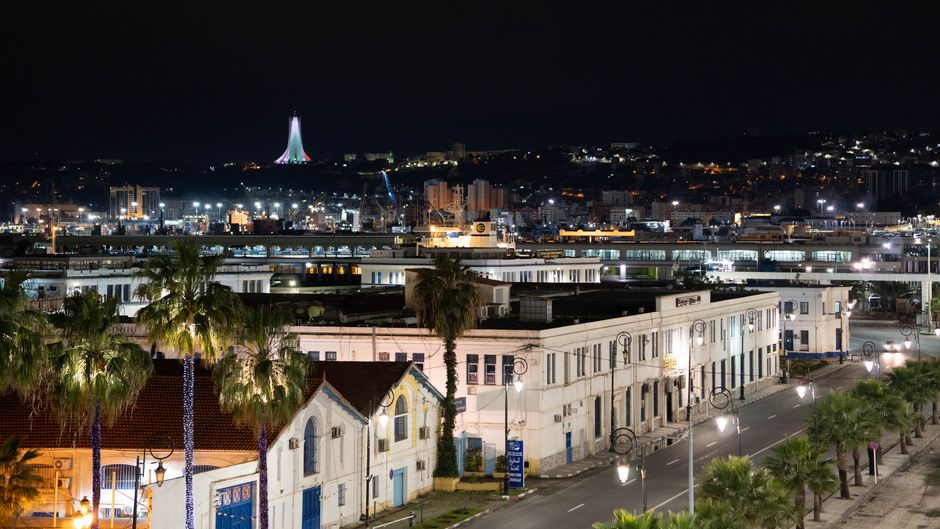
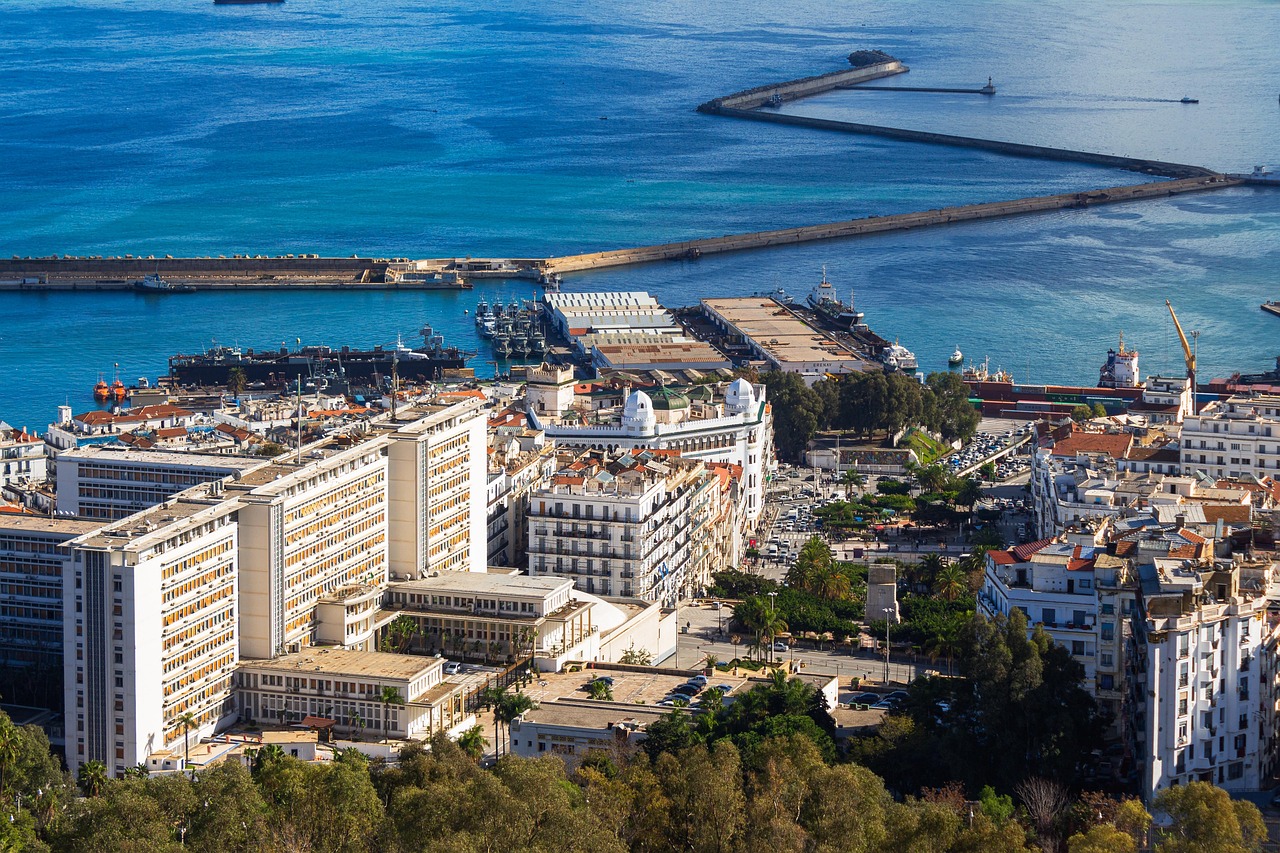
Algiers, Algeria’s capital, rises in tiers of white buildings above a wide Mediterranean bay, which is why it’s known as Alger la Blanche, “Algiers the White.” It’s one of North Africa’s most striking cities and still one of its least visited, so you’ll often have its sights to yourself. At its heart is the Casbah, the old Ottoman-era city, a UNESCO World Heritage Site since 1992, where steep stairways and narrow lanes wind past whitewashed houses, palaces with tiled courtyards, fountains and historic mosques. Below it, the grand 19th- and early 20th-century boulevards of the lower town are lined with arcaded buildings and neo-Moorish landmarks such as the Grande Poste. Above the city, the basilica of Notre-Dame d’Afrique looks out over the sea, the soaring Martyrs’ Memorial (Maqam Echahid) dominates the skyline, and along the bay, the new Great Mosque of Algiers has one of the tallest minarets in the world. Add the lush Jardin d’Essai botanical garden, excellent museums, seafood restaurants, a modern metro, trams and cable cars, and easy day trips to the Roman ruins of Tipasa, and Algiers makes a rewarding city break and the natural start to any trip to Algeria.
Right now in Algiers
- Wed 23–32°C 74–89°F Partly cloudy
- Thu 23–27°C 73–80°F Partly cloudy
- Fri 20–25°C 68–78°F Clear
Weather: MET Norway (CC BY 4.0) · Sea temperature: NOAA CoastWatch
Top tours in Algiers
See all tours for Algiers →
From local operators, with prices and reviews; you check availability and book on Viator, our partner. We may earn a commission at no extra cost to you. How we earn money
Algiers at a glance
- Best for: the Casbah, colonial and Moorish architecture, museums, sea views and the gateway to Algeria’s Roman sites.
- How long: 2–3 days for the city; add a day for Tipasa.
- Best time: April to June and September to October; summers are hot and humid, winters mild and rainy.
- Getting there: fly into Houari Boumediene International Airport (ALG), about 20 km (12 miles) east of the center.
- Getting around: the metro, trams, cable cars, taxis recommended by your hotel, and walking downtown.
- Good to know: you’ll need an Algerian visa, and visiting the Casbah with a good local guide is recommended.
- Before you go: visas, money and general safety are in our Algeria travel guide.
Algiers’s areas and where to stay
Algiers stretches for kilometers around the bay. The historic core, the Casbah and the lower town, sits at the western end; the central districts climb the hills behind; and newer neighborhoods spread east toward the airport.
The Casbah
The Casbah climbs the hillside above the port, a dense maze of lanes, stairways and traditional houses built around courtyards, crowned by the Citadel (Dar es-Soltane), the last palace of the Ottoman deys. It’s a living neighborhood, not a museum, with families, workshops and small shops. There are a few restored guesthouses on its edges, but most visitors stay elsewhere and explore with a guide.
The lower town and Place des Martyrs
At the foot of the Casbah, Place des Martyrs opens onto the sea, flanked by the Ketchaoua Mosque, the white Djamaa el Djedid (New Mosque) and the Djamaa el Kebir (Great Mosque), one of the oldest in the city. From here, arcaded streets lead south into the 19th-century city.
The city center
The central district around the Grande Poste, Rue Didouche Mourad, Rue Larbi Ben M’hidi and the Square Port Saïd has grand colonial buildings with balconies and arcades, cafés, bookshops, boutiques and many hotels. It’s the most convenient base for visitors, close to the metro and within walking distance of the Casbah.
El Biar, Hydra and the heights
The green hills above the center, including El Biar and Hydra, are upscale residential districts with embassies, villas, restaurants and some boutique hotels, cooler in summer and quieter at night.
Hamma, Belouizdad and the east
East of the center, the Hamma area has the Jardin d’Essai, the National Museum of Fine Arts and the Martyrs’ Memorial above them. Farther east, along the bay, the new Great Mosque of Algiers stands in Mohammadia, and large business hotels line the bay road toward the airport.
Where to stay in Algiers
- City center (Grande Poste, Didouche Mourad): walkable, near the metro, cafés and the Casbah; mid-range and historic hotels.
- El Biar and Hydra: quieter, upscale hotels and guesthouses in the hills.
- The bay toward the airport: large international hotels, convenient for flights and business.
- Sidi Fredj: a seaside marina resort about 30 km (19 miles) west, for a beach stay.
Top things to see in Algiers
The Casbah
The Casbah of Algiers was inscribed on the UNESCO World Heritage List in 1992 as a unique example of a medina built on a steep hillside, with Ottoman-era houses, mosques and palaces over older foundations. Wander its lanes to see carved doors, tiled fountains and views down to the sea, and visit restored palaces such as Dar Mustapha Pacha, now a museum of miniatures and calligraphy, and Dar Aziza, with its fine courtyard. At the top, the Citadel (Dar es-Soltane), the residence of the last deys, is being restored. Parts of the Casbah are fragile, with houses under repair, and the lanes are confusing, so explore with a good local guide, which also helps you meet residents and understand the neighborhood’s history. Dress modestly, and ask before taking photos of people.
Ketchaoua Mosque and Place des Martyrs
At the foot of the Casbah, the Ketchaoua Mosque, built in the Ottoman era and later turned into a cathedral, was restored and reopened as a mosque in 2018; its striking white facade with twin towers faces the square. Nearby, the Djamaa el Kebir dates from the 11th century, and the Djamaa el Djedid, built in 1660, has a white dome and a tall square minaret. Under Place des Martyrs, the metro station displays archaeological remains uncovered during construction.
Notre-Dame d’Afrique
On a cliff above the district of Bologhine, the 19th-century basilica of Notre-Dame d’Afrique combines Roman and Byzantine styles, with a black Madonna and an inscription over the apse asking for prayers for Muslims and Christians alike. The terrace has sweeping views over the bay. Reach it by taxi or by the cable car from Bologhine, and check opening hours locally.
The Martyrs’ Memorial (Maqam Echahid)
Inaugurated in 1982 for the 20th anniversary of independence, the Martyrs’ Memorial is a 92 m (302 ft) concrete monument of three stylized palm leaves rising from the hill of El Madania, with an eternal flame and statues at its base. The esplanade has some of the best views over Algiers, and the cable car from the Jardin d’Essai area runs nearby.
Jardin d’Essai du Hamma
Founded in 1832, the Jardin d’Essai du Hamma is one of the finest botanical gardens in the world, with avenues of plane trees, palms, dragon trees, giant ficus and bamboo, a French-style garden and an English-style garden, running down toward the sea. It’s a peaceful escape from the city, and there’s a small zoo.
The Great Mosque of Algiers
On the bay at Mohammadia, the Djamaa el Djazaïr, or Great Mosque of Algiers, inaugurated in 2024, is one of the largest mosques in the world, with a prayer hall for tens of thousands of worshippers and a minaret about 265 m (870 ft) tall, the tallest in the world, which includes a museum and viewing platforms. Check visiting arrangements for non-Muslims locally and dress modestly.
Museums
- Bardo National Museum: prehistory and ethnography in an elegant 18th-century villa with gardens.
- National Museum of Fine Arts: one of Africa’s largest art museums, above the Jardin d’Essai, with Algerian and European works.
- National Museum of Antiquities and Islamic Arts: Roman mosaics and sculpture and Islamic art, in a park near the center.
- Grande Poste: the striking neo-Moorish main post office, built in 1910 and now a museum of the postal service.
Other things to do in Algiers
Food and drink
Algiers’s food reflects its Andalusian, Ottoman and French heritage. Try rechta, fine fresh noodles in a chicken and turnip broth, an Algiers specialty; couscous; chorba soup; dolma (stuffed vegetables); karantika, the chickpea flan sold from street stalls; grilled sardines and other seafood by the port and at La Pêcherie; and pastries such as makroud, baklava and griwech. Cafés serve strong coffee and mint tea, and the city is known for its ice-cream parlors. Alcohol is served in some hotels and licensed restaurants, but many places don’t serve it.
Walking the city center
Stroll down Rue Didouche Mourad and Rue Larbi Ben M’hidi, browse the bookshops and cafés, admire the white arcades of the waterfront boulevard above the port, and walk through the Square Port Saïd and past the national theater. The Sablette promenade along the bay is a popular place for families in the evening.
Music
Algiers is the home of chaâbi, a soulful urban music played on the mandole and banjo; listen for it in cafés, at weddings and at concerts, especially during Ramadan nights. Andalusian classical music is also performed at cultural centers.
Beaches
In summer, Algerians head to the beaches west of the city, around Sidi Fredj, Zeralda and Tipasa, and east toward Bordj El Kiffan. The water is clean in the better areas, but beaches are busy in July and August; swim at supervised beaches and follow the flags. See our beaches guide.
Day trips from Algiers
- Tipasa: the UNESCO-listed Punic and Roman ruins by the sea, about 70 km (45 miles) west, with the Royal Mausoleum of Mauretania on the way.
- Cherchell: the ancient Caesarea, with its museum of Roman sculpture, about 90 km (55 miles) west.
- Kabylie: the mountains around Tizi Ouzou and the Djurdjura, with Berber villages and hiking, about 100 km (60 miles) east. See our hiking guide.
- Sidi Fredj: a seaside marina and beach about 30 km (19 miles) west.
- Blida and the Chréa National Park: cedar forests and mountain views south of the city, with snow in winter.
Nearby destinations
- Formentera256 km
- Ibiza284 km
Getting there and getting around
By air and sea
Houari Boumediene International Airport (ALG), about 20 km (12 miles) east of the center, is Algeria’s main gateway, with flights from Europe, the Middle East, Turkey and North Africa, including Paris, Marseille, Lyon, Madrid, Barcelona, Istanbul, Dubai, Doha and Tunis, and domestic flights to the Sahara. To reach the city, take a taxi arranged by your hotel or from the official rank, or the airport train to the central Agha station. A metro extension from El Harrach to the airport has been under construction; check whether it has opened when you travel. Ferries link the port of Algiers with Marseille and Alicante.
The Algiers metro
The Algiers metro has one main line, opened in 2011 and extended several times, running from Place des Martyrs, at the foot of the Casbah, through Tafourah–Grande Poste in the center and the eastern districts to El Harrach, with a branch toward Aïn Naâdja. It’s clean, cheap and air-conditioned, and the easiest way to cross the city. Buy single tickets or rechargeable cards at the stations, and keep your ticket until you exit.
Trams, cable cars and buses
A modern tram line runs east along the bay from the Ruisseau area to Bab Ezzouar and Bordj El Kiffan, connecting with the metro. Several cable cars (téléphériques) climb the steep hills, including one to Notre-Dame d’Afrique and one near the Martyrs’ Memorial, offering great views. City buses (ETUSA) cover the rest, but routes can be confusing for visitors.
Taxis and walking
Taxis are plentiful; ask your hotel to call a reputable company, agree the fare if there’s no meter, and don’t share with strangers. Taxis can be hard to find after dark, so book your return trip. Downtown Algiers and the lower Casbah are best explored on foot, but the city is very hilly, with many stairs, so wear comfortable shoes.
When to go and how long to stay
Algiers has a Mediterranean climate. Spring (April to June) and autumn (September to October) are the most pleasant times to visit, with warm, sunny days and comfortable evenings. Summer is hot and humid, with highs around 32–33 °C (90–91 °F) in July and August, and the city’s beaches are crowded. Winter, from November to March, is mild but rainy, with highs around 17–18 °C (63–65 °F) and occasional storms; November and December are the wettest months. The table uses the 1991–2020 climate normals for the Algiers–Dar El Beïda (airport) station of Algeria’s National Meteorological Office (ONM), as published by the World Meteorological Organization (WMO): average daily highs and lows, total precipitation, and days with at least 1 mm of rain.
| Month | Average high / low | Rain (days with 1 mm or more) | What to expect |
|---|---|---|---|
| January | 17 °C (63 °F) / 6 °C (42 °F) | 84 mm (3.3 in), 8 days | Mild and wet; Yennayer celebrations |
| February | 18 °C (64 °F) / 6 °C (42 °F) | 72 mm (2.8 in), 9 days | Cool and showery |
| March | 20 °C (67 °F) / 8 °C (46 °F) | 59 mm (2.3 in), 7 days | Spring begins; fresh and green |
| April | 22 °C (71 °F) / 9 °C (49 °F) | 58 mm (2.3 in), 6 days | Pleasant for walking |
| May | 25 °C (77 °F) / 13 °C (55 °F) | 39 mm (1.5 in), 4 days | Warm and sunny; ideal month |
| June | 29 °C (84 °F) / 16 °C (61 °F) | 9 mm (0.3 in), 1 day | Warm; beach season starts |
| July | 32 °C (90 °F) / 19 °C (67 °F) | 2 mm (0.1 in), 0 days | Hot and humid; Independence Day |
| August | 33 °C (91 °F) / 20 °C (69 °F) | 11 mm (0.4 in), 1 day | Hottest month; busy beaches |
| September | 30 °C (86 °F) / 18 °C (64 °F) | 28 mm (1.1 in), 4 days | Warm; sea still warm |
| October | 26 °C (80 °F) / 14 °C (58 °F) | 52 mm (2.0 in), 5 days | Pleasant; first autumn rains |
| November | 21 °C (70 °F) / 10 °C (50 °F) | 103 mm (4.0 in), 9 days | Wettest month |
| December | 18 °C (65 °F) / 7 °C (45 °F) | 86 mm (3.4 in), 8 days | Mild and rainy |
Algiers receives about 600 mm (24 in) of rain a year, mostly from October to April.
One day in Algiers
Start with a guided morning walk through the Casbah, from the Citadel down to Dar Mustapha Pacha and the Ketchaoua Mosque at Place des Martyrs. After lunch, walk through the city center to the Grande Poste, then take the metro east to the Jardin d’Essai and ride the cable car up to the Martyrs’ Memorial for the views at sunset.
Two to three days
Add Notre-Dame d’Afrique, the Bardo and fine arts museums, the Great Mosque of Algiers, a seafood dinner by the port, and a day trip to Tipasa and the Royal Mausoleum.
What a trip to Algiers costs
Prices are approximate, for October 2026, converted at about DZD 133.6 to the US dollar (Bank of Algeria).
| Item | Typical cost |
|---|---|
| Metro or tram ticket | about DZD 50–70 (about US$0.40–0.50) |
| Taxi across the center | DZD 400–1,000 (about US$3–7.50) |
| Taxi from the airport to the center | DZD 2,000–3,500 (about US$15–26) |
| Museum entrance | about DZD 200–600 (about US$1.50–4.50) |
| Half-day guided Casbah walk | about DZD 3,000–8,000 (about US$22–60) |
| Rechta or couscous at a local restaurant | DZD 800–1,800 (about US$6–13) |
| Mid-range hotel double, per night | DZD 12,000–27,000 (about US$90–200) |
Practical tips for Algiers
- Bring cash: euros or dollars to change at banks or licensed exchange offices; cards are accepted only in larger hotels.
- Hire a guide for the Casbah: it’s easy to get lost, and guides open doors to palaces and homes.
- Use the metro: it’s the quickest way across the city and avoids traffic.
- Book taxis back: taxis can be hard to find after dark, especially outside the center.
- Carry your passport: hotels need it, and you may be asked for ID at checkpoints.
Safety in Algiers
Algiers is generally calm, and there’s a visible security presence, with police on many streets and at checkpoints; carry your passport and follow their instructions. Pickpocketing and petty theft occur in crowded areas, markets and on public transport, so keep phones and wallets out of sight. Visit the Casbah with a good local guide, make sure your hotel or hosts know your plans, and avoid its lanes after dark. Use taxis recommended by your hotel rather than accepting lifts from strangers. Traffic is heavy and drivers can be erratic, so take care crossing roads, even at signals. Never photograph police, military sites, checkpoints or government buildings, and ask before photographing people, especially women. In summer, the sun is strong, so drink plenty of water, and at the beaches swim only where lifeguards are on duty. Algiers lies in an earthquake zone; familiarize yourself with your hotel’s emergency procedures. In an emergency, call 17 or 1548 for the police, 14 for the fire service and 1021 for an ambulance.
What to pack for Algiers
Modest clothing that covers shoulders and knees, a scarf for women visiting mosques, comfortable walking shoes with good grip for the Casbah’s steep stairs, a light jacket and umbrella from November to March, a hat and sunscreen for summer, euros or dollars in cash, copies of your passport and visa, and a European two-pin plug adapter. Leave drones and binoculars at home unless you have authorization. See our rain jackets, hiking shoes and travel adapters guides.
Algiers travel FAQ
Is Algiers worth visiting?
Yes. The UNESCO-listed Casbah, the colonial city center, Notre-Dame d’Afrique, the Martyrs’ Memorial and the Jardin d’Essai make it one of North Africa’s most rewarding and least crowded capitals.
Is the Casbah of Algiers a UNESCO site?
Yes, the Kasbah of Algiers was inscribed on the UNESCO World Heritage List in 1992.
Can I visit the Casbah without a guide?
You can, but a good local guide is recommended: the lanes are confusing, some houses are fragile, and guides can arrange visits to palaces and homes.
Does Algiers have a metro?
Yes. The metro runs from Place des Martyrs at the foot of the Casbah through the center to El Harrach, with a branch toward Aïn Naâdja, and connects with the tram.
Can I take the metro to Algiers airport?
A metro extension to the airport has been under construction; check whether it has opened. The airport train to Agha station and taxis are the usual options.
Do I need a visa for Algiers?
Yes, almost all visitors need a consular visa obtained in advance; the visa on arrival applies only to organized Saharan tours. See our Algeria travel guide.
What is the best time to visit Algiers?
April to June and September to October, when it’s warm and sunny but not too hot.
What is Algiers famous for?
Its white buildings above the bay, the Casbah, the Martyrs’ Memorial, Notre-Dame d’Afrique and chaâbi music.
Can I visit Tipasa from Algiers?
Yes. Tipasa’s Roman ruins are about 70 km (45 miles) west, an easy day trip by car or taxi, often combined with the Royal Mausoleum of Mauretania.
Is Algiers safe for tourists?
Most visitors have trouble-free stays. Take normal precautions against petty theft, explore the Casbah with a guide, carry your passport and follow police instructions.
Sources and last review
Researched and last reviewed on 5 October 2026. The Casbah’s UNESCO listing: the UNESCO World Heritage Center; visas and the Saharan visa on arrival: Algeria’s Ministry of Foreign Affairs; petty theft, the Casbah guide advice, security presence, taxis, traffic, photography, earthquakes, restricted equipment and emergency numbers: the UK government’s factual entry and safety pages, used for practical facts only; the exchange rate: the Bank of Algeria; climate normals: Algeria’s National Meteorological Office via the World Meteorological Organization’s 1991–2020 normals (Algiers–Dar El Beïda station). The metro route and airport extension, tram and cable cars, monument dates and heights, museums, the Great Mosque, distances and typical prices are general references or estimates, flagged for checking; the metro operator’s website was down for maintenance when checked. Prices and rules change, so check locally before you go. For visas, money and general safety, see our Algeria travel guide.
Plan your trip
Partner links: TravelerCenter may earn a commission if you book, at no extra cost to you.
🇪🇬 Useful Arabic phrases for Algiers
All 38 Arabic phrases: restaurant, hotel, emergencies, romance (printable) →